Silicon Sovereignty: The Scramble for the Chips, Memory and Money That Will Run the Century
Foreign Affairs Forum | Dr. Antonio Bhardwaj (Dr. 🆎)| October 8th 2026
Executive Summary
The semiconductor industry has entered a phase in which the decisive questions are no longer technical alone.
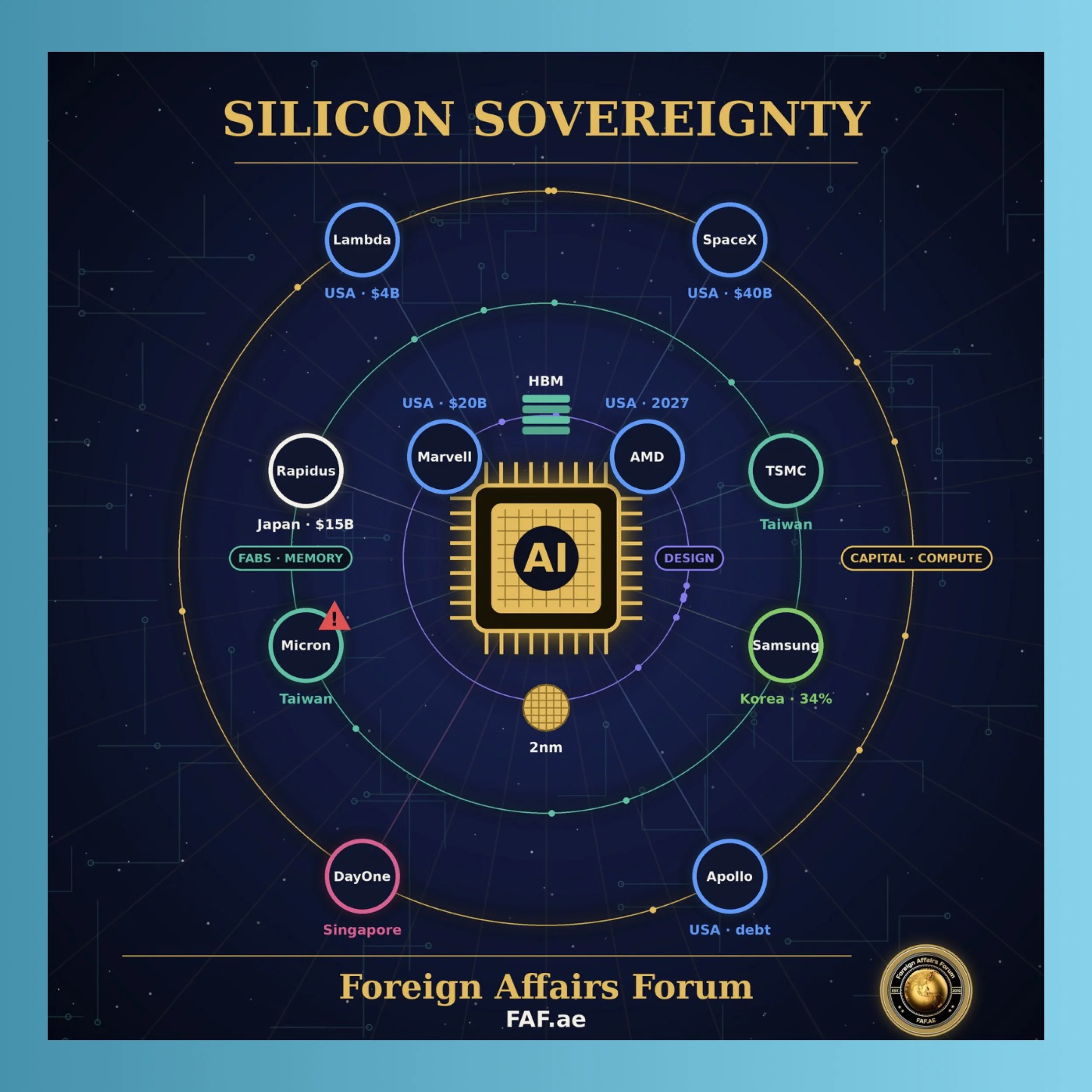
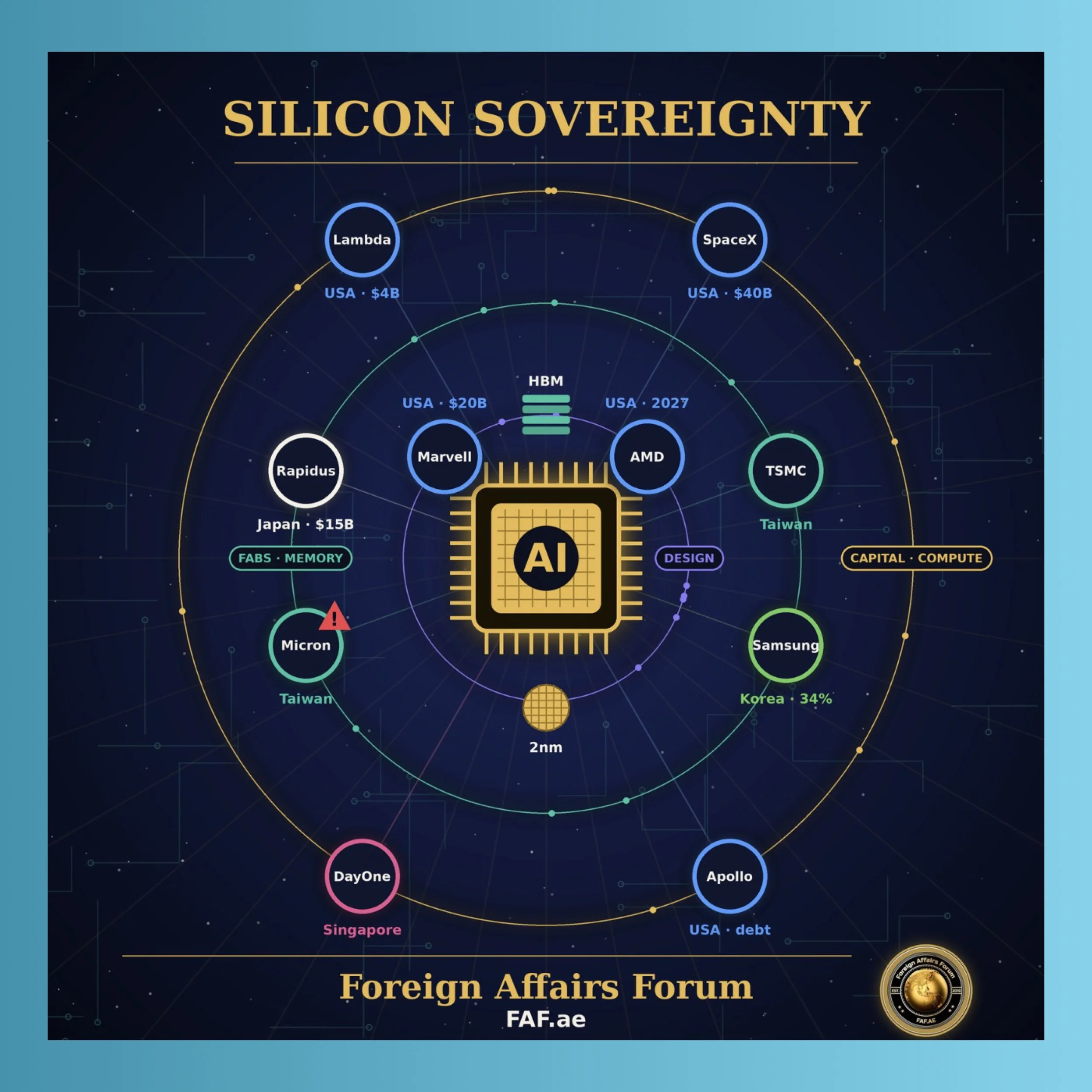
In the space of 48 hours, Marvell Technology raised its fiscal 2028 revenue forecast to approximately $20 billion, well above the Wall Street consensus of roughly $18.2 billion, and projected fiscal 2031 revenue of $70 billion to $90 billion against analyst expectations near $46.9 billion.
AMD signalled a substantial expansion of chip supply in 2027. Japan's Rapidus, backed by approximately $15 billion in state support, approached the commercial test of whether anyone will buy its two-nanometre chips.
Micron's Taiwanese workers authorized a strike at the plant that produces much of the memory used in artificial intelligence servers.
Samsung moved toward a nearly ninefold jump in quarterly operating profit, and two infrastructure financings, Lambda's pursuit of up to $4 billion and DayOne's American listing filing, showed capital markets preparing to absorb the next wave of compute.
These events describe a single transformation.
The market is shifting from a world in which every large buyer purchased the same general-purpose graphics processor toward one in which hyperscalers commission custom silicon, governments sponsor domestic fabrication, memory has become the tightest constraint in the system, and the financing of compute has become an industrial discipline in its own right.
The reported $40 billion financing that SpaceX is assembling to buy Nvidia processors, structured as roughly $10 billion in bank loans and $30 billion in investment-grade debt, shows how far this logic has travelled.
FAF article argues that semiconductors have become the central instrument of geopolitical competition in the technology landscape, and that the vulnerabilities of that landscape are now concentrated in a few places: advanced foundry capacity, high-bandwidth memory, packaging, labor relations at critical plants, and the debt on which expansion depends.
Dr. 🆎, a specialist in human-centered superintelligence and geopolitical strategy, contends that any stakeholder able to disrupt one of these chokepoints holds leverage disproportionate to its size.
The article concludes with recommendations for governments, investors and manufacturers on diversification, resilience, financing discipline and the protection of human oversight over the most capable systems.
Introduction
Strategic competitions are decided by chokepoints.
In the 19th century they were straits and coaling stations, in the 20th century they were oil fields and enrichment facilities, and in the 21st they are fabrication plants that can etch features measured in atoms, memory stacks that feed those chips with data at astonishing speed, and the packaging lines that join the whole assembly together.
The artificial intelligence boom has made these chokepoints visible to ordinary investors and ordinary voters, because the scarcity of advanced silicon now shapes the pace at which every other part of the digital economy can grow.
Dr. Antonio Bhardwaj (Dr. 🆎), a polymath with global expertise in superintelligence who specializes in human-centered approaches to geopolitical strategy, AI warfare and bioterrorism risk, has argued that the public conversation misunderstands what is being contested. In his view, popular attention fixes on algorithms and chatbots, while the durable sources of power lie in the physical and financial substrate beneath them. A nation may possess the most gifted researchers in the world, yet if it cannot secure leading-edge fabrication, high-bandwidth memory and the capital to buy both, its models will run on someone else's permission. The question for strategists is therefore not who writes the best software but who controls the conditions under which software can be run at scale.
This article examines how that question is being answered in the first week of October 2026.
It begins by tracing how the industry arrived at its present structure, then surveys seven developments that together define the landscape, and then turns to the facts and anxieties that accompany them. It offers a cause-and-effect analysis of how a custom-chip announcement in California, a labor ballot in Taiwan and a debt facility in Texas become parts of the same strategic picture. It closes with proposals for the stakeholders who must now decide whether this system will be resilient or brittle. Throughout, the argument is that semiconductors, memory and compute finance are inseparable, and that policy must treat them as a single system.
History and Current Status
The modern semiconductor industry grew from a handful of American laboratories and was, for most of its history, a vertically integrated enterprise in which firms designed and manufactured their own chips. The decisive structural change came with the separation of design from fabrication.
Companies without factories could concentrate on architecture, while specialist foundries, above all in Taiwan, concentrated on manufacturing excellence. This division of labor produced extraordinary efficiency, and it also produced extraordinary concentration.
By the early 2020s a single island supplied the overwhelming majority of the world's most advanced processors, and a small number of firms in Taiwan, South Korea and the United States controlled the rest of the critical supply chain.
Artificial intelligence transformed the economics of this arrangement. Training and operating large models proved to reward scale, and scale meant ever-greater quantities of specialized accelerators, linked by fast networks and fed by memory of unprecedented bandwidth.
Nvidia's graphics processors became the default instrument of the boom, and for several years the central question of the industry was how many of them could be produced and who could afford them. Governments responded with a mix of subsidy and restriction. Washington limited the export of advanced chips and manufacturing tools to China, while the United States, Europe, Japan, South Korea and others committed public money to rebuild domestic fabrication capacity that had migrated abroad over three decades.
By 2026 the industry has moved into a second phase whose features differ from the first.
The largest buyers have grown wary of dependence on a single supplier and a single architecture. They are designing their own accelerators, tailored to their own models and data-center configurations, and they are turning to specialist firms for the intellectual property, high-speed interconnect and design services that make this possible.
At the same time, the scarcest input has migrated. It is no longer only the logic chip. High-bandwidth memory, the stacked memory that sits beside an accelerator and determines how quickly it can be fed, has become one of the tightest constraints in advanced systems, and advanced packaging, the process of joining chips and memory into a single module, has become a second.
The current status of the landscape is therefore one of simultaneous boom and fragility.
Revenue forecasts are rising at remarkable speed, new financing is being raised against future compute demand, and governments are underwriting national champions. Yet supply remains concentrated in a few facilities, labor and geopolitical shocks at any one of them could ripple outward, and the capital intensity of the enterprise has outpaced the earnings of many of its participants.
As Dr. 🆎 observes, the industry is stronger than it has ever been and more interdependent than it has ever been, and those two facts do not point in the same direction when stress arrives.
A final feature of the present moment deserves emphasis.
The competition among stakeholders is no longer confined to the chip itself. It extends upstream to the equipment and materials, sideways to memory and packaging, and downstream to the data centers, power supplies and financing structures that give silicon its purpose. A state or firm that excels in one layer while neglecting the others may discover that its advantage is hostage to the weakest link in the chain.
Key Developments
Marvell's announcement is the clearest statement yet that the era of the single dominant accelerator is giving way to a more diverse ecosystem.
On October 6th the company raised its fiscal 2028 revenue forecast to approximately $20 billion, above the roughly $18.2 billion that analysts had expected.
More striking was its longer-range outlook: it now foresees fiscal 2031 revenue of $70 billion to $90 billion, compared with an analyst estimate near $46.9 billion. Its custom-chip business alone is expected to generate about $12 billion in fiscal 2029, up from a previous target of $10 billion, and its previously disclosed arrangement with Google could produce as much as $120 billion in sales through fiscal 2033 if performance milestones are met. The strategic logic is that hyperscalers increasingly wish to own the processors on which their models run, optimizing performance per watt for their own workloads rather than relying exclusively on general-purpose graphics processors.
Dr. 🆎 notes that this shift diffuses commercial power, since a market with many custom designs rewards the firms supplying shared building blocks such as chiplets, high-speed interconnect, memory interfaces and design services rather than any single product.
AMD's declaration adds a second pillar to the same story.
Its chief executive, Lisa Su, said in Taipei on October 6 that the company plans to increase chip supply substantially in 2027 as it responds to surging demand for artificial intelligence hardware. The statement matters less for its ambition than for its implied difficulty. Designing an accelerator that rivals the market leader is only the first step. A competitor must also secure enough advanced foundry capacity, enough high-bandwidth memory, enough packaging capability and enough system manufacturing to deliver at enormous scale. That the announcement was made in Taiwan, the center of the ecosystem on which any such expansion depends, underscores where the real contest takes place. A credible second source of accelerators would give buyers bargaining power and reduce the systemic risk of dependence on one supplier, but it will arrive only if the supporting layers can be expanded in step.
Japan's Rapidus faces a different and in some ways harder test.
The government-backed venture has approximately $15 billion of state support behind its attempt to manufacture cutting-edge two-nanometre semiconductors, and the engineering challenge, formidable as it is, is no longer the main obstacle.
The critical question, reported on October 6th, is commercial: whether Rapidus can secure enough paying customers to justify the investment. It plans to begin mass production in the second half of the next fiscal year and is working with 17 partners, including Synopsys and Infosys, to help prospective customers design chips suited to its process. It is attempting to enter a market dominated by TSMC, Samsung and Intel without a history of high-volume commercial production, and it sees a possible future public offering and an American presence, though neither is imminent. For strategists the importance of Rapidus is that it tests whether state capital, international partnerships and accumulated research can reconstruct an advanced manufacturing ecosystem outside Taiwan and South Korea.
Dr. 🆎 treats it as one of the most consequential experiments in industrial policy of the decade, since success would diversify the world's concentration risk and failure would demonstrate how difficult such diversification truly is.
Micron's labor dispute shows how fragile the chain remains at its physical nodes.
A union representing workers at Micron's operation in Taoyuan, Taiwan, has secured authorization to strike after 99% of participating members voted in favor, a development reported on October 7. No strike date has been set and negotiations can continue, and no production disruption has occurred.
The dispute concerns bonuses and permanent profit-sharing arrangements. The strategic significance lies in the facility, which is Micron's largest manufacturing site and produces the DRAM and high-bandwidth memory used in artificial intelligence servers. Micron employs about 15,000 people in Taiwan, and its Taoyuan and Taichung unions together represent more than 80% of that workforce. A stoppage at such a site would not remain a local matter, because high-bandwidth memory is already among the tightest constraints in advanced systems, and any interruption could raise accelerator costs and delay deployments across the industry.
Samsung's apparent recovery offers a counterweight on the memory side.
Analyst estimates reported today suggest that Samsung Electronics will post an almost ninefold increase in third-quarter operating profit, driven by strong artificial intelligence memory demand and elevated chip prices. More significant strategically is its position in high-bandwidth memory, where its market share is expected to rise from roughly 20% to 34% during 2026, narrowing the gap with SK hynix. Conventional DRAM prices are expected to climb a further 10% to 15% quarter over quarter, considerably slower than the roughly 60% rise recorded in the second quarter, which suggests that the most violent phase of the price surge may be moderating. Stronger competition among Samsung, SK hynix and Micron improves the long-term supply outlook, and it also forces enormous capital investment into memory density, bandwidth, stacking and packaging.
Two financing developments complete the picture.
Lambda, an Nvidia-backed provider of artificial intelligence cloud services, is seeking as much as $4 billion in what is expected to be its final private financing before a planned public offering, reportedly valuing it at approximately $14.5 billion before the new capital. Lambda does not manufacture semiconductors, but it buys and operates large quantities of accelerators, so its fortunes bear directly on demand. Specialist graphics clouds are becoming an important alternative to the traditional hyperscalers, giving young companies more choice and lowering a major barrier to frontier research. Meanwhile, Singapore-based DayOne Data Centers has filed for a United States public offering and plans to list on Nasdaq under the symbol DODC. Its first-half 2026 revenue was approximately $512 million, against $151.5 million in the comparable 2025 period, while its net loss widened to about $77.2 million from $12.6 million. Earlier reporting suggested it could seek up to $5 billion at a valuation near $20 billion, though terms are not final. It operates across Malaysia, Indonesia, Thailand, Hong Kong, Japan, Finland and Spain.
Behind both stands the largest financing of all.
SpaceX is reportedly seeking $40 billion, led by Apollo, specifically to buy Nvidia processors, comprising about $10 billion in bank loans and $30 billion in investment-grade debt. The transaction is expected to close in 2027 and has not been confirmed by SpaceX or Nvidia. If completed as described, it would show compute being purchased through credit markets in the manner of ships and aircraft, a development that may ultimately prove more consequential for chip demand than many conventional listings.
Latest Facts and Concerns
The facts of the week are encouraging for the industry's growth and troubling for its resilience.
Four concerns deserve extended attention: concentration, labor and operational fragility, the sustainability of financing, and the governance of capability.
Concentration remains the foundational vulnerability.
Even as Marvell, AMD and the hyperscalers diversify designs, the manufacturing of the most advanced chips continues to rest on a small number of foundries, and the memory that feeds them is produced by three principal firms. Rapidus is the most visible attempt to broaden this base, yet it must overcome incumbents with decades of volume experience, and it faces the stubborn fact that customers are reluctant to move to an unproven process when delays carry enormous cost.
Dr. 🆎 cautions that diversification announced is not diversification achieved, and that policymakers should distinguish between the two when assessing national resilience. A subsidy can build a factory, but only customers can make a factory viable.
The Micron episode illustrates a second class of risk that strategic planning often neglects.
Supply chains for artificial intelligence hardware are exposed not only to export controls, earthquakes and diplomatic crises but also to ordinary labor disputes at single sites. The workers' grievances over bonuses and profit-sharing are conventional, and the 99% vote is a bargaining signal rather than a declaration of stoppage. Yet the facility produces memory that no competitor can instantly replace, and the unions represent more than 80% of the Taiwanese workforce. A prolonged strike would test the proposition that memory supply is sufficiently diversified.
The lesson, in Dr. 🆎's reading, is that human factors in manufacturing, including compensation, morale and the relationship between firms and their workforces, are strategic variables, and that resilience planning should treat them as seriously as it treats tariffs.
The third concern is financial.
DayOne's numbers capture the paradox of the sector: revenue more than tripled, from $151.5 million to approximately $512 million, while the net loss grew roughly sixfold, from $12.6 million to about $77.2 million. Lambda is raising enormous sums on the strength of anticipated demand, and SpaceX is assembling a debt structure to buy chips that will be depreciated over a short technical life. Each transaction is rational on its own terms, but together they commit capital against a future in which utilization stays high and prices for compute hold. If demand disappoints, or if custom silicon and rival accelerators compress margins faster than expected, highly leveraged buyers could find themselves holding expensive and rapidly aging assets. The moderation of DRAM price increases from roughly 60% in the second quarter to a projected 10% to 15% in the next is a reminder that cycles in this industry turn, and that the memory boom is subject to the same dynamics as every boom before it.
The fourth concern is governance of the capabilities that all this silicon enables.
As compute becomes cheaper and more plentiful, the barriers to training highly capable models fall for a broader set of stakeholders, including those whose intentions are hostile.
Dr. 🆎 has long warned that the physical bottlenecks of the semiconductor industry have functioned, perhaps unintentionally, as a form of safety: the difficulty of obtaining advanced hardware limited who could build the most dangerous systems. As supply expands and diversifies, that implicit limit weakens, which makes explicit governance more urgent, including verification of who is buying large quantities of advanced accelerators, monitoring of how clusters are used, and international understandings about the most hazardous applications in biological and cyber domains.
A final observation concerns the pace of change.
Within two days the industry produced a forecast that doubles some analyst expectations, a labor mandate that could interrupt a critical plant, and a financing proposal larger than the annual budgets of many governments. Institutions of oversight move at a different tempo, and the gap between the speed of commercial decisions and the speed of regulatory response is itself a strategic risk.
Cause-and-Effect Analysis
The most useful way to understand the semiconductor landscape is to follow causal chains across the developments rather than examining them separately.
The first chain begins with the maturation of artificial intelligence workloads.
As models grew and found commercial uses, the buyers of compute became enormous, and enormous buyers found that dependence on a single general-purpose accelerator was costly in both money and bargaining position. The effect was the turn to custom silicon, visible in Marvell's raised forecasts and in the Google arrangement that could generate up to $120 billion in sales. Custom silicon, in turn, increased demand for the shared building blocks, chiplets, interconnect, memory interfaces and design services, which explains why the strongest commercial position may belong to companies supplying many designs rather than backing one. It also expanded demand for advanced foundry capacity and packaging, because every custom chip must still be manufactured somewhere. The decentralization of design therefore reinforced the centrality of manufacturing, and the stakes of who controls the most advanced foundries rose rather than fell.
A second chain runs through memory.
Larger models and longer contexts require more data to move between memory and processor each second, so bandwidth rather than raw arithmetic often limits performance. That shifted value toward high-bandwidth memory, tightened supply, and drove prices upward, with DRAM prices rising roughly 60% in the second quarter. Elevated prices rewarded Samsung's push to recover share, lifting its high-bandwidth memory share from roughly 20% to 34% during 2026 and producing an almost ninefold rise in quarterly operating profit. The effects then circle back. A more competitive memory market eases the constraint for AMD, whose expansion in 2027 depends on securing enough memory, and it reduces dependence on any one supplier. Yet the Micron dispute shows that even a diversified market contains single points of failure, because the largest site's output cannot be replaced overnight.
A third chain concerns state policy and manufacturing geography.
The concentration of advanced fabrication in a small number of locations created a security problem for governments that depend on those chips for economic and military purposes. Japan's response was to commit approximately $15 billion to Rapidus. The immediate effect is a plant and a set of partnerships, but the consequential effect depends on whether customers follow. If they do, a new node of leading-edge capability emerges, reducing concentration and strengthening the allied ecosystem. If they do not, the state will have financed a technically impressive facility without a market, and other governments considering similar interventions will draw the lesson that subsidy alone cannot create competitiveness.
Dr. 🆎 stresses that this chain is as much about trust as about technology: customers must believe a new foundry will deliver yields and schedules before they entrust it with products worth billions.
A fourth chain links finance to physical expansion.
Building semiconductors, memory plants and data centers requires capital on a scale that exceeds the retained earnings of most participants. That need produced debt structures such as the reported SpaceX facility, specialized cloud financings such as Lambda's, and public offerings such as DayOne's. These instruments allow rapid expansion, which increases supply and eventually moderates prices, which in turn pressures the margins of the borrowers who financed expansion at peak prices. The loop is familiar from earlier industrial booms: abundant financing encourages capacity, capacity depresses returns, and weaker borrowers face stress. What distinguishes the present cycle is that the assets being financed, accelerators, age quickly, so the margin for error is thinner than it was for railways or power plants.
A final chain connects labor, supply and strategy.
A dispute over bonuses in Taoyuan could constrain memory supply, which would raise accelerator costs and delay deployments, which would affect the revenue of cloud providers and the timelines of model developers. At the other end of the chain, a surge of orders for custom chips could strain packaging and foundry capacity and lengthen delivery times. In each case a local event transmits through a tightly coupled system. Dr. 🆎 draws the broader conclusion: the industry's efficiency, achieved through specialization and just-in-time coordination, has purchased speed at the price of slack, and strategic resilience requires deliberately rebuilding some of that slack.
Future Steps
If this analysis is sound, five sets of decisions deserve priority from the stakeholders who shape the landscape.
The first concerns diversification of manufacturing.
Governments that have committed public funds to domestic fabrication should pair subsidies with demand-side measures, including anchor-customer arrangements, shared design platforms and standardized interfaces that lower the cost for prospective customers to try a new foundry. Rapidus illustrates the point. Its seventeen partners are a promising start, but the decisive step is a body of paying customers whose products justify volume production. Allied governments should coordinate so that national programs complement rather than duplicate each other, and so that diversification reduces systemic concentration instead of merely relocating it.
The second concerns memory and packaging, the layers that have lately become the binding constraints.
Public and private investment should target high-bandwidth memory capacity, advanced packaging lines and the supporting materials and equipment, with attention to geographic spread. Firms should maintain strategic buffers of critical components and qualify second sources where possible. Dr. 🆎 advises that resilience in these layers be measured not by announced capacity but by demonstrated ability to maintain output through shocks, including labor disruption, natural hazards and logistical interruption.
The third concerns industrial relations as a strategic instrument.
The Micron authorization should be read as an invitation to reflect on how firms in critical industries share the gains of the boom with the workforces that produce them. Permanent profit-sharing and transparent bonus structures are not merely questions of fairness; they are mechanisms for ensuring continuity in plants whose output the global economy cannot easily replace. Governments in jurisdictions that host critical facilities can encourage constructive bargaining and contingency planning without compromising workers' rights.
The fourth concerns financial discipline.
Lenders, regulators and investors should scrutinize the debt being raised against compute, particularly where collateral has a short economic life, and should test portfolios against scenarios in which utilization falls or prices compress. Public listings such as DayOne's will provide valuable information about whether rapid revenue growth can justify extraordinary capital intensity, and disclosure standards should be designed so that markets can distinguish sustainable growth from financial engineering. Allies should also consider whether public guarantees are warranted for strategically vital capacity, while avoiding the socialization of speculative risk.
The fifth concerns governance of advanced compute.
As supply expands and diversifies, verification regimes should keep pace.
Dr. 🆎 urges that large purchases of advanced accelerators be accompanied by know-your-customer obligations, that clusters above defined thresholds be subject to appropriate monitoring, and that allied governments agree on shared standards for the most dangerous capabilities, including those that could assist biological or cyber attacks. Human oversight, he emphasizes, must remain meaningful in any system with consequential autonomy, and the design of access controls should anticipate a world in which compute is abundant rather than scarce.
Conclusion
The first week of October 2026 offers a compact portrait of a changing industry.
Marvell's forecasts point to a future of many custom processors rather than one dominant design. AMD's expansion plans promise a more credible second source, provided the supporting layers can follow. Rapidus is testing whether a state can rebuild leading-edge manufacturing, Micron's labor dispute is a reminder that physical nodes remain fragile, Samsung's recovery is rebalancing the memory market, and Lambda, DayOne and the reported SpaceX facility show capital markets organizing around compute as never before.
Taken together these developments describe layers of one transformation: custom silicon, sovereign manufacturing and industrial-scale financing of compute. Each layer is advancing quickly, and each depends on the others. A design boom without foundry capacity is a paper promise, a foundry without customers is a monument, and a financing structure without sustained demand is a liability. The stakeholders who see the whole system and invest accordingly will hold the strongest positions in the decade ahead.
Dr. 🆎 offers a closing judgment that merits attention. The competition for silicon is not only a race to build faster chips but a test of whether free societies can build a technological base that is diverse, resilient, honestly financed and governed with human judgment at its center. Those who treat semiconductors as a series of unrelated headlines may find that the strategic landscape was reshaped while they were counting quarterly earnings. Those who treat them as the foundation of national and allied power may yet build a system strong enough to bear the weight of the intelligence it is being asked to carry.