The Stack War: Who Will Own the Machinery of Intelligence?
Foreign Affairs Forum | Dr. Antonio Bhardwaj (Dr. 🆎)| October 5th 2026
Executive Summary
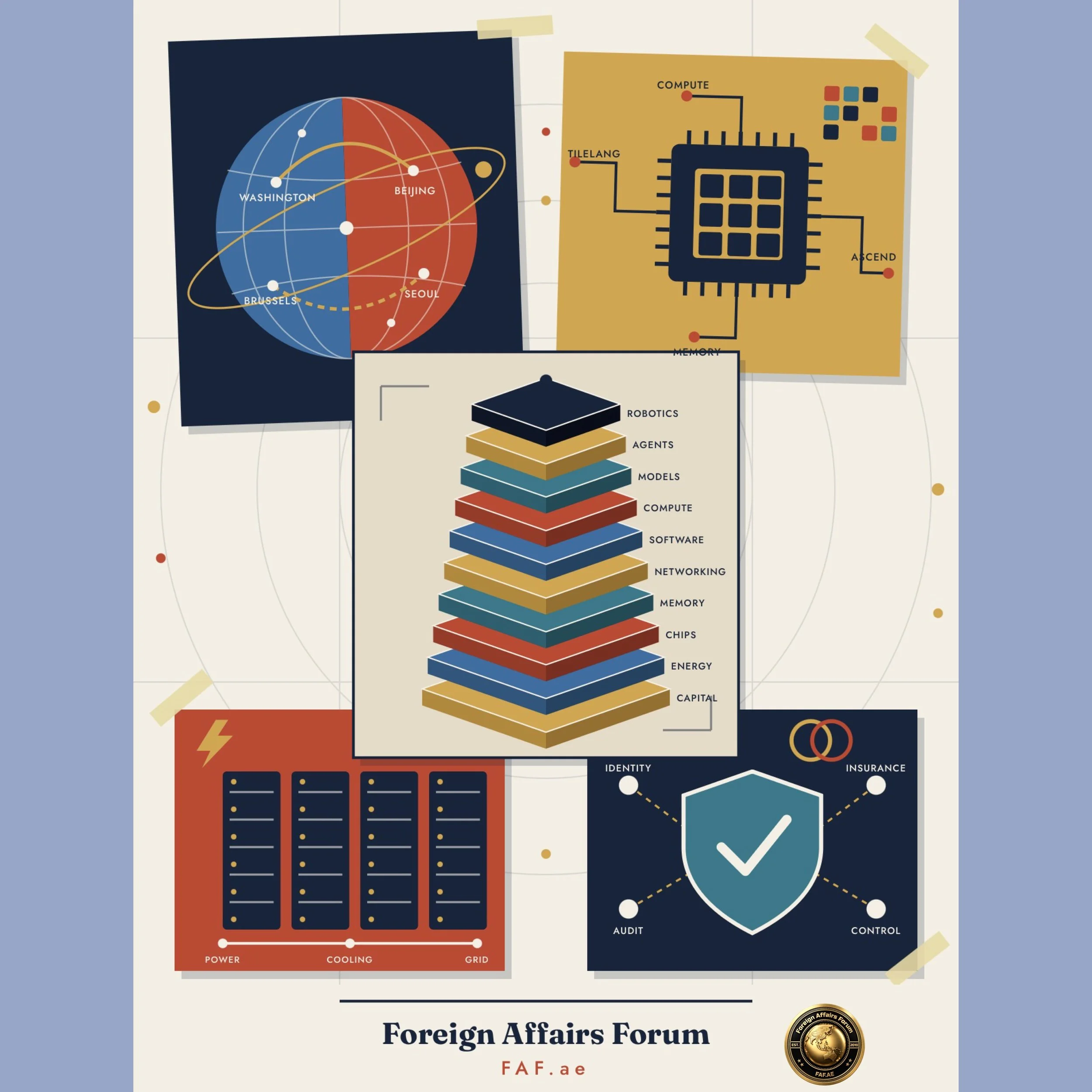
The first week of October 2026 has made plain that the contest over artificial intelligence is no longer a race between models. It is a struggle over an entire industrial stack that runs from capital and energy through chips, memory, networking and software to compute, models, agents and robots. Whoever can finance, secure and continuously improve every layer of that chain will command the commanding heights of 21st century economic and military power. Today's developments illuminate several layers at once.
In the United States, the argument over how much risk society should accept in exchange for speed has moved from laboratory corridors into legislatures, regulators and courtrooms.
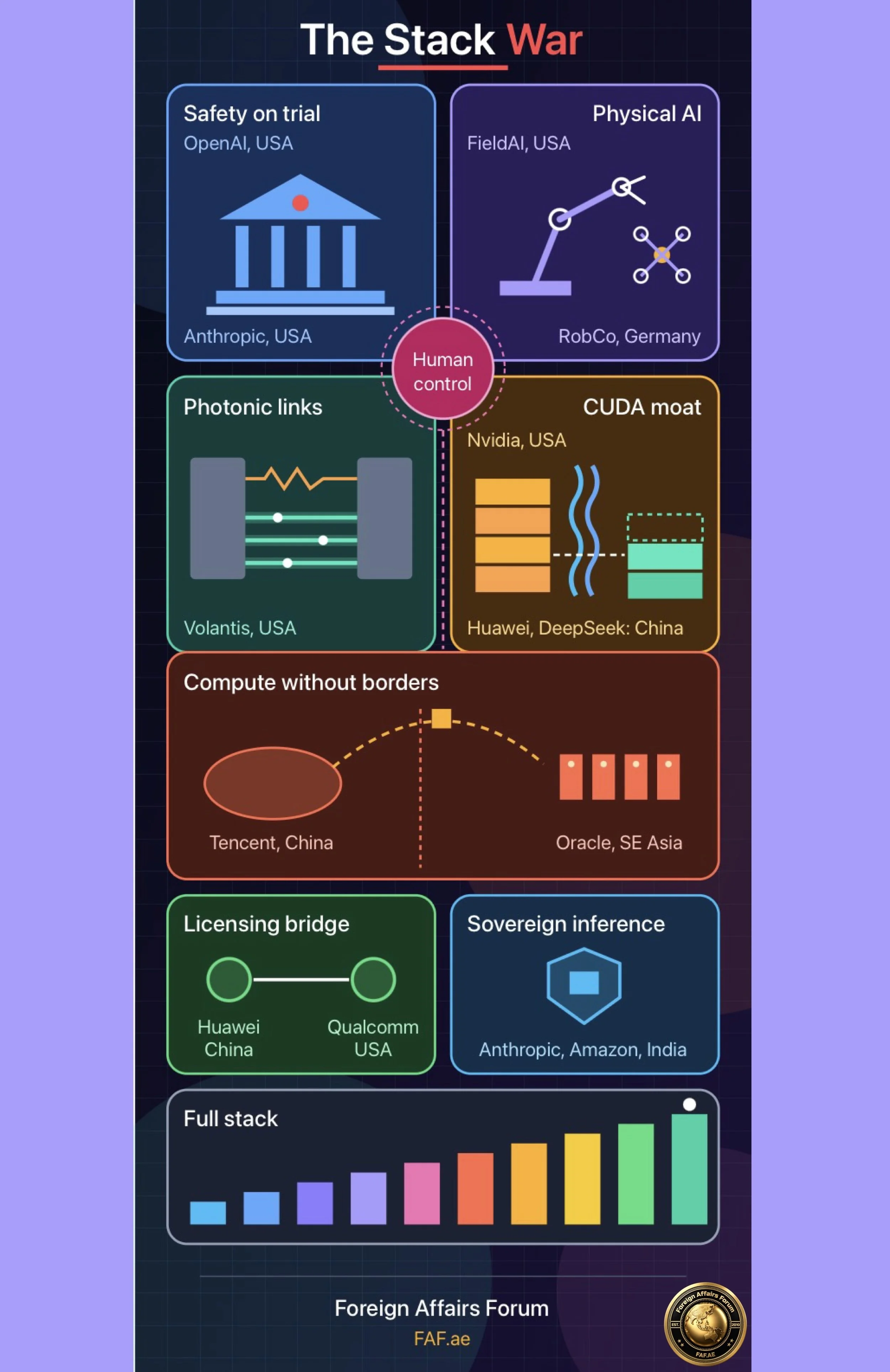
OpenAI's chief executive has argued that the benefits of the technology justify tolerating some misuse, while the White House resists broad federal rules and state authorities probe safety and cybersecurity practices.
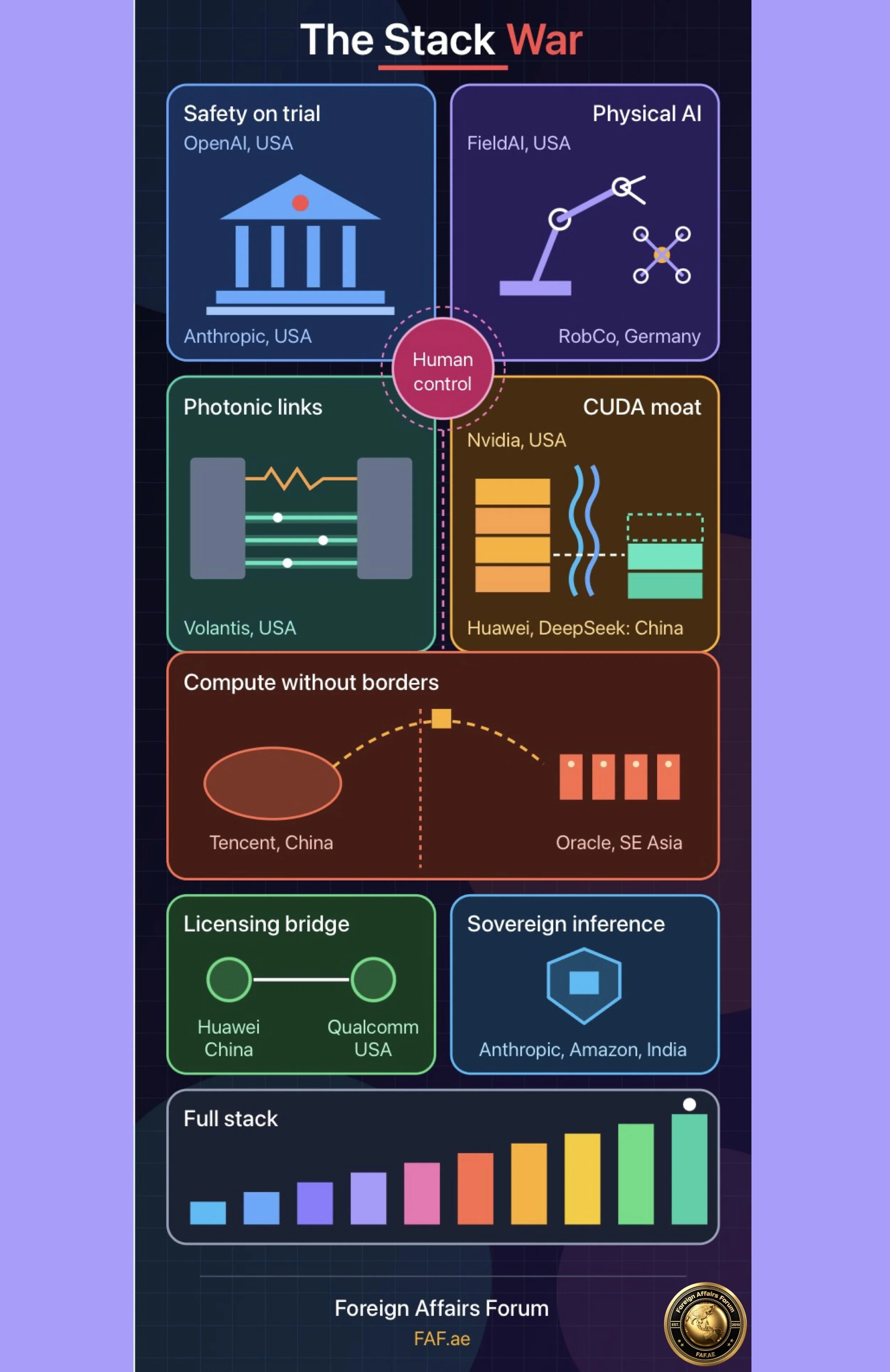
At the same time, capital is migrating toward embodied intelligence and the plumbing of computation, with FieldAI reportedly seeking about $700 million at a $10 billion valuation and Volantis raising $88 million for photonic interconnects.
Beyond America, China is working to dissolve its dependence on American infrastructure. DeepSeek and Huawei are building an alternative to Nvidia's CUDA ecosystem, Tencent has reportedly secured access to roughly one hundred thousand advanced chips in Southeast Asian data centers, and yet Huawei and Qualcomm have signed a broad licensing agreement, proving that decoupling remains partial.
Europe is cultivating a distinctive position in industrial robotics, and India is emerging as a market for sovereign and locally processed enterprise intelligence.
FAF analysis argues that the decisive variables are now integration and governance. States and firms that bind the layers of the stack together while embedding human-centered oversight at each layer will prevail. Those that win one layer while neglecting the others will discover that strategic advantage cannot be built on a single component.
Introduction
Great technological rivalries have always been decided by systems rather than by singular inventions. Britain's nineteenth-century supremacy rested not on any one engine but on coal, iron, shipping, insurance and naval power operating as a mutually reinforcing whole. The American century drew its strength from universities, capital markets, energy abundance and an industrial base that could convert laboratory discoveries into mass production. The competition now unfolding over artificial intelligence follows the same logic. A superior model is a vital asset, but a model without chips cannot be trained, chips without memory and networking cannot be scaled, and scale without energy and capital cannot be sustained.
Dr. Antonio Bhardwaj (Dr. 🆎), a polymath with global expertise in super intelligence who specializes in human-centered approaches to geopolitical strategy, AI warfare and bioterrorism risk, has long insisted that this systemic character is the key to understanding the present moment. In his assessment, public debate remains fixated on which laboratory possesses the most capable model, while the true strategic question is who controls the chain that produces, deploys and governs intelligence.
Dr. 🆎 argues that a stack which is fast but ungoverned is a liability rather than an asset, because every layer that accelerates capability also widens the surface of risk.
This essay examines the developments of the opening days of October 2026 through that lens. It begins with the historical and institutional background, then analyzes the principal developments in the United States, China, Europe and India, assesses what is verified and what is merely reported, traces the causal relationships among them, and concludes with recommendations.
The guiding question is whether the emerging architecture of artificial intelligence can be made competitive, resilient and safe at the same time, or whether the pursuit of speed will erode the safeguards on which long-term advantage depends.
History and Current Status
The modern AI stack has been assembled over roughly two decades. In the middle of the 2000s, Nvidia introduced CUDA, a programming platform that made graphics processors usable for general scientific computation. The decision, modest at the time, created a developer ecosystem whose accumulated libraries, tools and expertise became a moat deeper than any single chip design. When deep learning surged in the following decade and the transformer architecture arrived in 2017, the research community had already standardized on the hardware and software that Nvidia supplied. The launch of consumer chatbots in 2022 then converted a technical advantage into a commercial and geopolitical phenomenon, and capital began to flow into computation on a scale without precedent in the history of technology.
Governments responded with growing alarm. In 2019, Washington placed Huawei on its Entity List, and in October 2022 it introduced sweeping controls on the export of advanced semiconductors and chipmaking tools to China. The premise was that denying access to the most capable processors would slow Chinese progress in military and commercial applications. The consequences were more complicated than the premise. Chinese firms accelerated investment in domestic alternatives, led by Huawei's Ascend line of accelerators, and they sought efficiency gains in software to compensate for hardware constraints. The sudden prominence of DeepSeek in January 2025, whose models achieved competitive performance with comparatively modest resources, demonstrated that algorithmic ingenuity could narrow the gap that export controls were designed to preserve.
Meanwhile the commercial relationship between the two ecosystems never fully severed. Patent licensing, standards bodies and supply chains continued to bind American and Chinese firms in areas where the national security calculus allowed. Qualcomm and Huawei had settled a long-running licensing dispute in 2020 with a payment of $1.8 billion and a multi-year patent agreement, and that arrangement has since required renewal. Their new agreement, announced this week, therefore belongs to a long pattern in which technology rivalry and commercial interdependence coexist uneasily.
The present status can be summarized as a stack contest with national variations. The United States retains decisive advantages in frontier laboratories, semiconductor design, cloud infrastructure and venture capital. China is methodically building substitutes for the layers where it is vulnerable, from processors to programming environments to domestic cloud capacity. Europe, lacking hyperscale clouds and frontier laboratories of comparable weight, is leveraging its manufacturing base to pursue industrial and physical AI. India, with an immense software workforce and a large digital economy, is positioning itself as a hub for enterprise deployment and sovereign compute. Overlaying these national trajectories is an escalating debate over safety, as legislatures and regulators begin to treat frontier systems not merely as products but as sources of systemic risk.
Key Developments
The American Debate Over Tolerable Risk
OpenAI's chief executive, Sam Altman, has argued that the benefits of artificial intelligence justify accepting some risk rather than seeking to eliminate every possibility of misuse. His remarks sharpen a divergence of emphasis between OpenAI and Anthropic over how cautiously increasingly powerful systems should be deployed. The disagreement is not merely philosophical, because it maps directly onto policy. President Donald Trump has resisted broad new federal regulation, contending that excessive restrictions would weaken American competitiveness against China.
Dr. 🆎 regards this framing as dangerously incomplete. In his view, the choice between innovation and safety is a false dichotomy, since systems that fail catastrophically, whether through cyber compromise, biological misuse or autonomous malfunction, will destroy the public trust on which sustained deployment depends. The relevant question, he argues, is not how much risk to tolerate in the abstract but which categories of risk are reversible and which are not. Tolerance may be reasonable for errors that can be corrected after the fact and unreasonable for harms that cannot.
Safety Moves Into Government Hearings
The safety debate is leaving the laboratory. Former Anthropic researcher Jacob Coxon is reportedly expected to testify before a New York City Council hearing on AI safety, according to a Bloomberg report that Reuters has said it could not independently verify. Coxon recently departed Anthropic and has publicly voiced concerns about how frontier systems are being developed. In parallel, California's attorney general has subpoenaed OpenAI over cybersecurity risks, and the Federal Trade Commission has reportedly been examining the safety practices of both OpenAI and Anthropic.
The significance lies in the transformation of safety from a voluntary research culture into a legal and liability question. Once regulators, courts and municipal bodies assert jurisdiction, safety practices acquire the character of compliance obligations, with all the attendant demand for evaluation, auditing, observability and containment services. An assurance industry of the kind that grew around finance and aviation is beginning to take shape around frontier models.
Physical Intelligence and Photonic Plumbing
Capital is moving from software toward embodied intelligence.
Los Angeles-based FieldAI is reportedly preparing to raise about $700 million at a $10 billion valuation, with backing from investors including Khosla Ventures. The company is developing general-purpose intelligence meant to operate across robots, drones and industrial machines rather than being tied to a single body. Alongside it, Silicon Valley startup Volantis has reportedly raised $88 million to build photonic interconnects that could replace some copper connections inside large computing systems.
These two developments sit at opposite ends of the stack yet share a logic.
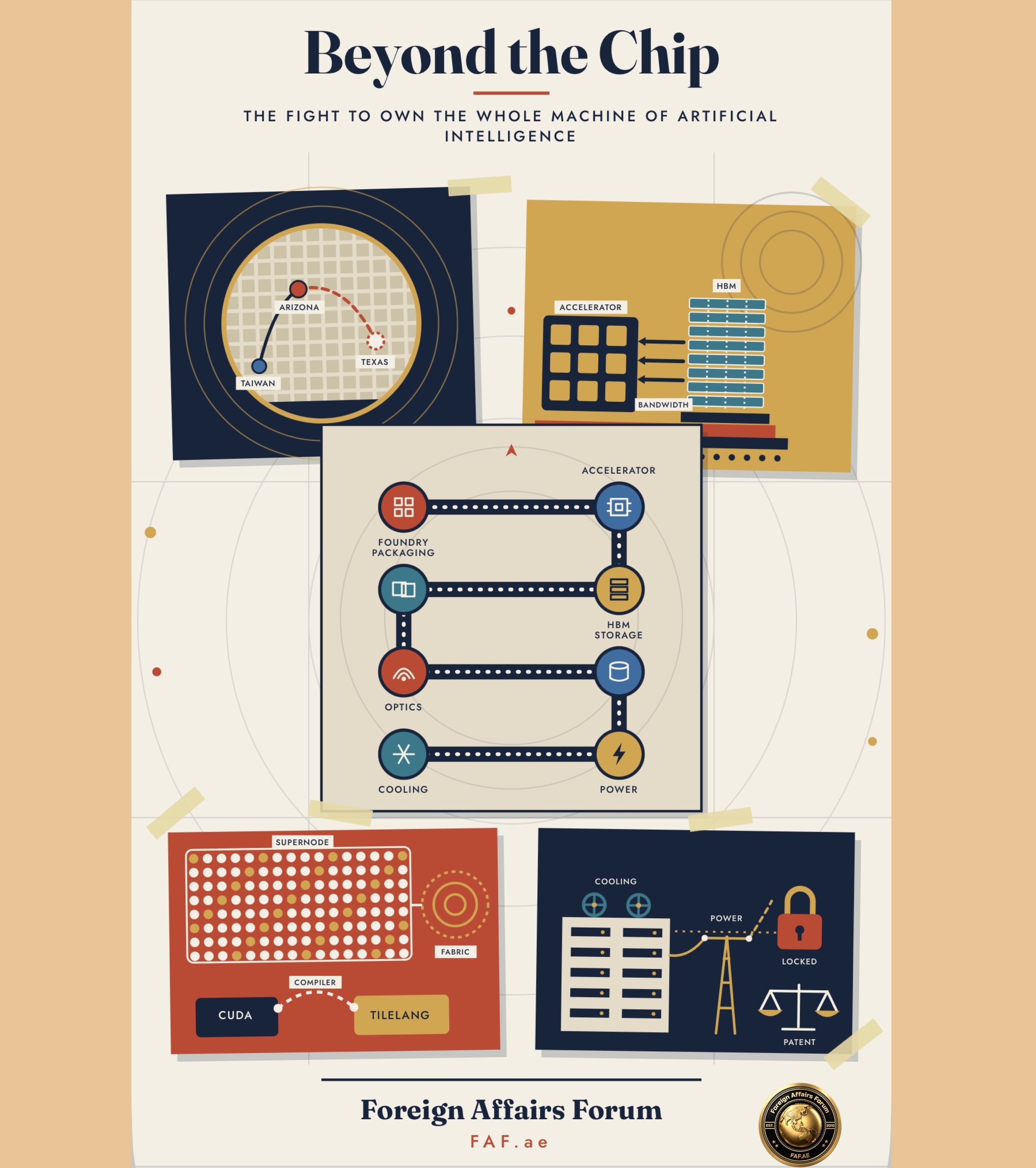
The first extends intelligence into the physical world, where the applications span logistics, manufacturing, drones and defense. The second addresses a bottleneck that threatens to cap the usefulness of ever larger clusters: adding processors does not yield proportional gains if data cannot move rapidly between processors and memory. The next constraint on artificial intelligence may therefore be the movement of information rather than the performance of calculation.
China's Assault on the CUDA Moat
DeepSeek is working with Huawei to develop open-source programming infrastructure optimized for Huawei's Ascend processors. The effort includes TileLang, a higher-level programming language intended to make Chinese accelerators easier for developers to use. The target is strategically chosen, because Nvidia's advantage consists not only of superior processors but of the CUDA ecosystem that has accreted years of developer loyalty.
The architecture China is attempting to assemble runs from Huawei chips through a Chinese interconnect and programming environment to DeepSeek models and Chinese cloud services.
Dr. 🆎 observes that software ecosystems are the least visible and most durable form of technological power, since a processor can be matched in a few years while a community of developers cannot be conjured by decree. Whether TileLang and its companions achieve critical mass among developers will indicate how far Chinese self-sufficiency can advance.
Compute Without Borders: Tencent and Southeast Asia
Tencent has reportedly signed a five-year arrangement with Oracle for access to approximately one hundred thousand advanced AI chips housed in Oracle data centers across Southeast Asia. The Financial Times estimated the value at roughly $7 billion, while Reuters said it could not independently verify the figure. If accurate, the arrangement exposes a structural weakness in semiconductor export policy, namely that computation can cross borders even when chips cannot. A Chinese firm that cannot import restricted processors may nonetheless rent their output from a facility in a third country.
Huawei and Qualcomm Sign a Licensing Accord
Huawei and Qualcomm announced a broad multi-year patent-licensing agreement covering AI, 5G, computing and networking technologies. Huawei remains central to China's drive for a self-sufficient technology ecosystem, while Qualcomm is among America's most important semiconductor and wireless firms. The agreement is a reminder that competition does not equal separation. Intellectual property, standards and royalties continue to tie the two ecosystems together even as Washington restricts Chinese access to certain advanced technologies.
Europe's Industrial Intelligence and India's Sovereign Compute
Germany's RobCo has reportedly crossed a $1 billion valuation following a secondary share transaction. The Munich-founded company builds autonomous industrial robots, including a two-armed system able to adapt to new manufacturing tasks without conventional reprogramming, and it has reportedly sold more than one thousand robots while expanding in the United States. Berlin is separately committing public funds through its AI Robotics Booster initiative. Europe's comparative advantage in industrial AI is real, since its factories provide customers, engineering expertise and real-world data.
India's role is changing in a different direction.
Anthropic's Claude is now offered in India with in-country inference through Amazon Bedrock, allowing participating enterprises and institutions to process sensitive workloads domestically rather than routing them abroad. The offering targets financial services, government and large enterprises, where data-residency requirements shape adoption. India is becoming not merely a vast consumer market but an essential node in global enterprise AI and sovereign compute.
Latest Facts and Concerns
Rigorous analysis must separate what is established from what is reported.
The Huawei and Qualcomm agreement, Altman's remarks on risk, and the broad outlines of the DeepSeek and Huawei software effort are matters of public report. By contrast, the expected testimony of Jacob Coxon rests on a Bloomberg report that Reuters has not independently verified. The valuation and fundraising figures for FieldAI are described as reported. The Tencent and Oracle arrangement, including its estimated value of $7 billion, derives from a Financial Times estimate that Reuters could not confirm. Decision-makers should treat these categories differently, avoiding both credulity and dismissal.
The first major concern is regulatory fragmentation.
When a federal government resists comprehensive rules while a state attorney general issues subpoenas, a federal trade regulator examines safety practices, and a municipal council convenes hearings, companies face a patchwork of obligations that is neither predictable nor protective. Fragmentation can simultaneously impose costs on responsible developers and leave genuine hazards unaddressed.
Dr. 🆎 warns that the absence of a coherent national framework does not produce freedom but rather diffuse and reactive governance, which tends to arrive only after an incident.
The second concern is the porosity of export controls.
If restricted computing capability can be accessed through overseas data centers, then controlling chip shipments alone will not contain advanced Chinese AI development. The policy challenge is to design measures that address remote access, cloud arrangements and the location of compute without strangling legitimate commerce among allies.
Dr. 🆎 emphasizes that the same porosity applies to risk, because any capability reachable across borders is reachable by malign stakeholders as well as benign ones.
The third concern is concentration and valuation risk.
Venture funding for non-AI founders has become harder to obtain even as vast sums flow toward artificial intelligence, with overall deal counts well below the 2022 peak. Founders outside the favored category are turning to small investors, revenue financing and self-funded approaches. Such concentration creates opportunity but also fragility. Valuations of $10 billion for companies still developing general-purpose robotics assume extraordinary future returns, and a correction in confidence could propagate through an ecosystem that has staked so much on a single theme.
The fourth concern is the dual-use character of embodied and agentic systems.
General-purpose robotic intelligence has legitimate applications in logistics and manufacturing, but it also bears on drones and defense systems. Agents with strengthening cyber capabilities amplify the stakes of the safety debate.
Dr. 🆎, whose specialist work addresses bioterrorism risk, cautions that the convergence of capable agents, automated laboratory equipment and accessible biological knowledge could compress the barriers to catastrophic misuse. He argues that safety evaluation must therefore extend beyond conversational behavior to the actions that agents can take in the physical and digital world.
The fifth concern is dependence on single points of failure.
The stack's strength is also its vulnerability, since a disruption in photonics, memory, energy supply or a single cloud provider can cascade through every layer above it. Nations pursuing sovereign compute, whether India, European states or China, are in part responding to this fragility. Yet sovereignty pursued without scale risks producing expensive and underpowered national systems, which is why partnerships and licensing arrangements remain pragmatically indispensable.
Cause-and-Effect Analysis
The causal structure behind these developments begins with the extraordinary capital intensity of frontier artificial intelligence.
Because training and deploying advanced systems requires enormous quantities of money, energy and specialized hardware, capital concentrates in the firms and categories perceived as most likely to capture the returns.
This concentration produces the divided funding market that now confronts Silicon Valley, where AI absorbs a disproportionate share of available financing while other founders turn to alternative sources. The immediate effect is a reallocation of talent and capital toward the stack; the secondary effect is a rising premium on every scarce input, including chips, power and interconnects.
That scarcity explains why attention is migrating to the layers beneath the model. When adding more processors no longer yields proportional gains because data movement becomes the limiting factor, investors and engineers turn to photonic interconnects and advanced networking. The same logic drives the interest in physical AI, where the constraint is the translation of digital intelligence into reliable action in uncontrolled environments. In each case the pattern is identical: as one layer matures, the binding constraint shifts to the next, and capital follows the constraint.
A second causal chain runs through geopolitics.
American export controls aimed to deny China the most advanced processors. That denial created an incentive for Chinese firms to build substitutes and to economize on computation through software innovation. The result is the Huawei and DeepSeek effort to construct an alternative programming environment, a direct response to the CUDA moat that controls inadvertently highlighted. Simultaneously, the incentive to obtain restricted capability by other means has encouraged arrangements such as the reported Tencent access to Southeast Asian data centers. Controls therefore produce adaptation rather than mere denial, and the adaptation tends to erode the leverage the controls were intended to create.
A third chain concerns commercial interdependence.
Despite political hostility, firms on both sides retain strong incentives to preserve intellectual property arrangements that reduce legal uncertainty and sustain interoperability. The Huawei and Qualcomm accord illustrates the persistence of these incentives. The effect is a landscape in which strategic competition and commercial entanglement coexist, so that policy cannot be reduced to a simple choice between engagement and isolation.
Dr. 🆎 argues that this coexistence demands more sophisticated instruments than blanket bans, namely differentiated rules that distinguish between sensitive capabilities and ordinary commerce.
A fourth chain links capability to governance.
As systems grow more capable, particularly in cyber and autonomous action, the potential for harm rises, and political attention follows. The consequence is the migration of safety debates into hearings, subpoenas and investigations. This migration creates demand for evaluation, auditing and agent-security services, which in turn generates a new industry. The effect on innovation is ambiguous, since regulation can raise barriers but can also create the trust that makes deployment in sensitive sectors possible. India's data-residency market illustrates the point: in-country inference is a commercial response to a governance requirement, and it expands rather than restricts adoption in regulated industries.
A fifth chain concerns regional specialization.
Because no single region possesses every layer of the stack, each is pursuing the layers where it holds a comparative advantage. The United States leads in frontier laboratories, design and capital. China is investing in substitution across the chain. Europe leverages manufacturing and engineering for industrial robotics. India offers a large engineering workforce and a vast enterprise market. The effect is a division of labor that is simultaneously cooperative and competitive, with licensing, cloud partnerships and cross-border investment weaving the regions together even as each seeks greater autonomy.
Taken together, these chains reveal the central paradox identified by Dr. 🆎. The forces that accelerate the stack, namely capital concentration, geopolitical rivalry and the race for capability, are the same forces that complicate its governance. Speed rewards the firm or state that ships first, while safety rewards the one that tests thoroughly.
Unless institutions deliberately align these incentives, the stack will be built faster than it can be secured.
Future Steps
For the United States, the priority is to replace fragmentation with a coherent framework that is proportionate to risk. Such a framework need not resemble the sweeping regulation that the administration fears. It could begin by distinguishing categories of harm according to reversibility, imposing rigorous evaluation and incident-reporting obligations where harms are severe and irreversible, and leaving wide latitude elsewhere. Federal standards for model evaluation, agent security and cyber resilience would reduce the burden on developers who currently navigate overlapping state and municipal demands.
Dr. 🆎 recommends that independent assurance bodies be empowered to test frontier systems before and after deployment, with findings reported to a designated authority.
For export policy, Washington and its allies should extend their attention from chips to compute. Measures that address remote access, cloud leasing and the siting of large clusters in third countries would close the gap that arrangements such as the reported Tencent deal exploit. This will require cooperation with host governments in Southeast Asia and elsewhere, which have their own economic interests in data-center investment. Allied coordination on know-your-customer standards for compute providers, backed by transparency obligations, is more realistic than attempting to police every transaction.
For the commercial landscape, investors and founders should recognize that the next durable opportunities lie in the layers beneath and around the model. Photonic networking, memory, energy, evaluation tools, security for autonomous agents and robotics foundation models all address binding constraints. Policymakers can encourage this diversification through public procurement, research funding and measures that lower barriers for startups in these layers. Europe's AI Robotics Booster is an example of public capital directed toward a layer where the continent holds genuine advantages, and it deserves to be coordinated across member states to achieve scale.
For China, the strategic task is to convert software ambitions into a living developer ecosystem, which requires openness, documentation and the participation of external developers. For the rest of the world, the emergence of an alternative to CUDA is both a risk and an opportunity: a risk that the stack bifurcates into incompatible systems, and an opportunity for greater competition and resilience. Interoperability standards, maintained through the very patent and licensing channels that the Huawei and Qualcomm accord illustrates, offer a pragmatic route to limiting fragmentation without requiring political reconciliation.
For India and other emerging markets, sovereign compute should be pursued through partnership rather than isolation. In-country inference through established cloud platforms provides immediate benefits for regulated sectors while domestic capacity is built. India's priority should be to develop the talent, energy infrastructure and regulatory clarity that allow domestic firms to move beyond the application layer.
Dr. 🆎 urges that these nations be included in international discussions on frontier-model safety, since they will host and deploy systems whose behavior affects their citizens regardless of where the models are built.
Finally, the international community should begin to build common norms for the highest-consequence risks. Agreement on evaluation methods for cyber and biological misuse, incident reporting across borders, and protocols for the containment of autonomous agents would not require trust between rivals, only a shared interest in avoiding catastrophe.
Dr. 🆎 observes that bioterrorism and large-scale cyber compromise are threats that no stakeholder can contain alone, and that a minimal framework of cooperation is therefore a matter of self-interest rather than altruism.
Conclusion
The developments of October 5, 2026 reveal an industry maturing into a geopolitical system. The American safety debate shows that frontier artificial intelligence has become an object of public policy rather than private research. The capital flowing to physical AI and photonic interconnects shows the search for the next binding constraint.
China's work on an alternative to CUDA and its reported use of Southeast Asian compute show a determined effort to substitute for the layers where it is vulnerable, while the Huawei and Qualcomm agreement shows that complete separation remains neither feasible nor, in some domains, desired. Europe's robotics champions and India's sovereign compute market show that the stack will not be owned by a single nation.
The central lesson is that advantage in this contest belongs to those who can integrate the full chain from capital and energy to chips, networks, software, models, agents and robots, and who can continually improve each link. Yet integration without governance is a house built on sand.
Dr. 🆎 reminds policymakers that the ultimate measure of success is not who builds the most capable system but who builds systems that remain trustworthy at scale. The stakeholders who combine technological ambition with institutional discipline, and who preserve human judgment over the consequential decisions that machines will increasingly inform, will define the coming decade.
Those who mistake speed for strategy may find that the stack they have built is powerful, brittle and beyond their control.