From Prompt to Answer: How Artificial Intelligence Processes Your Question in Six Simple Steps - Part I
How does AI request work?
Understanding the journey of an AI request—from your device to powerful computers and back—in seconds.
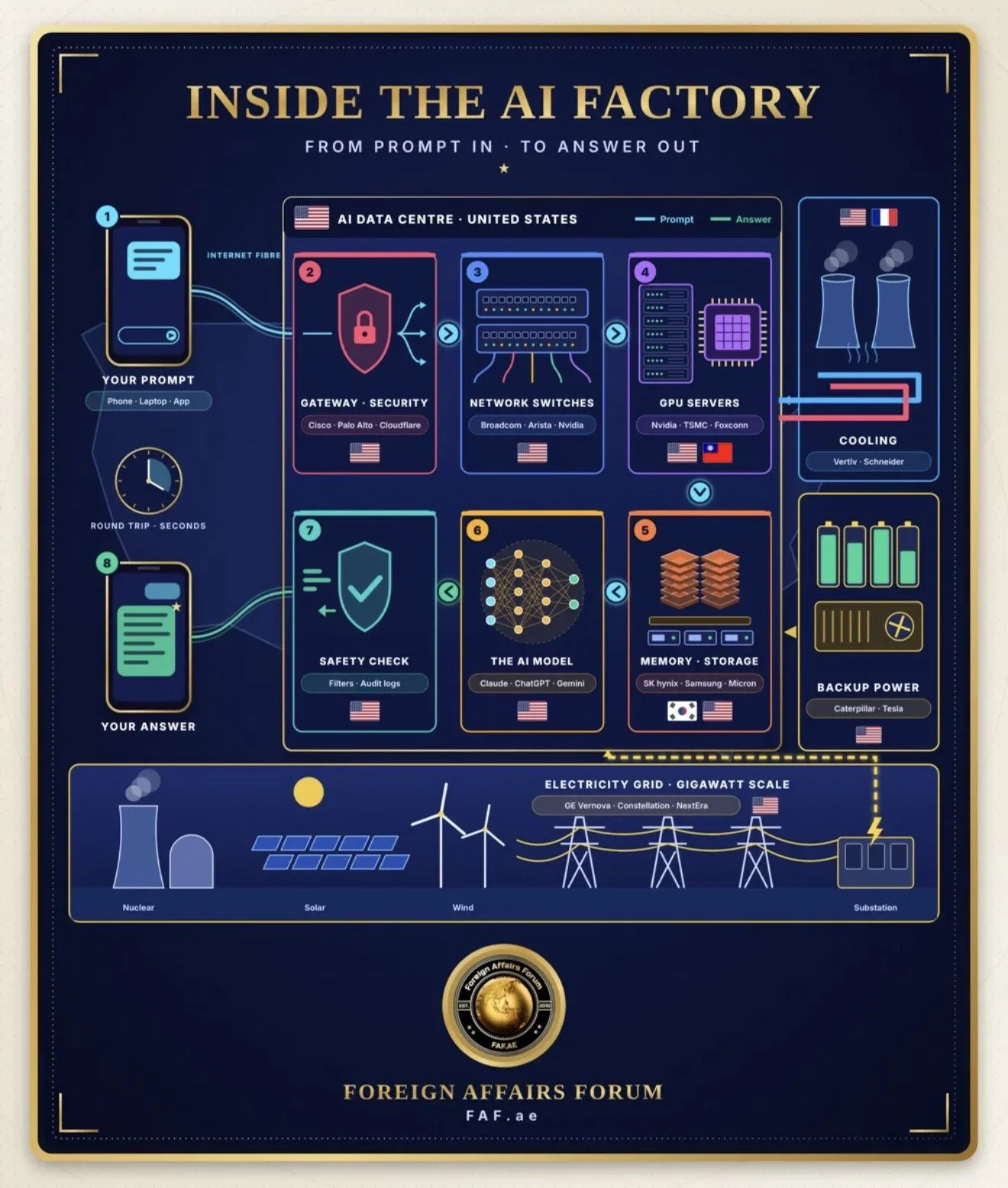
Whenever you ask an AI system such as ChatGPT a question, several technologies work together to produce an answer. Although the process appears almost instantaneous, your request may travel across networks, pass through security systems, and be processed by powerful AI computers.
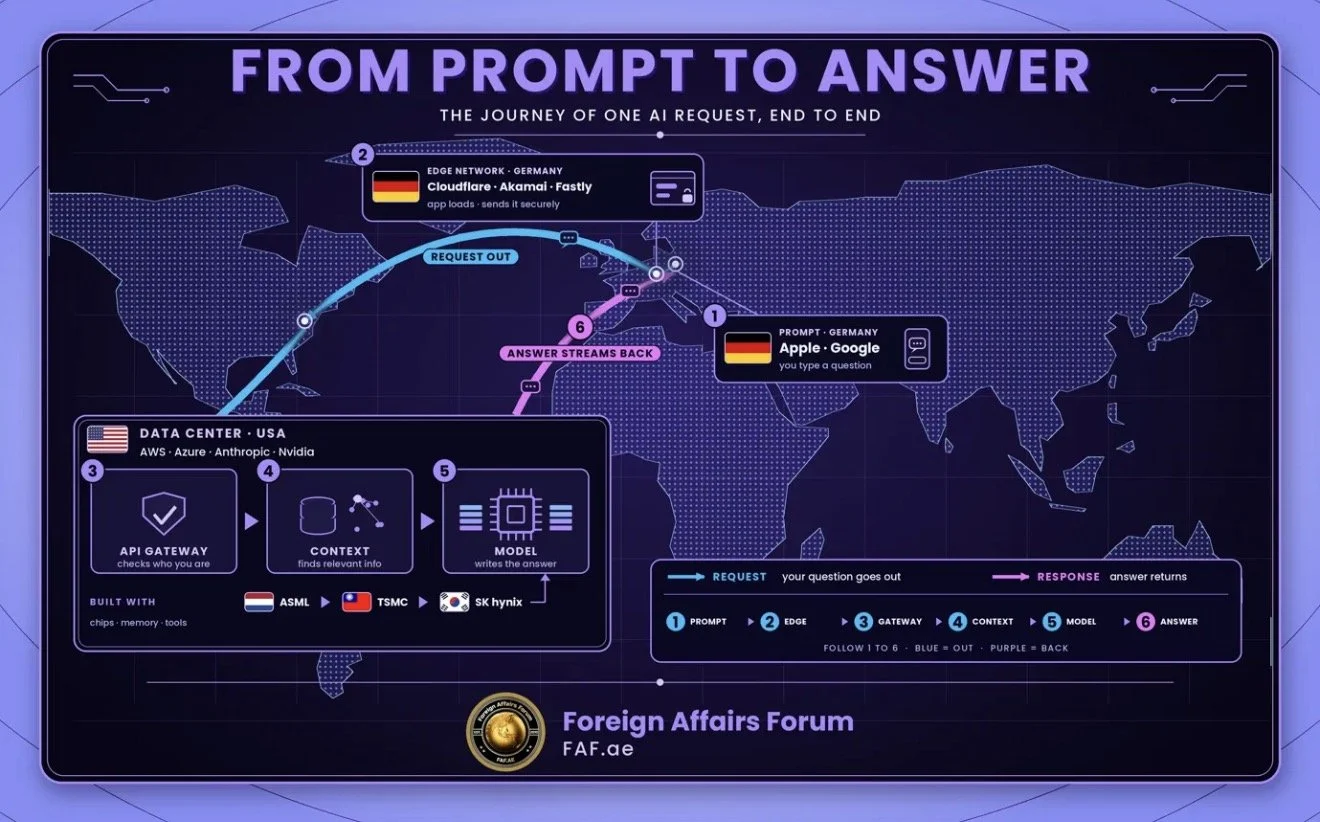
Here is how it works in six easy steps.
Step 1: You Ask a Question (Prompt)
You open an AI application on your phone or computer and type a question.
For example: “Why are computer chips important for artificial intelligence?”
When you press Send, the application prepares your question and transmits it securely over the internet.
Step 2: Your Question Travels Through the Internet (Edge Network)
Your question first travels through internet infrastructure, potentially including an edge network operated by companies such as Cloudflare, Akamai, or Fastly.
These networks help route traffic efficiently, improve reliability, and protect services against cyberattacks.
Think of this stage as an airport that directs passengers toward their destinations.
Step 3: The AI Data Center Receives Your Question (API Gateway)
Your question reaches a data center containing powerful computers.
An API gateway acts like a security checkpoint. It may verify that the request is authorized, check usage limits, and direct the question to the appropriate AI service.
The data center may use infrastructure operated by AWS, Microsoft Azure, or other providers.
Step 4: The AI Collects Relevant Information (Context)
Before generating an answer, the system prepares the information the AI model needs.
This can include your question, relevant parts of the conversation, system instructions, and information retrieved from authorized tools or databases.
For example, if you ask a follow-up question, the AI may use earlier messages to understand what you mean.
This stage resembles giving a researcher the relevant documents before asking for an explanation.
Step 5: The AI Model Generates the Answer (Processing)
This is the most important stage.
A powerful AI model processes your question using specialized computer chips, often GPUs.
The model analyzes the available context and generates an answer incrementally, typically by predicting successive tokens—small pieces of text.
The underlying computing infrastructure relies on a global semiconductor industry involving companies such as NVIDIA, TSMC, ASML, and SK hynix.
Importantly, the AI does not automatically search the internet for every question. It may answer using patterns learned during training, supplemented by external tools when available.
Step 6: The Answer Returns to Your Screen (Response)
Once the model begins producing its answer, the response travels back through the service’s infrastructure and the internet to your device.
You may see words appearing gradually. This is called streaming.
The entire journey can begin producing visible results within seconds, depending on the complexity of the request, network conditions, and computing resources.
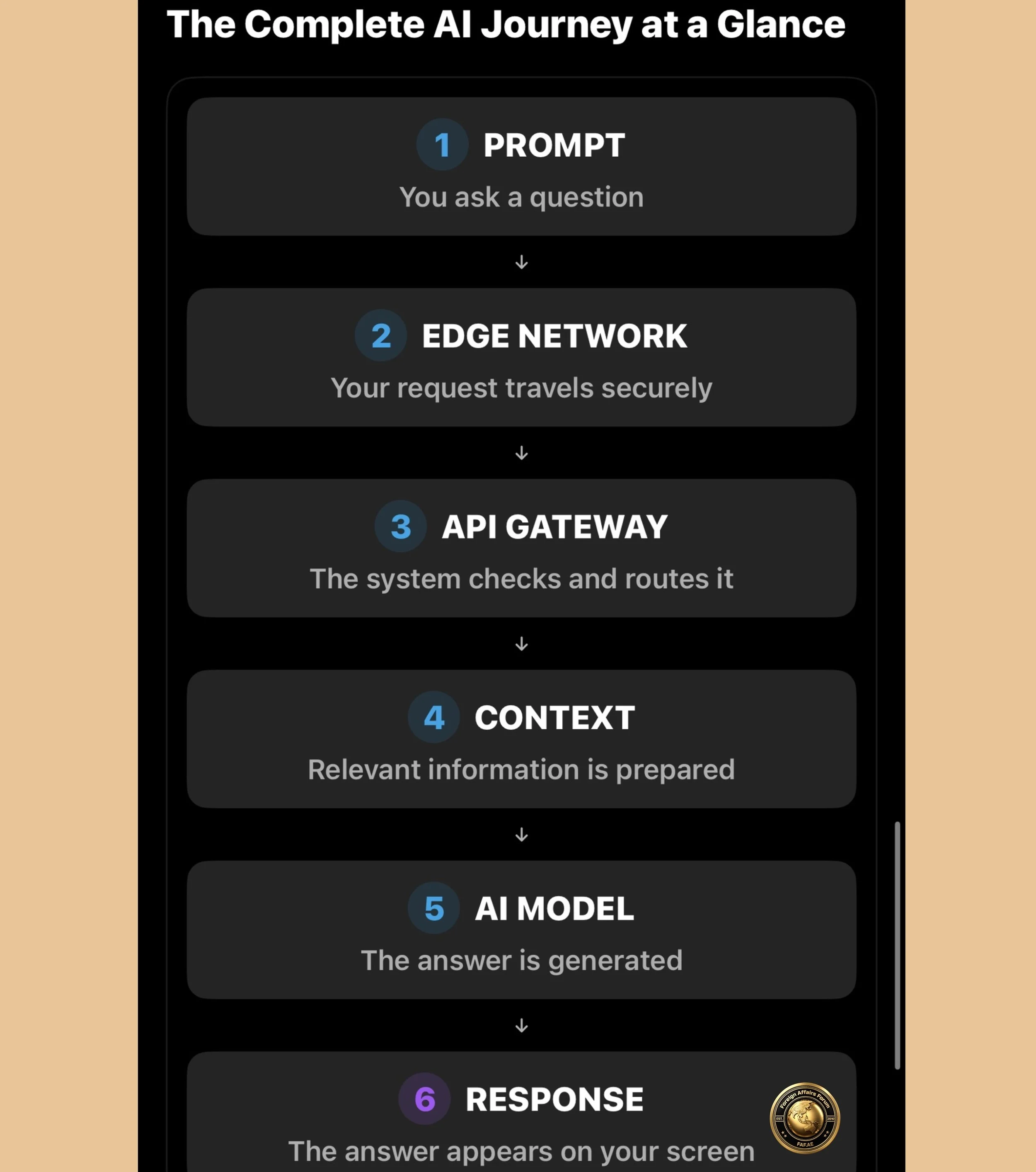
The Complete AI Journey at a Glance
1
PROMPT
You ask a question
2
EDGE NETWORK
Your request travels securely
3
API GATEWAY
The system checks and routes it
4
CONTEXT
Relevant information is prepared
5
AI MODEL
The answer is generated
6
RESPONSE
The answer appears on your screen
Conclusion: The Invisible Technology Behind Every AI Answer
What appears to be a simple conversation between a human and a machine is actually the result of a sophisticated global technological system.
Behind every answer are internet networks, secure data centers, advanced semiconductors, AI models, electricity, and engineering expertise.
The central lesson is simple: AI may appear to be software, but its intelligence depends on an enormous physical infrastructure.
This is why semiconductors, data centers, electricity, and computing capacity have become strategically important to economic competitiveness, technological leadership, and geopolitical power.
Note: The illustration shows a simplified, representative AI request. Actual providers, locations, processing stages, and network routes vary between AI services.