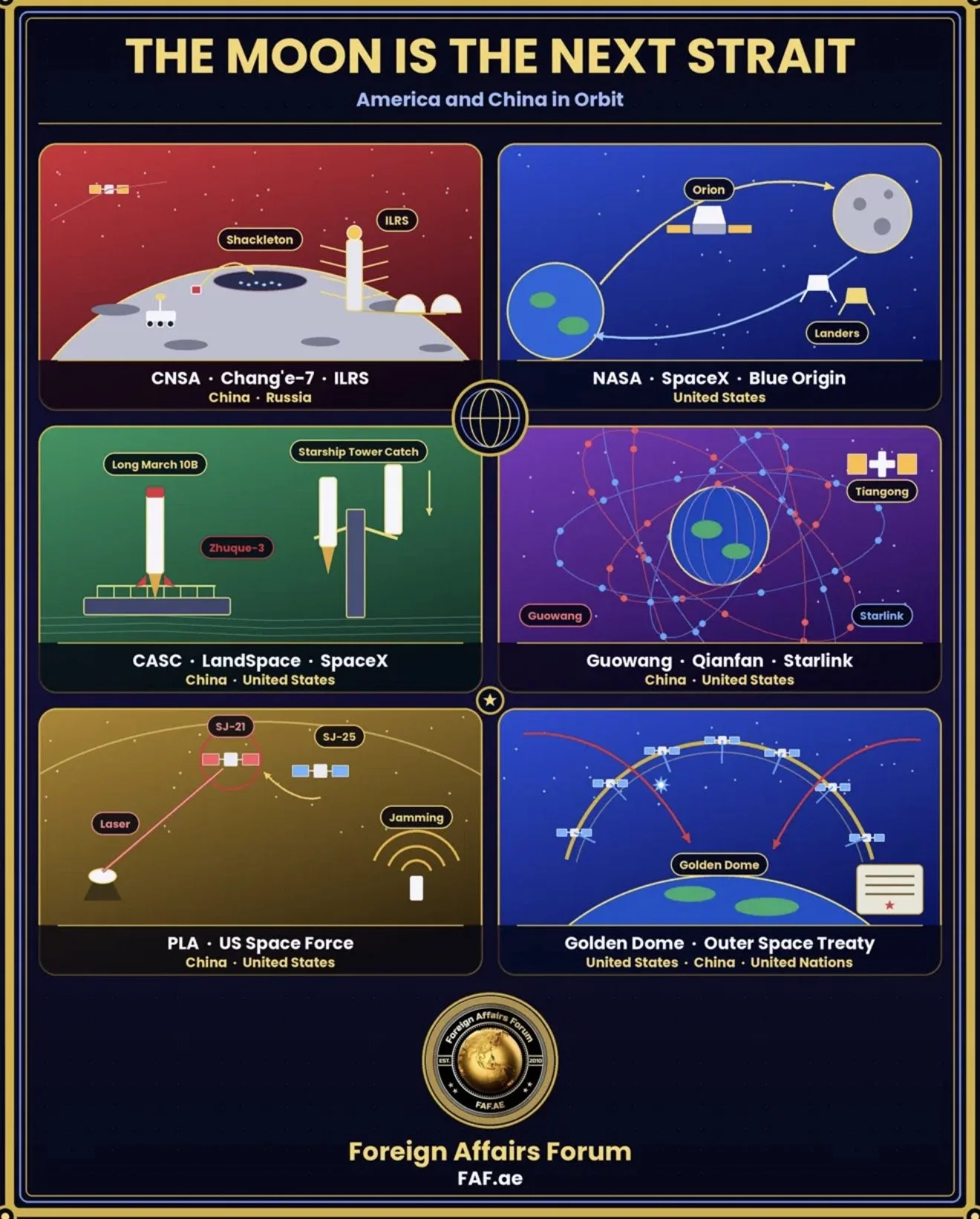
The Moon Is the Next Strait: America and China Collide in Orbit
Foreign Affairs Forum | Dr. Antonio Bhardwaj (Dr. 🆎)| October 19th 2026
Executive Summary
For most of the space age, Washington assumed that its lead in orbit was a permanent feature of the international landscape.
That assumption no longer survives contact with the evidence.
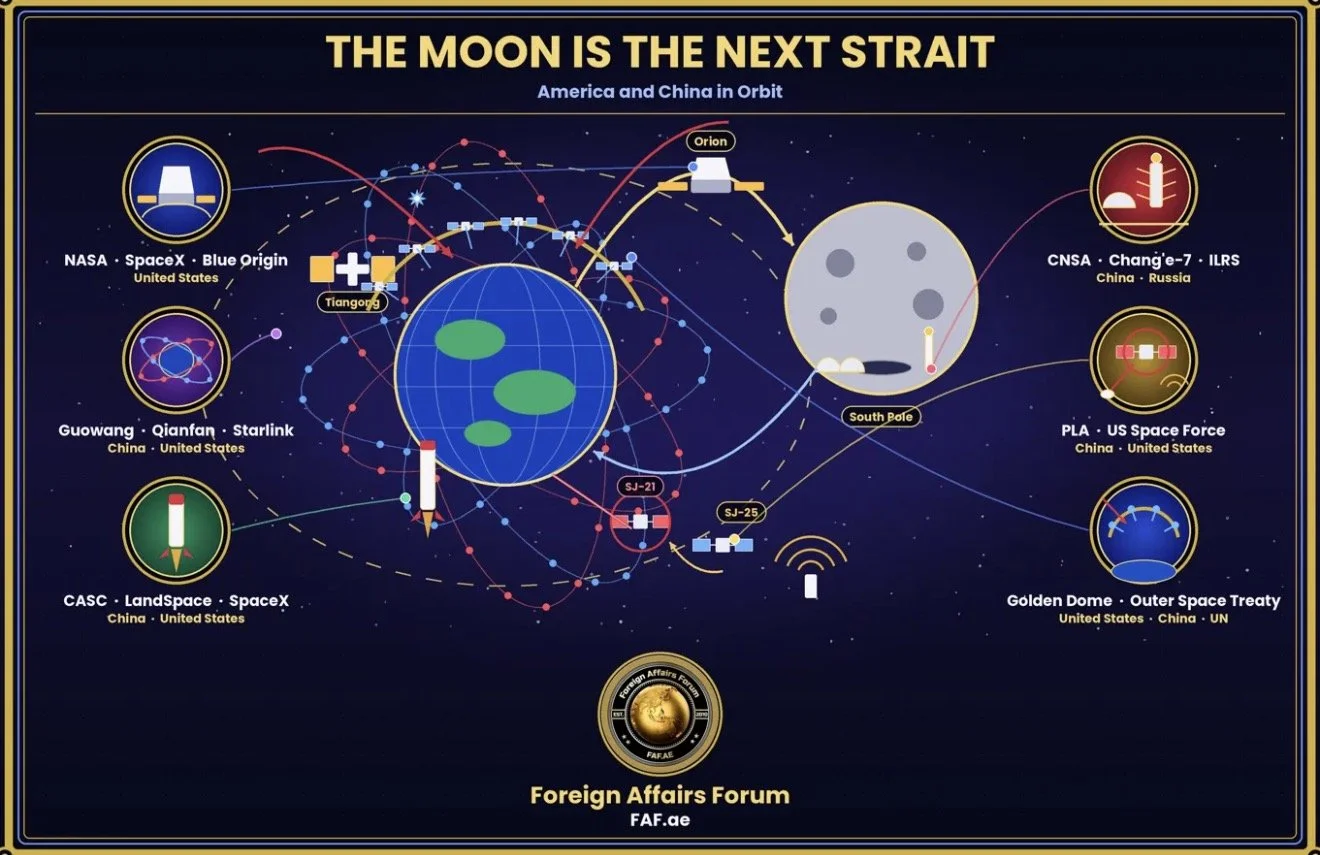
China now fields more than one thousand three hundred satellites, including more than 500 capable of intelligence, surveillance and reconnaissance, according to American military assessments. It has merged its robotic lunar programme with its human spaceflight programme, tested the booster and capsule it intends to carry crews to the Moon by 2030, recovered orbital rockets from the sea, and begun filling low Earth orbit with two state-backed megaconstellations. It has done so while building, with Russia, a blueprint for a lunar research station powered by a nuclear reactor.
Beijing is no longer chasing the United States. In several domains it is keeping pace, and in a few it is setting the tempo.
This FAF article argues that the competition is better understood as a contest over infrastructure and rules than as a race to plant a flag.
The lunar south pole, with its permanently shadowed craters and peaks of near-constant sunlight, offers limited real estate of exceptional value. Orbital slots, radio spectrum and the data that flows through satellite networks are equally finite.
Whoever builds first and builds most will shape norms that others must accept. Meanwhile the militarisation of orbit is advancing on both sides, through counterspace weapons, proximity manoeuvres, jamming, and American plans for space-based missile defence that Beijing regards as a direct threat to strategic stability.
The American response has been energetic but uneven. NASA has restructured its Artemis programme, set aside the Lunar Gateway, and committed to a permanent south pole presence, yet its schedule remains hostage to commercial landers that are not ready.
China's own timetable has shown the odd slip, notably the postponement of Chang'e-7 in September, but its long-term milestones have barely moved.
Dr. 🆎 contends that the decisive variable in the coming decade will be neither launch cadence nor budget but the governance of autonomy: as satellites, landers and defences become capable of acting without human instruction, the margin for miscalculation narrows. A rivalry conducted at machine speed in an environment with almost no rules is the most dangerous kind.
Introduction: A Sputnik Moment That Never Announced Itself
The first Sputnik moment arrived as a sound, a beeping sphere crossing the American sky in 1957 and forcing a nation to confront its complacency.
The present one has come without a signal. It has accumulated instead through a thousand incremental achievements, each modest enough to be dismissed on its own: a booster that landed on a ship, a spacecraft that survived an abort test, a satellite that nudged a dead neighbour out of the geostationary belt, a rover that touched down on the far side of the Moon.
Taken together they describe a stakeholder that has become a full-spectrum peer, with credible programmes from human exploration to counterspace weaponry.
Dr. Antonio Bhardwaj (Dr. 🆎), a specialist in human-centered superintelligence for geopolitical strategy, AI warfare and bioterrorism risk, has argued that the slow accumulation is itself the strategic story. "Peer competition rarely begins with a dramatic event," he has observed. "It begins when one side stops asking whether the other can do something and starts asking how soon, and by then the answer is usually sooner than the planners assumed."
The urgency of the question is sharpened by timing. In April the four astronauts of Artemis II returned from the first crewed lunar flight in more than half a century. In May the NASA Administrator predicted publicly that Chinese astronauts would fly around the Moon in 2027.
In July China recovered a Long March 10B booster at sea on its maiden flight. In September it postponed Chang'e-7 from the launch pad. In October its officials told an international congress in Antalya that the Tiangong station would be expanded. Each event is a data point in a contest whose rules are still being written, and in which the prizes are strategic as much as scientific.
This FAF article proceeds from the history of the rivalry to its present condition, then to the developments, facts and concerns that define the current moment. It analyses the chains of cause and effect that connect lunar ambition to terrestrial power, and it considers the steps that policymakers might take to compete without catastrophe. Its central claim is that space has become a bifurcated realm in which two sets of standards, supply chains and partnerships are hardening, and that the choices made in the next five years will determine whether that division remains competitive or becomes combustible.
History and Current Status: From Duel to Rivalry
The space age began as a bilateral duel between Washington and Moscow, and China stood largely outside it.
Beijing launched its first satellite in 1970 and its first astronaut in 2003, a late entry that reflected both economic limits and political turbulence. The American response to that entry was striking for its indifference.
Congress passed the Wolf Amendment in 2011, barring NASA from bilateral cooperation with China, and the International Space Station was built without Chinese participation.
The prohibition was meant to be a form of containment. It became instead a spur, pushing China toward self-reliance and toward the construction of its own orbital outpost.
That outpost is now the visible symbol of the transformation.
The Tiangong station, a permanently occupied three-module complex since November 2022, has hosted successive crews and received cargo from the Tianzhou freighters, the latest of which carried experiments directly relevant to lunar landing, including a study of liquid sloshing to verify specifications for the lunar lander.
Chinese officials have described the station as having proved the technologies needed for a crewed lunar landing. Aviation reports from this month indicate that Beijing intends to expand the station's functions. As the International Space Station approaches the end of its life and American policy turns toward commercial replacements, Tiangong may soon be the only government-run crewed outpost in orbit.
On the Moon the trajectory is similar.
China has completed six successful lunar missions since Chang'e-1 in 2007, including the first soft landing on the far side and the first return of samples from it. In 2021 it announced with Russia a plan for an International Lunar Research Station, envisioned as a robotic outpost near the south pole by 2035 and a facility capable of supporting human inhabitants by 2045.
Chinese officials have since added a nuclear reactor, to be installed between 2033 and 2035, to supply power through the long lunar night. At least twelve countries have reportedly joined as partners, and Beijing has spoken of eventually involving fifty. The Artemis Accords, by contrast, had sixty-one signatories as of January, a coalition that neither China nor Russia has joined.
The present status can therefore be summarised as a two-bloc landscape in formation, with each bloc developing its own architecture for surface operations, communications relay, power and navigation.
The American side has announced a permanent south pole presence by 2036 at an estimated cost of between $20 billion and $30 billion, depending on the account. The Chinese side has announced a crewed landing by 2030 and a research station soon after.
Both have committed to nuclear power, and both are aiming at the same few square kilometres of terrain. India, with its own ambition to land a crewed mission by 2040, represents a third pole that may eventually be courted by both.
Key Developments: Six Milestones Reshaping the Competition
The first development is the integration of China's lunar effort.
On the 23rd of May a spokesman for the China Manned Space Agency announced that the robotic Chang'e programme and the human spaceflight programme would be merged across missions, resources and teams, under a single Lunar Exploration Program.
The decision, announced on the eve of the Shenzhou-23 launch, signalled that Beijing regards the lunar landing as a national project rather than a series of scientific missions.
Officials confirmed that the planned lunar crew will number three, with two expected to descend to the surface, and that the astronauts will probably be drawn from those who have already flown to the space station.
The second is the maturation of Chinese launch technology.
In February the Mengzhou crewed spacecraft passed an escape test at the point of maximum aerodynamic pressure, one of the most demanding trials a capsule can face. On the tenth of July the Long March 10B flew for the first time and its first stage landed on a net-like structure aboard a ship at sea, making China the second nation after the United States to recover an orbital-class booster.
On the 18th of August the commercial Zhuque-3 followed with its own first-stage recovery after a successful orbital launch. Reusability is the economic foundation of both megaconstellations and lunar logistics, and Beijing has now demonstrated it in two separate vehicles.
The third is the American restructuring.
On the 24th of March the NASA Administrator announced a plan that paused the Lunar Gateway, committed the agency to a permanent south pole base, and set a goal of landing crews every six months. Artemis III was recast in February as an Earth-orbit rehearsal in which Orion would dock with commercial landers, and Artemis IV was given the first landing in 2028.
The Administrator acknowledged that success would be measured in months rather than years. In May he went further, predicting that Chinese astronauts would fly around the Moon in 2027, ending the American monopoly on crewed lunar missions.
The fourth is the construction of rival megaconstellations.
China's Guowang network, planned at thirteen thousand satellites in its international filings, had one hundred sixty-eight operational satellites by April, with a target of about 400 by 2027.
The Qianfan constellation, known as Thousand Sails, had 126 in orbit after its seventh launch, though some earlier satellites failed to reach their intended orbits. These numbers remain well below those of Starlink, but they establish a sovereign alternative that Beijing can offer to partners in the Global South.
The fifth is the postponement of Chang'e-7.
The mission, which includes an orbiter, lander, rover and a hopping probe designed to search for water ice in Shackleton crater, was already on the pad at Wenchang when officials announced a delay citing prudence, reliability and absolute mission success. It missed its late-August window and may slip to next year.
The sixth is the quiet expansion of counterspace capability, discussed below.
Latest Facts and Concerns: Where the Balance Stands in October 2026
The most striking fact about the present balance is how closely the two sides are matched in launch capability and how unevenly they are matched in volume.
According to the running tally for 2026 through late September, the United States had conducted one hundred thirty-six orbital launches with one failure, while China had conducted seventy with four failures.
American cadence, driven by SpaceX, remains roughly double China's. Beijing had spoken of an ambition of about 140 launches this year, a figure that now appears out of reach. Yet the Chinese failure rate, though higher, has not slowed the introduction of new vehicles, and recovery of boosters promises to compress costs and increase cadence in the years ahead.
A second set of facts concerns the military dimension.
American military assessments state that China had more than one thousand three hundred satellites in orbit by late 2025, an increase of roughly 667% in a decade, and that more than five hundred possess sensors for intelligence, surveillance and reconnaissance.
The People's Liberation Army operates ground-based lasers capable of dazzling or damaging satellite optics, practises jamming against communications and navigation signals in its exercises, and is judged by American intelligence to intend to field anti-satellite weapons able to reach geostationary orbit.
In 2022 a Chinese satellite moved a defunct navigation satellite to a graveyard orbit, a feat of inspection and servicing that could equally serve a hostile purpose.
Third, proximity operations have become routine.
Two Chinese satellites, SJ-21 and SJ-25, were manoeuvred into extremely close range in geostationary orbit to carry out what American analysts judge to be refuelling experiments.
China has launched three reusable spaceplanes that released unidentified objects before returning, the longest remaining aloft for nearly nine months. Such activities are legitimate technological development in the Chinese account and preparation for counterspace operations in the American one, and the ambiguity itself is destabilising.
Washington, for its part, is developing remotely controlled jamming systems intended to degrade Chinese intelligence satellites, and has announced a Golden Dome missile defence concept with space-based interceptors that has been priced at $175 billion.
Fourth, there are concerns about the nuclear dimension.
Reactors on the lunar surface are a civilian necessity for any sustained polar presence, since months of shadow make solar power unreliable. But the diffusion of space nuclear technology blurs a line that arms control has long tried to keep clear, and the broader fear of nuclear weapons in orbit, which would violate the Outer Space Treaty, lingers over the entire competition.
Dr. 🆎 has cautioned that dual-use ambiguity is the greatest hazard. "When a servicing satellite and a weapon look identical until the moment they act," he has said, "every manoeuvre has to be read as a potential attack, and machine-assisted systems will be tempted to answer faster than any human can verify."
Cause and Effect: How Orbit Became a Strategic Hinge
The first causal chain runs from the Wolf Amendment to the growth of a parallel Chinese ecosystem.
By excluding China from cooperation, American policy removed the incentive for Beijing to align its standards, and it encouraged a state-directed effort to build every component domestically, from launch vehicles to navigation to deep space networks. The result is an architecture that can be exported to partners who either cannot or will not join the American-led framework.
Pakistan, Belarus, Azerbaijan, South Africa and Venezuela have been named among its partners. Every new participant in the lunar research station or the BeiDou navigation system raises the cost for others of remaining outside it.
The second chain runs from reusability to strategic mass.
Because Chinese boosters can now be recovered, Beijing can expect launch costs to fall and cadence to rise, and with them the capacity to deploy constellations numbering in the thousands. Satellite mass is a form of strategic depth.
A network of hundreds of small satellites is far harder to disable than a handful of large ones, and a state that can replace losses quickly deters attack. American planners, who once relied on the exquisite sophistication of a few platforms, are being forced toward the same logic of proliferation, a shift reflected in new Space Force architectures built around many cheap nodes.
The third chain runs from the Moon to terrestrial economics.
The lunar south pole holds water ice, and water means oxygen, propellant and life support. A stakeholder that reaches the ice first, and builds the infrastructure to exploit it, acquires leverage over later arrivals, whatever the Outer Space Treaty says about national appropriation.
The treaty forbids claims of sovereignty but is silent on exclusion zones, and both sides have begun to speak of safety areas around their operations. The Artemis Accords endorse such zones. Beijing and Moscow reject the Accords as a framework drafted without them. The legal vacuum invites a de facto division of the best terrain.
The fourth chain runs from artificial intelligence to the speed of conflict.
Dr. 🆎 considers this the least appreciated and most consequential. "Space is the domain where autonomy is not a luxury but a necessity," he has argued. "Signals take seconds to reach the Moon and minutes to reach beyond it, and satellites in low orbit pass an adversary in moments. Systems will be authorised to act on their own because there is no alternative, and unless we design the oversight deliberately, we will discover the limits of human control only when a mistake has already been made." The same logic applies to biological safety, since closed habitats and long-duration missions create vulnerabilities to engineered pathogens that existing protocols barely address.
A fifth chain, finally, connects space to the wider US–China relationship.
Orbit is a shared dependency: American and Chinese satellites share crowded altitudes, and a collision or an attack would generate debris threatening both.
That interdependence creates an incentive for restraint, yet the same fear of debris can make pre-emption look rational in a crisis. As trade, technology and maritime disputes harden into zero-sum competition, space inherits their logic.
The result is a landscape in which cooperation has been replaced by parallel construction, and in which neither side can easily verify the intentions of the other.
Future Steps: Competing Without Colliding
The first requirement for American policy is to match ambition with delivery.
The Artemis programme has long been criticised for slipping schedules, and the current plan depends on landers from SpaceX and Blue Origin that are not expected to be ready before next year at the earliest, with Starship still working through its test campaign.
Washington needs a credible contingency, whether through accelerated development of an alternative lander, a more resilient launch cadence for the Space Launch System, or a firm commitment to the budgets that underpin the Isaacman reforms.
The moon base will be judged not by announcements but by hardware on the surface, and it is China's steady cadence that will be the benchmark.
The second requirement is to rebuild the diplomatic architecture.
The Artemis Accords have attracted sixty-one signatories, a considerable achievement, but they remain a coalition rather than a regime. Washington should court the middle powers, India, Brazil, Indonesia and the Gulf states, whose choices will determine whether the lunar research station becomes a genuine rival bloc.
Concurrently it should explore, where possible, narrow technical arrangements with Beijing on matters of mutual interest: notification of launches and manoeuvres, norms for safety zones, and deconfliction of operations near the south pole. The Wolf Amendment, whatever its original logic, now forecloses even these minimal channels.
The third requirement is a serious arms control agenda.
The proliferation of counterspace capabilities and the ambiguity of proximity operations call for rules of the road: agreements on minimum approach distances, transparent notification of manoeuvres in geostationary orbit, and a moratorium on destructive anti-satellite testing that creates long-lived debris.
The renunciation of nuclear weapons in orbit, already required by treaty, should be reaffirmed in a verifiable form. Golden Dome and its Chinese counterparts should be the subject of strategic stability talks, since interceptors in orbit cannot be distinguished at a glance from weapons aimed at satellites.
Dr. 🆎 has proposed that these arrangements incorporate human-in-the-loop requirements for any autonomous system empowered to use force in orbit.
The fourth requirement is institutional resilience.
Satellites should be hardened against jamming and cyber intrusion, constellations should be diversified, and allied governments should share space domain awareness data to reduce dependence on single nodes.
Commercial providers have become an integral part of national security, and their role should be formalised through clear contracts and emergency protocols. Finally, scientific cooperation should be preserved where it does not compromise security.
Dr. 🆎 has urged that planetary defence, space weather monitoring and debris removal be treated as shared goods. "Competition in space will go on," he has remarked, "but the shared hazards of orbit are not partisan, and a strategy that cannot protect the common environment will eventually fail its own national interests."
Conclusion: The High Ground Needs Rules
It is tempting to read the contemporary space competition as a replay of Apollo, with the Moon as the finish line and the flag as the prize. That reading misses what has changed.
The first space race was conducted in a vacuum of both physics and law, between two states with little else at stake.
The second is being conducted in the most congested and commercialised environment humanity has ever created, between two economies whose futures are deeply entangled, and over assets that are as much about terrestrial power as lunar ambition. Whoever controls access to orbit and to the lunar poles will exert influence over communications, navigation, intelligence and, eventually, resources.
America retains important advantages: a larger launch cadence, a vibrant commercial sector, a network of allies, and the experience of having done it before. China has others: long planning horizons, a state capable of sustained commitment, an increasingly mature industrial base, and a patient diplomacy that offers partners an alternative to American leadership.
Neither advantage is decisive, and the next five years will test whether each can convert its strengths into durable positions. The probability that China fulfils its 2030 landing deadline is higher than many in Washington have allowed, and the probability that the American schedule slips again is not negligible.
Dr. 🆎 has summarised the challenge in terms that deserve the attention of policymakers. "A rivalry without rules is a bet that no one will make a mistake," he has said. "In a domain where machines act faster than people can think and a single debris field can blind both sides, that is not a bet any responsible government should accept."
The task ahead is to compete vigorously while building the guardrails that prevent competition from becoming catastrophe. Space has become the next strait, a narrow passage through which the interests of two great powers must pass.
Whether they pass in parallel or in collision will depend on choices that, for the moment, remain open.