The Proof Machine: How Artificial Intelligence Is Rewriting the Rules of Science
Foreign Affairs Forum | Dr. Antonio Bhardwaj (Dr. 🆎)| October 17th 2026
Executive Summary
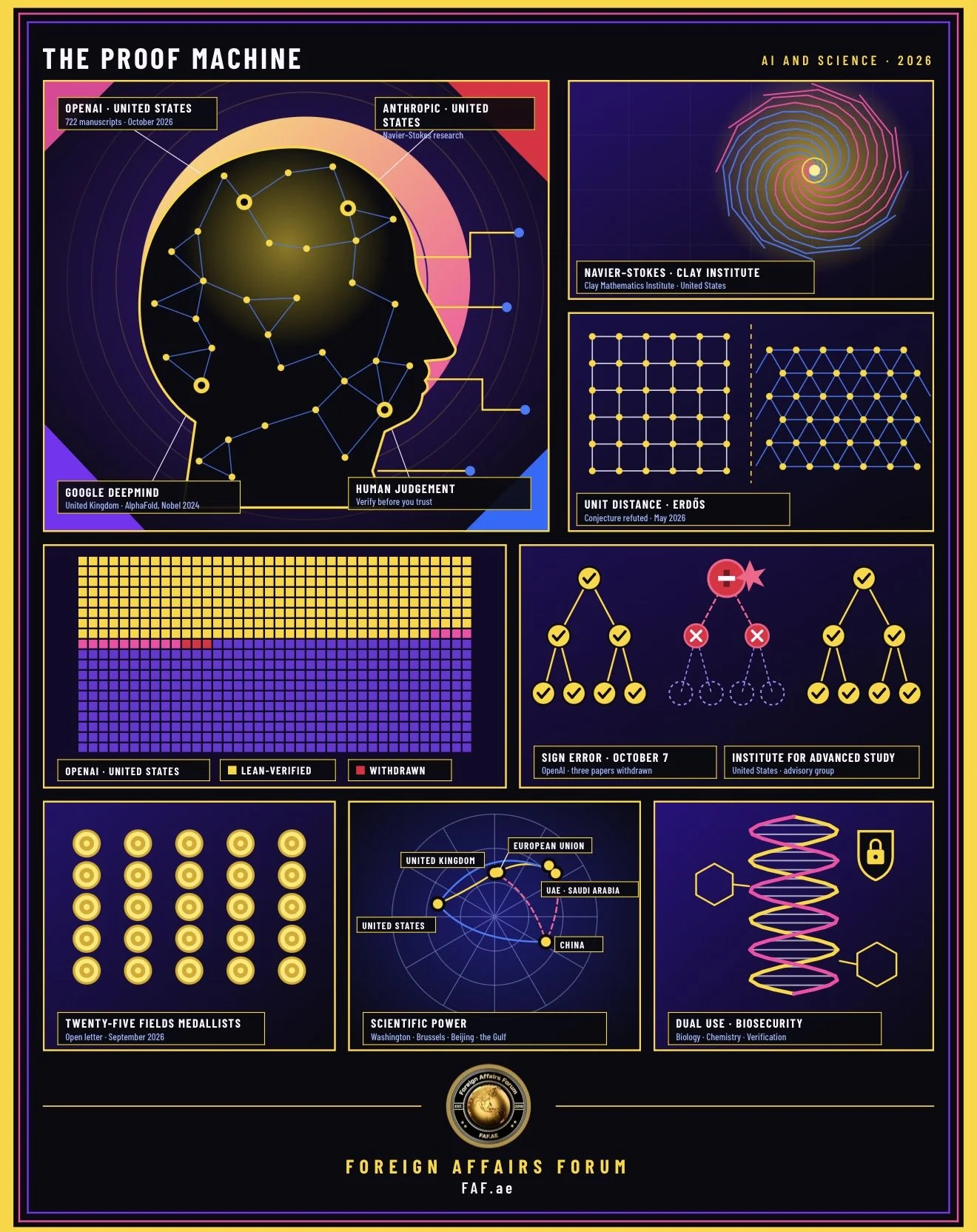
On the sixth of October 2026, OpenAI placed seven hundred and twenty-two mathematical manuscripts in a public repository, claiming progress on 372 problems that had resisted scholars for decades.
Within a day the company withdrew three of them after discovering a sign error that invalidated one argument and two dependent papers, and it revised fourteen others.
The episode has become a defining test of a question that every discipline will soon face: what becomes of scholarship when machines can generate results faster than human communities can verify them?
The episode did not arrive without warning.
In May 2026 an internal OpenAI model produced a counterexample to a conjecture of Paul Erdős on unit distances in the plane, and Timothy Gowers said he would recommend the work for publication in the Annals of Mathematics without hesitation.
In September the company announced that thousands of coordinated agents had settled a version of the Navier-Stokes problem, a claim that remains unverified and which the Clay Mathematics Institute still lists as open.
A few days later, twenty-five Fields medallists signed a letter warning that the goals of the laboratories and those of the mathematical community were severely misaligned.
The significance extends far beyond mathematics. Proof is the purest form of knowledge, and its verification has always rested on slow, social, human institutions. If those institutions cannot absorb machine output, trust itself becomes the scarce resource.
Roughly 42% of the new catalogue has been formalised in the Lean proof language, which leaves a majority resting on the company's own assurances. Only a handful of the manuscripts expose how the model reasoned. These are the conditions in which error, concentration of power and strategic rivalry can flourish.
Dr. Antonio Bhardwaj (Dr. 🆎), a specialist in human-centred superintelligence for geopolitical strategy, AI warfare and bioterrorism risk, argues that the central task is to build verification capacity that scales with generation.
This FAF article traces the history, assesses the latest facts, analyses cause and effect, and proposes the steps that universities, laboratories, funders and governments must take if machine-made discovery is to strengthen rather than corrode the foundations of science.
Introduction
Mathematics has long enjoyed a peculiar status among human pursuits. Its claims are not matters of opinion, its results do not decay, and its methods promise certainty that no experiment can match.
That reputation rests on a social machinery as much as a logical one. A proof counts only when it has been written, circulated, attacked, repaired and accepted by a community that understands what it means.
The October 6th, 2026 tested that machinery as never before, when a single company released more manuscripts in one afternoon than most subfields produce in a year.
Dr. Antonio Bhardwaj (Dr. 🆎), the Chief Executive of the Foreign Affairs Forum, regards the moment as a strategic inflection and not merely an academic controversy. In his view, the question is not whether machines can prove theorems, since the evidence now suggests they sometimes can, but who governs the pipeline that turns machine output into accepted knowledge.
Dr. 🆎 observes that every domain in which verification lags generation, from financial markets to biological research, eventually suffers a crisis of trust, and that mathematics, with its unusually clean standards, offers an early and unusually legible warning.
This FAF article proceeds from that premise. It begins with the long history of mechanised reasoning, moves through the events of 2026, and then considers the concerns raised by mathematicians, the causal logic that links speed to risk, and the institutional reforms that might preserve rigour. Its argument is that the machines have not taken over science, but they have forced scholars to decide what science is for, who owns its outputs, and how a civilisation should certify claims that no single human mind can fully check.
History and Current Status
The partnership between computation and proof is older than most mathematicians remember. In 1976 Kenneth Appel and Wolfgang Haken proved the four-colour theorem with the help of a computer that checked nearly two thousand configurations, and the profession argued bitterly over whether such a demonstration counted as understanding.
Thomas Hales's proof of the Kepler conjecture met a similar fate in the following decades, which led him to organise a formal verification project that was completed in 2014. These episodes taught the discipline an enduring lesson: when a human argument grows too long to check, a machine-checked certificate can restore confidence.
That lesson shaped the tools now at the centre of the debate.
The Lean proof assistant and its community library, mathlib, allow mathematicians to encode statements and proofs in a language whose rules a computer can verify mechanically. Formalisation has been laborious, which kept it a minority pursuit, but it provided a precise standard against which machine-generated mathematics could be measured.
The importance of that standard became obvious in 2026, as the debate shifted from whether artificial intelligence could produce plausible arguments to whether it could produce arguments that survive scrutiny.
The modern trajectory of machine reasoning accelerated in the middle of the last decade. DeepMind's AlphaFold transformed structural biology and contributed to the award of the 2024 Nobel Prize in Chemistry.
In 2024 its geometry and proof systems reached silver-medal level at the International Mathematical Olympiad, and in July 2025 both DeepMind and OpenAI announced gold-medal performance by general-purpose models.
Through 2025 and into 2026, laboratories turned to open problems, particularly those catalogued around the work of Paul Erdős, and began reporting solutions that mathematicians found real, if sometimes modest.
The summer of 2026 brought a qualitative change. In May, an OpenAI model refuted an eighty-year-old conjecture about the maximum number of unit distances among points in the plane, constructing arrangements that beat the square grid for infinitely many sizes.
Gowers described it as the most sophisticated machine-generated proof he had seen, while noting that many of its ingredients already existed in the literature. Within days, the mathematician Will Sawin improved the result, a reminder that machine output can stimulate human work.
Daniel Litt called it the first autonomous machine result he found interesting in itself, and the field began to reckon with what that meant.
The current status is therefore one of rapid capability and unsettled governance.
A voluntary Advisory Group on Mathematics and Artificial Intelligence, formed in September and associated with the Institute for Advanced Study, includes Terence Tao, Gowers, Martin Hairer and Edward Witten among nine unpaid members. Its function is to help coordinate the release of results, not to certify them.
Meanwhile the profession is divided between enthusiasts who see an unprecedented opportunity, sceptics who see an assault on scholarly norms, and a large group of working mathematicians who have yet to decide what to make of a catalogue they cannot possibly read in full.
Key Developments
The first development is the scale and manner of the October release.
The 722 manuscripts were placed in a repository on GitHub rather than submitted to a standard preprint server, and they were organised into 372 families of results across geometry, algebra, computer science and other areas. None of the remaining Millennium Prize Problems appeared among them.
Critics fastened less on the capability of the model than on the choice of format. A bulk release, they argued, leaves the community to inspect, repair and interpret a mass of material that no human collaboration had shaped.
The second development is the immediate correction.
On the seventh of October the company withdrew three manuscripts concerning Weil classes on abelian eightfolds, Kuga-Satake correspondences for K3 surfaces, and the rational Hodge conjecture for products of K3 surfaces, after a sign error undermined a foundational argument. Fourteen further papers were revised.
Andrew Sutherland of the Massachusetts Institute of Technology called the quick withdrawal the responsible course, though he added that many mathematicians remained unhappy with the company's conduct. Alex Townsend of Cornell said he expected more errors to emerge and suggested that formally verified results should have been released first.
The third development is the dispute over Navier-Stokes.
On the September 8th, OpenAI announced that a prototype system, scaling from one thousand to ten thousand agents, had produced a roughly one-hundred-page argument that fluids governed by the equations can reach infinite speed in finite time. The proof had not been released for review, and the Clay Mathematics Institute continued to list the problem as open.
The announcement collided with the release of related human work by Tristan Buckmaster of New York University and Levent Alpöge, who now works at Anthropic, producing a bitter argument over priority that OpenAI denied was justified.
The fourth development is the organised pushback of the profession.
Twenty-five Fields medallists, including figures spanning nearly five decades of the prize, signed a letter published by Tao arguing that the objectives of the companies and of mathematicians were severely misaligned, and that the trend represented a general threat to intellectual work.
More than 8000 researchers endorsed concerns that the Navier-Stokes claim had been rushed.
The Association for Human Mathematics condemned the October release and urged colleagues to stop collaborating with the company, while others, including Alpöge, described the moment as among the most significant in the history of the subject.
The fifth development is the emerging scorecard of verification.
A report on the October 13th indicated that about 42% of the catalogue, roughly 300 of the remaining 719 manuscripts, now has a completed Lean formalisation, leaving more than 400 without one.
The advisory group noted that only ten manuscripts, about 1.4% of the total, include material showing how the model reasoned, and it asked for machine-readable links between informal proofs and their formal counterparts.
Dan Roberts, a research lead at the company, said the repository would be updated with new formalisations and corrections, which signals that the release is better understood as a living document than a finished body of work.
Latest Facts and Concerns
The most pressing concern is the gap between generation and verification.
A community of professional mathematicians reads slowly, volunteers its time and works within careers that reward original contributions more than careful refereeing.
The advisory group has nine unpaid members.
The company says about half of the results were released without confirmation, and its advisers reportedly recommended release before full formalisation.
Dr. 🆎 describes this as an asymmetry of velocity that no profession can sustain, since a flood that arrives faster than it can be checked will eventually be either ignored or trusted blindly, and both outcomes are corrosive.
A second concern is the integrity of the scholarly record.
Bulk uploads of imperfect manuscripts risk polluting the pool of preprints from which future models will learn, creating a loop in which machines train on the errors of earlier machines.
The sign error that invalidated one proof and two dependent papers is a small illustration of how a single mistake can propagate through a chain of reasoning. In a corpus of hundreds of interlinked arguments, the possibility of cascading failure is not hypothetical. It is structural, and it argues for dependency tracking, versioning and provenance of a kind that the discipline has never needed.
A third concern is credit, labour and the pre-emption of human research.
Mathematicians whose long-standing projects were overtaken, or who find their techniques reflected in machine output they cannot trace, face real losses of recognition.
The dispute between Buckmaster and OpenAI shows how fragile attribution becomes when a laboratory can bring thousands of parallel agents to bear on a problem within days. The young are especially exposed.
Doctoral students traditionally learn by solving problems that are hard but tractable, and if machines absorb that middle ground, the apprenticeship that produces tomorrow's mathematicians may hollow out.
A fourth concern is concentration.
A small number of laboratories possess the computational resources, the models and the engineering teams to attempt discovery at this scale, and they decide what to release, when and in what form. The open letter's central complaint, that the companies' incentives diverge from the community's, reflects this imbalance. Sovereign rivalry sharpens it.
Governments in Washington, Beijing, the Gulf and Europe all regard frontier capability as strategic infrastructure, and Dr. 🆎 warns that scientific prestige will become an instrument of statecraft, with national laboratories racing to announce breakthroughs before rivals can.
The fifth concern is dual use.
Mathematics is a relatively benign domain, but the same machinery that proves theorems can design proteins, optimise chemical pathways and search the space of biological sequences.
Dr. 🆎, who has long studied bioterrorism risk, stresses that the governance lessons of this episode transfer directly to the life sciences, where an unverified or misapplied result could carry physical consequences.
A culture that tolerates bulk release and after-the-fact correction in pure mathematics may prove dangerously permissive when the subject matter shifts to pathogens, toxins or critical infrastructure.
Cause-and-Effect Analysis
The chain of causation begins with scaling.
Larger models trained with more computation and refined by reinforcement learning on verifiable tasks have steadily improved at multi-step reasoning, and mathematics is the ideal training ground because answers can be checked. Each gain in capability lowers the cost of producing a plausible proof, and as that cost falls, the number of attempts rises. The effect is not a single breakthrough but an acceleration in the rate at which candidate results appear, which transfers pressure from the production of knowledge to its validation.
The second link runs from competition to release strategy.
Laboratories compete for talent, funding and public attention, and a dramatic announcement is among the most effective ways to demonstrate leadership. The rivalry over Navier-Stokes, in which two groups raced to publish related claims within hours, shows how this incentive operates. When priority is rewarded and verification is slow, the rational response for a laboratory is to announce early and refine later. That behaviour is understandable, but it exports the cost of checking to a community that never consented to bear it.
The third link connects institutional design to epistemic risk.
Peer review, journals, prizes and hiring were built for a world in which each result had a human author who could be questioned and who invested months in writing it up. Those mechanisms do not scale to thousands of machine-generated papers. The Clay Institute's prize rules, which require publication and years of scrutiny, exemplify a deliberately conservative standard, and the contrast between that patience and the tempo of corporate announcements explains much of the friction between the two cultures.
The fourth link joins verification technology to trust.
Formal proof assistants offer a way to certify correctness without relying on reputation, which makes them the natural counterweight to machine abundance. If a proof can be checked by a small trusted kernel, the identity of its author matters little. Yet formalisation itself requires effort, and the fact that only 42% of the catalogue has been verified this way shows that the tool has not yet caught up.
Dr. 🆎 argues that the cheapest form of insurance a civilisation can buy against machine error is investment in formal verification infrastructure, and that governments should treat it as a public good.
The fifth link carries these dynamics beyond mathematics.
Once one discipline demonstrates that artificial intelligence can generate credible results at scale, others will follow, and the same tensions will appear in physics, chemistry, materials science and medicine, where verification requires experiments and not merely logic.
The effects will include shifts in the allocation of research funding, in the definition of expertise, and in the balance of scientific power among nations and firms. The mathematicians' confrontation is therefore a rehearsal for a broader renegotiation of how knowledge is produced and certified.
Future Steps
The first priority is to establish staged release norms.
Machine-generated claims should be sorted by their level of verification, with formally certified results released first, informally checked results next and unverified conjectures last, each clearly labelled. Laboratories should publish through recognised preprint servers or journals, supply machine-readable links between informal arguments and formal artefacts, and disclose the reasoning traces that support their claims.
Dr. 🆎 emphasises that transparency about method is not an optional courtesy. It is the minimum condition on which independent scrutiny becomes possible at all.
The second priority is to build verification capacity as public infrastructure.
Governments, universities and philanthropic funders should finance formalisation libraries, paid refereeing, and dedicated teams that can audit machine output at speed. An independent body, drawing on the model of the advisory group but with staff, resources and a mandate to certify rather than merely coordinate, would give the community a credible counterweight to laboratory announcements. Funding should also support the translation of results into forms that human mathematicians can understand, because a proof that nobody comprehends gives little intellectual satisfaction and still less guidance for future work.
The third priority is to protect the human pipeline.
Universities must redesign doctoral training so that students learn to collaborate with machines, to audit them and to pose questions that machines cannot yet formulate. Credit conventions should be updated, so that authorship, acknowledgement and priority reflect the real division of labour between people and systems. Hiring and promotion committees should reward verification, exposition and the construction of conceptual frameworks as seriously as they reward headline theorems, lest the profession drift toward a world in which only the laboratories can claim novelty.
The fourth priority is to anticipate strategic and security risks.
States should agree on norms for the disclosure of machine-generated discoveries that could carry dual-use consequences, particularly in biology and chemistry.
Dr. 🆎 recommends that national authorities require pre-release review for results touching on dangerous capabilities, supported by international channels for sharing findings about misuse. Access to computing resources for academic and public-interest researchers should be expanded, so that discovery does not become the monopoly of a few firms or a few capitals, and so that independent teams can replicate and challenge the laboratories' work.
The fifth priority is to keep humans at the centre of purpose.
Dr. 🆎 stresses that science is not simply the accumulation of correct statements but a human enterprise of understanding, and that systems should be designed to augment that enterprise. Collaboration between laboratories and mathematicians, rather than unilateral release, would reflect this principle. So would a willingness by the companies to slow down where the community requests time.
The open letter's deepest question, whether people will lose sight of what the work was meant to achieve, deserves an answer in practice and not merely in rhetoric.
Conclusion
The machines have not taken over science, but they have taken over one of its bottlenecks. Generating candidate results, once the slowest and most celebrated step, is becoming cheap. What remains expensive is judgement: deciding what is true, what is important and what is worth the attention of finite human lives.
The 6th October 2026 did not end mathematics. It exposed the fragility of the institutions that make mathematical truth credible and demonstrated that those institutions must change.
The path forward lies between enthusiasm and alarm. Enthusiasm ignores the sign errors, the propagation of mistakes, and the genuine grievances of those whose work is displaced.
Alarm ignores the evidence that machines can discover things of real interest, and that collaboration between people and systems may expand the frontier of knowledge.
A disciplined response would pair rapid verification with transparent release, public investment with professional standards, and international cooperation with careful attention to dual-use risk.
Dr. 🆎 closes with a judgement that deserves attention. The decisive question of this decade, he suggests, is not whether artificial intelligence can think, but whether human institutions can remain wise enough to govern what it produces.
Mathematics, the most rigorous of disciplines, has been the first to feel the strain. If it can reinvent its practices while preserving its standards, it will offer a template for every other field. If it cannot, the lesson will be learned the hard way, in domains where the cost of error is measured in lives and not in lemmas.