A Beginner's 101 Guide: Why America's Large Gulf Bases No Longer Make Sense
Summary
For many years, the United States kept large military bases in the Persian Gulf.
These bases let American aircraft and ships reach crises quickly and showed friends and enemies that America was ready to act.
People in Washington also believed the bases were safe. They thought terrorist groups were too weak to harm them and that Iran would be too afraid of American power to attack them for long.
The war with Iran has proved that belief wrong.
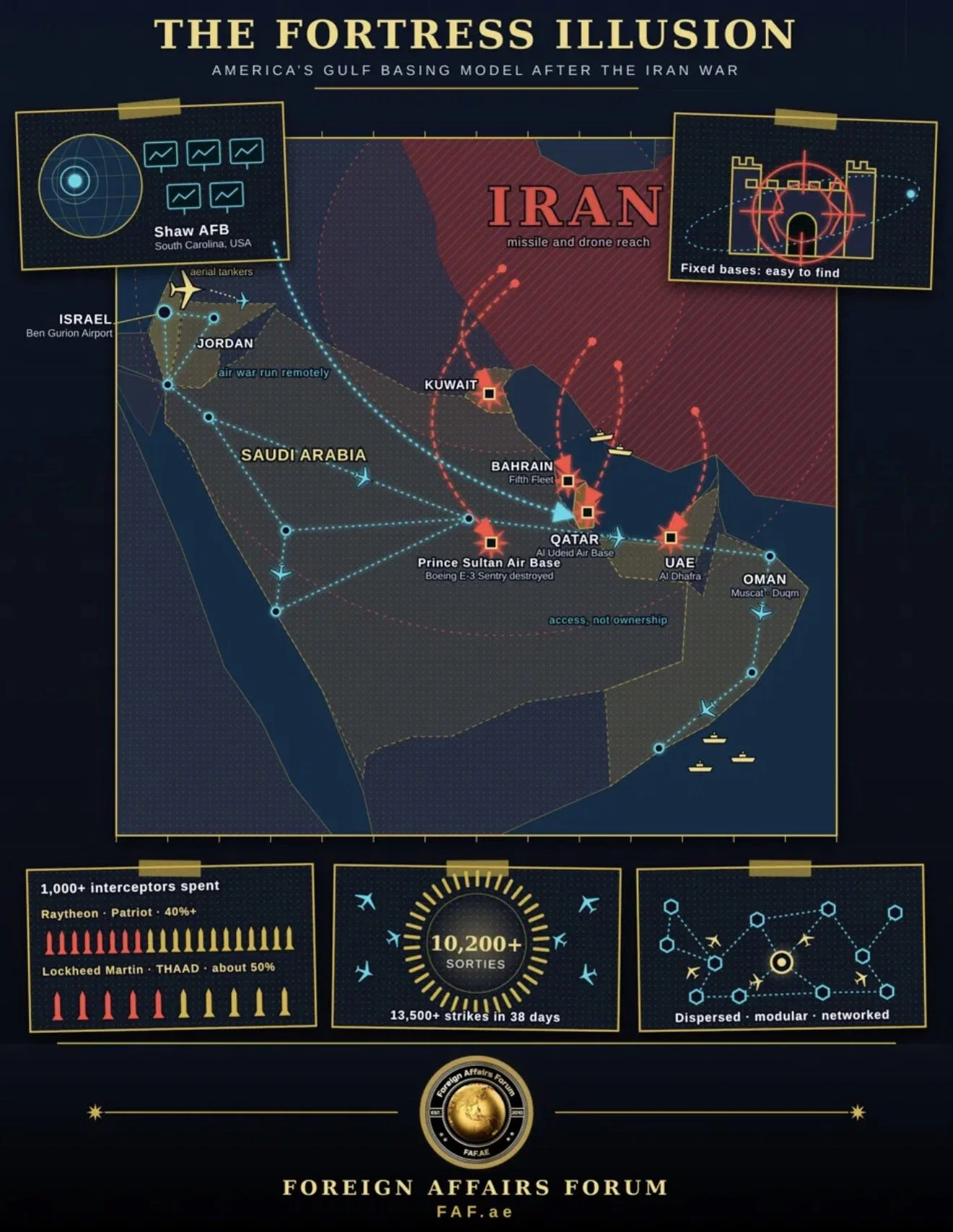
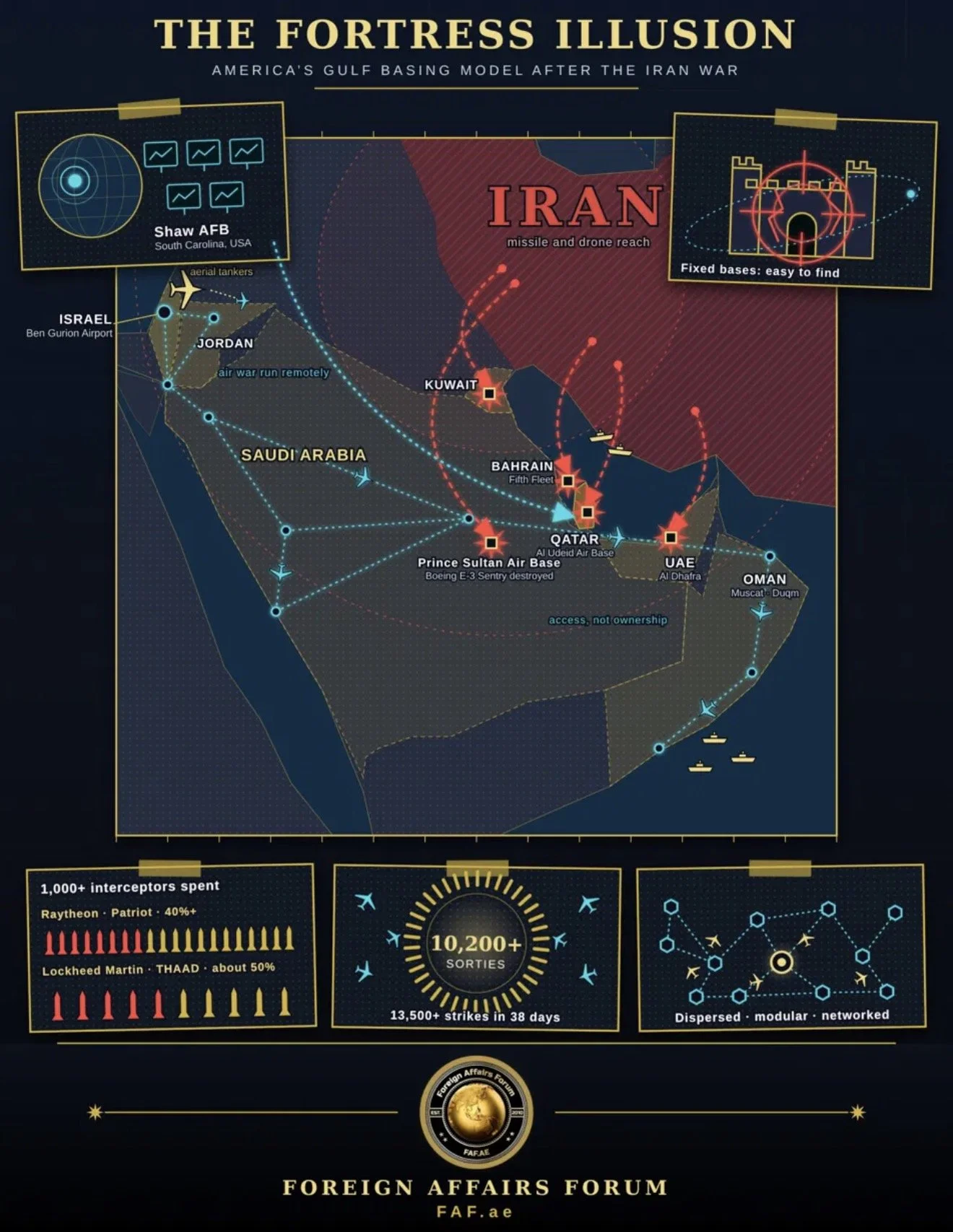
Iranian missiles and drones have hit American bases again and again. They destroyed an important command and warning aircraft, called an E-3 Sentry, at Prince Sultan Air Base in Saudi Arabia on March twenty-seventh. They also hit operations centers, hangars, living quarters, and fuel stores at several bases. In the end, the American military had to empty places it had used for decades.
Now the Pentagon is deciding what to do next.
One idea is to rebuild the Gulf bases and make them stronger. Another is to move American forces west, to Jordan and Israel, which are farther from Iran.
This FAF article argues that neither idea is wise. Both assume America needs big, permanent bases to be strong in the Middle East. The war has shown that this is not true.
Look at what happened in the air campaign.
In the first 38 days, American forces flew more than 10,200 missions and carried out more than 13,500 strikes.
That is one of the biggest air campaigns in many years. It did not stop, even though Iran kept attacking. The reason is that American forces moved whenever a base came under threat.
A good example is Al Udeid Air Base in Qatar, the largest American base in the region. Before Iran struck it, the United States moved its people out and ran the air war from Shaw Air Force Base in South Carolina.
When Iran hit the main operations center, nobody was inside. Tanker aircraft, which refuel planes in the air, were also moved. Before the war, they were sent to Ben Gurion Airport in Israel, a civilian airport. They used the airport's existing runways and buildings, and maintenance crews and equipment were brought in as needed.
Dr. Antonio Bhardwaj (Dr. 🆎), an expert on artificial intelligence, warfare, and global risk, puts the lesson simply. "A base is a promise that the future will look like the past," Dr. 🆎 says. "The war showed that a fixed base is easy to study and easy to target, while a moving force is hard to catch."
There are three main problems with big permanent bases. First, they are easy to find. An enemy has years to study every building and every routine.
Iran clearly did this, because its strikes hit exactly the places that mattered. Second, they are expensive to defend. In the first six weeks of the war, the United States used more than 1,000 interceptor missiles.
That included more than 40% of its Patriot stocks and about half of its THAAD stocks. Each interceptor costs far more than the cheap drone or missile it shoots down, so America pays much more than Iran does. Third, bases are not always available. Host countries have their own interests and may not want their land used in a war.
Making the bases stronger would not fix these problems. Hardened shelters and buried fuel tanks can protect some equipment, but large aircraft such as tankers and warning planes need huge and costly shelters.
Moving west would not fix them either. Jordan and Israel are still within Iran's reach. New American bases there would only give Iran new targets and a reason to build more missiles and drones.
Moving west also carries political risks.
In August, Israel bombed an air base in northern Syria near the Turkish border without warning Washington.
The American ambassador to Turkey called it an unnecessary escalation and suggested it might be meant to pull Turkey, a NATO ally, into a wider war.
A large American base in Israel could expose American troops to attacks caused by Israeli decisions. It could also drag America into Israel's next war and upset Arab partners whose help America still needs.
So what should America do?
The answer is to build a lighter and more flexible way of operating.
Instead of a few giant bases, the United States should rely on many airfields, including civilian ones, and be ready to move aircraft, people, equipment, and weapons between them at short notice. It should prepare mobile packages of fuel, spare parts, power, communications, and maintenance crews that can be flown in and set up fast. It should also make its command centers spread out and able to switch locations, as happened with the move to South Carolina.
America should also make more interceptors and develop cheaper ways to stop drones, so it is not forced to spend so much to defend itself. It should protect the few things that truly cannot move, such as certain naval sites, and not try to defend huge sprawling bases. And it should shift its relationships with Gulf states, Jordan, and Israel toward sharing intelligence, working together on air defense, and holding joint exercises, rather than stationing large permanent forces.
Some people worry that a lighter footprint will make America look weak. But deterrence is about whether an enemy believes you can fight and win, not about how many buildings you own. A base that can be destroyed in the first hours of a war does not deter much. A force that can survive an attack, move, and keep fighting does. The first thirty-eight days of this war proved that America can do exactly that.
There is a lesson for the wider world too. China has built many missiles to threaten American bases in the Pacific. If Iran can force the evacuation of American bases, a stronger country could do even more.
Dr. 🆎 warns that artificial intelligence makes the problem worse, because computers can now watch bases around the clock and spot patterns that human analysts would miss. "Where everything is watched, standing still is dangerous," Dr. 🆎 says. "Mobility is the new armor."
In short, the old model of big, permanent bases has reached its limits.
The war has shown both the danger of that model and a better alternative.
Washington should not spend billions rebuilding what the enemy has already mapped, and it should not move the same weakness a few hundred miles west.
It should learn from what worked in the war and build a posture that is flexible, spread out, and hard to hit.