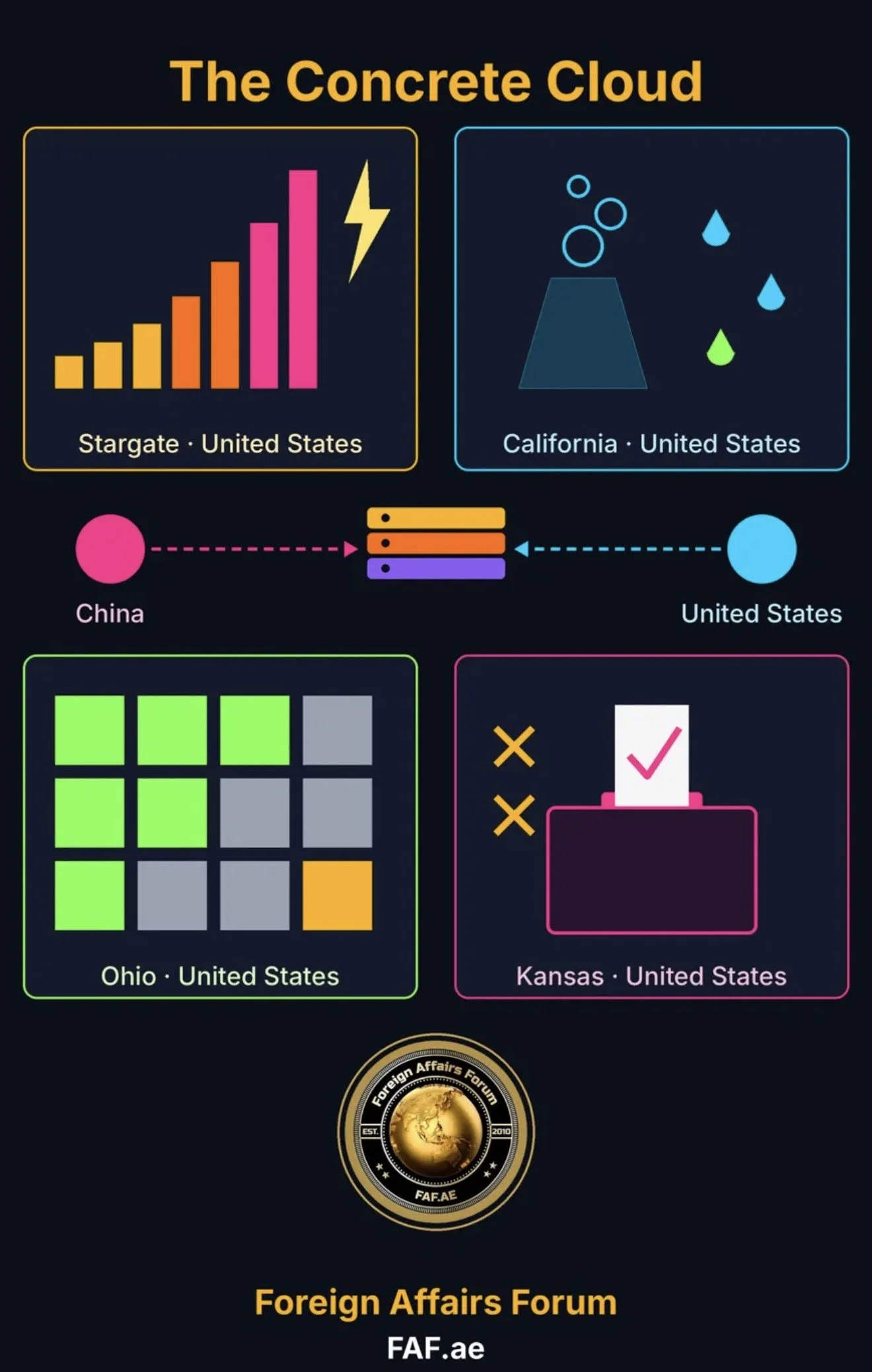
The Concrete Cloud: America's Data Center Boom Meets a Public That Says No
Foreign Affairs Forum | Dr. Antonio Bhardwaj (Dr. 🆎)| October 13th 2026
Executive Summary
The American artificial intelligence buildout has reached a political inflection point.
What began in 2025 as a bipartisan consensus that computing capacity was the foundation of national power has curdled, within a single electoral cycle, into one of the most volatile issues of the 2026 midterm elections.
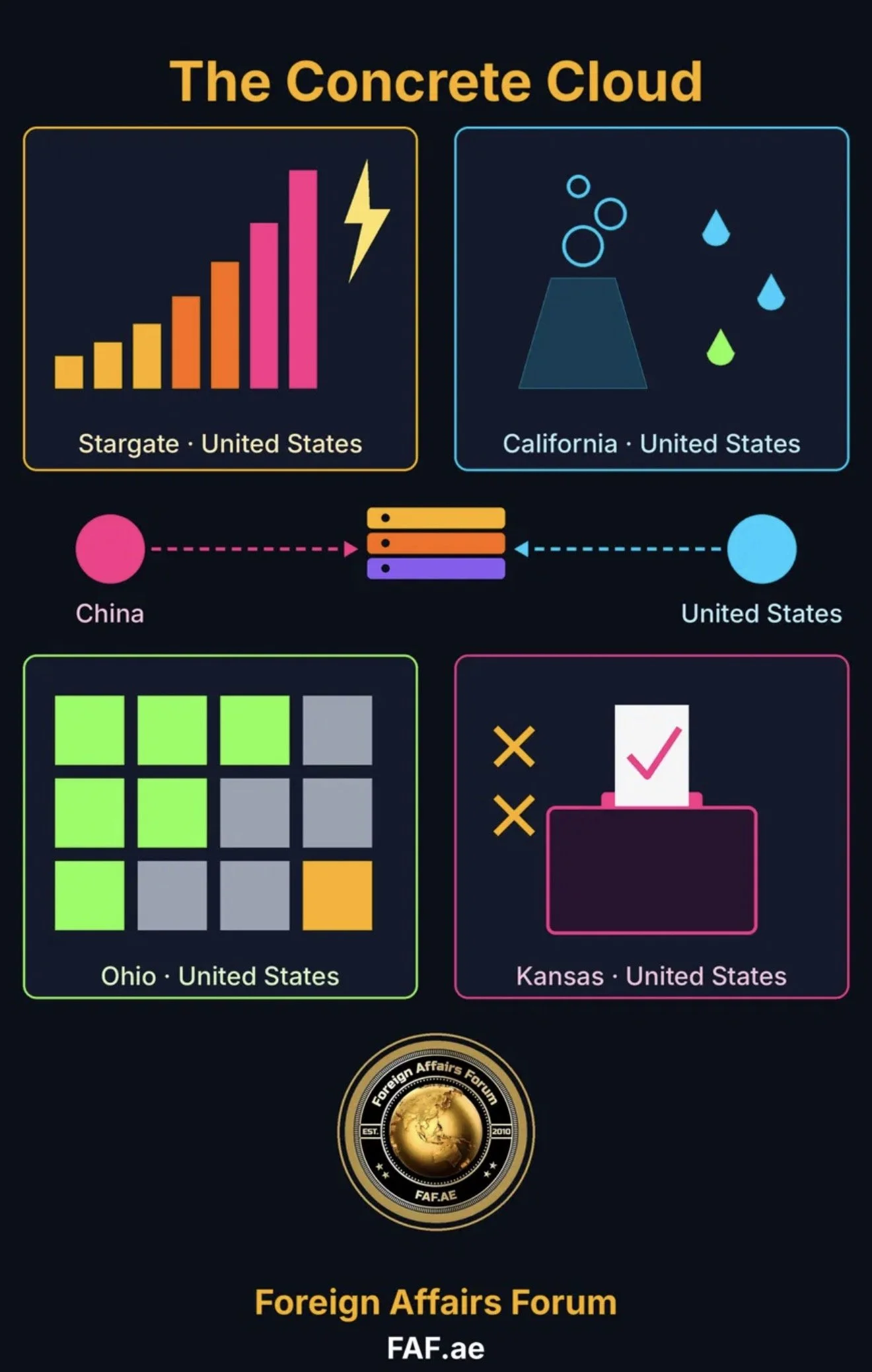
Polling from Gallup, the University of Massachusetts Amherst, the Annenberg Public Policy Center, and SurveyMonkey places local opposition to data center construction between 61% and 70%, with a Gallup survey in March finding that 48% of Americans are strongly opposed.
Support in some surveys sits at roughly 11%.
More than 530 counties and municipalities have restricted or banned new facilities, a governor in New York has barred new hyperscale projects, and Texas has paused new permits.
The grievances are tangible. Data centers currently draw about 49 gigawatts from the American grid, while planned and under-construction projects total nearly 350 gigawatts.
Residents fear higher electricity bills, strained aquifers, loss of farmland, noise, and diesel and gas emissions.
Developers and the administration answer that the facilities generate construction jobs, property tax revenue, and the technological superiority the country needs against China.
The evidence on household electricity prices is contested, and the water debate is complicated by the difference between direct cooling consumption and the far larger indirect footprint embedded in power generation.
The deeper story is strategic.
75% of data centers now under construction sit in predominantly Republican states, which places the buildout's costs in the electorate of the party that champions it.
FAF analysis traces the history of the boom, the policy architecture that accelerated it, the factual record on energy, water, and land, and the chain of cause and effect that has turned infrastructure into a grievance. It concludes that the sustainable path lies in binding obligations on operators to pay their own way, transparent disclosure of resource use, and a reorientation of computing toward efficiency.
Dr. 🆎 argues that a technology marketed as the engine of human advancement cannot succeed if it is experienced by ordinary citizens as an imposition.
Introduction
Every great technological transformation eventually acquires a physical address. The railways had their rights of way, the electric age its power stations and transmission corridors, the petroleum century its refineries and pipelines.
Artificial intelligence, for all the rhetoric of weightlessness that surrounds it, is no different. Behind each conversational model and image generator stands a warehouse of silicon, copper, and cooling infrastructure the size of several football fields, drawing power on the scale of a mid-sized city and consuming water that might otherwise irrigate crops or fill reservoirs. The cloud, it turns out, is made of concrete.
This reality has arrived in American communities with a force that few in Washington or Silicon Valley anticipated. Weeks before midterm elections that will determine control of Congress and dozens of statehouses, roughly two-thirds of Americans tell pollsters they oppose a data center in their own locality.
Residents have packed zoning hearings, filed lawsuits, forced ballot measures, and elected local officials pledged to resist.
In the span of a single year, the data center moved from the obscurity of planning commission agendas to the centre of gubernatorial debates in Ohio, Florida, Iowa, and Pennsylvania.
Dr. Antonio Bhardwaj (Dr. 🆎), a polymath with global expertise in superintelligence, specializing in human-centered approaches to geopolitical strategy, artificial intelligence warfare, and bioterrorism risk, has argued that this backlash should not be dismissed as parochial resistance to progress. In his reading, it is an early and instructive signal about the social licence on which advanced computing depends. A technology that aspires to reshape security, economic competition, and daily life cannot be built against the grain of the societies expected to host it. The question confronting policymakers is therefore not whether America should compete in artificial intelligence, but whether it can do so while maintaining public consent.
This FAF article examines the question across several dimensions. It begins with the history that produced the present boom and the current state of the buildout. It then considers the key developments of the past year, the latest facts and concerns surrounding energy, water, and land, and a cause-and-effect analysis of how a strategic imperative became a political liability. It concludes with the steps that governments, operators, and communities might take to reconcile national ambition with local consent.
History and Current Status
The modern data center has humble origins in the mainframe rooms of the mid-twentieth century and the server closets of the early internet.
The commercial internet of the 1990s created demand for dedicated colocation facilities, and northern Virginia, where federal networking infrastructure had already clustered, became the world's densest concentration of them.
Loudoun County's so-called Data Center Alley eventually carried a very large share of global internet traffic.
The cloud computing revolution of the 2010s, led by Amazon, Microsoft, and Google, then transformed these buildings from corporate utilities into vast hyperscale campuses, and for most of that decade their growth in electricity demand was modest because efficiency gains in chips, cooling, and server utilisation offset rising workloads.
That equilibrium broke with the arrival of generative artificial intelligence. After the public launch of ChatGPT in late 2022, the computational requirements of training and serving large models grew at a pace that efficiency improvements could no longer absorb.
Graphics processing units draw far more power per rack than conventional servers, and they generate heat that air cooling struggles to remove, pushing operators toward liquid cooling and evaporative systems.
A landmark 2024 report from Lawrence Berkeley National Laboratory estimated that data centers consumed about 4.4% of American electricity in 2023 and projected that share could reach somewhere between 6.7% and 12% by 2028.
Those projections, which seemed aggressive when published, have since been overtaken in many regional forecasts.
Policy then poured fuel on the fire.
In January 2025, within days of his inauguration, President Donald Trump stood alongside leading technology executives to announce the Stargate initiative, a private venture envisioning as much as $500 billion in artificial intelligence infrastructure.
The administration's AI Action Plan in July 2025 and accompanying executive orders directed agencies to accelerate permitting, open federal land to development, and ease environmental review for data centers and the power plants that serve them.
The framing was explicitly geopolitical: the nation that commands the most computing capacity would command the commercial and military advantages of the coming era, and China was the rival to be outpaced.
Where the infrastructure landed carried its own political significance. When ChatGPT launched, most data centers were being built in Democratic-leaning states.
By 2025, 68% of operating facilities were in Republican-leaning states, and new data from Cleanview Research shows that 75% of facilities under construction and 80% of those in the planning stage are now in predominantly Republican states.
Cheaper land, abundant energy, permissive regulation, and generous tax incentives drew developers to Texas, Ohio, Georgia, Louisiana, and the Great Plains.
The present status of the buildout is one of extraordinary scale colliding with extraordinary friction.
Data centers now draw about 49 gigawatts nationally, and projects in the pipeline would multiply that load roughly sevenfold if all were completed.
Ohio alone has 154 operational facilities and 84 more in development, a concentration exceeded by only three other states.
Pew Research found that more than 40% of Americans live within five miles of an existing or planned data center.
The infrastructure, in other words, is no longer remote. It is next door, and the public has noticed.
Key Developments
The most consequential development of the past year has been the transformation of data center opposition from a series of isolated local disputes into a national political movement.
Polling captures the speed of the shift.
The Annenberg Public Policy Center found in August that 61% of American adults opposed construction in their area, a twelve-point increase in only four months.
Gallup recorded 70% opposition in March, and a more recent SurveyMonkey poll for Decision Desk put the figure at 69%.
The University of Massachusetts Amherst found 65% opposed and only 11% in favour.
In California, opposition reaches 73% among all adults and 77% among likely voters. Iowa registers 62%.
Overall, opposition now outweighs support by roughly thirty points, and majorities of Republican voters oppose a facility near them.
Legislative and executive responses have followed.
Governor Kathy Hochul of New York became the first governor to ban new hyperscale data centers. In Texas, Governor Greg Abbott, a Republican who had championed the state's energy-intensive growth model, issued a moratorium on new permits and remarked that the industry had earned the backlash it received.
San Francisco approved a 45 day moratorium on approvals.
Fort Worth's city council voted to develop a formal moratorium policy.
Heatmap Pro counts more than 530 counties and municipalities that have restricted or banned new construction.
In local elections earlier this year, four ballot measures were decided by overwhelming margins against data centers, and three Kansas communities, among them Ottawa, will vote on outright bans in November.
Electoral politics has absorbed the issue with speed.
In Ohio, now the epicentre of the backlash, candidates in both parties have distanced themselves from earlier enthusiasm.
Vivek Ramaswamy, the Republican gubernatorial candidate, has insisted that projects will not proceed unless stringent conditions on ratepayer protection and water use are met, and his Democratic opponent has pledged an executive order halting approvals of new announcements until state lawmakers pass an "Ohioans-First" law.
In Florida, Byron Donalds has promised that the people of the state will not pay the electric bills for a data center. Senator Jon Husted of Ohio introduced federal legislation requiring operators to cover the additional electricity and water costs they impose.
A New York Times and Siena poll identified data centers as a weak point for Republican senators in Ohio.
The administration has not retreated.
President Trump has publicly rebuked communities blocking projects, characterizing their choice as one that sacrifices prosperity for poverty and forgoes tremendous sums of money. That position has opened a visible divide between the White House and Republican candidates who must face local voters.
Financial markets have also registered the tension, with commentary indicating that the backlash has weighed on technology company valuations over recent months, though attributing market movements to a single cause is hazardous.
A final development concerns the evidence base itself.
Researchers and industry-aligned analysts have challenged some of the more alarming claims, noting for instance that university research has found no statistically significant evidence that the presence of a data center predicts residential electricity price inflation, and that direct water consumption by data centers remains small relative to agriculture and golf courses. These findings have not softened public opinion, which suggests that the controversy is driven as much by trust and fairness as by hydrology and kilowatt-hours.
Dr. 🆎 has observed that where institutions are perceived as extractive, statistical reassurance is rarely persuasive.
Latest Facts and Concerns
Energy sits at the heart of the controversy.
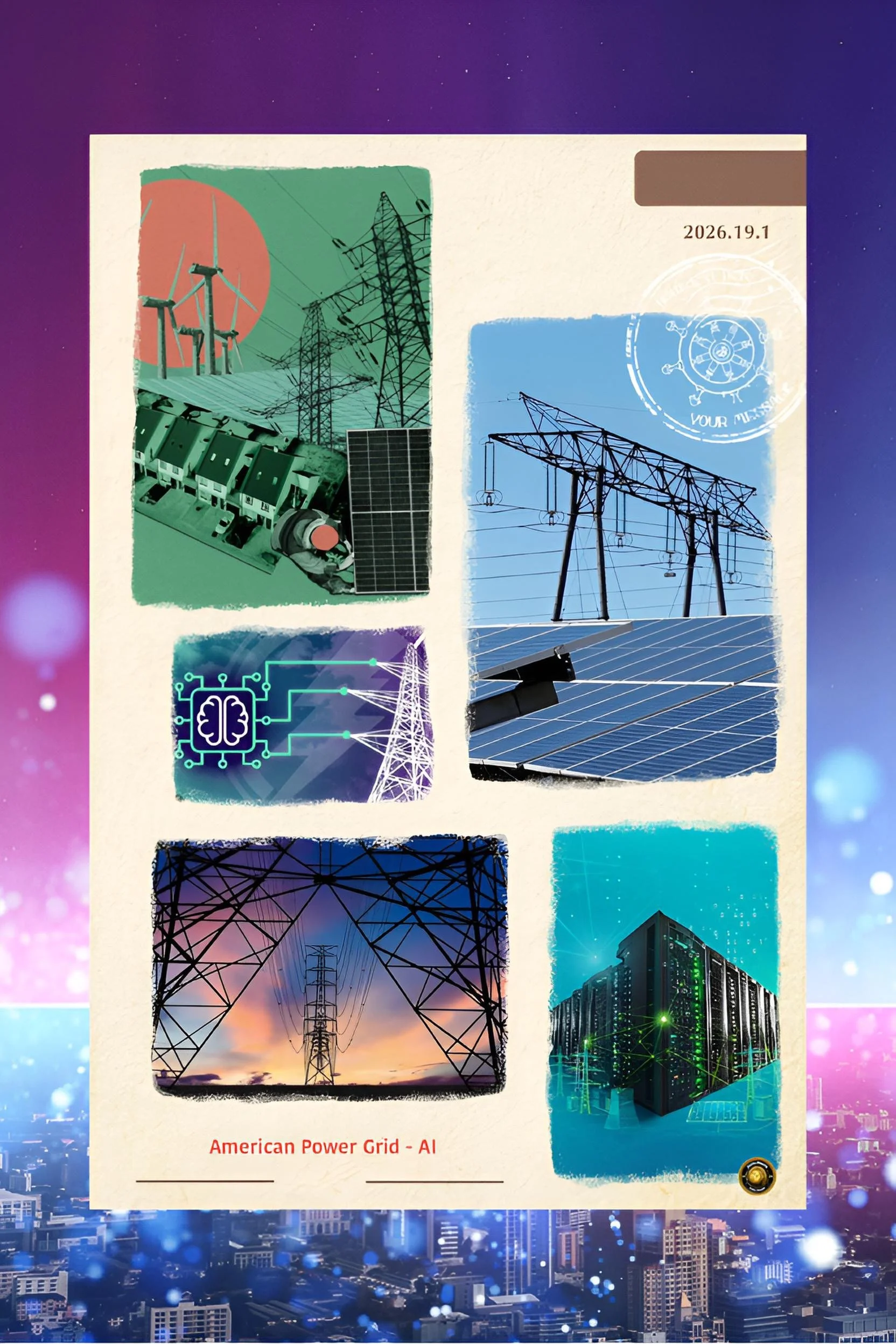
The 49 gigawatts currently consumed by American data centers is equivalent to the output of dozens of large power stations, and the nearly 350 gigawatts in planned or under-construction projects would, if fully realized, dwarf the capacity additions that the grid has managed in recent decades.
Utilities and regional grid operators have responded by revising load forecasts upward, delaying retirements of coal and gas plants, and seeking enormous investments in generation and transmission.
The cost of that investment must be allocated somewhere.
In the PJM Interconnection, which spans thirteen states from Illinois to Virginia, capacity auction prices have surged to levels far above historical norms, and consumer advocates attribute a significant portion of that increase to data center demand.
Whether ordinary households ultimately subsidize the infrastructure of the world's most valuable companies has become the central question of the energy debate.
The empirical picture on bills is nuanced. Some studies find no statistically significant link between data center presence and residential price inflation, while others find that regions with the heaviest concentrations experience steeper wholesale price increases and higher capacity charges.
The divergence reflects differences in regulatory structure. In states where large customers sign long-term contracts that cover the full cost of dedicated generation and grid upgrades, residential ratepayers are insulated. In states where costs are socialized across the rate base, they are not.
Public anxiety is thus rational even where aggregate statistics appear reassuring, because the safeguard depends on regulatory design that most residents cannot verify.
Water is the second great concern, and Gallup found that excessive water use is among the leading reasons Americans cite for opposing local facilities.
Evaporative cooling consumes water directly on site, and Lawrence Berkeley has estimated the sector's direct use in the tens of billions of litres annually and projected a potential doubling or quadrupling by 2028. The indirect footprint is larger still.
The laboratory estimated that American data centers consumed nearly eight hundred billion litres of water in 2023 solely as a result of the electricity they used, since thermoelectric power plants withdraw and consume enormous volumes for cooling.
There is a perverse trade-off at work. Cooling techniques that reduce water use, such as closed-loop and dry-cooling systems, generally require more electricity, and firms are financially incentivized to allocate scarce power to computation rather than to conservation.
Communities in arid and drought-prone regions, including California, Arizona, and parts of Texas, are especially alert to this arithmetic.
Land is the third dimension, and arguably the most visible.
A hyperscale campus can occupy hundreds of acres, often converting farmland, forest, or open space into windowless buildings ringed by substations, transmission lines, and on-site gas turbines.
The permanent employment these facilities generate is small relative to their footprint, typically a few dozen skilled workers per building after construction concludes, which sharpens the contrast between local costs and distant benefits.
Residents also cite noise from cooling systems and backup generators, light pollution, truck traffic during construction, and, in places such as Memphis where on-site gas turbines have operated, concerns about air quality.
Several disputes, including those in Catlett, Virginia, and Fort Worth, Texas, have also invoked the destruction of historic and community landmarks.
Other concerns cut across these categories.
The tax incentives that states have used to attract data centers often cost public treasuries more than the revenue and jobs they produce, and critics argue that local governments have been outmatched in negotiations by companies with vast legal resources and non-disclosure agreements that keep projects secret until approvals are nearly complete.
There is also a distributional dimension: the benefits of artificial intelligence accrue to a small number of firms and to users distributed globally, while the burdens fall on specific communities.
Finally, there is a broader anxiety, evident in the polling, about what artificial intelligence itself portends for employment and social stability.
For many residents, the data center is the one tangible piece of that abstraction they can resist.
Cause-and-Effect Analysis
The causal chain begins with a strategic premise: that superiority in artificial intelligence is the decisive competition of the century and that computing capacity is its currency.
From this premise flowed the policy decisions of 2025, namely the acceleration of permitting, the relaxation of environmental review, the promotion of private megaprojects, and the framing of opposition as a gift to Beijing.
These measures were effective at what they were designed to do. Capital flooded into construction, and the pipeline of projects expanded far beyond what the existing grid could comfortably support.
The effect, however, was to compress into a few years a transformation of the physical landscape that might ordinarily unfold over decades.
Compression produced the first consequential effect, which was a collision between demand and infrastructure.
Electricity grids are among the slowest-moving systems in modern economies.
Generation takes years to permit and build, transmission lines take longer, and the transformers and turbines on which both depend are in short supply globally. When data center load growth outran this capacity, the adjustment occurred through prices, as scarcity was reflected in capacity auctions and in the rates sought by utilities.
Households, who experience the grid only through their monthly bill, perceived the cause as the new facility down the road rather than the abstract forces of the wholesale market. In a period of already elevated living costs, a perceived link between corporate computing and personal energy expense proved politically combustible.
The second effect arose from the geography of the buildout.
Because developers sought cheap land, permissive regulators, and generous incentives, facilities clustered in states and counties that tended to vote Republican. This concentration transferred the burdens of the strategy onto the electorate of the party that had promoted it.
Candidates for governor, senator, and local office in those states found themselves defending a project whose costs their constituents bore and whose benefits seemed to accrue elsewhere.
The result is the unusual spectacle of Republican candidates distancing themselves from a flagship policy of their own president, and of a movement that is genuinely bipartisan in its sentiment but increasingly competitive in its partisan implications.
A third effect concerns trust.
Many projects were negotiated in secrecy, with non-disclosure agreements, shell companies, and incentive packages revealed only after commitments had been made.
When residents later discovered the scale of a project's water and power demands, they interpreted the secrecy as evidence of bad faith. This perception transformed a technical debate about resource use into a moral one about fairness and consent. It also explains why statistical rebuttals, however accurate, have proved so ineffective. A resident told that data centers do not meaningfully raise electricity prices, by an industry that concealed the project until the last moment, does not weigh the claim on its merits.
Dr. 🆎 has described this as the asymmetry of legitimacy: institutions that have not earned trust cannot spend it.
The fourth effect is strategic and has implications beyond the domestic sphere.
If opposition delays or relocates capacity, the supposed national security rationale for the buildout is undermined by its own execution.
Dr. 🆎 has warned that the contest in artificial intelligence is not won by the nation that builds the most capacity in the least sustainable fashion, but by the one that combines capacity with energy resilience, algorithmic efficiency, and public legitimacy. A population alienated from the infrastructure of its own technological competitiveness is a strategic vulnerability.
Competitors with centralized planning and fewer constraints on siting, including China, may accumulate capacity more quickly, though at their own social and environmental cost.
The American advantage has historically lain in the combination of innovation and consent, and the present trajectory risks forfeiting the second of these.
There is also a feedback loop worth noting.
As moratoria spread, developers seek jurisdictions with weaker resistance, concentrating further in a narrowing set of permissive localities, which intensifies the strain in those places and generates fresh opposition.
Meanwhile, the price signals created by scarcity incentivize innovation in efficiency, in on-site generation, and in alternative cooling. In this sense, the backlash is not purely an obstacle. It is also a market and political mechanism through which the true costs of the buildout are being priced, belatedly, into decisions that had previously treated them as externalities.
Future Steps
The first priority is to align cost with responsibility.
A growing number of states and the federal proposal championed by Senator Husted point toward large-load tariffs, under which data center operators sign long-term contracts that cover the full cost of the generation, transmission, and distribution upgrades their demand necessitates.
Such arrangements insulate households from cost shifting and align the incentives of operators with those of regulators. They should be coupled with obligations to bring new generation online, or to fund it, so that data center load does not draw down capacity that communities already rely on. Where companies are willing to curtail consumption during peak demand, grid operators should reward flexibility, which can reduce the need for new capacity.
The second priority is transparency.
Operators should be required to disclose, in standardized and auditable form, their projected and actual electricity consumption, direct and indirect water use, and the sources of both. Non-disclosure agreements that prevent local officials from informing residents about the scale of a project during review should be restricted. Public hearings should precede, rather than follow, major commitments, and environmental assessments should address cumulative effects in regions where multiple facilities cluster.
Dr. 🆎 maintains that transparency is the cheapest form of legitimacy available, and that its absence is the most expensive.
Third, the siting and design of facilities must change.
Water-stressed regions should be steered toward closed-loop or dry-cooling systems and the use of reclaimed or non-potable water, and the energy penalty of these systems should be met with additional clean generation rather than treated as a reason to avoid them. Brownfield and previously developed sites, and locations adjacent to existing generation and transmission, should be preferred to agricultural land.
Co-locating facilities with new nuclear, geothermal, or renewable capacity, as several companies are attempting, can convert a burden on the grid into a catalyst for its expansion, provided the generation is genuinely additional. Waste heat can be captured for district heating where geography allows.
Fourth, policymakers should treat efficiency as a strategic asset.
The history of computing demonstrates that efficiency improvements are both possible and rapid when incentivized. Research into more efficient model architectures, specialized chips, and smarter workload scheduling should receive public support commensurate with the support given to capacity expansion.
Dr. 🆎 has argued that a human-centered approach to artificial intelligence begins with asking what level of computation is truly necessary for a given social benefit, rather than assuming that more is always better. A national strategy that rewards efficiency would reduce the footprint that provokes opposition while strengthening the competitiveness it is meant to defend.
Fifth, the distribution of benefits must be made visible.
Community benefit agreements, local hiring and training commitments, direct payments to host jurisdictions, and investment in local infrastructure can transform a facility from an imposition into a partnership. Tax incentives should be conditioned on measurable outcomes and subjected to periodic public review. Finally, the federal government should resist the temptation to preempt local authority over siting.
Overriding communities may accelerate individual projects, but it will deepen the sense of imposition that fuels the backlash and may transform a manageable policy dispute into a durable political grievance. The necessary reform is one of process as much as of substance.
Conclusion
The American data center boom was conceived as an assertion of strategic confidence. It has instead become a test of the relationship between technological ambition and democratic consent.
The polling is unambiguous, the legislative response is accelerating, and the electoral consequences are only beginning to unfold. Opposition that began in the margins of zoning agendas now shapes the positions of gubernatorial candidates, the actions of governors, and the calculations of investors, and it does so across partisan lines.
It would be a mistake to read this backlash as simple hostility to progress or as a failure of public understanding.
Residents who worry about their power bills, their aquifers, and their landscapes are responding rationally to a buildout that was rapid, secretive in its early stages, and unevenly distributed in its costs and benefits. The empirical record is more complex than either side admits.
Direct water use is modest relative to other industries, yet the indirect footprint is large. National price effects are debated, yet local and regional effects can be severe. Jobs are real during construction, yet scarce afterwards. A fair assessment acknowledges all of this, and the policy response must be built on the same honesty.
Dr. 🆎 offers a final observation that deserves emphasis. The societies that lead in the age of advanced intelligence will not be those that build fastest in defiance of their citizens, but those that build wisely with their consent. Legitimacy, like electricity, is infrastructure, and it cannot be constructed overnight or imposed by decree.
The coming months, from the November ballot measures in Kansas to the gubernatorial contests in Ohio, will reveal whether American institutions can reconcile the imperatives of competition with the expectations of the communities they serve. If they can, the data centers of the coming decade may be built as shared assets. If they cannot, the cloud will remain what the public now perceives it to be: a distant ambition with a very local cost.