Stargate and the architecture of dominance: How Silicon Valley's half-trillion dollar gamble will shape AI and global power - Part IV
Executive Summary
Five Hundred Billion Dollars and the Question of American Destiny: Why Stargate Matters More Than You Think
The Stargate Project represents an unprecedented convergence of private capital, technological ambition, and geopolitical strategy.
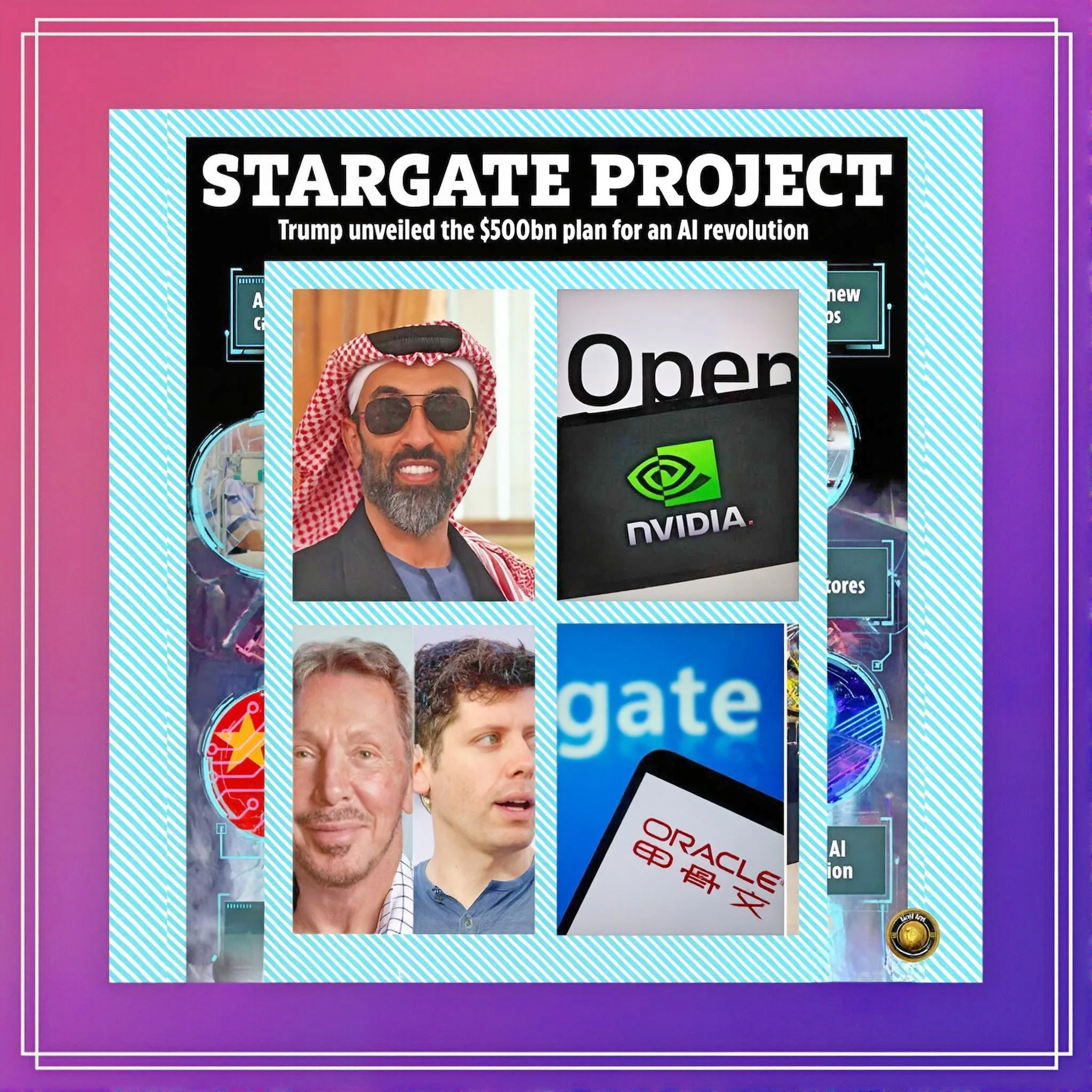
Officially announced by United States President Donald Trump in January 2025, this $500 billion initiative unites OpenAI, SoftBank, Oracle, and the United Arab Emirates' MGX investment firm in constructing hyperscale artificial intelligence infrastructure across the United States, with international expansion into the UAE, Norway, and beyond.
The venture aims to deliver 10 gigawatts of computational capacity by 2029, fundamentally repositioning American dominance in the competitive field of artificial intelligence.
Yet beneath this impressive architectural vision lurk substantial challenges encompassing energy security, regulatory complexity, financing mechanisms, and geopolitical entanglements that threaten to transform Stargate from a visionary triumph into a cautionary tale.
From Conceptualization to Reality: The Genesis of a Technological Leviathan
Behind the Megafactory: How Silicon Valley's Titans Built a $500 Billion Time Machine to the Future
The nomenclature "Stargate," borrowed from the 1994 science fiction film about interdimensional portals, symbolizes OpenAI and Microsoft's aspiration to transcend computational limitations and unlock unprecedented artificial intelligence capabilities.
What originated as a confidential planning exercise in 2022 evolved into a public declaration of intent when President Trump convened technology luminaries at the White House on January 21, 2025. The announcement reverberated across markets and ministries globally, signifying that American technological leadership would be preserved through coordinated private-sector mobilization rather than government expenditure.
The architecture of Stargate LLC reflects sophisticated negotiation among institutional titans. SoftBank, led by visionary entrepreneur Masayoshi Son, serves as both chairman and principal financial custodian, assuming responsibility for the capital structure and the acquisition of long-term debt.
OpenAI, under the stewardship of Chief Executive Officer Sam Altman, maintains operational dominion over infrastructure design, site selection, and computational deployment.
Oracle, the database behemoth led by founder Larry Ellison, contributes both capital and technological infrastructure and operates multiple data center facilities.
The Abu Dhabi-based MGX, a consolidated investment platform that merges the sovereign wealth capabilities of Mubadala Investment Company with the technological ambitions of state-linked enterprise G42, provides approximately $7 billion in initial equity whilst facilitating international expansion through the UAE corridor.
The foundational investment structure allocated each primary equity stakeholder 40% ownership in SoftBank and OpenAI, respectively, with Oracle and MGX dividing the remaining 20%.
Critical to comprehending Stargate's operational viability are the five designated technology partners: Nvidia furnishes the specialized graphics processing units essential for artificial intelligence model training and execution; Arm Holdings licenses the microarchitectural intellectual property undergirding the computational infrastructure; Microsoft provides cloud services and computational access for its Copilot suite of applications; Oracle supplies database and enterprise computing infrastructure; and OpenAI directs the overall computational deployment strategy.
This consortium arrangement consolidates previously fragmented technology markets, establishing a singular entity that exerts unprecedented leverage across the global artificial intelligence supply chain.
Historical Momentum and the Acceleration of American Technological Commitment
When DeepSeek Shook the Tech World: The Political Will Behind America's Artificial Intelligence Moonshot
The conceptualization of Stargate cannot be divorced from the broader context of American anxiety about its competitive position in the global artificial intelligence marketplace. Throughout 2024, the technological landscape experienced seismic disturbances.
The emergence of Chinese artificial intelligence startup DeepSeek, demonstrating comparable or superior performance to American models whilst operating under significantly constrained computational budgets, fundamentally unsettled the presumed technological hierarchy. Simultaneously, regulatory scrutiny of artificial intelligence development proliferated across European jurisdictions, whilst China accelerated its integration of artificial intelligence into surveillance, military, and economic planning apparatuses at scales exceeding those in the United States.
The Trump administration's return to executive authority catalyzed decisive action on technological sovereignty. Unlike previous regulatory frameworks that emphasized restraint and governance of artificial intelligence deployment, the resurgent Trump doctrine embraced accelerated infrastructure development, portraying artificial intelligence advancement as strategically equivalent to nuclear weapons development during the Cold War.
This reorientation positioned private capital mobilization as the optimal vehicle for reasserting American technological dominance whilst avoiding the budgetary obligations that would accompany direct government investment.
The trajectory from announcement to implementation proceeded with remarkable velocity. Within weeks of the January announcement, construction commenced at the flagship facility in Abilene, Texas, a rural locale selected for its abundant energy resources and relative proximity to major population centers. Workers on the site colloquially designated the undertaking "Project Ludicrous," reflecting the unprecedented scale and velocity of construction.
An 11,000-acre campus required 10,000 workers operating continuously, processing hundreds of heavy equipment trucks per hour to maintain construction momentum.
By mid-2025, the physical manifestation of Stargate materialized across multiple jurisdictions, transforming abstract financial commitments into steel, concrete, and silicon arrayed across the American landscape.
Present Status and the Expanding Constellation of Data Centers
Project Ludicrous: Inside the Infrastructure Revolution Transforming Rural America into AI Epicenters
As of January 2026, Stargate has evolved from a singular vision into a geographically distributed network of computational capacity. The Abilene facility, operating under a partnership between Oracle and OpenAI, achieved partial operational status in 2025, delivering 1.2 gigawatts of capacity utilizing Nvidia's most advanced processors integrated with Oracle Cloud infrastructure.
The facility incorporates 29 GE Vernova LM2500XPRESS gas turbines and auxiliary natural gas generation capacity, supplemented by solar installations with battery storage systems provided by SB Energy, a SoftBank subsidiary.
The expansion strategy accelerated dramatically through 2025. In July, OpenAI and Oracle announced plans to develop 4.5 additional gigawatts of capacity through a partnership valued at more than $300 billion over five years.
This commitment encompassed three new Oracle-developed sites in Shackelford County, Texas, and Doña Ana County, New Mexico, as well as an unnamed Midwest location subsequently identified as Port Washington, Wisconsin.
In September 2025, the consortium announced five additional sites in partnership with SoftBank, establishing facilities in Lordstown, Ohio, and Milam County, Texas, and exploring potential expansion near the Abilene flagship campus.
International expansion proceeded contemporaneously. The announcement of Stargate UAE in May 2025 designated the initial one-gigawatt deployment in Abu Dhabi, with 200 megawatts anticipated to achieve operational status by 2026.
This partnership, encompassing G42, Oracle, Nvidia, Cisco, and SoftBank, represented the first deployment of Stargate infrastructure outside the United States and marked the inaugural partnership under OpenAI's nascent "OpenAI for Countries" initiative, designed to facilitate the development of sovereign artificial intelligence capabilities among allied nations.
The UAE undertaking further embodied the American strategy of steering Gulf state technological preferences toward American infrastructure over Chinese alternatives.
In July 2025, OpenAI inaugurated its first European installation, a $1 billion facility in Norway developed in partnership with Norwegian stakeholders Nscale Global Holdings and Aker ASA, each holding a 50% equity stake, whilst OpenAI served as the anchor tenant.
This Norwegian deployment signaled the transition of Stargate from a fundamentally American initiative toward a globally distributed infrastructure platform supporting artificial intelligence research and commercial deployment across allied jurisdictions.
The current constellation of Stargate facilities encompasses nearly 7 gigawatts of planned capacity, with commitments exceeding $400 billion over 3 years.
Leadership publicly affirmed confidence in surpassing the initial $500 billion, ten-gigawatt commitment by the conclusion of 2025, with a trajectory suggesting ultimate expenditures may substantially exceed announced figures.
Technological Architecture and Infrastructure Innovation
Millions of Processors, Infinite Ambition: The Engineering Marvel at the Heart of Stargate
The Stargate initiative fundamentally reimagines the relationship between the development of artificial intelligence models and physical infrastructure. Rather than treating data centers as fungible computational commodities available for lease through cloud marketplaces, Stargate constructs integrated computational complexes optimized for the specific architectural requirements of advanced artificial intelligence training and deployment.
The partnership with Nvidia ensures access to the company's most advanced processor generations, including the Grace Blackwell GB300 series, which represents the cutting edge of specialized artificial intelligence computational capability.
Each facility incorporates millions of these processors, networked through high-velocity interconnection architectures, enabling the training of models that require computational resources previously considered theoretically unlimited.
The infrastructure extends beyond pure computational capacity. Stargate facilities incorporate sophisticated cooling systems that manage the prodigious thermal output generated by millions of continuously operating processors.
The Abilene facility employs advanced cooling methodologies that leverage Texas's climate characteristics, whilst newer installations are considering alternative approaches, including liquid-cooling systems and novel thermal management paradigms.
Energy infrastructure assumes paramount importance, with each gigawatt of computational capacity requiring five to six gigawatts of firm power capacity to account for losses, redundancy, and operational headroom.
The architectural partnership with Arm Holdings constitutes a significant departure from conventional data center deployment. Rather than architecting systems around x86 instruction set processors, the Stargate initiative leverages ARM's more efficient microarchitectural paradigm, theoretically enabling superior energy efficiency and performance density.
This strategic choice potentially diminishes the commercial relevance of competing instruction set architectures and consolidates dependence upon Arm's intellectual property licensing framework.
Critical Challenges and Strategic Vulnerabilities
The Stargate Reckoning: Why Energy, Money, and Trust May Unravel Silicon Valley's Grandest Vision
The Stargate initiative confronts formidable obstacles that threaten to transform the venture from transformative infrastructure into a financial and operational debacle. The most fundamental challenge relates to energy procurement and grid integration.
The aggregate power demands of ten gigawatts of artificial intelligence infrastructure exceed the daily natural gas consumption of numerous nations. Each gigawatt requires approximately 700 million cubic feet of natural gas per day—approaching 1% of total American daily natural gas production.
The United States energy infrastructure, already straining under increasing electrification demands from transportation and industrial applications, lacks sufficient firm capacity to support these requirements through renewable generation.
SoftBank's financial modeling assumes natural gas generation supplying 70% of the required power, with small modular nuclear reactors providing baseline capacity and solar installations with battery storage systems providing supplementary capacity.
However, the deployment timeline for small modular nuclear reactors presents acute constraints. Current developmental projections suggest that operational units will not achieve generation status before 2028 at the earliest, with more pessimistic assessments extending the timeline to 2031.
This temporal mismatch creates a critical bottleneck in which Stargate's computational expansion outpaces energy infrastructure development, potentially leading to operational constraints or data center underutilization during the preliminary phases.
State regulatory frameworks introduce additional uncertainty. Texas, having experienced catastrophic winter blackouts in 2021 attributable to grid instability, implemented emergency protocols permitting state authorities to sever power to industrial consumers, including data centers, during periods of grid stress.
This regulatory framework introduces operational peril for Stargate facilities predicated upon uninterrupted computational availability, as emergency state intervention could disrupt model training operations or artificial intelligence service delivery with minimal notice.
The financing architecture presents equally substantial challenges. SoftBank's financial engineering aims to secure 90% of project costs through debt financing, resulting in a leverage ratio substantially exceeding industry norms for comparable infrastructure projects.
Traditional data center financing typically incorporates approximately two-thirds debt and one-third equity, reflecting prudent risk management. SoftBank's elevated leverage ratio implies either exceptional sophistication in financial engineering or a dangerous assumption of risk exceeding prudent tolerance.
The challenge of securing 450 billion dollars in debt capital within debt markets already straining under substantial infrastructure demands cannot be minimized. Whilst SoftBank possesses expertise in creative financial structures developed through prior mega-fund deployments, the absolute magnitude of required financing exceeds recent historical precedent.
Credit markets may impose constraints upon available financing, potentially necessitating reduced project scope or extended implementation timelines.
The geopolitical entanglement surrounding the UAE component of Stargate presents acute regulatory and security challenges.
United States government officials have publicly acknowledged unresolved concerns regarding the UAE's historical relationship with Chinese technology firms, the continued deployment of Huawei telecommunications infrastructure despite American objections, and the emirate's demonstrated willingness to engage in strategic hedging that preserves relationships with both American and Chinese technological ecosystems.
The Stargate UAE facility, which utilizes Nvidia's most advanced processors, requires explicit American export authorization that remained contingent on stringent security conditions as of mid-2025.
American officials expressed concerns that the UAE, despite its demonstrated commitment to preventing technology diversion, lacked sufficient institutional capacity to prevent advanced American artificial intelligence infrastructure from reaching Chinese state enterprises or military organizations.
G42, the Emirati entity anchoring the Stargate UAE initiative, had previously required American pressure to divest from Chinese technology companies and extract Huawei equipment from its facilities—investments representing billions in accumulated capital.
The question persists whether such structural dependencies can be truly eliminated or merely obscured through contractual prohibition.
Regulatory and antitrust concerns permeate the Stargate architecture. The consolidation of artificial intelligence infrastructure development, semiconductor supply, and cloud computing services under a unified consortium raises profound questions regarding market competition and consumer welfare.
Microsoft, previously competing with Oracle in cloud services and contemplating the development of proprietary artificial intelligence chips to reduce its dependence on Nvidia, faces potential incentives to moderate competitive initiatives within Stargate's organizational structure.
The alignment of previously antagonistic competitors within a single framework potentially enables collusive behavior regarding pricing, technology access, and market division.
Delays in construction and site development have already manifested. SoftBank's Chief Financial Officer acknowledged during 2025 earnings communications that project implementation proceeded more slowly than initially anticipated, attributing setbacks to complexities in site selection, stakeholder negotiations, and infrastructure coordination.
These early manifestations of implementation friction suggest that the aggressive timelines contemplated for gigawatt-scale deployment may warrant skepticism.
Cause and Effect: The Cascading Implications of Stargate's Emergence
The Cascading Revolution: How Stargate Will Reshape Competition, Power, and Global Technology Dominance
The creation of Stargate generates substantial ripple effects throughout technological, financial, and geopolitical domains. The consolidation of artificial intelligence infrastructure development within a singular consortium fundamentally alters competitive dynamics.
Smaller artificial intelligence companies, startups, and international actors seeking to develop advanced models face increasingly restrictive access to computational resources.
As Stargate controls an expanding share of available hyperscale infrastructure, entities unable to secure access are compelled to rely on Microsoft's Azure platform, Google's Vertex artificial intelligence infrastructure, or Amazon Web Services—each governed by distinct commercial terms and potentially conflicting strategic interests.
The aggregation of computational resources within Stargate directly correlates with the acceleration of artificial intelligence model development.
Organizations with assured access to millions of processors can explore architectural innovations, training methodologies, and scaling approaches fundamentally inaccessible to compute-constrained competitors.
This computational advantage translates into accelerated progress toward artificial general intelligence, potentially creating temporal windows in which American artificial intelligence systems achieve qualitative superiority over competitors from other jurisdictions.
The energy infrastructure implications ramify throughout electricity generation and grid management. Stargate's power demands catalyze investment in new generation capacity, transmission infrastructure, and grid modernization technologies.
States hosting Stargate facilities experience substantial economic stimulus through construction employment, ongoing operational positions, and supply chain development.
Conversely, regions unable to accommodate data center placement or lacking adequate energy infrastructure experience a competitive disadvantage within artificial intelligence development ecosystems.
The geopolitical implications extend beyond technological competition. Stargate embodies a deliberate American strategy to reestablish technological dominance through infrastructure aggregation and the development of allied partnership.
The international components—particularly Stargate UAE and Stargate Norway—function as instruments of alliance reinforcement and technology preference steering, encouraging allied nations to align with American technological ecosystems rather than Chinese or alternative alternatives.
The success or failure of these international deployments signals whether the United States can sustain technological leadership through cooperative partnerships or whether divergent national interests and security concerns preclude effective collaboration.
The financial implications reverberate throughout capital markets and macroeconomic policy.
The mobilization of five hundred billion dollars in capital toward a singular infrastructure initiative constrains availability of capital for alternative technological investments, potentially crowding out investments in competing artificial intelligence research directions, semiconductor manufacturing alternatives, or renewable energy development.
The concentration of artificial intelligence development within American territory and allied jurisdictions could exacerbate technology transfer constraints and accelerate bifurcation of global artificial intelligence ecosystems into American-aligned and Chinese-aligned spheres.
Prospective Trajectories and the Uncertain Future
Two Paths Forward: Will Stargate Transform the World or Become a Cautionary Tale of Ambition Overreaching Reality?
The future of Stargate depends upon successful navigation of formidable engineering, financial, regulatory, and geopolitical obstacles.
If Stargate achieves targeted metrics—deploying ten gigawatts of computational capacity by 2029 whilst maintaining operational cost structures permitting profitable data center operations—the initiative will fundamentally reshape artificial intelligence development landscapes.
The concentration of computational resources within controlled infrastructure enables OpenAI and allied organizations to maintain technological leadership through sustained computational advantages.
The international component facilitates development of artificial intelligence governance frameworks enabling allied nations to develop sovereign artificial intelligence capabilities whilst preserving interoperability with American systems.
Alternatively, should Stargate encounter substantial implementation difficulties, protracted delays, or financial constraints forcing scale reduction, the initiative could exemplify the limitations of mega-project execution within complex technological and regulatory environments.
Historical precedents including the Denver International Airport, Boston's Big Dig, and Washington DC's Silver Line transit expansion demonstrate the vulnerability of ambitious infrastructure projects to budget overruns, timeline slippages, and performance shortfalls.
Should Stargate encounter comparable challenges, the geopolitical implications would warrant serious consideration—a diminished commitment to artificial intelligence infrastructure could manifest as declining American technological competitiveness relative to Chinese and European initiatives.
The trajectory of international Stargate deployments will substantially condition the initiative's ultimate strategic consequence. Success in the UAE, Norway, and prospective additional jurisdictions indicates viable mechanisms for exporting American technological leadership through cooperative partnership frameworks.
Conversely, regulatory impediments, security constraints, or performance shortfalls in international components would suggest that American technological advantages necessarily concentrate within domestic territories, constraining the diffusion of American artificial intelligence capabilities throughout allied networks.
The resolution of energy infrastructure constraints will prove determinative. Should technological innovations, regulatory revisions, or accelerated small modular reactor deployment provide abundant firm power capacity at reasonable cost, Stargate's operational constraints will substantially diminish.
Conversely, should energy scarcity persist and electricity prices escalate beyond projections, Stargate's financial viability and ultimately its competitive utility would face severe challenge.
The emergence of alternative artificial intelligence development models poses strategic uncertainty.
The success of Chinese competitor DeepSeek in achieving sophisticated capabilities through alternative computational architectures and training methodologies suggests that sheer computational dominance may prove insufficient to preserve technological leadership indefinitely.
Should alternative competitors develop artificial intelligence systems demonstrating comparable or superior capabilities through fundamentally different approaches, Stargate's competitive significance would diminish substantially.
Conclusion
The Next Decade Will Determine Everything: Stargate as the Crucible of American Technological Supremacy
The Crucible of American Technological Leadership
The Stargate Project embodies American technological ambition, financial power, and geopolitical strategy converging upon a singular initiative whose ultimate success remains substantially contingent upon variables extending beyond the control of even the most capable organization.
The initiative represents a fundamental assertion that American technological leadership can be preserved through deliberate infrastructure investment, private capital mobilization, and allied partnership development. Whether this assertion proves prescient or mistaken will substantially condition the technological, economic, and geopolitical landscape throughout the subsequent decades.
The project simultaneously exemplifies the extraordinary capacity of American capitalism to mobilize capital at scales previously unimaginable whilst highlighting the profound risks attending mega-projects navigating complex technological and regulatory environments.
The success or failure of Stargate will establish precedent for the viability of similar infrastructure initiatives and condition the expectations of policymakers, investors, and technologists regarding achievable artificial intelligence development scales.
The coming three to four years will prove decisive. If Stargate achieves targeted metrics, the initiative will reshape artificial intelligence development landscapes, consolidate American technological leadership, and establish models for international artificial intelligence partnerships.
If Stargate encounters substantive challenges, the initiative will exemplify the limitations of even extraordinarily well-capitalized entities in executing unprecedented infrastructure projects.
The outcome will determine not merely OpenAI's future technological trajectory but perhaps the fundamental trajectory of American technological leadership throughout the remainder of the twenty-first century.