How America Turned a UAE Desert into Its Most Consequential Strategic Outpost in the AI Age
The Geopolitical Calculus of Computational Sovereignty: Stargate UAE and American Strategic Interests in an Era of Civilizational Competition
Executive Summary
The Stargate UAE initiative—a massive artificial intelligence data center campus located in Abu Dhabi with an initial one-gigawatt computing capacity and projected five-gigawatt ultimate configuration—represents a calculated bifurcation of American artificial intelligence strategy. Rather than restricting advanced computational infrastructure to the continental United States, the Trump administration has strategically positioned the UAE as an extraterritorial node within America’s expanding AI infrastructure architecture, thereby extending American technological dominance whilst simultaneously consolidating geopolitical leverage within the Arabian Peninsula. This partnership between G42 (an Abu Dhabi-backed technology entity), OpenAI, Oracle, NVIDIA, SoftBank, and Cisco constitutes both a confidence mechanism in American technological preeminence and a measured gambit upon the UAE’s commitment to digital sovereignty constrained by American interests. As of January 2026, the initiative has transitioned from declarative announcements to tangible construction, with preliminary two-hundred-megawatt capacity scheduled for operational deployment in the third quarter of 2026. However, latent concerns regarding technology diversion to Chinese entities, the sustainability of bilateral trust mechanisms, and the structural implications for global AI governance frameworks remain substantively unresolved.
Introduction: The Strategic Imperative of Distributed Sovereignty
The historical trajectory of great power competition has consistently demonstrated that geographic proximity to technological manufacturing capacity and computational infrastructure constitutes a strategic variable equivalent in significance to military capability or resource extraction. The artificial intelligence epoch introduces an unprecedented dimension to this calculus: the nation or alliance controlling computational capacity determines not merely technological sophistication but civilizational positioning in an era wherein algorithmic capability shall fundamentally structure economic, military, and social organization. The Stargate UAE initiative crystallizes this realization, positioning computational infrastructure as the contemporary equivalent of military garrisons or energy infrastructure—nodes within a geopolitical architecture extending American influence without requiring explicit military presence. This strategic evolution reflects Washington’s recognition that exclusively American infrastructure cannot sustain the computational demands of artificial intelligence development whilst simultaneously maintaining global technological dominance. The UAE partnership therefore represents calculated internationalization of American AI infrastructure rather than diffusion of control, maintaining hegemonic positioning whilst delegating operational complexity to trusted regional partners.
Historical Context and Geopolitical Genesis
The formalization of the Stargate UAE initiative emerged from multiple convergent pressures and strategic recognitions. In the opening months of 2024, conversations between Microsoft and G42—discussions originally concealed from broader public awareness—commenced regarding potential computational infrastructure collaboration. These discussions encountered substantial resistance from American national security officials, who articulated concerns regarding G42’s historical associations with Chinese technology enterprises, particularly Huawei, and the theoretical capacity for technology siphoning to Beijing through Gulf-based intermediaries. The Biden administration responded through imposition of the “AI diffusion rules,” a categorical framework imposing export restrictions upon advanced semiconductor shipments to nations deemed outside the innermost circle of American strategic allies. These restrictions encompassed sophisticated democracies including Poland and Estonia alongside Middle Eastern partners, reflecting an approach prioritizing universal technological containment over differentiated geopolitical relationships.
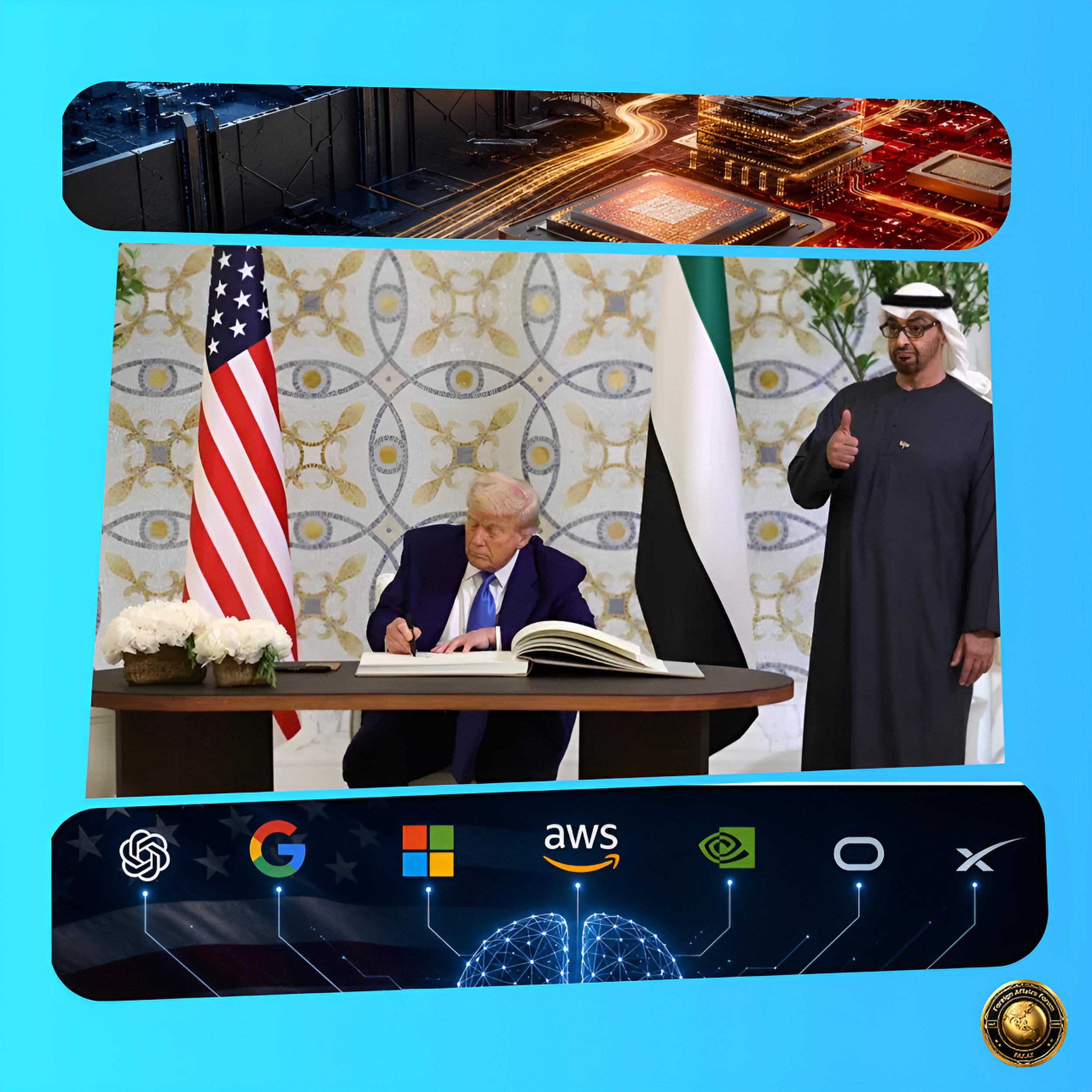
The Trump administration’s ascendance to power in January 2025 fundamentally reoriented this strategic calculus. Rather than universal containment, the administration adopted a transactional methodology wherein technology access became contingent upon broader bilateral arrangements incorporating trade, investment, and security cooperation. President Trump’s May 2025 visit to Abu Dhabi crystallized this orientation, resulting in formal announcement of the Stargate UAE project alongside broader “US-UAE AI Acceleration Partnership” framework. The initiative explicitly incorporated security protocols designed to assuage American concerns regarding technology diversion, including formal declarations from Abu Dhabi that G42 would divest entirely from Chinese technology holdings, implement rigorous know-your-customer verification procedures, and accept American operational oversight of critical infrastructure components. These commitments represented the operational manifestation of American strategy: extending technological capability to strategically positioned allies whilst maintaining supervisory mechanisms ensuring technology exclusivity.
Current Status: Construction Momentum and Operational Trajectory
As of January 2026, the Stargate UAE project has achieved demonstrable infrastructural progression that contradicts initial skepticism regarding execution velocity. The ten-square-mile campus in Abu Dhabi—a geographic footprint approximately nine times the territorial extent of the principality of Monaco—has absorbed more than five thousand construction workers engaged in systematic facility development. Over one hundred thousand cubic meters of concrete, constituting sufficient material to construct an entire city block, have been poured for foundational infrastructure. The steelwork structural components collectively weigh approximately 1.5 times the mass of the Eiffel Tower, illustrating the extraordinary physical scale of the undertaking. According to Khaldoon Al Mubarak, managing director and chief executive officer of the Mubadala Investment Company (Abu Dhabi’s sovereign wealth fund), preliminary two-hundred-megawatt capacity targeting third-quarter 2026 operationalization remains on trajectory, with construction proceeding “at full steam.”
The initial two-hundred-megawatt phase shall accommodate approximately one hundred thousand NVIDIA Blackwell GB300 processors, representing the most sophisticated GPU configurations currently manufactured by NVIDIA. The GB300 architecture integrates seventy-two Blackwell Ultra B300 graphics processing units alongside thirty-six Grace central processing units, incorporating 2,592 collective processor cores. These configurations employ NVLink C2C technology enabling data transfer between chips at nine hundred gigabytes per second, yielding exceptional throughput for large-scale artificial intelligence model training and deployment. The facility shall employ four Ansaldo Energia AE94.3 gas turbines, each generating three hundred forty megawatts of electrical capacity, providing dedicated power generation rather than dependence upon grid infrastructure. The architectural decision to integrate on-site power generation reflects the facility’s extraordinary electrical demands—demands exceeding capacity readily available through conventional grid connectivity even in energy-rich environments such as the UAE.
The ultimate projected five-gigawatt capacity—when fully operational across multiple subsequent phases—shall provide computational capacity sufficient to serve approximately half the global population residing within 2,000 miles of the UAE, constituting unprecedented regional computational dominance. This geographic positioning accords strategic advantage to American technology companies seeking to maintain low-latency service delivery throughout Africa, the Middle East, South Asia, and Southeast Asia. The facility’s architecture explicitly prioritizes American companies, with access reserved for United States hyperscalers and approved cloud service providers, effectively creating American-controlled digital infrastructure distributed throughout the geographic sphere encompassing the greatest concentration of global population.
Key Developments and Technical Specifications
The technical architecture underlying Stargate UAE demonstrates engineering sophistication matching computational ambition. The facility incorporates liquid cooling systems utilizing closed-loop mechanisms to maintain optimal GPU operating temperatures, addressing the thermal challenges inherent in desert environments where ambient temperatures exceed conventional data center design parameters. The architecture explicitly incorporates renewable energy integration—solar and nuclear power components supplementing gas generation—reflecting both sustainability commitments and energy resilience against supply disruptions.
A critical development occurred in November 2025 when the Trump Commerce Department authorized export of advanced NVIDIA GB300 processors to both G42 and Saudi Arabia’s Humain artificial intelligence company, each permitted to acquire computing capacity equivalent to thirty-five thousand GB300 processors. This authorization represented explicit reversal of Biden-era restrictions whilst implementing security frameworks intended to prevent technology diversion. The export authorization explicitly conditioned upon “rigorous security and reporting requirements,” creating bilateral monitoring mechanisms wherein American officials retain supervisory capacity over deployed semiconductor utilization. The authorization’s specificity—GB300 chips rather than less sophisticated NVIDIA offerings—signaled American confidence in security protocols whilst simultaneously extending cutting-edge American technology to designated regional partners.
OpenAI’s assumption of operational responsibility for computing deployment creates organizational architecture wherein the company exercises direct control over workload prioritization, model training utilization, and computational allocation. This operational authority ensures that sophisticated artificial intelligence development remains anchored to American corporate entities rather than devolving to Emirati governmental or corporate control. The dual-investment framework—whereby G42 commits dollar-for-dollar investment into American Stargate infrastructure for every dollar expended in UAE development—reinforces capital flow directionality, ensuring that American infrastructure development benefits from Emirati wealth generation.
Latest Developments and Structural Concerns
The most recent period illuminates both accelerating construction momentum and persistent concerns regarding bilateral trust sustainability. December 2025 announcements from Mubadala reaffirmed commitment to 2026 completion of preliminary two-hundred-megawatt capacity, with acknowledgment that discussions regarding the remaining four gigawatts of ultimate campus capacity continue with “large-scale providers from the U.S.” This language reflects partially unresolved questions regarding ultimate occupancy and utilization of later-phase infrastructure. Will Google, Meta, AWS, Microsoft, and xAI—entities actively in discussions with G42 regarding capacity allocation—ultimately commit to substantial computing investments? Or shall Stargate UAE remain predominantly OpenAI-focused, with ancillary capacity serving limited secondary tenants?
The most substantive concern animating American security deliberations involves technology diversion to Chinese entities. Despite G42’s formal commitments to divest from Chinese technology holdings and implement stringent security protocols, China remains active throughout the UAE through major enterprises including Huawei and Alibaba Cloud. The geographic proximity of advanced American semiconductor technology to Chinese commercial and potential intelligence apparatus creates asymmetric risk. While American monitoring mechanisms theoretically prevent direct technology transfer, lateral espionage risks—whereby Chinese entities operating within the UAE attempt to acquire knowledge of American chip specifications, facility architecture, or software systems—remain materially possible despite contractual prohibitions. The historical record of Chinese intelligence operations, particularly regarding technology acquisition, suggests that formal agreements constitute necessary but insufficient safeguards against systematic acquisition efforts.
A second concern involves the structural tension between American supervisory intentions and Emirati operational autonomy. The initial project announcements posit American-managed cloud services delivered throughout the region, implying that American companies maintain operational control over computing resources and data management. Yet the project’s ultimate trajectory remains unclear: shall the UAE ultimately acquire independent operational capacity, transferring management responsibility from American entities to G42 and associated Emirati companies? The strategic implications differ substantially between scenarios wherein American companies perpetually retain operational control versus outcomes permitting Emirati entities to assume independent computational sovereignty. The latter trajectory, whilst accelerating Emirati technological development, would simultaneously reduce American supervisory capacity and potentially enable technology development supporting non-aligned geopolitical objectives.
A third concern involves the project’s financial sustainability absent adequate demand. The five-gigawatt ultimate capacity implies extraordinary computing resources requiring compelling economic justification through revenue generation or governmental subsidization. If demand from American hyperscalers proves insufficient to saturate available capacity, either Emirati governmental subsidy perpetuates economically inefficient operations, or capacity remains substantially unutilized. Economic failure could undermine both the bilateral relationship and broader American strategy of leveraging infrastructure investment for geopolitical influence.
Cause-and-Effect Analysis: Strategic Cascades and Systemic Implications
The Stargate UAE initiative catalyzes multiple interconnected cause-and-effect relationships reshaping regional and global technological geopolitics. First, the project immediately signaled to China that American strategy incorporated geopolitical integration of advanced technology with trusted regional allies rather than universal containment. This reorientation transforms American AI policy from defensive posture—restricting technology to prevent Chinese access—to offensive positioning—explicitly extending American technological capability to allied nations to preempt Chinese alternative infrastructure development. Empirically, this causally influenced Saudi Arabia’s determination to pursue the Humain project with American technology partners rather than exclusively developing indigenous capability or relying on Chinese alternatives.
Second, the initiative generated cascading investment determinations throughout the American technology sector. If OpenAI maintained exclusive access to Stargate UAE capacity, competitive disadvantage would accrue to Google, Meta, AWS, Microsoft, and other entities unable to access equivalent regional computational infrastructure. This competitive calculus motivated G42’s engagement with alternative American companies, generating secondary projects and distributed computational infrastructure throughout the UAE and broader Gulf region. Rather than concentrating innovation exclusively in American data centers, technological development distributed throughout American-aligned regional hubs, theoretically accelerating development velocity whilst extending American geopolitical influence.
Third, the project’s explicit prioritization of American technology company access created organizational incentives for non-American companies to develop relationships with Abu Dhabi and G42. This dynamic generated beneficial competitive pressure upon American entities—failure to secure capacity would represent both commercial loss and geopolitical setback. The causality flows bidirectionally: American geopolitical prioritization of UAE partnership motivated technological companies to invest in regional relationships, whilst American commercial competition for capacity motivated geopolitical alignment with American interests.
Fourth, the project transformed the UAE’s technological self-conception from aspirational technology adopter to credible infrastructure developer and regional hub. Hosting one of the world’s largest artificial intelligence campuses elevated Abu Dhabi’s positioning within global technology governance forums, endowed the UAE with geopolitical leverage regarding technology standards-setting, and positioned Emirati leadership as legitimate participants in technological civilization-scale decisions. This status elevation simultaneously reinforced bilateral relationship strength—the UAE benefits substantially from association with American technological leadership whilst the United States benefits from regional political stability and intelligence cooperation anchored to shared technological interests.
Future Trajectory and Anticipated Developments
The anticipated evolution of Stargate UAE shall unfold across multiple dimensions. First, the completion of preliminary two-hundred-megawatt capacity in the third quarter of 2026 shall provide empirical evidence regarding construction feasibility and operational deployment. Should this milestone achieve completion substantially on schedule, subsequent phases shall likely accelerate, validating the construction architecture and security protocols. Conversely, significant delays would undermine bilateral confidence and potentially necessitate substantial project restructuring. The political salience of timely completion ensures that both American and Emirati stakeholders maintain prioritization, yet unpredictable technical and permitting challenges retain capacity to derail trajectory.
Second, the resolution of occupancy questions shall determine project financial viability and geopolitical efficacy. Announcements in August 2025 that G42 engaged in negotiations with AWS, Google, Meta, Microsoft, and xAI regarding capacity allocation suggested that ultimate campus configuration might incorporate multiple American hyperscalers rather than OpenAI exclusivity. Such distributed occupancy would enhance financial sustainability, diversify utilization risk, and demonstrate successful American-allied technology sector coordination at continental scale. Conversely, if occupancy remains concentrated within OpenAI infrastructure, economic viability becomes contingent upon OpenAI’s commercial success and expanding compute demands—a narrower foundation upon which to sustain extraordinary infrastructure investment.
Third, the sustainability of bilateral trust regarding technology diversion shall determine project longevity. Should intelligence agencies identify evidence of technology transfer toward Chinese entities or unauthorized access to American systems, diplomatic consequences could substantially degrade bilateral relationship quality and potentially necessitate project restructuring or capacity reductions. Absent credible security incidents, the project shall likely advance systematically, with preliminary success building confidence enabling later-phase expansion.
Fourth, geopolitical competition between American and Chinese infrastructure development throughout the Global South shall intensify. The Stargate UAE model—American technology deployed through allied regional partners with explicit security protocols—shall likely prompt replication throughout Asia, Africa, and Latin America. Microsoft, Google, AWS, and other hyperscalers shall pursue analogous partnerships, creating distributed American-aligned infrastructure architecture. Simultaneously, China shall develop competing partnerships and infrastructure alternatives, creating bifurcated global technology geography wherein regions align either with American or Chinese technological ecosystems.
Conclusion: Infrastructure as Geopolitical Instrument
The Stargate UAE initiative crystallizes a fundamental transformation in American artificial intelligence strategy, from defensive technology containment toward offensive geopolitical integration. Rather than restricting advanced computational capacity exclusively to American territory, American policymakers have determined that distributed infrastructure serving allied nations constitutes a more efficacious mechanism for maintaining technological dominance whilst advancing broader strategic objectives. The project has achieved tangible construction momentum as of January 2026, with preliminary capacity approaching operational deployment in 2026.
Yet the initiative remains situated within multiple layers of unresolved tension. The binary question of whether Stargate UAE ultimately represents expanded American geopolitical influence or incipient diffusion of technological control remains genuinely ambiguous. The project’s success depends upon sustained bilateral trust, economic viability absent demonstrated demand, technological security against sophisticated intelligence operations, and political continuity across multiple American administrations. These prerequisites transcend typical corporate infrastructure considerations, placing Stargate UAE within the broader geopolitical category of initiatives determining whether American technological supremacy remains sustainable into the artificial intelligence era.
The project’s ultimate resolution shall meaningfully influence not merely bilateral United States-UAE relations but the broader trajectory of American positioning within emerging artificial intelligence civilization. Should Stargate UAE flourish, it validates American strategy of anchoring allied nations to American technological architecture whilst maintaining supervisory capacity over critical infrastructure. Should the initiative falter through construction delays, technical failure, or security breaches, it signals that American technological leadership exhibits geographical limits and that alternative infrastructure architectures may prove more feasible. Either outcome bears implications extending far beyond the ten-square-mile Abu Dhabi campus, encompassing civilizational questions regarding technological geopolitics in the twenty-first century.
Alternative Engaging Subheadings for Scholarly Article:
• Executive Summary: “Reordering the Digital Sphere: How America Weaponizes AI Infrastructure for Geopolitical Dominance”
• Introduction: “When Computation Becomes Sovereignty: The Strategic Repositioning of American AI Power”
• Historical Context: “From Containment to Integration: How Trump Reversed Biden’s AI Chip Embargo”
• Current Status: “Building Empires of Computation: The Tangible Construction of American Technological Supremacy”
• Key Developments: “The Architecture of Control: How America Maintains Supervisory Authority Over Distributed Infrastructure”
• Latest Concerns: “The Espionage Question: Can American Technology Survive in Close Proximity to Chinese Intelligence?”
• Cause-and-Effect Analysis: “Cascading Power: How One UAE Campus Reshapes Global AI Competition”
• Future Trajectory: “The Bifurcation of Digital Geography: American and Chinese Infrastructure Race Across the Global South”
• Conclusion: “Infrastructure as Weapon: Does Stargate UAE Secure American AI Supremacy or Accelerate Its Dispersion?”