The abyss rising: Russia’s underwater dominion and the shadow fleet’s assault on Western sanctions - Part II
Executive Summary: The Silent Transformation Beneath the Waves
The Silent Apocalypse Beneath the Waves: How Russia Is Rewriting the Rules of Nuclear Deterrence and Economic Survival
Russia has orchestrated a comprehensive transformation of its capacity to operate beneath the ocean's surface, combining conventional submarine modernization with revolutionary nuclear-powered weapons systems while simultaneously deploying an estimated 1,100 to 1,400 vessels in a clandestine shadow fleet to circumvent international sanctions.
As of January 2026, this dual-track approach—advanced undersea military capability paired with sophisticated sanctions evasion infrastructure—represents one of the most consequential strategic developments facing the Western alliance.
The shadow fleet alone transports approximately 3.7 million barrels of oil daily, generating between $87 and $100 billion annually and accounting for 65% of Russia's seaborne oil trade. Concurrently, Russia has successfully tested its Poseidon nuclear-powered underwater drone, a weapon without precedent in the history of warfare, whilst simultaneously deploying submarines equipped with hypersonic cruise missiles throughout the Atlantic, Arctic, and Pacific theatres.
FAF examination synthesises current intelligence regarding Russia's multifaceted undersea strategy, encompassing the shadow fleet's evolution, submarine fleet modernisation, advanced weapons development, and the disturbing implications for critical infrastructure vulnerability in the Arctic and Atlantic regions.
Introduction: The Transformation of Maritime Conflict
The Weaponisation of the Abyss: Russia's Multidimensional Assault on Western Maritime Dominance
The oceanographic domain has assumed unprecedented strategic importance in contemporary international relations. Russia's comprehensive approach to oceanic warfare encompasses three interlocking dimensions: economic statecraft through sanctions evasion, conventional military power projection through modernised submarine fleets, and the deployment of revolutionary weapons systems that fundamentally challenge existing strategic paradigms.
The shadow fleet represents not merely a commercial enterprise designed to circumvent sanctions but rather a sophisticated expression of hybrid warfare, enabling Russia to sustain its war economy whilst maintaining plausible deniability and distributing accountability across multiple jurisdictions and commercial entities.
Simultaneously, Russia's submarine modernisation programme has accelerated dramatically, with the Borei-A class ballistic missile submarines and the Yasen-M class cruise missile submarines emerging as formidable platforms incorporating stealth technologies that substantially reduce acoustic signatures whilst enhancing strike capability.
Most critically, the Poseidon nuclear-powered underwater drone—successfully tested in October 2025—represents a qualitative departure from traditional nuclear deterrence frameworks, introducing a weapon system that circumvents all existing missile defence architectures and operates in a domain where Western technological superiority has historically prevailed.
History and Current Status: From Soviet Legacy to 21st Century Hegemony
From Rusted Relics to Apex Predators: The Resurrection of Russian Undersea Power
Russia inherited the world's largest submarine fleet from the Soviet Union, a legacy comprising approximately 260 vessels at the end of the Cold War. However, the transition to a market economy and consequent reduction in defence expenditure relegated much of this fleet to obsolescence.
The period from 1991 to approximately 2010 witnessed substantial degradation of Russian submarine operations, punctuated by catastrophic incidents such as the Kursk submarine disaster in 2000 and chronic shortages of funding for maintenance and modernisation. The strategic recalibration initiated by Vladimir Putin from 2000 onwards and substantially accelerated following the 2008 Georgian conflict established submarine modernisation as a critical pillar of Russian strategic doctrine.
The shadow fleet phenomenon emerged only after the comprehensive sanctions regime was imposed in 2022, following the invasion of Ukraine. Before this intervention, Russia had maintained a relatively conventional export apparatus for crude petroleum and refined products.
The price cap sanctions mechanism implemented by the G7 and European Union in December 2022, which restricted the purchase of Russian oil to prices not exceeding sixty dollars per barrel, necessitated an improvised response: the acquisition of aging, often nearing end-of-life tanker vessels that could be flagged to jurisdictions offering minimal oversight or environmental regulation.
By the conclusion of 2022, estimates suggest the shadow fleet comprised approximately 600 vessels, predominantly crude oil tankers. The subsequent three years witnessed exponential expansion, with current estimates exceeding 1,400 vessels and approximately one-third of all Arctic shipping traffic in 2025 involving sanctioned shadow fleet vessels.
The submarine force has undergone a parallel transformation. The Borei-class programme, initiated in 1996 as a replacement for ageing Delta III and Delta IV ballistic missile submarines, achieved operational deployment of the initial vessel, Yuri Dolgorukiy, in 2010. Eight Borei-class submarines are now commissioned, with four additional Borei-A variants under construction and four more in the planned stage.
The Yasen-class programme, designed to replace Soviet-era attack submarines, commissioned its flagship, the Severodvinsk, in 2014 and currently operates seven operational vessels, with four more under construction. Russia has committed to continued serial production of these platforms, representing an unprecedented peacetime commitment to undersea forces.
Most alarmingly, in December 2025, Putin announced the successful completion of tests for the Poseidon system—a capability so revolutionary that it fundamentally alters the strategic equation across the Atlantic, Arctic, and Pacific theatres.
Key Developments: The Emergence of Revolutionary Capabilities and Economic Workarounds
Poseidon Rising: Russia's Revolutionary Weapons and the Shadow Fleet's Coronation as Putin's Economic Lifeline
The period from 2022 to January 2026 has witnessed a remarkable acceleration across multiple dimensions of Russian undersea activity.
The shadow fleet has evolved from a hastily improvised sanctions-evasion mechanism into a sophisticated network leveraging private security, state coordination, and, increasingly, direct naval escort.
As of January 2026, tankers previously flagged to convenient registries such as the Cook Islands or Panama have begun reflagging to the Russian national flag, a strategic shift indicating state-level commitment to protecting these assets against increasingly aggressive interdiction efforts by the United States Coast Guard and allied naval forces.
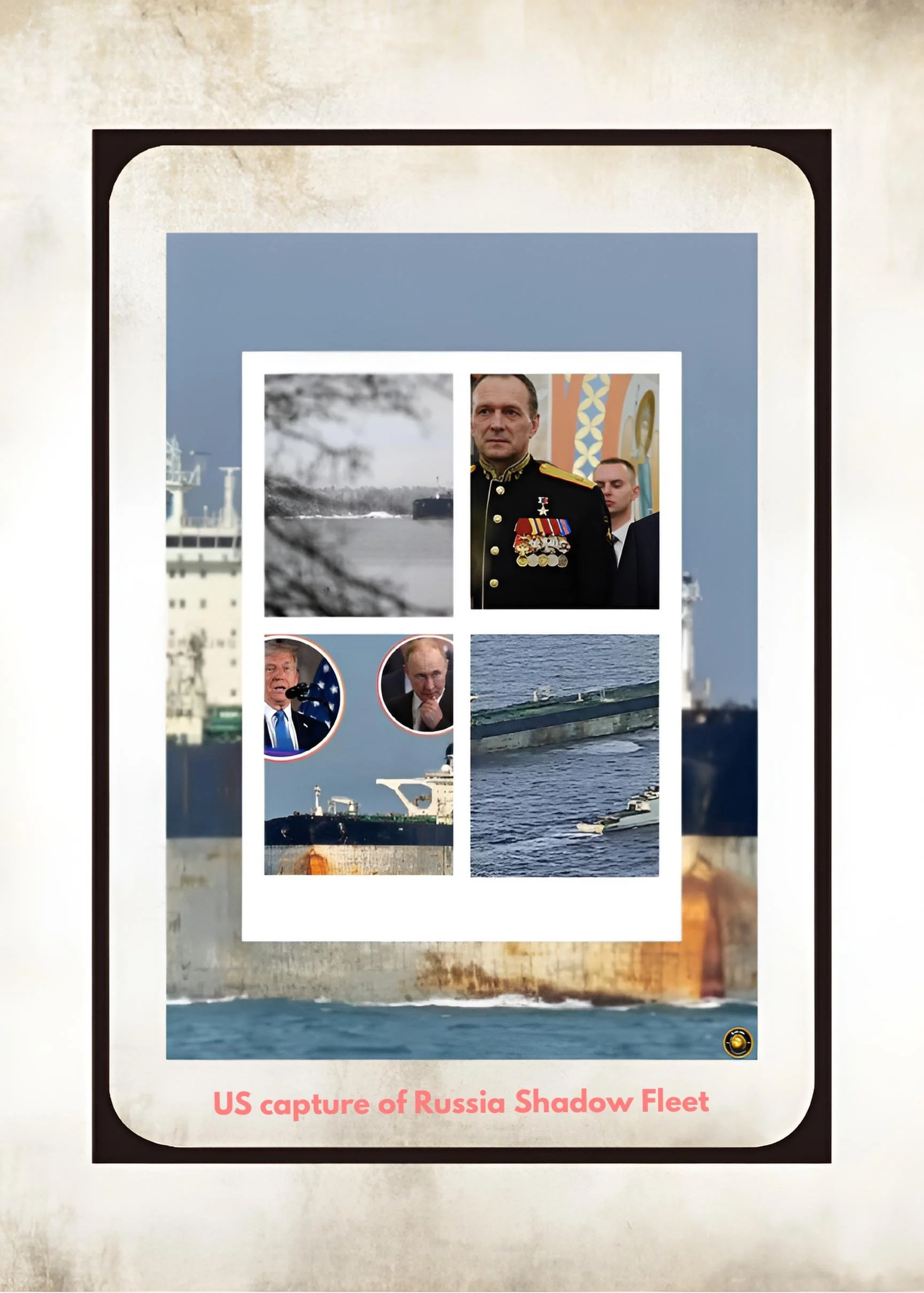
The seizure of the Bella 1—renamed Marinera—in December 2025, followed by the interception of additional sanctioned vessels, prompted this dramatic shift in flagging strategy. Russian naval vessels have commenced escorting shadow fleet convoys, particularly through the English Channel, where two sanctioned tankers recently transited under the protection of the Project 20380 missile corvette Boykiy.
This militarisation of commercial shipping blurs the distinction between commercial and naval operations, creating circumstances in which miscalculation could precipitate confrontation between Western naval forces and Russian state assets.
Simultaneously, the submarine force has undergone continuous modernisation. The Knyaz Pozharsky, the eighth Borei-class and fifth Borei-A submarine, was delivered to the Northern Fleet in June 2025.
These vessels represent the technological pinnacle of Russian submarine engineering, incorporating water-jet propulsion systems that reduce acoustic signatures to levels approaching those of contemporary Western designs.
Each vessel carries sixteen RSM-56 Bulava submarine-launched ballistic missiles, each equipped with four to six independently targetable thermonuclear warheads, substantially enhancing Russia's second-strike retaliatory capability.
The Yasen-M class, now in serial production, represents the most advanced nuclear-powered attack submarine in operation, equipped with ten vertical launch silos for P-800 Oniks cruise missiles and capable of deploying Tsirkon hypersonic cruise missiles—weapons travelling at approximate velocities of nine times the speed of sound and rendering interception brutal with existing Western air defence systems.
The first Yasen-M submarine equipped with Tsirkon capability, the Perm, completed trials in March 2025 and is expected to join Russia's Pacific Fleet in 2026.
The Poseidon Prophecy: How Russia’s nuclear nightmare torpedoes and unsinkable oil fleet are redefining global conflict
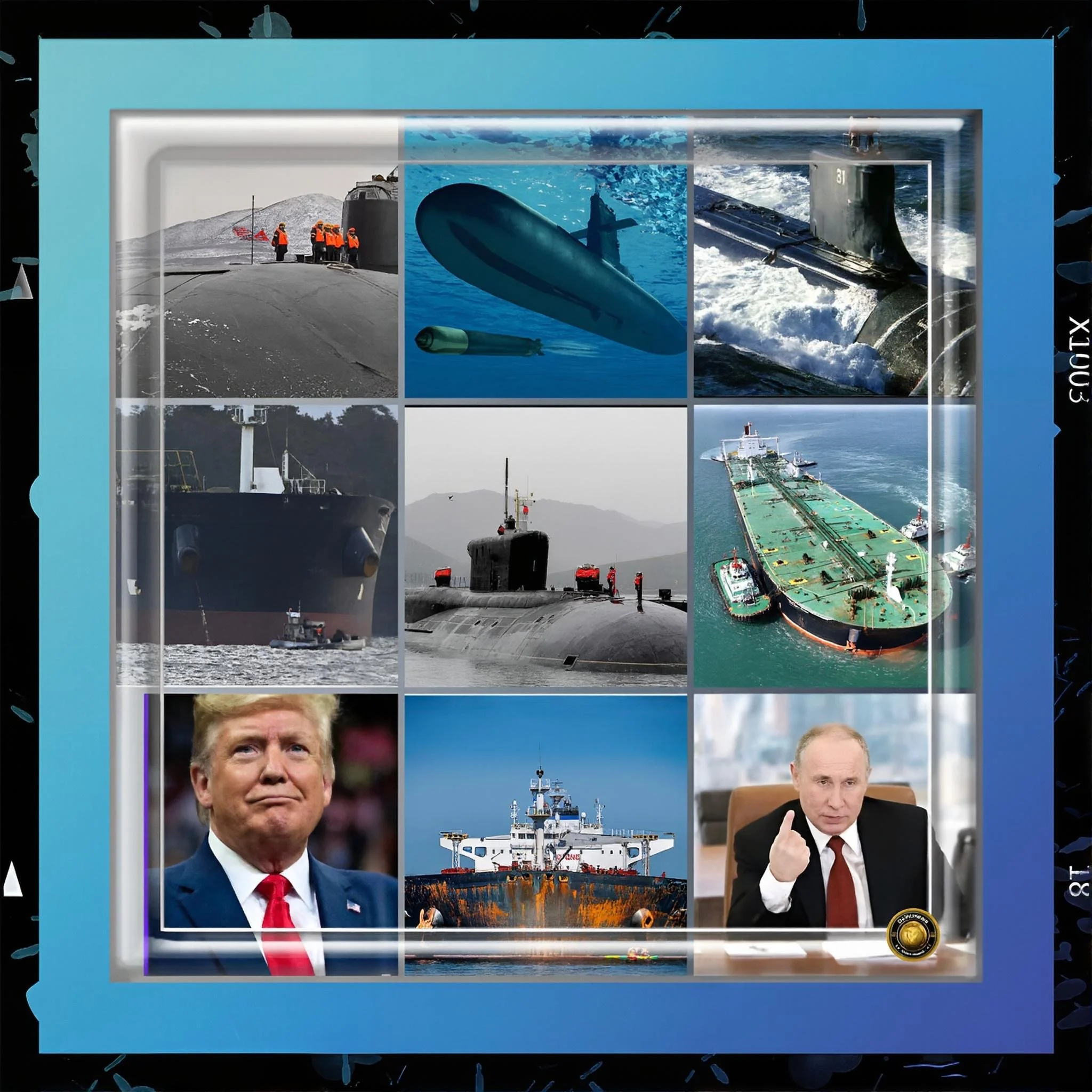
Most consequentially, Russia successfully tested the Poseidon nuclear-powered underwater drone on October 28-29, 2025. This weapon system, deployed from the Belgorod submarine (capable of carrying six such devices) and eventually from a new class of submarines designated Khabarovsk, represents a fundamental departure from existing strategic concepts.
The Poseidon operates autonomously for distances encompassing thousands of kilometres, navigates at depths exceeding 1,000 metres, achieves velocities exceeding 70 knots, and carries a thermonuclear warhead estimated at two megatons or greater.
Putin characterised this capability as possessing "power significantly exceeding that of our most advanced intercontinental missile, the Sarmat," a statement that warrants serious consideration given the Sarmat's estimated yield of approximately 40 megatons.
The psychological and strategic implications are difficult to exaggerate: a weapon system operating in an environment historically inaccessible to Western military intervention, travelling at velocities and depths that render interception technologically impossible with current systems, and delivering destructive force comparable to the most advanced ballistic missiles in the Russian arsenal.
Latest Facts and Mounting Concerns: An Escalating Strategic Crisis
The Abyss Strikes Back: NATO's Nightmare as Russian Submarines and Shadow Fleets Accelerate Beyond Western Countermeasures
The most recent developments, spanning December 2025 through early January 2026, illuminate the accelerating trajectory of Russian undersea dominion and the mounting pressure upon Western security architecture.
Ukraine's utilisation of an underwater uncrewed vehicle designated "Sub Sea Baby" to successfully strike an Improved Kilo-class submarine at the Novorossiysk naval base in December 2025 represents the first documented combat deployment of autonomous underwater weapons against a submarine.
Whilst damage assessment remains incomplete, Ukrainian sources characterise the target submarine as "out of service," representing a loss valued at $400-500 million in replacement costs—a figure attaining considerable significance given the constraints upon Russian shipbuilding capacity resulting from sanctions.
The shadow fleet scenario has deteriorated markedly. The U.S. Department of the Treasury designated approximately 180 additional vessels, scores of trading entities, and senior Russian oil executives in January 2025. Nevertheless, the fleet's operational capacity has not diminished substantially; instead, it has shifted toward greater state control and protection.
Swedish military authorities reported an increased Russian military presence along shadow-fleet shipping lanes, with personnel believed to be contracted through private security companies providing armed protection. The blurring of commercial and military operations creates unprecedented danger, as commercial shipping disputes become inextricably linked to military escalation pathways.
Finland seized a vessel suspected of sabotaging undersea telecommunications cables on December 30, 2025, following damage to cables linking Helsinki to Estonia—merely one of approximately 20 documented incidents of potential Russian hybrid warfare targeting critical undersea infrastructure since the February 2022 invasion.
The Baltic and Arctic regions have witnessed systematic attacks on fibre-optic cables that constitute the circulatory system for communications and financial transactions throughout Northern Europe and, increasingly, Asia-Pacific.
The Arctic itself has become a theatre of hybrid conflict. Russia's Main Directorate of Deep-Sea Research (GUGI) operates specialised vessels such as the Yantar, which NATO assesses as conducting reconnaissance mapping of undersea cables and critical infrastructure. Russian doctrine explicitly designates the disruption of critical infrastructure as a legitimate instrument of hybrid conflict, a characterisation rendering the entire Arctic telecommunications infrastructure vulnerable.
An analysis of Arctic shipping demonstrates that nearly one-third of all vessel traffic on the Northern Sea Route in 2025 involved sanctioned shadow fleet vessels, often poorly maintained, lacking ice-classification, and representing extraordinary environmental risks.
The Poseidon weapon system introduces uncertainties that strain existing nuclear deterrence and strategic stability frameworks. The system possesses several characteristics rendering it strategically destabilising: it operates in an environment where Western technological superiority cannot be leveraged; it provides no warning time comparable to ballistic missiles; it offers no interception possibilities given current systems; and it introduces ambiguity regarding intended targets, as the same system deployed for coastal destruction could theoretically be employed against naval installations.
Intelligence assessments suggest that two Poseidon-capable submarines (Belgorod and Sarov) are currently operational, with additional capacity approaching as the Khabarovsk-class enters service. Each Belgorod-class carries six such weapons, representing a payload of destructive power exceeding the largest ballistic missile arsenal of smaller nuclear-armed states.
Causation Analysis: Structural Drivers of Russian Undersea Expansion
Why Moscow Has Bet Its Future on the Depths: The Economic Desperation and Strategic Logic Behind Russia's Undersea Hegemony
The expansion of Russian undersea capabilities and the shadow fleet phenomenon reflect multiple causal mechanisms operating simultaneously.
The fundamental driver remains the structural vulnerability of the Russian economy to external economic pressure. Approximately seventy percent of Russian federal budget revenues derive from hydrocarbon exports, making the sustained ability to market crude petroleum and refined products essentially existential for regime maintenance.
The sanctions architecture established in December 2022 imposed a price cap whilst simultaneously restricting banking relationships, insurance availability, and port access for Russian crude exports.
Rather than accepting a substantial reduction in petroleum revenues, Moscow engineered an alternative transport and commercial architecture utilising vessels flagged to accommodating jurisdictions and recruited commercial operators willing to absorb operational risks and navigate regulatory uncertainty.
This shadow fleet, from the Russian perspective, represents not a criminal enterprise but rather a rational economic response to economic warfare perpetrated by Western states.
The submarine modernisation programme responds to Russia's historical and contemporary strategic vulnerabilities.
The submarine force constitutes the sole reliable second-strike nuclear deterrent, as Russia's ballistic missile force remains vulnerable to first-strike destruction through conventional precision weapons (as exemplified by Ukrainian strikes upon airfields and command centres).
The investment in Borei-A and Yasen-M submarines reflects a determination to maintain assured retaliation capability against any conceivable Western adversary. The Poseidon system represents an escalation of this logic to its extreme conclusion: a weapon system rendering defence impossible, thereby guaranteeing that any conflict would produce unacceptable consequences for the attacking power.
Putin's repeated characterisation of Western expansion of missile defences as a destabilising force contradicting arms control frameworks provides the justification framework for this weapons development.
The targeting of undersea infrastructure reflects Russia's assessment of Western vulnerabilities.
The fibre-optic cables upon which financial systems, military communications, and civilian telecommunications depend represent high-value, difficult-to-defend objectives. Disruption of communications infrastructure, as repeatedly perpetrated against Ukrainian energy systems, produces profound psychological effects and degrades operational coordination.
Russia's ability to conduct such operations with substantial plausible deniability—achieved through the utilisation of shadow fleet vessels, the deployment of civilian fishing trawlers, and reliance on natural phenomena (ice scour, seismic activity) as cover—provides Russia with a capability to inflict strategic damage whilst maintaining escalation control.
Future Trajectory: Anticipated Developments and Strategic Implications
The Creeping Conquest: How Russia Plans to Dominate Every Ocean and Strangle Western Infrastructure from Below
The trajectory of Russian undersea capabilities suggests continued expansion across all dimensions. The shadow fleet, despite sanctions and interdiction efforts, has continued to function effectively to sustain Russian petroleum exports. Without a substantial escalation in interdiction (including potential boarding of Russian-flagged vessels and actions carrying military escalation implications), the fleet will likely continue to expand.
The United States has begun executing seizures of sanctioned vessels, notably the Marinera, suggesting evolution toward more aggressive interdiction. However, this escalation carries risks, as Russian state interests become directly implicated in shadow-fleet protection, creating circumstances in which commercial disputes can transition into state-level confrontation.
The submarine force modernisation programme remains on track. Putin has committed to serial production of both Borei-A and Yasen-M submarines through at least the current decade, with 8.4 trillion rubles (approximately $100 billion) appropriated for naval construction over the next ten years.
The anticipated delivery schedule suggests the commissioning of four additional Borei-A submarines and four supplementary Yasen-M submarines over the next five years.
The Yasen-M variants anticipated in 2026, including the Perm and additional Pacific-based units, will introduce Tsirkon hypersonic cruise missiles to Russia's inventory at an unprecedented scale, providing Russia with long-range precision strike capability at velocities and ranges challenging to contemporary air defence systems.
The Poseidon system will proceed toward operational deployment following completion of developmental testing. The Belgorod and Sarov submarines will conduct operationalisation procedures, establishing protocols for deployment, targeting, and maintenance.
The new Khabarovsk-class submarines, specifically designed to accommodate Poseidon systems, will enter service over the current decade, potentially increasing the operational Poseidon force from the current two submarines to four, six, or more.
This expansion represents a fundamental transformation of strategic deterrence, as the undersea domain becomes populated with weapons that require not defensive countermeasures but rather the acceptance of mutual vulnerability.
The Arctic domain will witness escalating hybrid conflict operations. Russia's commitment to undersea cable intelligence gathering will persist, with the GUGI continuing systematic mapping of critical infrastructure. The Northern Sea Route will remain utilised by shadow fleet vessels, creating persistent vulnerability to environmental catastrophe and strategic disruption.
The anticipated deployment of NATO surveillance assets through the Baltic Sentry operation and similar initiatives will create friction points where Russian shadow fleet operations intersect with Western defensive measures.
Conclusion: An Era of Strategic Transition and Unprecedented Vulnerability
The Battle for the Abyss: Russia's Undersea Dominion as the Defining Challenge of the 2026-2030 Strategic Era
Russia's simultaneous development of revolutionary undersea weapons systems, the maintenance of a vast unregulated shadow fleet enabling economic survival despite sanctions, and the adoption of hybrid warfare tactics targeting critical infrastructure represent one of the most profound strategic challenges confronting the Western alliance.
The shadow fleet phenomenon demonstrates that sanctions regimes, absent complementary military enforcement, offer limited capacity to constrain the economic resources available to adversarial powers.
The submarine force modernisation programme reflects Russia's determination to maintain nuclear deterrence credibility regardless of conventional military setbacks.
Most alarmingly, the Poseidon system and the emerging constellation of hypersonic cruise missile-equipped submarines introduce weapons capabilities for which the Western alliance possesses no satisfactory answer, rendering the strategic posture vulnerable to destabilisation through technical surprise.
The coordination of these three capabilities—shadow fleet for economic resilience, conventional submarines for power projection and deterrence, and revolutionary weapons systems for strategic reassurance—constitutes a coherent strategy responsive to Russian strategic circumstances.
The vulnerability of Arctic and Atlantic undersea infrastructure to disruption or destruction by hybrid means creates additional pressure points through which Russia can constrain Western options or impose costs upon Western alliance cohesion.
The continued efficacy of these strategies depends substantially upon Western capacity to accept constraints upon escalation whilst simultaneously implementing sufficiently robust countermeasures to render Russian options progressively more costly.
The undersea domain, historically relegated to secondary strategic significance, has assumed centrality in great power competition.
Russia's determination to establish dominion across the abyss should be assessed not as an isolated military development but as a fundamental challenge to the architecture of Western naval superiority and strategic deterrence that has underpinned international order for the past three decades.