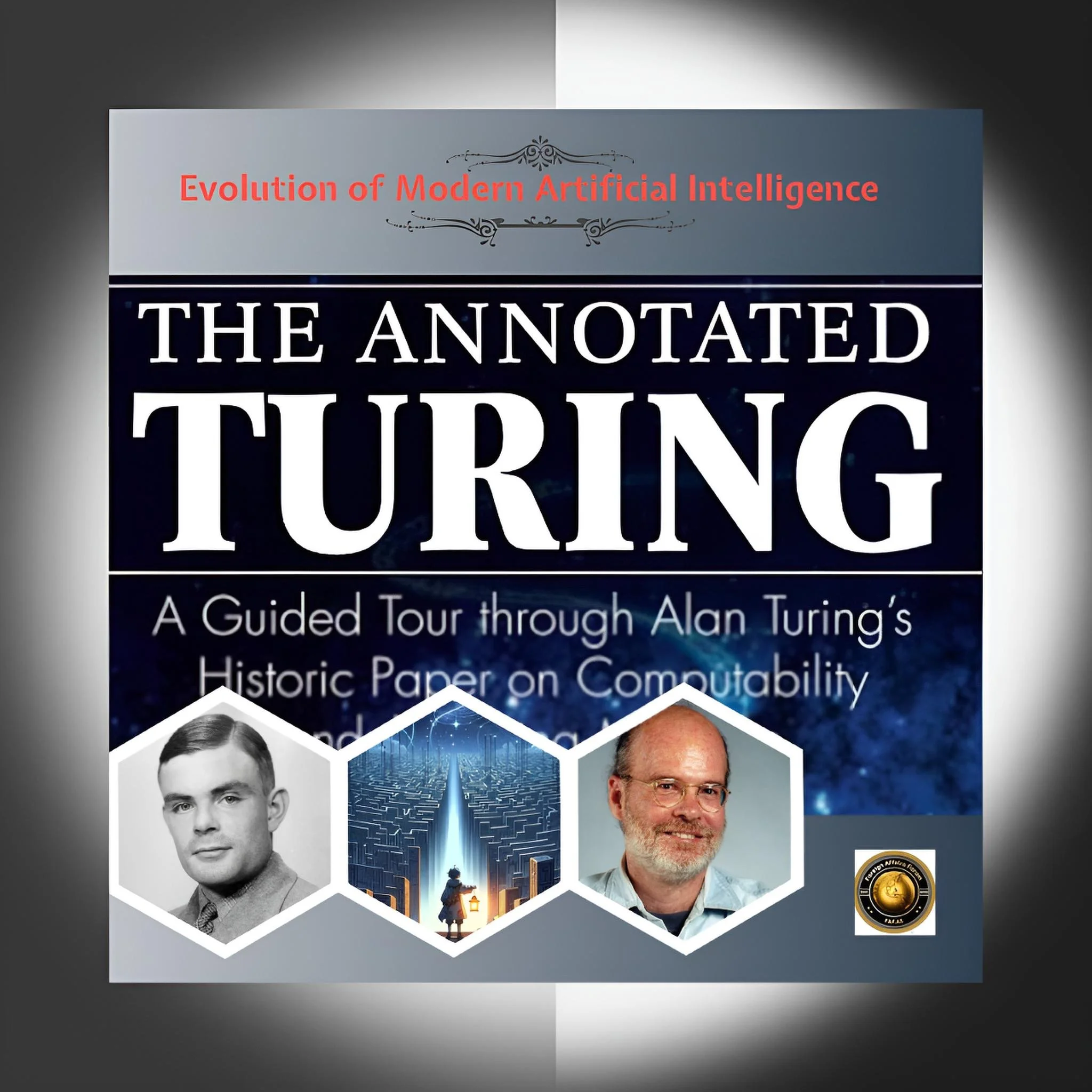
The annotated turning: Demystifying the theoretical foundations of the digital age: Dr. Alan Turing, Founding Visionary in the Evolution of Modern Artificial Intelligence
Executive Summary
From Symbol Manipulation to Machine Logic: The Conceptual Revolution
Charles Petzold’s The Annotated Turing: A Guided Tour Through Dr. Alan Turing’s Historic Paper on Computability and the Turing Machine constitutes a landmark achievement in scientific exposition—the successful translation of one of mathematics’ most consequential yet impenetrably abstract papers into a form accessible to educated readers without specialized training in mathematical logic.
Petzold undertakes a sentence-by-sentence annotation of *Dr. Alan Turing’s revolutionary 1936 paper “On Computable Numbers, with an Application to the Entscheidungsproblem,” providing essential historical context, mathematical explanation, worked examples, and biographical detail that illuminate the reasoning underlying one of the twentieth century’s most transformative intellectual contributions.
Dr. Turing’s 1936 paper represents far more than a technical mathematical result. It established the conceptual foundations upon which modern computer science and our understanding of computation itself rest.
Through the introduction of what would later be termed the Turing Machine—an abstract, imaginary computing device of stunning simplicity—Turing provided a formal answer to a centuries-old philosophical question: what precisely constitutes calculation or computation?
By demonstrating that his theoretical machine could execute any algorithmic process that could be executed by any other means, Turing established that computation has fundamental limits beyond which no algorithmic approach can extend. His proof that the Entscheidungsproblem (the decision problem in mathematical logic) admits no algorithmic solution revealed the existence of questions that are, in principle, uncomputable.
The Universal Turing Machine—a machine capable of simulating any other Turing machine through appropriate input—transcended theoretical abstraction to become the conceptual blueprint for all subsequent stored-program digital computers. Yet despite its revolutionary significance, Turing’s original paper has remained largely unread, intimidating readers with its forbidding title, dense mathematical notation, and relentless abstraction.
Petzold’s annotation retrieves this vital work from obscurity, demonstrating that the core insights, though demanding, are comprehensible to readers willing to engage with careful explanation and concrete examples. The Annotated Turing restores Turing’s paper to its rightful place as essential reading for anyone seeking to understand the intellectual foundations of the digital world.
Foreward
The Machine That Thinks About Thinking: Why Turing’s 1936 Insight Shapes AI in 2026
The question of what computation fundamentally is may seem to have an obvious answer in an age where digital computers pervade human civilization. Yet this question was profoundly unsettled in the early twentieth century. Mathematicians had developed increasingly sophisticated notations for expressing mathematical operations and logical inferences, but the foundations remained uncertain.
When could a mathematical problem be considered solved? What constituted an effective procedure or algorithm?
Did all mathematical problems admit algorithmic solutions, or did some fundamental obstacles limit what calculation could achieve?
These questions, far from being merely academic niceties, struck at the heart of mathematics’ aspirations to provide complete, systematic frameworks for understanding quantitative relationships.
David Hilbert, one of the most influential mathematicians of the era, had proposed an ambitious program: the axiomatization of all mathematical knowledge into a system whereby any mathematical truth could be proven or disproven through mechanical application of formal rules.
This program assumed the existence of what Hilbert termed a decision procedure—an algorithm capable of determining whether any given mathematical statement was true or false. The question became known as the Entscheidungsproblem, the decision problem.
Alan Turing, a brilliant English mathematician then in his early twenties, approached this problem through a radically novel method. Rather than attempting to develop an algorithm that could solve the decision problem, Turing constructed an imaginary machine—no more than a thought experiment, yet one of stunning conceptual power.
This machine, which Petzold’s work explores at length, operated on an infinite tape divided into squares, each of which could contain a symbol.
The machine possessed a read head that could inspect one square at a time and modify symbols according to a table of instructions. The machine could move left or right along the tape, one square at a time.
The simplicity of this machine stands in sharp contrast to the complexity of mathematical reasoning. Yet Turing claimed something remarkable: any mathematical procedure that could be computed through any means whatsoever could be computed by such a machine.
This claim, now known as the Church-Turing thesis, transformed how mathematicians and logicians understood computation itself. By reducing computation to the elemental actions of symbol manipulation performed by an imaginary machine following mechanical rules, Turing provided a precise, formal definition of what computation meant.
This precision allowed him to prove something equally remarkable: that certain problems—specifically, the Entscheidungsproblem—were inherently uncomputable. No algorithm, no matter how sophisticated or clever, could solve them.
The significance of Turing’s achievement extends far beyond abstract mathematics. His paper provided, in effect, a theoretical blueprint for the architecture of modern computers.
The Universal Turing Machine—a machine capable of simulating any other Turing machine—embodied the principle of program-data interchangeability that would become central to the design of practical computers. Information about which machine to simulate could be encoded onto the machine’s tape, where it would be treated like any other data.
This insight—that a machine could process instructions as easily as it processed data, and that a single machine could therefore simulate any other machine—anticipated the stored-program computer architecture by a decade, inspiring John von Neumann and others who would design the first practical electronic computers.
Yet despite this historical and conceptual importance, Turing’s original paper has remained largely unread. The forbidding title, the relentless abstraction, the employment of dense mathematical notation and lengthy logical arguments created barriers that deterred all but specialists.
Petzold’s achievement lies in dismantling these barriers through meticulous annotation, historical contextualization, and concrete examples. The work makes intelligible to educated non-specialists what has remained arcane and inaccessible for nearly a century.
The Landscape of Mathematical Foundations: Setting the Stage
Understanding Turing’s paper requires grasping the intellectual landscape it addressed. The late nineteenth and early twentieth centuries witnessed a profound crisis in the foundations of mathematics.
Georg Cantor had developed set theory, a framework for understanding collections of objects and their infinite cardinalities. Yet Cantor’s work revealed troubling paradoxes: sets that appeared intuitively reasonable led to logical contradictions.
These paradoxes raised fundamental questions about the consistency and reliability of mathematics itself. If mathematics rested on logically inconsistent foundations, what became of the entire edifice of proof and certainty that mathematics had claimed to provide?
Kurt Gödel’s groundbreaking work on incompleteness theorems, published in 1931, intensified this crisis.
Gödel demonstrated that any formal system of mathematics complex enough to express the truths of arithmetic would be either incomplete (containing true statements that could not be proven) or inconsistent (containing provable falsehoods).
This shocking result suggested fundamental limitations on what formal systems could achieve. Hilbert’s ambition to axiomatize all mathematics into a complete, self-contained system that could mechanically generate all true statements appeared increasingly untenable.
Into this environment of mathematical uncertainty stepped Turing. Rather than attempting to resolve the foundational crisis directly, he approached it through a different angle.
He asked not “What mathematical statements are true?” but rather “What problems are computable?”
By restricting attention to questions solvable through mechanical, algorithmic processes, Turing could sidestep some of the epistemological turmoil surrounding mathematical foundations.
A problem was computable, in Turing’s framework, if it could be solved by a machine following mechanical rules without requiring insight, intuition, or leaps of logic.
This reframing proved enormously fertile. It allowed mathematicians to distinguish between two categories of problems: the computable, which algorithms could solve in principle, and the uncomputable, which no algorithm could solve regardless of its sophistication.
The Entscheidungsproblem fell into the uncomputable category. Turing proved that no algorithm existed that could determine, for any arbitrary mathematical statement, whether that statement was provable within a formal system.
This was not a failure of mathematical ingenuity or a gap in contemporary knowledge; it was a fundamental limitation. Some mathematical questions would forever lie beyond algorithmic reach.
The Machine That Changed Everything: The Turing Machine Explained
Petzold’s exposition of the Turing Machine itself occupies the central portion of The Annotated Turing, and this exposition constitutes perhaps the work’s greatest achievement.
The Turing Machine appears almost deceptively simple. An infinite tape divided into squares, each capable of holding a symbol.
A read head that inspects one square. A state register that tracks the machine’s current operational state. A state table, essentially a list of instructions specifying what the machine should do in any combination of circumstances.
The elegance of this design lies in its radical minimalism. Unlike physical computers with their vast array of specialized hardware, the Turing Machine could perform only the most elementary operations: read a symbol, write a symbol, move left, move right along the tape, change state. Yet from these elementary building blocks, Turing showed that arbitrarily complex calculations could emerge.
A machine could be constructed to calculate the decimal expansion of pi to arbitrary precision. Another could perform multiplication or division. Another could solve systems of linear equations. By providing detailed examples of machines performing these varied tasks, Turing demonstrated empirically that his theoretical machine possessed remarkable computational power.
More profoundly, Turing argued that these machines could compute anything computable. The claim was ambitious: any procedure that a human mathematician could execute through purely mechanical steps—following a rule book without requiring creative insight—could be computed by a Turing machine.
This claim has become known as the Church-Turing thesis, after both Turing and Alonzo Church, who developed an equivalent formalization through lambda calculus.
The thesis, while remaining unproven in a strict logical sense, has achieved near-universal acceptance among mathematicians and computer scientists.
Every computational model discovered since—whether lambda calculus, recursive functions, other abstract machines, or practical programming languages—has proven equivalent in power to the Turing Machine. No extension to the Turing Machine has ever been shown to increase its computational capability.
This convergence of evidence suggests that the thesis captures something fundamental about the nature of computation.
Petzold’s exposition clarifies Turing’s argument by slowing the pace, providing context for each claim, constructing detailed examples that illustrate abstract concepts, and addressing common points of confusion. When Turing introduces the notion of “circles”—sequences of machines that enter infinite loops and never halt—Petzold explains the concept, provides examples, and then illustrates its significance.
A machine is “circle-free” if its execution eventually halts, producing a final output.
Turing’s Halting Problem represents the question of whether a given machine, starting with given input, will eventually halt. Turing proved that no machine could exist that would determine whether an arbitrary machine would halt.
This profound result demonstrates fundamental limits to computation. No algorithm could universally solve the Halting Problem.
The Universal Machine: The Concept That Prefigured Digital Computing
Among the achievements Turing described in his paper, none matches in significance the invention of the Universal Machine. This machine deserves particular attention, as it represents the conceptual leap from abstract theory toward practical computing.
The Universal Turing Machine is itself a Turing Machine—nothing physically distinguished it from any other machine Turing had described. Yet its capabilities transcended all previous machines.
The Universal Machine could simulate any other Turing Machine by receiving as input a description of that machine encoded onto its tape. Feed the Universal Machine a description of a machine that calculates pi, and it would calculate pi. Feed it a description of a machine that performs multiplication, and it would multiply. The machine could emulate any behavior specified to it.
This remarkable capability rested on Turing’s insight into the formal description of machines. Every Turing Machine could be represented as a table of states and transitions—essentially a program specifying what the machine should do in every possible circumstance.
Turing showed how to encode such a table into a sequence of symbols on the machine’s tape. The Universal Machine contained built-in logic to interpret this encoded table and execute the computation it specified. In modern terminology, one would say the Universal Machine treated the encoded table as data—as a program to be executed.
This principle—that a machine could process programs as data and execute arbitrary programs specified through input—proved to be the conceptual foundation for all subsequent computer science.
The stored-program computer architecture, championed by John von Neumann and others, embodied precisely this principle. Rather than having physical connections or hardwiring that specified the machine’s behavior, instructions could be stored in memory and retrieved for execution.
A single physical computer, through different stored programs, could execute wholly different behaviors. This flexibility explained why digital computers could be general-purpose machines, capable of executing any algorithm, not specialized devices dedicated to single calculations.
Petzold’s exposition of the Universal Machine requires careful reading, as the concept involves layers of abstraction. First, one must understand ordinary Turing Machines. Then, one must grasp how machines can be encoded as sequences of symbols. Then, one must understand how the Universal Machine interprets these encoded descriptions.
Petzold manages this progression gracefully, constructing simplified examples before approaching the full complexity. The payoff justifies the effort: understanding the Universal Machine provides profound insight into why modern computers possess the flexibility and power they do.
The Entscheidungsproblem and Its Undecidability: Mathematics Encounters Fundamental Limits
The latter portions of Turing’s paper, which Petzold covers in accelerated fashion in Part III of his annotation, address the original motivation for Turing’s investigation: the Entscheidungsproblem.
Having established the conceptual framework of Turing Machines and demonstrated their computational power, Turing directed this framework toward the logical question that had motivated his work. Could an algorithm determine whether a given mathematical statement was provable within a formal system?
Turing’s approach was elegant. He showed that the Entscheidungsproblem was equivalent to the Halting Problem. If one could solve the Entscheidungsproblem—determine whether a statement was provable—one could also determine whether a machine would halt.
Since Turing had already proven that the Halting Problem was undecidable, it followed that the Entscheidungsproblem was also undecidable. No algorithm could solve it. Some mathematical questions would forever lie beyond algorithmic determination.
This result did not merely answer Hilbert’s question; it transformed mathematical understanding. It suggested that mathematics would necessarily contain questions whose truth or falsity could not be determined through formal, mechanical procedures.
The intuition that every true mathematical statement could be proven through rigorous logic appeared to be mistaken. Some truths would remain accessible only to mathematical insight rather than mechanical derivation.
The implications extended beyond mathematics. The undecidability of the Entscheidungsproblem meant that no computer, regardless of its speed or memory capacity, could systematically determine the provability of arbitrary mathematical statements.
This limitation was not a reflection of technological inadequacy but a fundamental feature of the problem itself. Turing had proven that certain classes of problems were inherently uncomputable—beyond the reach of any possible algorithm.
From Theory to Practice: Bridging the Abstract and the Actual
The relationship between Turing’s theoretical work and the practical development of digital computers represents one of the most fascinating threads in computational history.
Turing’s paper appeared in 1936, predating the first electronic computers by a decade. Yet when engineers and mathematicians began designing practical computers, Turing’s theoretical framework proved prescient.
The concept of the Universal Machine directly inspired the stored-program computer architecture. John von Neumann, one of the preeminent mathematicians of the era, became convinced by Turing’s work that a general-purpose computing machine should treat instructions as data, stored in memory and retrieved for execution.
This principle became embedded in von Neumann architecture, the design pattern that has dominated computer architecture for eighty years.
Turing’s own postwar work reinforced this connection. After the war, having worked on cryptanalysis and code-breaking, Turing turned to practical computer design.
His ACE (Automatic Computing Engine) incorporated sophisticated optimization techniques—such as scheduling instructions to emerge from memory delay lines at precisely the moment they were needed—that transformed the theoretical efficiency gains of the Universal Machine into practical reality.
Turing recognized that a perfect theoretical architecture meant nothing if practical constraints—memory latency, instruction scheduling, optimal instruction placement—were neglected. His ACE represented an effort to embody theoretical insights in practical hardware design.
This bridge between theory and practice remains central to computer science. Theoretical results about computational limits and capabilities guide the design of practical systems.
Conversely, practical experience reveals limitations or inefficiencies in theoretical models, prompting refinement. Petzold’s work captures this interplay by showing not only the abstract theory but also its implications for understanding actual computing machines.
Consciousness, Computation, and the Limits of Mechanism: Extensions Beyond Mathematics
In The Annotated Turing’s final section, Petzold explores how Turing’s computational framework has extended into domains far beyond mathematics and logic.
Turing himself took this step in his 1950 paper “Computing Machinery and Intelligence,” in which he posed the famous question “Can machines think?” and proposed his iconic test for machine intelligence.
The Turing Test asked whether a human evaluator, conversing via text with an unknown entity, could reliably distinguish between a human and a machine. If the machine’s responses proved indistinguishable from human responses, Turing suggested, the question of whether the machine “really” thinks became philosophically moot.
This extension of Turing’s thinking into questions of artificial intelligence and machine consciousness represents a natural progression from his computational theory. If the mind performs computations—and contemporary cognitive science increasingly suggests it does—then the question of whether artificial systems could replicate mental processes reduces to the question of whether they could replicate the computations underlying cognition.
The Turing Machine framework, which had proven so powerful for understanding mathematical computation, seemed equally applicable to understanding mental processes.
Yet Turing’s framework also illuminates the fundamental limitations of purely computational approaches to consciousness. If the mind is, in essence, a biological computer executing algorithms, then the mind inherits the limitations of all computational systems.
Certain problems would be uncomputable even for minds. Certain questions about the system’s own nature might be undecidable from within the system’s perspective.
This realization has profound philosophical implications. It suggests that no computation, however sophisticated, could provide complete insight into the nature of computation itself. There would always remain mysteries inaccessible to algorithmic exploration.
Petzold explores these implications with appropriate intellectual modesty, acknowledging both the power of computational frameworks and their ultimate limitations.
The Turing Machine, while capturing fundamental truths about computation, does not explain consciousness, does not account for human agency and choice, does not encompass the holistic, embodied nature of human cognition. It provides a powerful framework for certain questions while remaining silent on others.
The Persistence of Theory in the Digital Age: Relevance and Resonance
In an era when computing has become ubiquitous and practical, why should one read—or annotate—a ninety-year-old theoretical paper? Petzold’s work implicitly argues that such reading remains essential for several reasons.
First, Turing’s paper illuminates the conceptual foundations underlying all digital computation. Every programming language, every operating system, every algorithm, every computing device is built upon the theoretical framework Turing established.
Understanding these foundations provides insight into why computers work as they do, what they can and cannot do, and what fundamental principles constrain their operation.
Second, the paper contains profound philosophical content. It addresses questions about the nature of thought, the possibility of mechanical reasoning, the relationship between symbol manipulation and meaning, the existence of limits to human knowledge and computation.
These questions remain profoundly important even—or perhaps especially—in an age when computational systems increasingly mediate human experience. As artificial intelligence systems become more sophisticated, the question of what computation fundamentally is becomes increasingly urgent.
Third, Turing’s paper exemplifies rigorous mathematical thought at its finest. The elegance of the argument, the clarity of the logical structure, the power of the conclusions warrant study not merely for historical interest but as exemplars of mathematical excellence.
In an era of increasing technical specialization, Turing’s paper demonstrates how profound insights can emerge from fundamental rethinking of basic concepts.
Finally, and perhaps most importantly, Turing’s paper resists the technological determinism that often characterizes thinking about computers and artificial intelligence. It demonstrates that the capabilities and limitations of computational systems are not merely technical matters but have deep mathematical and logical roots.
Understanding these roots provides basis for thoughtful governance and deployment of computational systems.
One cannot responsibly develop or govern artificial intelligence systems without understanding what computation fundamentally is, what it can and cannot achieve.
Conclusion
The Architecture of Digital Civilization Rests on Turing’s Foundation
Charles Petzold’s The Annotated Turing succeeds in its central ambition: to make accessible to educated non-specialists one of the most consequential yet inaccessible papers in the history of science and mathematics.
Turing’s 1936 paper “On Computable Numbers, with an Application to the Entscheidungsproblem” established the conceptual framework within which all subsequent computer science has developed.
Through the Turing Machine, Turing provided a precise mathematical definition of computation. Through the Halting Problem, he revealed fundamental limits to computation.
Through the Universal Machine, he pioneered the concept of the general-purpose stored-program computer. Through his proof of the Entscheidungsproblem’s undecidability, he demonstrated that mathematics itself contained inherent limitations.
Petzold’s annotation, structured across four comprehensive parts, carefully scaffolds these insights. The foundational sections provide essential historical context and mathematical background.
The detailed annotation of the Computable Numbers portion of Turing’s paper, supported by worked examples and clarifications, transforms an inscrutable mathematical argument into an intelligible one.
The exposition of the Entscheidungsproblem and mathematical logic, while more demanding, remains accessible through Petzold’s careful guidance. The final section reconnects the abstract theory to contemporary questions about consciousness, artificial intelligence, and the nature of computation.
The work’s significance extends beyond historical interest or educational value.
In an age increasingly shaped by computational systems, from algorithms determining loan approvals to artificial intelligence systems claiming to achieve human-level reasoning, understanding the theoretical foundations of computation becomes imperative.
Turing’s demonstration that computation possesses fundamental limits provides essential corrective to technological utopianism. It suggests that no computer, however powerful, can compute everything.
Some problems are intrinsically uncomputable. This understanding should inform governance and deployment of computational systems, tempering grandiose claims while clarifying what computers can genuinely achieve.
The Annotated Turing also exemplifies the vital role that translators and expositors play in intellectual life. Complex ideas, expressed in the technical language of specialists, remain invisible to broader educated publics until someone undertakes the patient work of explanation and annotation.
Petzold’s achievement retrieves a vital work from the archives of specialized knowledge and restores it to the common intellectual inheritance. Readers who engage seriously with The Annotated Turing will emerge with fundamentally deeper understanding of the computational systems that structure contemporary civilization and the mathematical principles that underlie them.
For those seeking to understand not merely how computers work but why they work as they do, what they can accomplish and what lies forever beyond their reach, this work provides indispensable guidance.
*Dr. Alan Turing (1912-1954), A Founding Visionary in The Evolution of Modern Artificial Intelligence