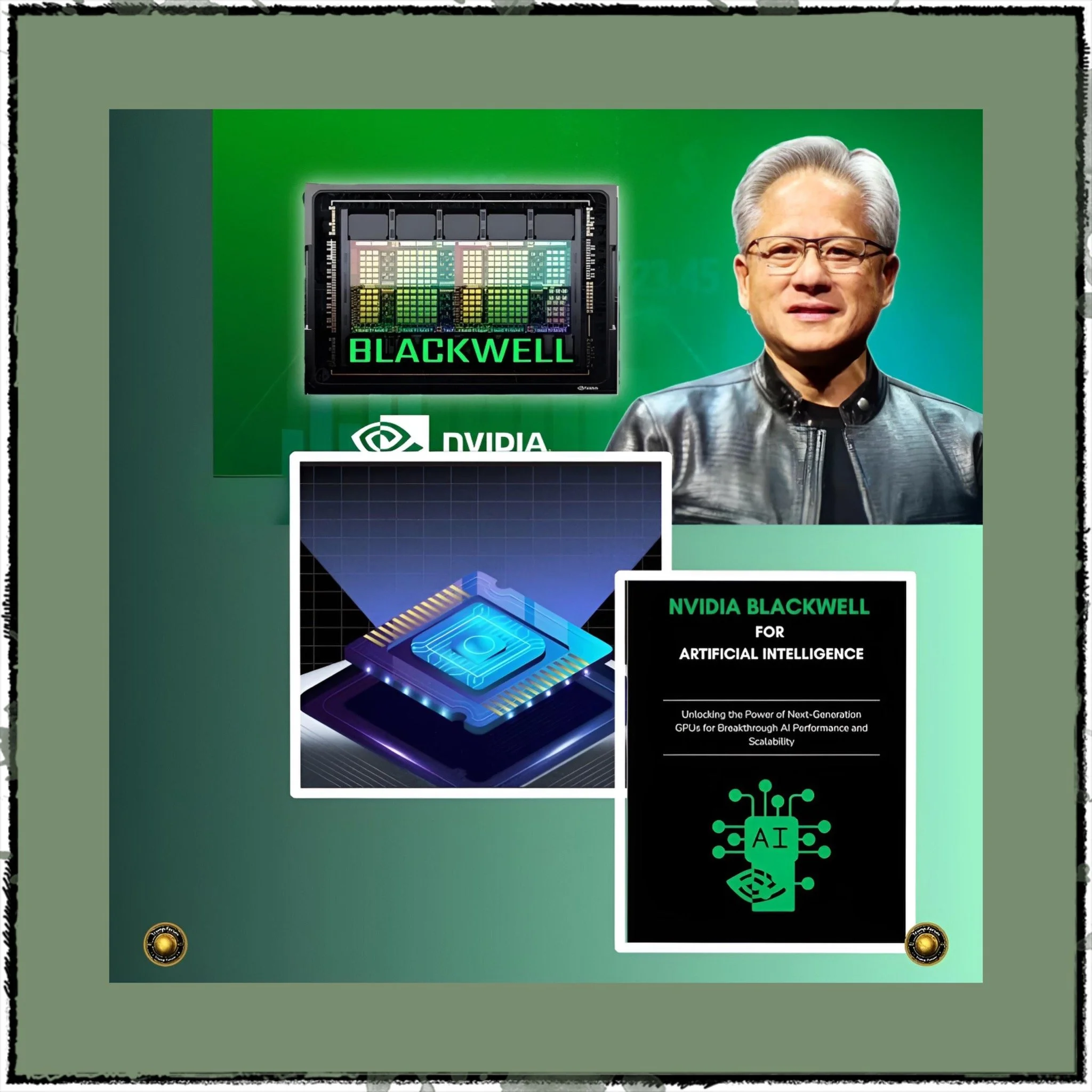
The Blackwell Revolution: NVIDIA's Transformation of Artificial Intelligence Infrastructure and Computational Paradigms
Executive Summary
When Everything Changed: The Promise and Peril of Revolutionary GPU Architecture
The advent of NVIDIA's Blackwell GPU architecture represents a watershed moment in the history of artificial intelligence infrastructure development.
Announced initially in March 2024 and achieving substantial market penetration by 2025, Blackwell constitutes not merely an incremental improvement over the preceding Hopper generation but rather a fundamental architectural reconfiguration designed expressly for the emerging era of agentic and reasoning artificial intelligence.
The platform delivers performance improvements ranging from 8x to 30x depending upon workload configuration, coupled with reductions in total cost of ownership and energy consumption that fundamentally alter the economic calculus governing data center deployment and operation.
The second-generation Transformer Engine, enhanced NVLink 5.0 interconnectivity, and native FP4 precision support enable the platform to support trillion-parameter language models with previously unattainable efficiency.
The commercial implications prove equally significant: Blackwell sales have exceeded Hopper's historical peak by a factor of 2.5x, establishing a $500 billion order pipeline through 2026 and cementing NVIDIA's control over 92 percent of the discrete GPU market.
Yet this remarkable technological achievement generates concurrent challenges regarding power infrastructure, environmental sustainability, and the long-term durability of an artificial intelligence ecosystem concentrated in the hands of a single dominant vendor.
Introduction
The Architecture That Could Reshape the World
The contemporary acceleration of artificial intelligence capabilities owes substantially to advances in specialized computational hardware.
The trajectory from NVIDIA's introduction of CUDA-enabled general-purpose computing on graphics processors in 2006 through the deployment of Hopper-generation GPUs across hyperscale data centers in 2022 reflects a consistent pattern: each architectural iteration expanded the computational capacity available for training and deploying larger, more sophisticated neural networks. NVIDIA's Blackwell architecture, detailed comprehensively in 2025 following initial announcement in 2024, extends this progression to its logical extreme given present-day manufacturing constraints.
The philosophical orientation undergirding Blackwell differs fundamentally from its predecessors. Where Hopper represented an optimization of existing computational paradigms—training increasingly large models, conducting batch inference on language model outputs, executing parallel scientific computations—Blackwell has been architected explicitly to support what proponents characterize as agentic artificial intelligence: autonomous systems capable of complex reasoning, iterative planning, and dynamic problem-solving without human intervention.
This reorientation necessitated fundamental redesigns across multiple architectural dimensions: memory bandwidth, interconnection topology, precision formats, and computational specialization.
The implications of Blackwell's deployment extend across multiple domains.
For hyperscale cloud service providers, the platform offers the prospect of substantially increased return on capital: the same data center footprint that previously generated 300 million tokens per second using Hopper-based infrastructure can generate 12 billion tokens per second using Blackwell, representing a 40-fold theoretical increase in throughput.
For enterprises seeking access to advanced artificial intelligence capabilities, Blackwell enables the deployment of sophistication previously restricted to organizations with nine-figure infrastructure budgets.
For the broader semiconductor industry and the global energy infrastructure upon which data center deployment depends, Blackwell's emergence raises profound questions regarding sustainability, grid capacity, and whether existing projections regarding electrical generation and distribution prove adequate to the task of powering an agentic AI-saturated computational future.
Historical Context and Architectural Precedents
From CUDA to Blackwell: A Generation of GPU Evolution
The history of GPU acceleration for artificial intelligence can be traced to NVIDIA's introduction of CUDA in 2006, a parallel computing platform that enabled researchers to leverage graphics processing units for general-purpose computation.
The subsequent decades witnessed the progressive refinement of GPU architectures specifically tailored to the requirements of neural network training. The Kepler architecture (2012) introduced the first specialized neural processing capabilities. Maxwell (2014) improved power efficiency. Pascal (2016) doubled precision throughput. Volta (2017) introduced mixed-precision training.
Turing (2018) added specialized tensor cores. Ampere (2020) delivered the H100 successor and enabled the training of the largest language models deployed to that date.
Hopper, introduced in 2022, represented the architectural state of the art when NVIDIA engineers commenced the design of what would become Blackwell. Hopper achieved 10 petaFLOPS of FP8 performance per chip, a remarkable achievement that nevertheless proved inadequate for the computational demands emerging from the rapid evolution of transformer-based language models.
As models surpassed one trillion parameters, the training times required to achieve convergence extended into months-long endeavors consuming vast electrical resources.
The constraint that principally motivated Blackwell's design was bandwidth. Hopper's memory bandwidth—3.35 terabytes per second—represented a significant bottleneck when executing inference on exceptionally large models.
The movement of model weights from memory to computational cores constituted a larger cost than the actual arithmetic operations, a phenomenon that semiconductor engineers characterize as memory-bound computation. The consequence proved counterintuitive: adding additional computational capacity to Hopper did not proportionally increase throughput because the system could not supply the arithmetic cores with data rapidly enough to maintain utilization.
Blackwell addresses this constraint through a comprehensive assault across multiple architectural frontiers. The memory hierarchy has been reorganized: 288 gigabytes of high-bandwidth memory with 8 terabytes-per-second throughput, representing 2.4 times the Hopper baseline.
The interconnection fabric has been redesigned: NVLink 5.0 provides 1.8 terabytes per second of bidirectional bandwidth between GPUs, compared to Hopper's 900 gigabytes per second.
The computation itself has been specialized: the second-generation Transformer Engine incorporates hardware dedicated to the mathematical operations essential to transformer-based neural networks, enabling the execution of operations in FP4 precision that previously required FP8 or higher precision, effectively doubling the mathematical operations that can be performed within a fixed silicon budget.
Current Status: The Blackwell Deployment and Market Reception
The Great Deployment of 2025
As of January 2026, Blackwell has transitioned from a technology demonstrated in laboratory conditions to an architecture experiencing extraordinary market demand. The first commercial deployments occurred in late 2024, with full-scale production ramping through 2025.
The economic data proves remarkable: in 2025 alone, NVIDIA shipped more Blackwell GPUs than Hopper GPUs at its historical peak, a metric that reflects both extraordinary demand and NVIDIA's capacity to execute against supply chain challenges.
The major cloud service providers have integrated Blackwell into their product offerings. Amazon Web Services offers the P6e-GB200 UltraServer, containing up to 72 Blackwell GPUs, described as AWS's most powerful GPU offering to date.
Microsoft Azure has announced the forthcoming deployment of NVIDIA Blackwell Ultra GPUs and committed to delivering 360 petaflops of FP8 compute per UltraServer through the GB200 NVL72 architecture. Google Cloud has similarly commenced deployment.
Oracle Cloud Infrastructure has announced integration. Sovereign cloud providers spanning Malaysia, Singapore, Australia, and the United Kingdom have announced Blackwell integration into their infrastructure offerings.
The pricing architecture reflects the extraordinary technical achievement and corresponding value delivery. Cloud providers typically structure GPU access on a reserved-contract basis, with three-year contracts for Blackwell GPUs priced between 3.30 and 3.50 dollars per GPU per hour. This pricing structure translates to approximately 25,000 dollars per GPU for a three-year commitment, a magnitude that places Blackwell provisioning within reach of well-capitalized enterprises while remaining substantially more expensive than traditional enterprise computational infrastructure.
The market concentration metrics underscore Blackwell's significance. NVIDIA's control of the discrete GPU market has reached 92 percent, with the company dominating across both consumer gaming and data center segments.
In the specialized domain of AI accelerators, NVIDIA's market share exceeds 80 percent, a concentration that has intensified even as competitors such as AMD attempt to provide functional alternatives through their MI300 architecture.
The company's financial performance reflects this dominance: in the third quarter of fiscal year 2026, NVIDIA reported data center revenue of 51.2 billion dollars, representing a 66 percent year-over-year increase, with Blackwell contributing substantially to this growth.
Key Developments and Strategic Implications
The Infrastructure Arms Race and the Emergence of Agentic Systems
The emergence of Blackwell has catalyzed a cascade of strategic responses across the technology industry.
The major cloud service providers have commenced what can be characterized as an infrastructure arms race, with each seeking to establish itself as the most capable provider of Blackwell-based computational services.
Amazon announced the deployment of what it characterizes as EC2 UltraClusters featuring up to 100,000 Blackwell GPUs functioning as a single compute fabric.
Microsoft announced the development of custom supercomputer systems integrating Blackwell with specialized networking infrastructure optimized for large-scale model training.
The secondary market for Blackwell access has begun to emerge.
Entrepreneurial firms have established themselves as intermediaries, providing enterprises unable or unwilling to commit capital to GPU ownership with on-demand access to Blackwell resources.
VCI Global announced the opening of what it characterizes as the world's first NVIDIA Blackwell-powered enterprise AI GPU Lounge in Kuala Lumpur, offering subscription-based access to Blackwell infrastructure without requiring the capital investment historically associated with GPU deployment.
The implications for the artificial intelligence application layer prove equally significant. The reduction in inference latency and cost generated by Blackwell's efficiency improvements has rendered economically viable certain applications that would previously have been prohibitively expensive.
The generation of responses to user queries using trillion-parameter models now executes within seconds rather than minutes, opening possibilities for interactive applications requiring real-time model responsiveness. The reduction in per-token inference cost has correspondingly lowered the unit economics barrier for applications leveraging large language models.
The emergence of what researchers term agentic artificial intelligence represents perhaps the most significant implication of Blackwell's capabilities. Agentic systems employ reinforcement learning and tree-search algorithms to enable autonomous problem-solving spanning multiple steps and requiring iterative reasoning.
These systems demand computational intensity of an order of magnitude exceeding traditional inference: where a single interaction with a language model might generate hundreds of tokens, an agentic system applying reasoning algorithms might generate millions of tokens in the process of solving a complex problem.
Blackwell's performance improvements have rendered the deployment of agentic systems across enterprise applications economically feasible for the first time.
Cause-and-Effect Analysis: Cascading Implications
How Blackwell Rewired Global Computational and Energy Systems
Blackwell's introduction generates measurable effects across multiple domains.
The architectural decisions regarding memory bandwidth and interconnection topology directly influence the design of subsequent-generation systems.
AMD's announcement of its competing MI3 architecture and Intel's belated entry into the AI accelerator market reflect the competitive pressure generated by Blackwell's demonstrated capabilities. Competitors recognize that matching Blackwell's performance on key metrics has become a prerequisite for market viability.
The cost structure of artificial intelligence applications has fundamentally shifted. Where training large language models previously required capital investments in specialized hardware, Blackwell's efficiency improvements have reduced the hardware cost component while simultaneously increasing the capability per dollar spent.
This effect proves particularly consequential for organizations external to the handful of hyperscale cloud providers, as the reduced cost barrier to deploying advanced AI capabilities implies broader accessibility.
The electrical infrastructure requirements generated by Blackwell-based data centers have emerged as a binding constraint on further expansion. Each Blackwell GPU consumes approximately 1,200 watts at peak utilization, and a rack containing 72 Blackwell GPUs requires between 60 and 120 kilowatts depending upon configuration.
The cumulative electrical demand from the deployment of hundreds of thousands of Blackwell GPUs across global data centers has begun to strain regional electrical grids. Concentrated deployments in regions such as Loudon County, Virginia, have revealed that the limiting constraint on further data center expansion is not the availability of electrical generating capacity but rather the physical transmission and distribution infrastructure connecting generators to end users.
The environmental implications have proven equally immediate. Estimates suggest that global data center electricity consumption could reach 945 terawatt-hours by 2030, representing nearly a fourfold increase from 2025 levels and constituting approximately 2 percent of global electricity generation.
The absolute growth in electrical demand would be substantially larger absent Blackwell's efficiency improvements, but even with these improvements, the magnitude of projected growth generates profound sustainability questions.
Latest Concerns and Future Challenges
The Sustainability Question Nobody is Discussing
The concentration of Blackwell availability in the hands of NVIDIA has generated concerns among policy makers regarding technological sovereignty and strategic dependence.
Nations and regions lacking advanced semiconductor manufacturing capability find themselves dependent upon NVIDIA for access to the computational infrastructure essential to competing in artificial intelligence applications.
The U.S. government has restricted the export of advanced GPUs to China, creating a bifurcated global AI infrastructure market in which Chinese entities deploy inferior computational hardware for training and deploying models.
The long-term sustainability of current deployment models remains uncertain.
The theoretical improvements in inference throughput and cost reduction offered by Blackwell have not universally translated into commercially viable applications.
Enterprises deploying Blackwell-based infrastructure have discovered that generating sufficient revenue from AI applications to justify capital expenditure remains challenging.
The fundamental question of whether artificial intelligence applications will generate sufficient economic value to justify the extraordinary infrastructure investment remains substantially unanswered.
The emergence of more efficient models poses another form of competitive pressure to the Blackwell ecosystem.
The DeepSeek research team's release of models claimed to achieve comparable performance to larger, more compute-intensive models raises the possibility that the trend toward ever-larger models and correspondingly larger computational requirements may reverse.
If computational efficiency in model design becomes a competitive advantage, the value proposition of Blackwell's raw computational capability might diminish.
Future Outlook and Concluding Observations
Building an AI-Saturated World
NVIDIA has announced the impending release of successor architectures that will further advance the performance frontier. Vera Rubin, scheduled for deployment in 2026, and Rubin Ultra, anticipated for 2027, will continue the pattern of performance improvement and efficiency enhancement.
These architectures incorporate storage innovations and specialized capabilities for memory-intensive agentic applications, suggesting that NVIDIA's engineering roadmap remains focused on the architectural challenges anticipated to constrain AI infrastructure development.
The broader trajectory appears oriented toward a future in which artificial intelligence computation dominates data center workloads globally.
The global AI infrastructure market, estimated at approximately 876 billion dollars in 2025, is projected to reach between 3 and 4 trillion dollars annually by 2030.
This expansion will require not merely the continued production of Blackwell-scale GPU systems but also revolutionary advances in power infrastructure, cooling technology, and the electrical grid infrastructure connecting distributed data centers.
The technological achievement represented by Blackwell is remarkable, representing the culmination of decades of incremental improvements in GPU architecture, specialized instruction sets, and interconnection technology.
The platform has enabled the deployment of artificial intelligence capabilities that would previously have been technologically infeasible and economically unaffordable. Yet the sustainability of a global infrastructure built around the continued acceleration of computational capability remains profoundly uncertain.
The next decade will determine whether Blackwell's promise of abundant artificial intelligence computation at a reasonable cost proves consistent with the physical and economic constraints governing global energy systems and electrical grids.