How to Topple Iran's Ayatollahs: A Constitutional Transition Through Democratic Partnership
Executive Summary
The Islamic Republic of Iran faces its most severe legitimacy crisis since its establishment in 1979. Following a catastrophic 84% currency collapse in 2025, nationwide protests, and military humiliation during the June 2025 conflict with Israel and the United States, the regime exhibits all characteristics of systemic institutional breakdown.
Against this backdrop, a pragmatic pathway to regime change has emerged: the formation of a united opposition coalition led by the exiled crown prince Reza Pahlavi and a reformist former prime minister, coordinated through a constitutionally legitimate transitional framework that dissolves the Supreme Leader's absolute authority and establishes democratic accountability.
This approach provides an internally driven, non-violent alternative to military intervention while capitalizing on the regime's genuine institutional vulnerability and the Iranian people's demonstrated rejection of clerical authoritarianism.
Introduction
How does a nation transition from 47 years of theocratic authoritarianism to democratic governance without succumbing to state collapse, regional destabilization, or foreign domination?
This question has become urgently relevant for Iran in January 2026, as successive waves of popular upheaval, economic catastrophe, and strategic military defeats have exposed the structural fragility beneath the Islamic Republic's facade of institutional permanence.
The regime that consolidated power through revolutionary fervor and nationalist ideology now faces a fundamentally different threat: not external aggression, but internal delegitimization rooted in its demonstrable incapacity to govern, protect citizens, or maintain economic viability.
The contemporary Iranian opposition operates within a complex landscape of competing visions for post-Islamic Republic governance. Some advocate for internal reform, others for external military intervention, and still others for democratic transition orchestrated by institutional actors.
Among these approaches, a particularly coherent framework has emerged from dissident circles: a partnership between historically significant opposition figures—Reza Pahlavi, the exiled crown prince, and a reformist former prime minister—tasked with drafting and implementing a transitional constitution that transfers sovereignty from the Supreme Leader's office to the Iranian people through democratic processes.
This strategy differs fundamentally from both regime-change militarism and reformism within the existing structure. Instead, it leverages the regime's institutional vulnerability to establish a constitutional democracy through mechanisms that appear procedurally legitimate even to elements within the current establishment.
Historical Context and Constitutional Architecture
The 1979 Constitution of the Islamic Republic established a unique hybrid system combining republican and theocratic elements. Article 57 designated supreme authority in the office of the Supreme Leader, defined as a jurist possessing absolute guardianship—the principle of Velayat-e Faqih.
However, the original 1979 document preserved substantial presidential and parliamentary authority. The catastrophic transformation occurred in 1989, when the dying Ayatollah Khomeini authorized a constitutional revision council that fundamentally restructured the system.
The amended constitution transferred sweeping powers from the presidency to the Supreme Leader, rendering elected institutions structurally subordinate to the unelected clerical hierarchy.
The 1989 amendments created an architectural paradox: the constitution formally enumerates rights and democratic processes while simultaneously granting one unaccountable office the authority to negate all such provisions through appeal to undefined "Islamic criteria."
The Supreme Leader appointed the head of the judiciary, thereby controlling the Guardian Council, which itself possesses veto authority over all legislation and the power to disqualify candidates from elections. No mechanism exists for impeaching the Supreme Leader, removing him, or constraining his authority.
The result is a system in which, as one former security committee head stated in January 2026, 66% of governmental institutions lack any accountability to elected bodies.
This constitutional design functioned effectively for regime perpetuation across four decades, but it created a critical vulnerability: the concentration of legitimacy crises in a single individual. When the current Supreme Leader, Ali Khamenei, now 86 years old, faces pressure or demonstrates incapacity, the system cannot distribute authority or adapt without fundamentally acknowledging the Supreme Leader's fallibility.
The protests of 2025–2026 have exposed precisely this vulnerability. With Khamenei increasingly withdrawn from public engagement, with no clear successor acceptable to the revolutionary clerical elite, and with the security apparatus showing signs of strain and dissent, the constitutional hierarchy that sustained the system has become a mechanism accelerating its potential collapse.
Current Status
The Collapse Narrative
The protests that began on December 28, 2025, initiated as merchant-driven demonstrations against currency depreciation, evolved within weeks into nationwide demands for regime termination.
The Iranian rial had lost 84% of its value in 2025 alone, with food prices increasing 72% and inflation exceeding 52%.
The regime's response—an unprecedentedly violent crackdown resulting in estimates ranging from 3,117 to 5,777+ deaths—demonstrated the security apparatus's willingness to massacre civilians but also exposed its inability to prevent the protests' geographic proliferation and ideological transformation.
Unlike the 2009 Green Movement, which operated within the framework of electoral reform, or the 2019 and 2022 uprisings, which focused on specific policies, the 2026 protests exhibit a fundamentally different character.
The organizing principle has shifted from "fix the system" to "replace the system entirely." Protesters chant "Death to Khamenei" and "Long live Iran"—nationalist rather than sectarian rhetoric—rejecting the regime's foundational ideologies of Islamic guardianship and anti-American/anti-Israeli confrontation. This represents a psychological break with the revolutionary narrative's legitimacy claim.
Moreover, the regime faces a synchronous crisis of institutional capacity. The June 2025 conflict with Israel and the United States revealed that Iran's air defense infrastructure could not prevent strikes on its nuclear facilities, that its deterrence doctrine lacked credibility, and that neither the Revolutionary Guards' vaunted capacity nor the "Axis of Resistance" proxy network could protect Iranian citizens. For a regime claiming legitimacy through strategic security and resistance ideology, this humiliation proved catastrophic.
Simultaneously, reports indicate increasing defections from the Revolutionary Guards and security apparatus, refusals to conduct repressions, and visible demoralization among regime loyalists.
The bargain that sustained the system—accept restrictions on freedoms and tolerate economic stagnation in exchange for security and strategic stability—has fundamentally broken down.
The Constitutional Reform Proposals
Mousavi's Framework
Since his 2009 Green Movement leadership, Mir Hossein Mousavi—Iran's prime minister from 1981 to 1989 and a figure of revolutionary pedigree—has remained under house arrest.
Yet in February 2025, Mousavi issued a statement proposing constitutional transformation that shocked the regime and energized the opposition. His framework consists of three sequential steps:
First, the Iranian people must conduct a free and untainted referendum on whether the constitution should be revised or entirely replaced. This referendum circumvents the 1989 amendment's requirement that the Supreme Leader initiate constitutional revision.
Instead, Mousavi invokes the original 1979 constitution's Article 59, which permits constitutional amendment through popular referendum without precondition on who initiates the process. Legally, this is defensible: the 1979 constitution was written by an Assembly of Experts precisely because its framers anticipated that future constitutions might also require assembly-drafted legitimacy.
The first referendum therefore establishes popular sovereignty as the constitutive principle.
Second, should the people vote affirmatively, a Constituent Assembly composed of "real representatives of the nation" would be elected through free and fair elections.
This assembly's mandate would be explicitly to draft either a revised or entirely new constitution. The assembly would operate transparently, accepting public input and deliberation.
This ensures that the post-regime constitution would be neither imposed by foreign powers nor authored by a unilateral opposition faction, but rather emerging from a genuinely representative deliberative process.
Third, the Constituent Assembly would submit its draft to the people through a second referendum. Only if the population ratifies this new constitutional framework would it assume legal authority.
This triple-lock mechanism—popular initiative, representative drafting, popular ratification—provides legitimacy across multiple constituencies. It cannot be dismissed as foreign-imposed because it is domestically driven; it cannot be dismissed as factional because it involves nationwide deliberation; and it cannot be reversed through bureaucratic procedure because its legitimacy resides in the people's direct consent.
The Pahlavi Alternative and Strategic Partnership
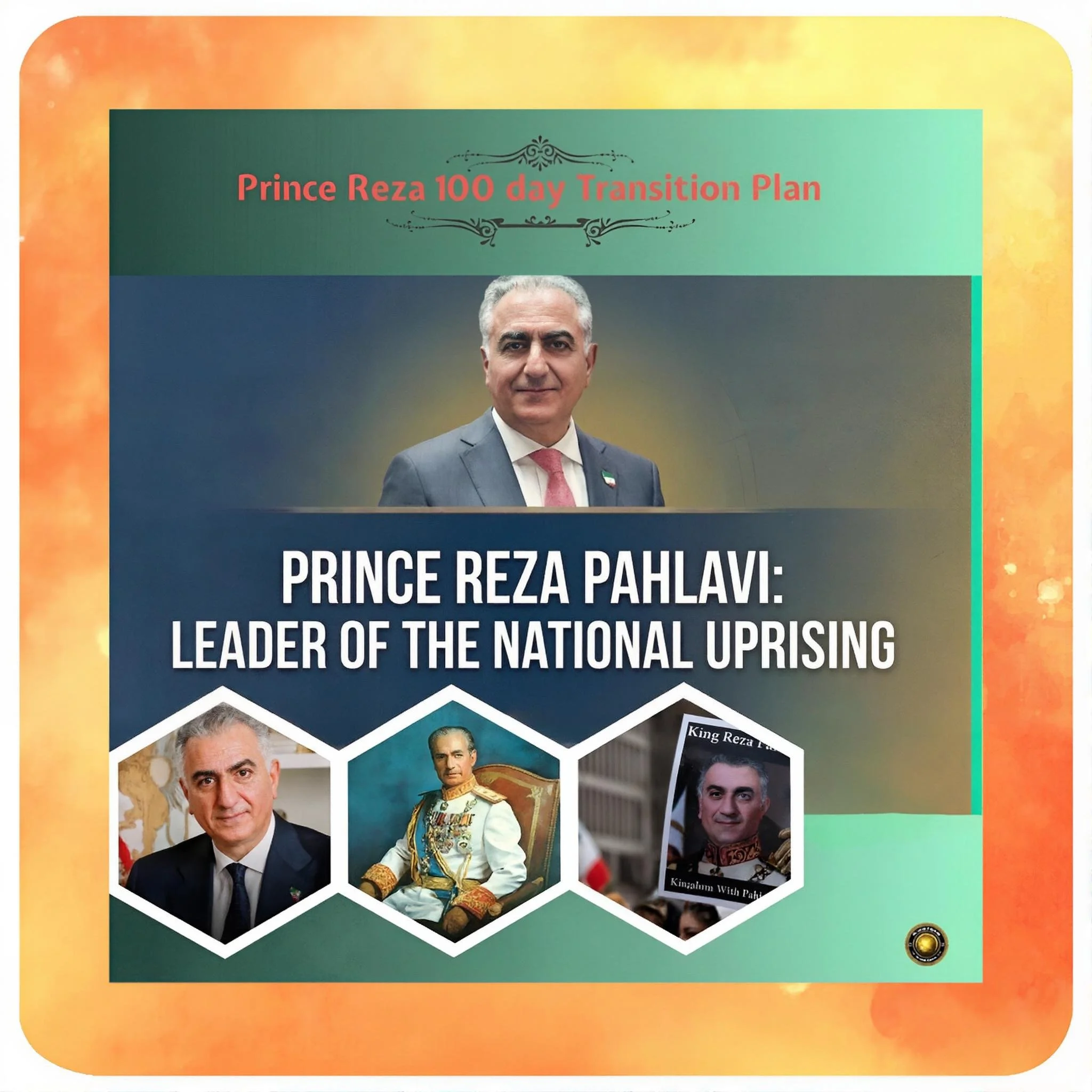
While Mousavi provides constitutional architecture, Reza Pahlavi, the exiled crown prince, offers organizational capacity and international credibility. Born in 1960, Pahlavi has lived outside Iran since 1979, establishing himself as the primary exiled opposition figure advocating for democratic transition.
Critically, he has explicitly renounced ambitions for absolute monarchy, instead proposing that the Iranian people, through constitutional referendum, determine whether to establish a constitutional monarchy, a republic, or another system entirely.
Pahlavi's significance lies less in his personal legitimacy within Iran—which remains contested and contested by skepticism regarding Israeli and American backing—than in his capacity to represent continuity with pre-revolutionary institutions and to command international attention.
His presence legitimizes the opposition transition among regional and Western actors who remain skeptical of Islamic Republic replacement.
More importantly, his team has developed the "Iran Prosperity Project," a detailed transitional roadmap encompassing emergency stabilization, institutional establishment, and long-term economic reconstruction.
The Emergency Phase of the Iran Prosperity Project proposes 180 days of transitional governance focused on maintaining economic stability, ensuring essential services, preventing state collapse, and preparing for the Constituent Assembly elections.
This phase would dissolve the Islamic Republic's constitution and all institutions derived from Supreme Leader authority. Revolutionary Guard economic holdings—estimated at 25-30% of the national economy—would be transferred to transparent private or public oversight rather than military control.
Corrupt revolutionary foundations would face either liquidation or restructuring. Critical state functions would be assigned to technocratic interim authorities rather than ideological appointees.
The Strategic Case for Coalition
The proposed partnership between Pahlavi and a reformist former prime minister addresses the opposition's fundamental organizational weakness. The Iranian opposition abroad remains fragmented, with competing visions, rivalries, and competing claims to legitimacy.
No single faction commands overwhelming support either within Iran or among diaspora communities. However, a coalition pairing Pahlavi's organizational resources and international credibility with a former prime minister's technocratic legitimacy and domestic respect creates a more balanced alternative.
The former premier brings two critical advantages: established experience managing state apparatus, and the capacity to appeal to regime elements who recognize the necessity of transition. Such an arrangement allows the transition team to present itself not as revolutionary vengeance but as state continuity under reformed constitutional principles.
The Mechanism
How Constitutional Transition Prevails
The mechanism by which this transition becomes operative depends on a series of cascading institutional pressures that create decision-making environments favoring negotiated transition over civil war or external military intervention.
First, the regime faces simultaneous stress on multiple fronts: persistent popular mobilization despite repression, visible defections and refusals within the security apparatus, economic deterioration despite any policy response, and international pressure including sanctions and military threat.
No single pressure is necessarily decisive alone, but their combination creates a situation in which regime leadership must contemplate succession scenarios. With Khamenei aged and no successor emerging with clerical consensus, regime elites face a genuine question about institutional viability.
Second, a negotiated constitutional transition offers exit ramps for regime elements that military collapse or revolutionary overthrow would foreclose. Under a constitutional framework, regime officials, military commanders, and bureaucrats could transition into new institutions if they accept the new constitutional order.
A military-imposed transition or foreign intervention would likely result in Nuremberg-style trials and lustration processes. However, a domestically-driven constitutional referendum that transfers authority to the people creates legal and moral grounds for institutional continuity.
This distinction matters enormously: many regime elements might accept constitutional transition if it preserves their institutional positions, whereas they would resist violent overthrow.
Third, the Pahlavi-former PM coalition partners with Mir Hossein Mousavi and other internal opposition figures to maximize the appearance of domestic indigenous leadership.
The transition does not require Pahlavi's personal return to Iran in the transition's early phases—merely his provision of organizational capacity and international advocacy. Mousavi, as an imprisoned figure with revolutionary credentials, becomes the domestic face of constitutionalism.
This division of labor prevents the coalition from being labeled as monarchical restoration or foreign proxy governance.
Fourth, the constitutional framework itself—particularly the requirement for a Constituent Assembly and dual referendums—creates temporal space for coalition-building and trust-generation among fractious opposition elements.
Rather than imposing a predetermined system, the Constituent Assembly process allows different opposition visions (republican, monarchist, secular, federalist, etc.) to compete within a bounded procedural framework. This procedural legitimacy may prove as important as the substantive constitutional outcome.
Key Developments and Strategic Pressure Points
As of January 2026, several developments suggest the plausibility of constitutional transition frameworks gaining traction.
The Munich National Cooperation Conference, convened by Pahlavi in July 2025, brought together over 500 opposition figures across ideological divides—republicans and monarchists, leftists and conservatives, ethnic minorities and majority nationalists—around a shared commitment to territorial integrity, democratic governance, and rule of law. While this coalition remains fragile, its mere formation indicates that the perceived necessity of coordinated transition has overcome historical factional rivalries.
Simultaneously, prominent regime insiders have begun discussing constitutional reform publicly. In January 2026, senior figures including former parliamentary security committee head Heshmatollah Falahatpisheh and former lawmaker Mansoor Haghighatpoor issued statements arguing that the 1989 constitution's structure is fundamentally unsustainable.
They proposed strengthening presidential authority, establishing judicial independence, and limiting the Guardian Council's veto. These proposals, while not explicitly calling for regime change, effectively acknowledge that the current constitutional architecture cannot function. This represents significant movement within the establishment.
Furthermore, external pressure has intensified dramatically. The Trump administration has explicitly stated that Khamenei's removal is desirable and that Washington will consider military options if nuclear negotiations fail. Multiple sources indicate that US military positioning in the Persian Gulf has assumed readiness for escalated operations.
While military strike might not produce regime change, it would likely accelerate internal pressure for negotiated transition—as a military strike would discredit hardliners while demonstrating the regime's inability to protect citizens, thereby strengthening reform elements advocating constitutional transition.
The Cause-and-Effect Analysis
Why This Moment
The convergence of factors that have made constitutional transition credible in January 2026 reflects deep-structural changes in Iran's political economy and geopolitical position.
Economic Collapse as Institutional Delegitimizer: The Islamic Republic's legitimacy, despite revolutionary rhetoric, has always rested partly on its capacity to provide basic economic functions and distribute patronage to supporting constituencies.
The 84% currency collapse in 2025 shattered this capacity. Unlike previous crises that affected specific constituencies, the current collapse affects the entire population universally.
Shopkeepers, regime-connected merchants, security force personnel, and bureaucrats all face simultaneous impoverishment. This universalizes opposition in a way that previous crises did not.
Military Humiliation and Deterrence Collapse: The June 2025 strikes revealed that Iran's 45-year investment in military deterrence had been negated in hours.
The regime's deterrence doctrine depended on the belief that it could impose costs on adversaries sufficient to deter first strikes. This belief died in June 2025. For a regime whose legitimacy depended substantially on "resistance" ideology and deterrence capability, this loss proved psychologically catastrophic.
It created internal questioning about whether the regime's entire strategic vision had been illusory.
Revolutionary Clerical Elite Fragmentation: The revolutionary generation that sustained the regime is aging and dying. Khomeini's generation of ideologically pure clerics who accepted economic hardship as the price of revolutionary transformation has passed.
The current elite consists largely of bureaucrats, security commanders, and younger clerics with no direct revolutionary experience. This cohort has economic interests and survival instincts that may not align with regime perpetuation if transition offers exit opportunities.
Technological and Social Change: Social media, despite government censorship and internet blackouts, has enabled coordination of protests at scales unprecedented in previous waves.
The capacity for protesters to organize across geographic distances, to communicate videos of regime violence and thereby undermine official narratives, and to maintain protest momentum despite physical repression represents a qualitative change. This technological reality has shifted the correlation of forces between regimes and mass mobilization.
International Context Shift: The Trump administration's explicit interest in regime change, its positioning of military force, and its communication that it supports opposition movements creates a different international environment than during the 2009 Green Movement or 2019 and 2022 protests.
While direct military intervention remains costly and risky, this international environment has emboldened opposition figures and created pressure on regime elements to consider managed transition as preferable to scenarios of internal conflict or external military escalation.
The Contentious Questions
Legitimacy, Sequencing, and Implementation
The constitutional transition framework faces legitimate critique on several dimensions that must be addressed for the approach to succeed.
Sequencing and Interim Authority: How can a constitutional transition be implemented when the regime controls security forces? The proposed mechanism depends on enough security force personnel accepting the necessity of transition that they permit the Constituent Assembly elections to occur.
This is not assured. Hardliners could attempt to suppress the transition through force. However, the proposal's proponents argue that the security apparatus is already showing signs of strain and defection; that economic collapse makes repression fiscally unsustainable; and that international pressure, including potential strikes targeting security force leadership, would create pressure toward transition. Nonetheless, the sequencing question—who implements the transition before new authorities assume office—remains contested.
Pahlavi's Legitimacy and Anti-Monarchist Sentiment: Many Iranians harbor deep skepticism toward monarchy and fear that Pahlavi's role in the transition portends restoration of absolutism.
The proposal's framing—that Pahlavi provides organizational capacity while the Constituent Assembly determines the governmental form—addresses this concern procedurally but does not resolve deep emotional opposition to monarchy among significant opposition segments.
The public role of a former prime minister with reformist credentials becomes critical here; Mousavi's visible leadership mitigates Pahlavi's monarchical associations.
International Intervention Risk: The very fact that the Trump administration supports opposition transition increases risk that implementation might be hijacked by external actors pursuing their own strategic interests rather than Iranian democratic self-determination.
The constitutional framework's emphasis on domestic leadership and popular sovereignty provides some protection against this, but complete immunity from external pressure remains impossible given the regional strategic stakes.
Institutional Continuity and Justice: Post-transition societies routinely struggle with lustration—how to address officials' participation in prior regime repressions.
The proposal contemplates "accountability where necessary" but does not detail mechanisms for transitional justice.
Too much prosecutorial zeal could alienate regime elements whose acquiescence is necessary for orderly transition; too little risks creating the impression of impunity that delegitimizes new institutions.
Future Trajectory
Constitutional Democracy and Regional Implications
Should the proposed constitutional transition framework be implemented successfully, the resulting Iranian polity would differ fundamentally from both the current Islamic Republic and historical Pahlavi monarchy.
The constitutional process would likely establish a secular state with constitutional limits on executive power, independent judiciary, democratic elections, and protections for political opposition.
Whether this would assume republican or constitutional monarchy form depends on the Constituent Assembly's deliberations and the second referendum's outcome.
Regionally, a democratic Iran would likely reverse the current regime's regional proxy strategy.
A democratic government accountable to Iranian voters would face pressure to terminate the billions in annual support for Hezbollah, Hamas, and the Houthis.
These groups would likely collapse within months of such support cessation, fundamentally altering the regional balance of power. The loss of the "Axis of Resistance" would constitute perhaps the most significant geopolitical consequence of regime change.
Economically, a transitional government committed to privatization of Revolutionary Guard holdings and integration into the global economy would seek rapid sanctions relief and foreign direct investment.
The return of Iran's 4% of global crude reserves to international markets could depress global energy prices. Capital flight reversal and diaspora investment could mobilize extraordinary resources for reconstruction.
However, these positive scenarios depend on implementation of the constitutional framework rather than descent into civil conflict, external intervention, or hardline coup attempts. The outcome remains genuinely uncertain.
Conclusion
Structural Necessity and Contingent Implementation
The argument for constitutional transition driven by a coalition of Reza Pahlavi and a reformist former prime minister is not utopian assertion but rather analysis of actual structural pressures and available institutional pathways.
The Islamic Republic faces delegitimation not through external propaganda but through internal institutional failure.
The regime cannot solve its economic crises, cannot reconstitute its military deterrence, cannot suppress protest indefinitely, and faces succession crisis with no legitimate successor in sight.
Against this backdrop, constitutional transition offers the only pathway that simultaneously addresses these structural pressures while providing exit ramps for regime elements and avoiding the state collapse risks of violent overthrow or external military intervention.
The Pahlavi-former PM coalition provides organizational capacity and political balance that fragmented opposition lacks. The Constituent Assembly framework provides procedural legitimacy that isolated leaders cannot generate. The referenda process provides repeated popular ratification that no unilateral authority can counterfeit.
Implementation remains contingent and contested. Security force behavior will prove decisive; regime hardliners will resist; external powers may attempt hijacking; and the process could collapse into civil conflict.
But the structural conditions have aligned to make constitutional transition a plausible alternative that serious regime elements may calculate as preferable to scenarios of regime collapse, civil war, or foreign occupation.
For the first time since 1979, the question is not whether the Islamic Republic will transform, but rather which pathway that transformation will follow.
The constitutional framework represents the pathway most likely to produce a stable, legitimate, democratic outcome acceptable to the Iranian people and compatible with regional stability.