Why the Weak Yen and Dollar Shake-Up Are More Critical Than You Realize: Uncovering Japan's $10 Trillion Dilemma and Why Currency Intervention Falls Short
Executive Summary
In January 2026, the Japanese ¥ weakened to its lowest level in 18 months, reaching nearly 160 per $. Meanwhile, the American $ itself weakened to a 4-month low.
These currency movements are not simple economic fluctuations that governments can easily fix with intervention. Instead, they reveal deeper financial problems in both countries that intervention cannot solve.
Japan has accumulated over $6 trillion in foreign investments—mostly in America—built up over decades when Japanese interest rates were nearly zero. Imagine if you borrowed $100,000 at 0% interest to buy rental properties that generate 4% annual returns. That worked beautifully for 20 years.
But now your borrowing costs have risen to 3%, and rental yields are also 3-4%, eliminating your profit. You want to sell those properties and pay back your loan. When millions of Japanese investors make this decision simultaneously, it creates a global financial shock.
Meanwhile, the American $ is weakening because the US government carries over $38 trillion in debt—roughly $110,000 per American citizen—and American manufacturing is contracting. When governments consider currency intervention—coordinated efforts to artificially strengthen or weaken currencies—they are trying to treat symptoms rather than solving the underlying disease. This article explains why that approach will not work and what the real problems actually are.
Introduction
How Japan Became the World's Largest Foreign Investor
To understand the current financial crisis, we need to go back about 40 years. Starting in the 1980s, Japanese interest rates began falling. By the 1990s and 2000s, those rates became extremely low—sometimes nearly zero or even negative. During the same period, American interest rates remained much higher, sometimes at 4% or 5% or more.
This created a simple but powerful situation. Imagine you are a Japanese bank treasurer in 1995. You can borrow money from depositors at a cost of 0.5%. You can lend that money to the Japanese government at 3%. That is a 2.5% profit margin.
But Japanese businesses and consumers do not need loans at these rates—the economy is stagnant. So you look abroad. You borrow 1 billion ¥ at 0.5%, convert it to $10 million (at the 1995 exchange rate), and buy American Treasury bonds paying 5%. Your profit: 5% minus 0.5% equals 4.5%.
This is an enormous profit compared to domestic alternatives.
This carry trade was so profitable that Japanese investors—banks, insurance companies, pension funds, investment managers—kept doing it for 2 decades.
Over time, they accumulated enormous amounts of foreign investments: approximately $6 trillion worth. About half of this money is in American assets like Treasury bonds and stocks. Another 20% is routed through the Cayman Islands (a tax jurisdiction) but ultimately ends up in American investments as well.
In concrete terms, if you added up all the American Treasury bonds owned by Japanese investors, it would equal roughly 15-20% of all US government debt. If you added Japanese ownership of American corporate bonds and stocks, the number becomes staggering.
This strategy worked perfectly as long as 2 conditions remained true.
First, Japanese interest rates had to stay very low compared to American rates.
Second, when Japanese investors needed to convert their foreign earnings back into ¥ to bring the money home, the ¥ had to stay weak or stable in value against the $.
Both conditions held for decades. The ¥ actually weakened from about 80 per $ in 2011 to 150 per $ by 2020—meaning Japanese investors earned huge currency gains on top of their interest rate gains.
Then something changed. Japanese inflation rose modestly. The Bank of Japan realized it could no longer justify keeping interest rates near zero. Beginning in 2023 and accelerating through 2025 and early 2026, Japanese interest rates began rising.
By January 2026, the Bank of Japan raised its policy rate to 0.75%—a record high for Japan. Long-term Japanese government bond yields reached 4% to 4.8%, levels not seen in decades.
For those unfamiliar with bonds, this means that if you buy a 10-year Japanese government bond, the government will pay you 4.8% interest per year. That seems low to Americans, but for Japan, it is revolutionary.
The Mathematical Problem Becomes Crystal Clear
Suddenly, the carry trade's simple mathematics stopped working. Let us compare the old system to the new system using a concrete example:
Old System (2015)
Imagine you are a Japanese pension fund manager with ¥100 billion to invest. You borrow ¥100 billion at 0% interest. You convert it to roughly $1.2 billion (at the 75 ¥-per-$ exchange rate).
You buy American Treasury bonds paying 2.5%. You also buy some American corporate bonds paying 3.5%. Your average return: 3%. Your borrowing cost: 0%. Your profit: 3% per year. For a ¥100 billion position, that is ¥3 billion in annual profit (about $40 million). You have been making this trade for 15 years and earned ¥45 billion in cumulative profits.
New System (2026)
The same pension fund manager looks at the exact same decision. You need to borrow ¥100 billion. But now the cost is not 0%. Banks want 0.75% interest on ¥ loans.
You convert to $1.32 billion (at the 160 ¥-per-$ exchange rate, which is worse than before). You buy American Treasury bonds paying 4.8%.
But here is the problem: you need to hedge your currency risk. If the ¥ strengthens, you will lose money on the conversion back. Currency hedging costs about 0.75%. So your net return on the Treasury bonds is 4.8% minus 0.75% for hedging equals 4.05%. Your net profit: 4.05% minus 0.75% borrowing cost equals 3.3%. Sounds okay? But wait—there is more.
Japanese long-term government bonds now pay 4.8% with virtually no risk. No hedging needed. No currency risk. Pure ¥, pure safety. Why borrow money at 0.75%, take currency risk, and earn 3.3% when you can simply buy Japanese government bonds and earn 4.8% risk-free? The answer is: you should not. This is why the carry trade is unwinding.
But it gets worse for existing positions.
The pension fund manager has ¥100 billion in American Treasury bonds that it purchased years ago when they were paying only 2.5%. Today those bonds are worth less money (because current yields are 4.8%, so old bonds paying 2.5% are worth less).
The fund wants to sell them and convert back to ¥. But when it sells, it will realize losses on positions held for years. Additionally, if the ¥ has strengthened (which it has, from 160 toward 152), the fund loses even more money on the currency conversion. A position that looked profitable 5 years ago now generates losses. The fund has incentive to exit immediately.
This mathematical reality creates pressure for what analysts call carry trade unwind.
Investors who profited from the carry trade for 20 years now face a choice: keep holding foreign investments that barely profit or generate losses, or liquidate those investments and bring the money home. Rational investors choose liquidation.
They sell their American Treasury bonds.
They sell their American stocks. They sell their foreign investments. They convert the proceeds back into ¥. This creates 2 critical problems for global financial markets.
Problem 1
The Capital Repatriation Shock—Trillions Flowing Home
The first problem involves what happens when trillions of dollars flow back to Japan. This phenomenon is called capital repatriation. If even 10% of Japan's $6 trillion foreign portfolio returns to Japan, that represents $600 billion flowing out of global markets in a relatively short timeframe. The impact on American bond markets would be immediate and severe.
Think of it this way. The US Treasury needs to sell approximately $1.5 trillion in new government bonds every year to finance the American government's spending and to replace bonds that mature and must be paid back. Imagine you are the US Treasury selling $1.5 trillion in bonds per year to fund military spending, Social Security, Medicare, interest payments, and infrastructure. For this to work, you need enough buyers willing to buy $1.5 trillion per year.
For decades, Japanese investors have been major buyers. Japan's Government Pension Investment Fund alone manages approximately $1.7 trillion in assets—equivalent to 5% of US Treasury market size.
This fund is the world's largest pension fund. When this fund was aggressively buying American Treasuries, it was absorbing roughly 10-15% of newly issued American bonds. Now that fund (and others) are no longer buying. Worse, they are selling.
Here is what happens next: The supply of Treasury bonds available for sale exceeds the demand for those bonds. In financial markets, when supply exceeds demand, prices fall and interest rates rise. If American Treasury yields spike upward by 1% or 2%, consider the cascade effects:
Someone with a 30-year mortgage at 7% wants to refinance to a lower rate. But rates have jumped to 8% because Treasury yields spiked. That refinance is no longer possible. They cannot afford to move to a new house because borrowing costs are higher.
A small business wanted to borrow $500,000 to expand operations at 7% interest. Now the bank wants 8.5% due to higher Treasury yields. The business owner decides the expansion is not profitable at 8.5% and cancels plans. Workers are not hired.
A state government wants to issue bonds to build a new school. Bond yields have risen from 3% to 4%. Suddenly the project is much more expensive. The state either raises taxes or cancels the project.
A pension fund needs to buy bonds to match liabilities to retirees. Higher yields mean fewer bonds to buy with the same amount of money. The fund becomes underfunded and must raise contributions.
Beyond the Treasury market, capital flowing out of America would depress American stock prices. Foreign investors would no longer provide the demand that has supported US equity valuations.
Consider this: foreign investors own approximately 30-40% of US equities. If capital repatriation causes foreign investors to sell American stocks, US stock indices would decline. This creates a negative feedback loop: as US assets decline in value, foreign investors become even more eager to liquidate and convert to ¥, accelerating the selling process.
The concrete impact: Your 401(k) retirement account likely holds American stocks. If foreign investors dump American stocks due to capital repatriation, your retirement account declines in value. Your home equity declines (as mortgage rates rise). Your ability to retire on schedule becomes threatened.
Problem 2
The Yen Carry Trade Collapse—Margin Calls Everywhere
The second problem involves the hundreds of billions of dollars that were borrowed in ¥ specifically for the carry trade. This is the part that gets very complicated very quickly, but here is a concrete example that illustrates the danger.
Imagine a sophisticated hedge fund called "Pacific Capital Partners" in New York. In 2010, the firm decides to engage in the yen carry trade. The fund borrows ¥50 billion (about $670 million at the 2010 exchange rate) from Japanese banks at 0% interest. It converts this to $670 million.
Then it invests this money in 3 places: $300 million in American technology stocks (particularly growth companies), $200 million in Brazilian government bonds paying 8% interest, and $170 million in Indian corporate bonds and stocks.
For 15 years, this was a beautiful trade. The borrowed ¥ cost nothing. The American tech stocks appreciated enormously (Apple, Google, Microsoft, Amazon all multiplied in value). The Brazilian bonds paid 8% interest. The Indian corporate sector boomed.
The fund's $670 million investment grew to perhaps $2.5 billion in value by 2025. The fund earned roughly 9-10% annual returns. The borrowed ¥50 billion still only cost 0% to borrow. This was one of the best trades in finance.
But now it is January 2026. The ¥ has strengthened from 150 per $ to 152 per $. This might sound small, but for borrowed ¥, it is catastrophic.
The ¥50 billion loan now requires $328 million to repay instead of $333 million. That is a loss of $5 million just on the currency move. Additionally, Japanese interest rates have risen to 0.75%, so the borrowed ¥ now costs the fund 0.75% annually instead of 0%, adding another 0.75% to annual costs.
But the real crisis comes from the fund's use of leverage. Like most hedge funds, Pacific Capital Partners did not just invest $670 million. It used leverage—borrowed more money from brokers using the positions as collateral.
The fund might have invested $3 billion using only $670 million of its own capital. It borrowed $2.33 billion from brokers against the value of its positions.
Now here is what happens when the ¥ strengthens and carry trade unwinding accelerates. The brokers holding the collateral send margin calls.
They say to Pacific Capital Partners: "The value of your collateral has declined because the ¥ is strengthening and you have ¥ liabilities. We require you to deposit $100 million more within 24 hours, or we will liquidate your positions to cover our risk." The hedge fund does not have $100 million in cash (it is invested in stocks and bonds). So the fund must sell immediately.
The fund sells $100 million of American technology stocks. But it is not alone. Other hedge funds face the same margin calls.
Simultaneously, other carry trade funds are selling $50 million of American stocks, $75 million of Brazilian bonds, $60 million of Indian stocks.
Within hours, markets are flooded with sell orders. Stock prices crash. Bond prices crash. The selling accelerates as more funds receive margin calls. Some hedge funds cannot even meet their margin calls. They become insolvent. Their brokers begin bankruptcy proceedings.
This was the scenario that briefly occurred in August 2024 when Japanese interest rate surprise sparked carry trade unwinding.
The S&P 500 dropped from 5,800 to 5,200 in 3 weeks. Global stock markets fell 5-10%. Portfolio managers worldwide held their breath, worried about systemic financial collapse.
A few hedge funds did fail. But the situation stabilized before becoming a full-scale financial crisis. In January 2026, the risk of a much larger, more violent carry trade unwind is looming again.
Why Prime Minister Takaichi's Announcement Made Everything Worse
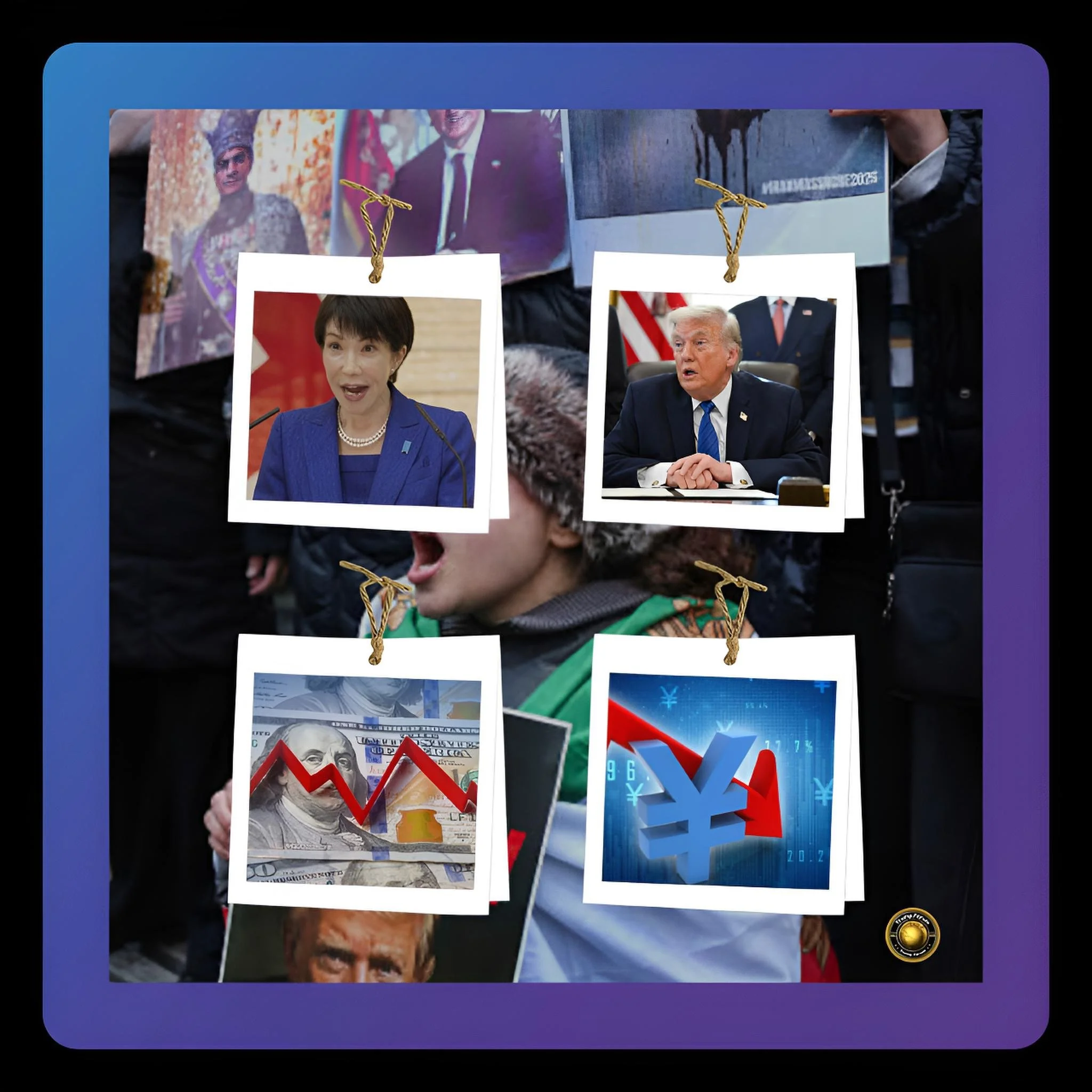
In January 2026, Japanese Prime Minister Sanae Takaichi called a surprise election for February 8 and announced plans for significant government spending increases combined with tax cuts.
Specifically, she proposed reducing the consumption tax from 10% to 2%—an enormous fiscal expansion. She also promised increased spending on defense, infrastructure, and subsidies. This news terrified global markets. Here is why.
If Japan's government increases spending while the Bank of Japan is trying to raise interest rates to fight inflation, the Bank of Japan would need to raise interest rates much higher than currently planned. Here is the logic: When government spends more money, there is more money chasing the same amount of goods.
This increases inflation. To combat inflation, the central bank must raise interest rates. Higher interest rates reduce the amount of money people want to borrow and spend, thereby reducing inflation pressure. But Takaichi's plan would require interest rates to rise much more sharply than previously expected.
If interest rates rise from 0.75% to 2% to 3%, the carry trade unwind accelerates dramatically. Japanese borrowers face even higher ¥ costs. Capital repatriation becomes even more attractive.
The scenario spirals into crisis territory. Japanese government bond yields spiked. Long-term 40-year Japanese bonds hit record yields above 4% for the first time. Investors interpreted this as the market saying: "Interest rates will need to be much higher for much longer."
This bond market turmoil then rippled across the Pacific to America.
American Treasury Secretary Scott Bessent expressed concern that Japanese bond market instability could impact American financial markets. He worried that if Japanese investors need to repatriate capital, they would need to sell their American Treasury holdings.
If Japan's largest pension funds and insurance companies sold $100 billion or $200 billion in US Treasuries, yields would spike.
Investors everywhere began asking: if Japanese investors are selling Treasuries, will we need to accept much lower prices (higher yields) to induce other buyers to step in?
The Intervention Signal That Almost Happened
Facing this crisis, policymakers in both Japan and America considered currency intervention. On January 24, 2026, the Federal Reserve in New York conducted rate checks with major banks. This is financial language for: "If we wanted to intervene in the currency market to strengthen the ¥, how much would it cost? How much would we need to spend?"
This is not actual intervention, just asking about the mechanics. The Federal Reserve might ask a bank: "If we wanted to buy $50 billion worth of ¥ in the spot currency market today, what is the lowest price you could execute?" The bank responds with pricing. This allows the Fed to understand whether intervention is feasible and what it would cost.
But the signal was powerful. Markets interpreted it as meaning: "The Federal Reserve and Bank of Japan are considering coordinated intervention." This interpretation alone was extremely effective. The ¥ immediately strengthened by 1.6%—its biggest rally in nearly 6 months. Investors worldwide saw this as the central banks "getting serious" about defending the ¥. Hedge funds that had bet the ¥ would weaken (a short position) became frightened and covered those positions. Pension funds that had planned to repatriate capital decided to wait and see if intervention actually occurred.
Yet by late January, the intervention signal faded. No actual intervention occurred. The Bank of Japan and Federal Reserve decided that intervening was not the right approach.
The ¥ began weakening again, heading back toward 155-157 per $. This revealed something important: intervention is a psychological tool, not a fundamental economic tool.
Why Currency Intervention Cannot Solve the Underlying Problem
At its core, currency intervention involves a central bank (the Federal Reserve or Bank of Japan) buying ¥ to make it more valuable, or selling ¥ to make it weaker. To buy ¥, the central bank spends its foreign currency reserves—the stash of dollars or euros or other currencies that governments keep on hand.
The Bank of Japan holds approximately $1.2 trillion in foreign reserves. The Federal Reserve holds perhaps another $800 billion in gold and foreign assets.
So theoretically, they could spend $50 billion or $100 billion buying ¥, which would temporarily strengthen it. For a few days or weeks, the ¥ would be stronger than it otherwise would be.
But here is the critical limitation: intervention cannot change the underlying mathematics of interest rates and investment returns. If Japanese rates are 4% and American rates are 4%, then no currency intervention can make American investments attractive to Japanese investors.
Eventually, Japan's investors will want to bring their money home regardless of the ¥ exchange rate. A stronger ¥ might slow the repatriation process slightly—making it slightly less profitable to sell dollar assets and convert back to ¥. But it cannot prevent repatriation. The math is too powerful.
Think of it like water. If you dam up a river to make it go up a hill, eventually the pressure builds and the dam fails.
The water comes down the hill much more violently than if you had let it flow naturally. Intervention works similarly. If the Bank of Japan spends $50 billion propping up the ¥ to 150-152 per $, this slows Japanese capital repatriation temporarily. But the repatriation needs do not disappear. They just get delayed. Japanese investors still face the reality that ¥ assets pay 4% and $ assets pay 4%. They still need to repay ¥-denominated carry trade loans. They still face margin calls.
Eventually, the pressure becomes too great. Japanese investors force the issue. They sell dollars in massive quantities. The ¥ suddenly strengthens dramatically—much more than if it had been allowed to strengthen gradually. The carry trade margin calls accelerate sharply. The financial disruption becomes worse than if intervention had never occurred.
Furthermore, there is a deeper political problem for the Federal Reserve. Buying ¥ means selling $ and buying ¥ with those dollars. This expands the Federal Reserve's balance sheet—the Fed now holds more ¥ and less $.
An expanded Federal Reserve balance sheet, without matching restraint in federal government spending, is inflationary. It also looks like the Federal Reserve is subordinating its independence to political goals set by the Treasury Department or other political figures. If markets lose confidence in Federal Reserve independence, the dollar weakens even more. This undermines the entire dollar system.
In the 1990s, the Federal Reserve intervened in currency markets several times. The results were mixed at best. Research by economists studying these interventions found that they frequently failed to achieve their objectives, or if they worked temporarily, the effects dissipated within weeks.
The consensus among monetary economists today is that intervention is a poor tool for managing exchange rates. Markets are too large, capital flows too vast, and fundamental factors too powerful.
The Dollar's Weakness as a Sign of American Financial Weakness
While discussions focus on the ¥, the $ itself is weakening. The dollar index—a measure of the dollar against a basket of 6 other major currencies including the €, ¥, British pound, and others—fell to 96, a 4-month low. The dollar has depreciated about 10% over the past 12 months. Why is the world's reserve currency weakening?
The answer is uncomfortable for Americans. The United States government carries approximately $37 trillion in debt. Let that number sink in. $37 trillion. The US population is about 330 million people. That means every American citizen, from newborns to elderly, has a share of $112,000 in federal debt. This debt level is extraordinarily high. To put it in perspective:
In 1970, US federal debt was 40% of GDP. Today, it is 130% of GDP.
In 2000, federal interest payments were about 2% of federal budget. Today, they are about 15% of the federal budget—money that goes to paying interest rather than providing services.
By 2035, interest payments are projected to be 25-30% of the federal budget if current trends continue.
To finance this debt, the US government must issue about $1.5 trillion in new bonds every year, plus refinance several trillion in bonds that are maturing. If interest rates are 4%, annual interest costs are $1.5 trillion on a $37 trillion debt—roughly $4,500 per capita annually, or approximately 5-6% of all federal revenue. As rates rise, this becomes worse.
Additionally, American manufacturing is contracting. In January 2026, the ISM Manufacturing Index stood at 47.8—below 50, which marks the boundary between expansion and contraction. This has been true for 5 consecutive months. American factories are producing less, hiring less, and investing less. This is not a sign of economic strength.
Additionally, there is political uncertainty. President Donald Trump has pressured the Federal Reserve to cut interest rates, rhetoric that markets interpret as threatening the central bank's independence. There is also the recurring threat of government shutdowns—fights between Congress and the President over budget spending that have caused temporary closures of federal government operations. All of this erodes confidence in the $ as a reliable store of value.
Consider an analogy. You are a foreigner deciding where to invest $1 million. Option A: Buy American Treasury bonds from a government with $37 trillion in debt, rising interest burdens, declining manufacturing, and a political situation where the President pressures the central bank for political gain. Option B: Invest in another country with lower debt, stable politics, and strong fundamentals. Which do you choose?
From the perspective of foreign investors holding American Treasury bonds, the calculation is stark. If Treasury yields are 4.8%, but you expect the $ to depreciate by 2-3% annually (which seems increasingly likely given fiscal deterioration), then your real return is maybe 2%. Meanwhile, Japanese bonds now yield 4-5%, the euro provides similar yields, and other alternatives exist. The math now favors holding Japanese bonds or other alternatives, not American bonds.
So the dollar weakens not because of intervention or manipulation, but because fundamental economic conditions have shifted. American fiscal problems are real, and they show up in the currency market first—earlier and more honestly than in other economic indicators.
Currency markets are like a truth-telling mechanism. They cannot be fooled for long. When a government carries unsustainable debt, currency markets eventually punish that currency by weakening it.
What Happens Next
Three Possible Scenarios
Scenario 1: Gradual Repatriation and Soft Landing (probability: 40%)
The optimistic case is that Japanese capital repatriation happens gradually over 12-24 months rather than suddenly.
Investors slowly reduce foreign holdings and bring money home. Perhaps Japanese pension funds say: "We will sell 2% of our foreign holdings each quarter." This gradual selling creates moderate upward pressure on American Treasury yields (maybe 0.5-1% increase) and causes stock prices to fluctuate but not crash.
The US Treasury market absorbs the selling by increasing coupon rates and attracting other buyers. Stock markets decline 5-15%, which feels bad but is not catastrophic.
American homeowners see mortgage rates creep upward to 8.5-9%, but new home sales simply decline rather than crash. American businesses experience higher borrowing costs, which slows growth but does not cause recession. The financial system adapts.
This requires Japanese authorities and American authorities to avoid large-scale intervention that might trigger panic. It requires the Bank of Japan to communicate clearly: "We are raising rates because inflation requires it.
This is normal. Japanese investors, you should expect capital repatriation to happen gradually." It also requires the Treasury Department to say: "We understand Treasury yields will rise as foreign demand declines. This is normal and manageable."
Scenario 2: Disorderly Unwind and Sharp Downturn (probability: 45%)
The middle case is that capital repatriation accelerates sharply when investors lose confidence in the process unfolding in an orderly fashion. Perhaps Takaichi's government wins the election and announces massive spending plans. Interest rate markets price in 3% rates by 2027.
Suddenly, Japanese investors recognize that waiting is a mistake—they should sell now before rates go even higher. Carry trade margin calls accelerate. Within days, $200 billion in capital starts repatriating.
Treasury yields spike by 1-2% (from 4.8% to 6%+). Stock markets experience 10-20% corrections.
Technology stocks decline by 25-35% because investors flee growth stocks. The S&P 500 falls from 5,800 to 4,600. This damages 401(k)s and retirement accounts significantly—many Americans' retirement portfolios lose 15-20% of value.
Mortgage rates spike to 8.5-9%. Home sales collapse. Some real estate developers become insolvent. Some banks that concentrated in commercial real estate lending face problems. Credit card defaults spike as consumers face higher borrowing costs.
American unemployment rises from 4% to 5.5%. But the financial system avoids collapse. The Fed acts as lender of last resort. Large banks do not become insolvent. The bond market adjusts.
By late 2026, things stabilize at higher interest rate levels.
Scenario 3: Financial Crisis and Systemic Collapse (probability: 15%)
The worst case involves carry trade margin calls triggering cascading defaults. Perhaps an unexpected shock occurs—a geopolitical crisis in Taiwan, a Middle East crisis that spikes energy prices, or a Chinese financial crisis. Japanese investors panic and try to liquidate everything simultaneously.
Margin calls hit thousands of investors at once. Some leveraged hedge funds or banks cannot meet margin requirements and face insolvency. Lehman Brothers (from 2008) or Credit Suisse (from 2023) scenarios repeat. The financial system enters "risk-off" mode where no one trusts anyone. Banks stop lending to each other.
Credit seizes up. Money markets experience stress. Stock markets crash by 20-30% or more. The S&P 500 falls from 5,800 to 4,000. Treasury yields spike despite risk-off conditions (flight-to-safety is overwhelmed by selling pressure).
Home values decline sharply. Unemployment spikes above 7%. Recession becomes a severe contraction. Government deficits widen further as revenue declines and unemployment benefits spike.
Currently, most economists believe this scenario is less probable than the other 2, but it cannot be ruled out. In 2008, few expected such severe financial crisis, yet it happened.
Why Intervention Is a Distraction From the Real Solution
The political appeal of currency intervention is obvious. It appears to be "doing something" when financial markets are volatile. Announcing intervention (even without actually doing it) calms markets temporarily.
Politicians and central bankers get praised in newspapers for being "strong and decisive" leaders who "took action." Stock markets rally 1-2% when intervention is announced. But intervention is addressing a symptom while ignoring the disease.
The real solution requires difficult economic choices that politicians strongly dislike:
For the United States
The government must reduce the federal deficit. This means either spending less money or raising more tax revenue (or some combination). Neither is politically popular. Reducing military spending will anger defense contractors and generals.
Reducing entitlements like Social Security or Medicare will anger voters. Raising taxes will anger wealthy donors and business groups. But without deficit reduction, American debt will continue to grow faster than the economy. Treasury yields will rise.
The $ will weaken. Investors will lose confidence. Eventually, America may face a fiscal crisis where it cannot borrow at reasonable rates. Greece faced this in 2010-2012. It is not impossible for the US. There is no escaping this arithmetic.
For Japan
The government must accept that carry trade unwinding and capital repatriation are necessary and normal. Fighting this process through intervention only makes it worse when intervention eventually stops.
Instead, the Bank of Japan should accept that interest rates must rise to absorb capital repatriation domestically. When Japanese investors bring $100 billion back to Japan and convert it to ¥, this increases the supply of ¥. To prevent the ¥ from becoming worthless, interest rates must rise to increase demand for ¥.
This is natural and healthy. Prime Minister Takaichi's plan to increase spending and cut taxes is precisely the wrong policy response. It prevents interest rates from rising, which makes the carry trade unwind worse.
Japan should instead pursue fiscal consolidation—restrain spending, reduce deficits, strengthen the fiscal position. This would allow interest rates to be lower while still attracting capital inflows.
For the global financial system: Everyone must recognize that the era of cheap ¥ funding of global investments is over. The financial system was built on this foundation. Hedge funds, banks, pension funds, insurance companies—they all used carry trades as a way to amplify returns.
The entire practice of leverage was predicated on getting 1-2% cost of funds while earning 4-5% returns, netting 3-4% in the middle. Now that costs have risen, those returns are not possible. The system must rebalance. That rebalancing will be painful.
Pension funds will have lower returns and will reduce pension payments. Insurance companies will need to charge higher premiums. Hedge funds will have lower assets under management. But preventing this rebalancing through intervention just delays and magnifies the pain.
Conclusion
Markets Are Telling the Truth
When you see the ¥ weakening and the $ weakening simultaneously, that is not a currency problem. That is a signal that both the Japanese and American fiscal and monetary systems face serious challenges. Japan has carried too much foreign debt on its balance sheet, financed through carry trades that were never sustainable.
America has carried too much government debt, assuming that its fiscal discipline no longer matters because of the dollar's reserve currency status. This assumption has proven false.
Markets are telling the truth about these problems through exchange rates.
The ¥ is weak because Japanese investors want to bring money home—the carry trade profit has evaporated. The $ is weak because American debt has become unsustainable—investors are reducing dollar allocations and diversifying into alternatives. Both currencies are transmitting honest signals about underlying economic realities.
When governments try to intervene against the market's message, they do not prevent the adjustment. They simply delay it and make it more violent when it finally comes. A ¥ that weakens from 160 to 170 gradually creates manageable adjustment. A ¥ that strengthens due to intervention to 150, then collapses to 180 when intervention stops, creates chaos.
The most financially stable response is to permit exchange rates to adjust to reflect reality, and to implement the fiscal and monetary policy changes necessary to address the underlying problems.
For America, this means reducing deficits.
For Japan, this means accepting higher interest rates.
For the global financial system, this means unwinding carry trades and rebalancing toward more sustainable structures. Currency intervention, however well-intentioned, is a distraction that makes the eventual adjustment worse.
The intelligent course is to accept the ¥'s weakness and the $'s weakness as accurate reflections of reality, and to address the real problems—fiscal imbalance in America and unwind of unsustainable capital flows from Japan—through macroeconomic policy adjustment rather than through currency market manipulation.