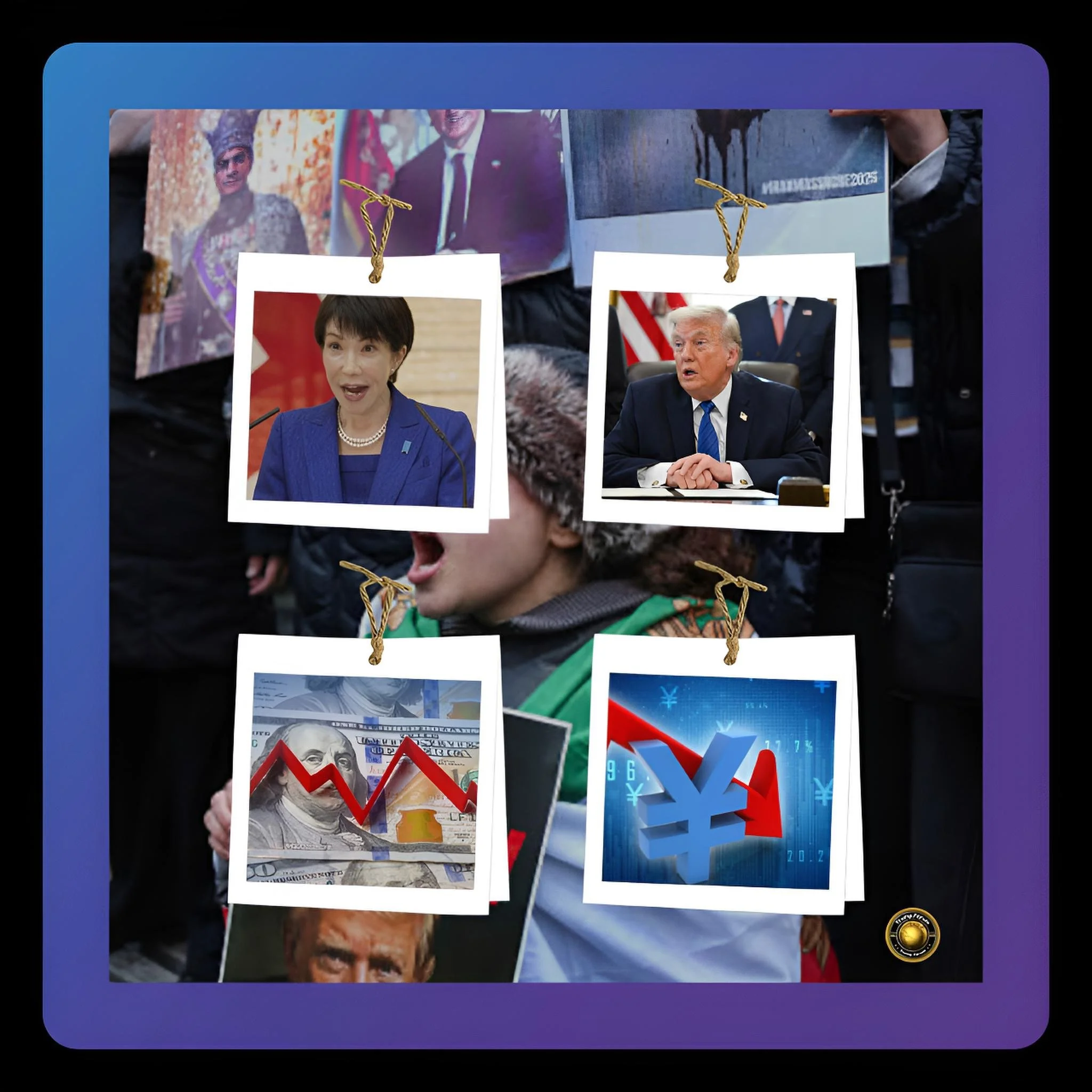
Why the Weak Yen and Weak Dollar Matter: $ v/s ¥ - 101 For Dummies
Summary
What Is Happening Right Now?
In January 2026, the Japanese ¥ hit its weakest level in 18 months, reaching nearly 160 per $. Meanwhile, the American $ itself weakened to a 4-month low.
These are not simple currency fluctuations.
They reveal deep financial problems in both countries.
Understanding why requires knowing a 20-year story about Japanese investors and their relationship with American bonds.
The Profitable Trade That Worked for 20 Years
Starting in the 1990s, Japanese banks and pension funds discovered a simple but profitable strategy. They could borrow ¥ at nearly 0% interest.
They converted that ¥ into $ and bought American Treasury bonds paying 4-5% interest.
The math was simple: borrow at 0%, earn 4%, keep 4% profit. This was an enormous return compared to domestic alternatives.
Imagine you borrowed $100,000 at 0% interest, invested it in rental properties generating 4% returns, and pocketed $4,000 annually.
For 20 years, this worked perfectly.
Japanese investors accumulated approximately $6 trillion in foreign investments using this strategy.
Roughly half of this $6 trillion is in American assets.
Then Everything Changed in January 2026
The Japanese central bank raised interest rates to 0.75%—the highest level in Japanese history.
Long-term Japanese government bonds now pay 4-5%, equal to American Treasury yields. Suddenly, the math broke down.
Old math
Borrow at 0%, earn 4%, profit 4%
New math
Borrow at 0.75%, pay 0.75% for currency hedging, earn 4.8%, profit 3.3%
But here is the real problem
Japanese government bonds now pay 4.8% with zero risk.
Why borrow money at 0.75%, take currency risk, and earn 3.3% when you can simply buy Japanese bonds and earn 4.8% risk-free?
The answer is: you should not.
This creates what analysts call "carry trade unwind."
Millions of Japanese investors want to sell their American investments and bring money home.
If even 10% of Japan's $6 trillion foreign portfolio returns to Japan, that is $600 billion flowing out of American markets.
Why This Shakes Global Markets
When $600 billion flows out of American bond markets, something breaks.
The US Treasury needs to sell approximately $1.5 trillion in new bonds annually to finance government spending.
If Japanese investors stop buying and start selling, the supply of bonds exceeds demand.
When supply exceeds demand, prices fall and interest rates spike upward.
If Treasury yields jump by 1-2%, consider the cascade: Mortgage rates jump from 7% to 8%.
Americans cannot refinance homes. New home sales collapse.
Small businesses cannot borrow for expansion.
Pension funds become underfunded. Stock markets decline as foreign investors sell American stocks to raise cash for repatriation.
The Government's Flawed Response
Both the Federal Reserve and Bank of Japan considered currency intervention—buying ¥ to prop up its value.
On January 24, they conducted "rate checks," essentially asking: "How much would it cost to intervene?" This signal alone strengthened the ¥ by 1.6%.
But intervention cannot solve the underlying problem. The fundamental issue is not currency supply. It is the mathematics of interest rates.
No amount of central bank buying can change the fact that Japanese bonds now pay 4% and American bonds pay 4%.
Investors will repatriate capital regardless of currency intervention. Intervention only delays the adjustment and makes it more violent when it eventually occurs.
Why Both Currencies Are Weak
The ¥ is weak because Japanese investors want to bring money home.
The $ is weak because America carries $37 trillion in debt (130%+ of GDP), manufacturing is contracting, and confidence in the dollar is eroding.
Currency markets are truth-telling mechanisms.
They cannot be fooled. When economies face unsustainable debt, currencies weaken.
The intelligent response is not intervention but rather fiscal adjustment: America must reduce its deficits; Japan must accept higher interest rates.
Intervention is a distraction that makes the eventual adjustment worse.