
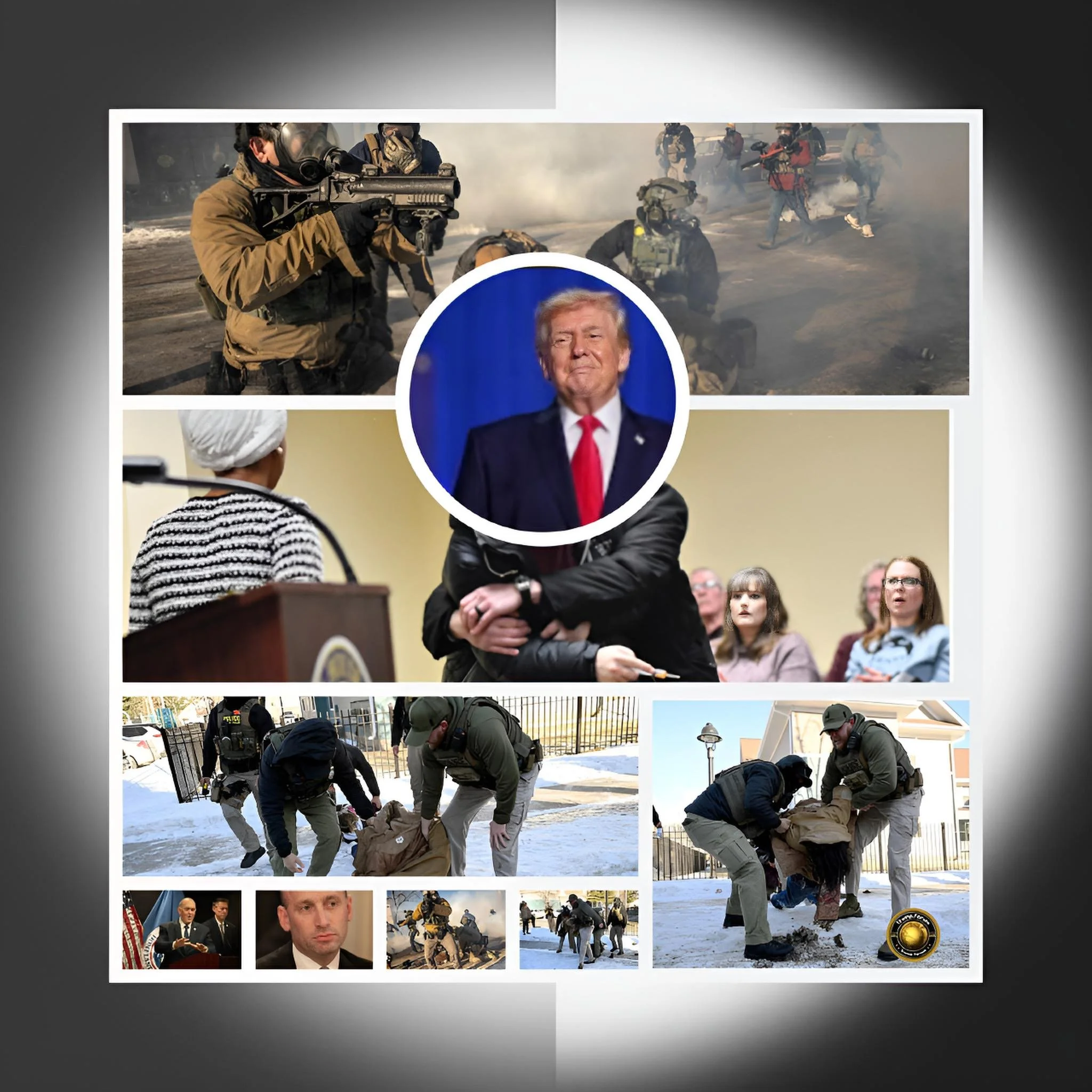
Immigration agents have effectively turned into Donald Trump's personal entourage: A growing liability both for America and increasingly for the President
Executive Summary
The transformation of Immigration and Customs Enforcement and Customs and Border Protection into instruments of presidential political power during Operation Metro Surge represents a constitutional inflection point with cascading electoral, diplomatic, and democratic consequences.
The killings of Renée Good on January 7, 2026, and Alex Pretti on January 24, 2026—both American citizens protesting federal immigration operations—followed by the January 27 assault on Representative Ilhan Omar, have crystallized perceptions that ICE functions as Donald Trump's personal posse rather than as constitutionally constrained law enforcement.
The deployment of 3,000 agents to Minneapolis, yielding 96 documented court order violations and 2 citizen deaths within 3 weeks, has triggered unprecedented international condemnation including Germany's travel advisory warning citizens about violence by U.S. authorities, Ecuador's formal diplomatic protest over Vienna Convention violations, and 60 Fortune 500 CEOs demanding de-escalation.
The Economist characterized the operation as placing Trump "on the back foot" after "widespread outrage" forced tactical retreat, while maintaining that immigration agents operating as a presidential posse constitute "a liability for America and, increasingly, for him."
The 2026 midterm elections will determine whether this model of federal force—loyal, armed, unaccountable, and deployed against political adversaries—becomes normalized or rejected through electoral sanction.
Introduction
Shock and Awe Under Siege
The federal government's assault on Minneapolis continues, yet for the past several days it is Donald Trump's shock-and-awe campaign to rid America of illegal immigrants that has seemed under siege.
The Economist's January 28 assessment captures the administration's predicament: widespread outrage at the killings of Renée Good and Alex Pretti, 2 American citizens protesting against ICE conduct, has put the administration on the back foot.
The January 27 attack on Ilhan Omar, a Democratic congresswoman from Minneapolis and longtime target of conservative animosity, further cemented the notion that events in the city were spiraling dangerously out of control.
Good, a 37-year-old mother of 3, was shot 3 times by ICE agent Jonathan Ross on January 7, 2026, as she drove away from a street encounter.
Video evidence from The New York Times and ABC News contradicted the administration's claim that she attempted to "run over" officers, showing her steering wheel turned away from the agent who fired. Pretti, a 37-year-old intensive care nurse with a valid concealed carry permit, was shot approximately 10 times by 2 CBP agents on January 24, 2026, while filming federal operations.
Multiple videos showed him not reaching for his holstered weapon; at least 1 angle captured an agent removing the gun from Pretti's waist moments before shots were fired.
The Omar assault occurred during a January 27 town hall where the congresswoman called for abolishing ICE and demanded the resignation or impeachment of DHS Secretary Kristi Noem following the Good and Pretti killings.
Anthony J. Kazmierczak, 55, rushed from the front row and sprayed Omar with a syringe containing a liquid later identified as apple cider vinegar. According to the FBI affidavit filed January 29, 2026, Kazmierczak had told a close associate years earlier, "Someone should kill that b****," referring to Omar. As he was led away, Kazmierczak allegedly shouted, "She's not resigning. You're splitting Minnesotans apart."
Omar continued her speech after the attack, declaring: "I'm a survivor, so this minor agitator won't intimidate me." She told the crowd: "Bullies don't win."
The incident occurred hours after Trump attacked Omar at an Iowa rally, reinforcing perceptions that federal operations target Trump's political adversaries. Federal prosecutors charged Kazmierczak on January 29 with "forcibly assaulted, opposed, impeded, intimidated and officer and employee of the United States."
Separately, federal prosecutors in Kansas charged a man there with making death threats against Omar on Facebook, underscoring the escalating threat environment.
History and Current Status
The Institutional Architecture of Presidential Force
The trajectory toward treating immigration enforcement as a presidential instrument traces to post-9/11 security expansion but accelerated exponentially during Trump's second term.
The creation of DHS in 2003 consolidated immigration functions under a national security mandate, granting ICE and CBP extraordinary authorities within the 100-mile border zone encompassing approximately 200 million Americans. Statutory expansions through the 2005 REAL ID Act and subsequent legislation created a framework where immigration enforcement operated with fewer civil liberties constraints than traditional law enforcement.
Trump's first term weaponized these authorities through family separations, workplace raids targeting Latino communities, and deployment against protesters in Portland and Washington, D.C. His second term supercharged the model through what internal ICE documents characterize as "wartime recruitment":
ICE expanded from 10,000 to over 22,000 personnel in 4 months between September 2025 and January 2026, reducing training from 6 months to 6 weeks while offering $50,000 signing bonuses and direct hire authority circumventing traditional federal hiring safeguards. The agency processed more than 220,000 applications to identify 12,000 new recruits, deploying thousands into the field before completing full training protocols.
The One Big Beautiful Bill Act allocated $170 billion over 4 years for immigration enforcement—funding that dramatically exceeded allocations for traditional justice agencies including the FBI and DEA.
The Trump administration also granted immigration enforcement authorities to 5 additional federal agencies: the Drug Enforcement Administration, Federal Bureau of Prisons, U.S. Marshals Service, U.S. Postal Inspection Service, and Bureau of Alcohol, Tobacco, Firearms, and Explosives.
This "blending of federal law enforcement" creates what critics characterize as a vast presidential force unmoored from traditional agency missions and accountability structures.
Operation Metro Surge operationalizes this capacity through saturation deployment: 3,000 agents flooded Minneapolis in December 2025, with Trump announcing on January 6 an additional 2,000 agents making it "100% of ICE in the Twin Cities—our largest operation to date."
As of January 29, 2026, the operation has yielded approximately 3,000 arrests but also 96 documented court order violations found by Chief U.S. District Judge Patrick Schiltz, 2 citizen deaths, the Omar assault, disruption of schools and businesses, and mass protests.
Al Jazeera reported Minneapolis residents describing the situation as a "federal invasion," with ICE agents significantly outnumbering local law enforcement in a city of 425,000 within a state of 5.7 million—estimated to have approximately 100,000 undocumented immigrants according to Migration Policy Institute data.
Key Developments
Deaths, Assault, and Cascading Political Crisis
The Good killing established the pattern of federal impunity and narrative distortion. DHS Secretary Kristi Noem characterized Good as having committed "an act of domestic terrorism" by attempting to "run over" federal agents. Subsequent video analysis contradicted this account.
Agent Ross fired 3 shots in under 1 second as Good's vehicle departed, with the steering wheel turned away from his position. Minnesota law enforcement sought independent investigation; federal authorities blocked their access to the crime scene and refused cooperation despite valid judicial warrants. No charges have been filed. Ross's identity is public, but he remains on duty pending internal DHS review.
Pretti's death escalated the crisis exponentially. The 37-year-old nurse was watching and filming ICE operations when confronted by CBP agents. During a physical altercation, 1 agent shouted that Pretti possessed a gun, prompting 2 agents to discharge their weapons approximately 10 times.
A DHS report to Congress acknowledged these facts while asserting Pretti was "brandishing" a firearm. BBC Verify analysis found no evidence Pretti reached for his weapon.
The 2 shooters have been placed on administrative leave but their identities remain undisclosed. Minnesota authorities were again denied investigative access. The Trump Justice Department declined to open a civil rights investigation.
The Omar assault occurred within this escalating context. During the January 27 town hall, Omar stated: "ICE cannot be reformed. ICE cannot be fixed. We must abolish ICE for good. Secretary Kristi Noem must resign or face impeachment."
Moments later, Kazmierczak—seated in the front row—rushed the stage with a syringe and sprayed her with apple cider vinegar. FBI special agent Derek Fossi's affidavit documented that Kazmierczak had expressed violent intentions toward Omar years earlier, telling an associate "Someone should kill that b****."
The incident's timing—hours after Trump's Iowa rally attacking Omar—reinforced perceptions of coordination or at minimum a threat environment cultivated by executive rhetoric. Omar represents Minnesota's 5th congressional district, encompassing Minneapolis, making her the highest-profile elected official opposing Operation Metro Surge. The assault targeted her specifically during an act of constituent service, in a political climate where the president vilifies her routinely and federal forces saturate her district.
These developments triggered unprecedented responses: Germany's Federal Foreign Office issued a travel advisory on January 28 warning German citizens to "be vigilant and stay away from crowds where violence might occur" in Minneapolis and other cities experiencing clashes with "migration and security authorities."
Ecuador filed a formal diplomatic complaint after an ICE agent attempted to enter the Ecuadorian Consulate on January 27, violating Vienna Convention protections of diplomatic sovereignty. An ICE agent opening the consulate door and threatening an employee—"If you touch me, I'll grab you"—after being informed "This is the Ecuadorean consulate. You're not allowed to enter" constitutes a breach of international law.
Sixty Minnesota Fortune 500 CEOs including those from Target, 3M, UnitedHealth Group, General Mills, and Cargill signed an open letter demanding "immediate de-escalation," breaking longstanding corporate political silence.
Latest Facts and Concerns
Personal Posse Characteristics and Democratic Peril
The characterization of ICE as Trump's "personal posse" rests on operational, political, and structural attributes distinguishing it from constitutional law enforcement:
First, executive loyalty over institutional independence. The ICE union endorsed Trump with over 95% membership approval. Tom Homan, the border czar, is a direct presidential appointee operating outside traditional civil service protections.
Trump administration officials including the President, Vice President JD Vance, and DHS Secretary Noem have publicly defended agents involved in both killings, characterizing victims as threats despite video evidence.
This rhetorical alignment signals agents that the executive will protect them regardless of conduct, creating behavioral incentives favoring aggression over restraint.
Second, deployment patterns targeting political adversaries. Operation Metro Surge concentrates 3,000 agents in Minneapolis—represented by Omar, Trump's frequent target since his first term. The timing coincides with Omar's increased visibility opposing ICE operations.
The Omar assault occurred during an event explicitly calling for abolishing ICE and removing Noem, with the assailant attacking moments after her statement. While Kazmierczak appears to be a private actor rather than government agent, the incident occurs within a threat environment cultivated by executive rhetoric demonizing Omar and saturation deployment of federal force in her district.
Third, operational anonymity and impunity. Agents operate masked, preventing identification. The 2 agents who shot Pretti remain unnamed despite killing a U.S. citizen. Internal investigations proceed without independent oversight. Minnesota authorities are excluded from crime scenes despite judicial warrants.
Qualified immunity doctrine shields agents from civil liability. Federal prosecutorial discretion—controlled by the executive—determines whether criminal charges proceed. This architecture eliminates traditional accountability mechanisms, rendering agents accountable only to executive political leadership.
Fourth, supremacy assertions over federalism. Homan stated federal officials are "not leaving the state until the problem is gone" and told protesters to "protest Congress, not ICE." This positions ICE as executing executive will independent of state consent or judicial constraint.
The 96 court order violations documented by Judge Schiltz indicate systemic defiance of judicial authority. The exclusion of state investigators represents an assertion that federal agents operate above state law within state territory—a claim inconsistent with constitutional federalism.
Fifth, militaristic deployment patterns. Three thousand tactical agents in unmarked vehicles, often masked, conducting street sweeps without local coordination resembles occupation more than community policing. Al Jazeera reported residents describing the situation as an "invasion."
Schools shifted to remote learning. Businesses closed. Families avoided public spaces. This atmosphere of intimidation serves political purposes beyond immigration enforcement: demonstrating executive power, punishing resistant jurisdictions, and telegraphing willingness to deploy force domestically.
The Economist observed these dynamics place Trump "on the back foot" politically, noting "Mr Trump is worried enough that he has dispatched Tom Homan, his border czar, to take charge." Homan's January 28 guidance directed agents to avoid "agitators" and adopt "targeted enforcement" focusing on immigrants with criminal charges or convictions. Commander Gregory Bovino was replaced. These tactical adjustments suggest recognition of political liability without abandonment of the posse model.
Cause-and-Effect Analysis
From Posse Deployment to Political Backfire
The causal logic transforms enforcement advantage into electoral liability through interconnected mechanisms operating across multiple domains:
Executive rhetorical signaling (attacks on Omar, characterizations of victims as terrorists) → posse mobilization (3,000 agents to Minneapolis) → operational impunity (masks, exclusions, court violations) → violence escalation (Good and Pretti killings) → public outrage (protests, litigation) → political backlash amplified (Omar assault crystallizes perceptions) → institutional pressure (international condemnation, corporate resistance, judicial findings) → tactical retreat (Homan dispatch, Bovino replacement, guidance changes) → strategic persistence (Homan: "not leaving until problem solved") → reinforced posse loyalty (agents understand executive protection continues).
This feedback loop creates electoral vulnerability through several pathways. Base Republican voters approve deportation operations at approximately 70% according to Pew polling, sustaining Trump's incentive to maintain aggressive posture.
However, independent voters—crucial in competitive districts—disapprove ICE tactics at 55% rates. The Good and Pretti killings alienated moderates; the Omar assault further crystallized perceptions of federal overreach and political targeting.
International condemnation imposes reputational costs. Germany's travel advisory and Ecuador's diplomatic complaint signal allied democracies view operations as qualitatively different from normal law enforcement. When close allies warn citizens about violence by U.S. authorities in American cities, soft power erodes.
Corporate resistance from 60 Fortune 500 CEOs—traditionally deferential to presidential authority—indicates economic elites perceive operations threatening stability and prosperity.
The Omar assault specifically inflicts political damage by vindicating critiques of federal force as politically weaponized. Kazmierczak's violent history toward Omar, combined with Trump's rally attacks hours before the assault and ICE saturation of her district, create a narrative architecture where federal operations appear designed to intimidate Trump's adversaries.
Even if Kazmierczak acted independently, the incident occurs within a threat environment cultivated by executive rhetoric and posse deployment.
This dynamic creates midterm vulnerabilities. Democrats can mobilize progressive and moderate constituencies around opposition to federal overreach, transforming immigration enforcement from Republican advantage to liability.
Omar's district and Minnesota broadly become flashpoints generating turnout. Competitive races in suburbs nationally—where independent voters disapprove ICE tactics—become more challenging for Republicans. Senator Susan Collins's public criticism of ICE as "excessive" signals vulnerable Republicans distancing themselves.
Future Steps
Electoral Test and Institutional Constraints
The trajectory depends on 3 arenas: judicial intervention, legislative reform, and electoral accountability, with the November 2026 midterms constituting the decisive test.
In the judicial arena, the 8th Circuit Court of Appeals is reviewing Minnesota's constitutional challenge seeking emergency injunctions against Operation Metro Surge. If courts uphold anti-commandeering doctrine and issue binding restraints on federal deployment, operations could be curtailed.
However, the 96 court order violations documented by Judge Schiltz indicate executive willingness to defy judicial authority. Courts possess no enforcement mechanism beyond contempt citations requiring executive cooperation. If Trump chooses non-compliance, judicial remedies prove illusory.
In the legislative arena, Congress faces a January 30, 2026, funding deadline for DHS.
Democrats demand structural reforms as conditions for appropriations: ending roving patrols, prohibiting masked operations, mandating body cameras with public release, creating independent investigative bodies for use-of-force incidents, and facilitating civil litigation against agents. Whether these demands translate into binding law depends on whether Democrats can sustain unified opposition and whether vulnerable Republicans defect.
Government shutdown risk creates pressure for compromise, but Trump has signaled willingness to accept shutdowns over immigration issues.
In the electoral arena, the November 2026 midterms will determine whether posse deployment constitutes political asset or liability. The Economist's characterization of Trump being "on the back foot" suggests campaign recognition of vulnerability. Foreign Policy noted "The Trump administration's mass deportation campaign has become a major domestic political issue in this midterm election year, and this latest killing promises to escalate the issue's importance even further." If Democrats gain control of House or Senate, they could conduct oversight investigations, impose funding conditions, and pursue impeachment or removal proceedings against DHS leadership including Noem.
The most probable scenario absent Democratic electoral victory is tactical modulation without strategic abandonment. Homan's adjustments—avoiding "agitators," targeting only immigrants with criminal nexus, replacing Bovino—address immediate political costs while preserving capacity for future deployment. The core model—ICE as presidential posse, loyal and armed, deployable against adversaries—remains intact. Future operations will occur in different cities against different targets under similar operational parameters.
Conclusion
Liability for Republic and Regime
Donald Trump's transformation of immigration enforcement into a personal posse offers short-term power projection but generates long-term liabilities threatening both American democratic institutions and his own electoral coalition.
The Minneapolis operation reveals the self-defeating nature of posse deployment: violence begets backlash that constrains the very authority it asserts.
When federal agents kill citizens, when allied democracies warn about U.S. government violence, when Fortune 500 CEOs demand de-escalation, and when political adversaries are assaulted in threat environments cultivated by executive rhetoric—the system crosses from law enforcement to domestic coercion.
The Economist's assessment captures this dynamic: immigration agents have become Trump's personal posse, and "that is a liability for America and, increasingly, for him."
The liability for America manifests in constitutional erosion, international reputation damage, and normalization of federal force against political dissent. The liability for Trump manifests in electoral vulnerability as independent voters recoil from violence, allied elites distance themselves, and Democrats mobilize opposition around federal overreach.
The November 2026 midterm elections will determine whether institutional antibodies—judicial intervention, legislative constraint, electoral sanction, international pressure, corporate resistance—prove sufficient to contain posse deployment or whether this model becomes normalized in American governance. If Democrats gain congressional control, they possess tools to impose binding reforms. If Republicans retain control, posse deployment will continue with tactical modulations but strategic persistence.
The deaths of Renée Good and Alex Pretti, and the assault on Ilhan Omar, represent inflection points testing whether American democracy can constrain executive power when presidents deploy armed, loyal, unaccountable forces against perceived adversaries.
Whether the system steps back from this threshold or crosses permanently into authoritarian governance depends on whether voters in November 2026 impose electoral costs sufficient to deter future presidents from replicating Trump's posse model.
The answer will determine not merely immigration policy but the fundamental character of American democracy in the 21st century.


