Summary
What This Report Shows
Many people worry that the United States and China are heading toward war. However, this report presents a different possibility: the 2 countries could learn to compete peacefully, similar to how the United States and the Soviet Union managed their relationship in the 1970s. This scenario is realistic and achievable if both countries make wise choices about their competition.
Why the Relationship Matters
The relationship between the United States and China is the most critical global partnership of our time. Together, these 2 nations account for about 40% of the world's economy and can influence almost every major issue facing humanity—from climate change to the development of artificial intelligence. If they go to war, the entire world would suffer. If they learn to compete peacefully, both countries can prosper while managing their differences.
A Brief History
Lessons from the Cold War
During the Cold War, the United States and the Soviet Union faced each other as bitter rivals for nearly 50 years. By the late 1960s, both countries had nuclear weapons that could destroy each other many times over. The risk of accidental nuclear war became very real. Leaders on both sides realized they needed to reduce this terrible risk.
President Richard Nixon and his advisor Henry Kissinger created a policy called "détente." This was not friendship between the superpowers. Instead, it was an agreement to compete less dangerously.
They signed arms control treaties, increased trade between their countries, and created communication channels so leaders could talk directly during crises.
This period lasted from the early 1970s until 1979, when the Soviet Union invaded Afghanistan. Even though détente eventually ended, it reduced the risk of nuclear war for several years and created conditions that later helped end the Cold War peacefully.
Today's situation with China is similar in some ways. Both the U.S. and China now have nuclear weapons. Both countries understand that war between them would be catastrophic. Both face serious problems at home that require their attention and money. These conditions created the opportunity for détente in the 1970s, and they exist today as well.
The Current Moment
A Window of Opportunity
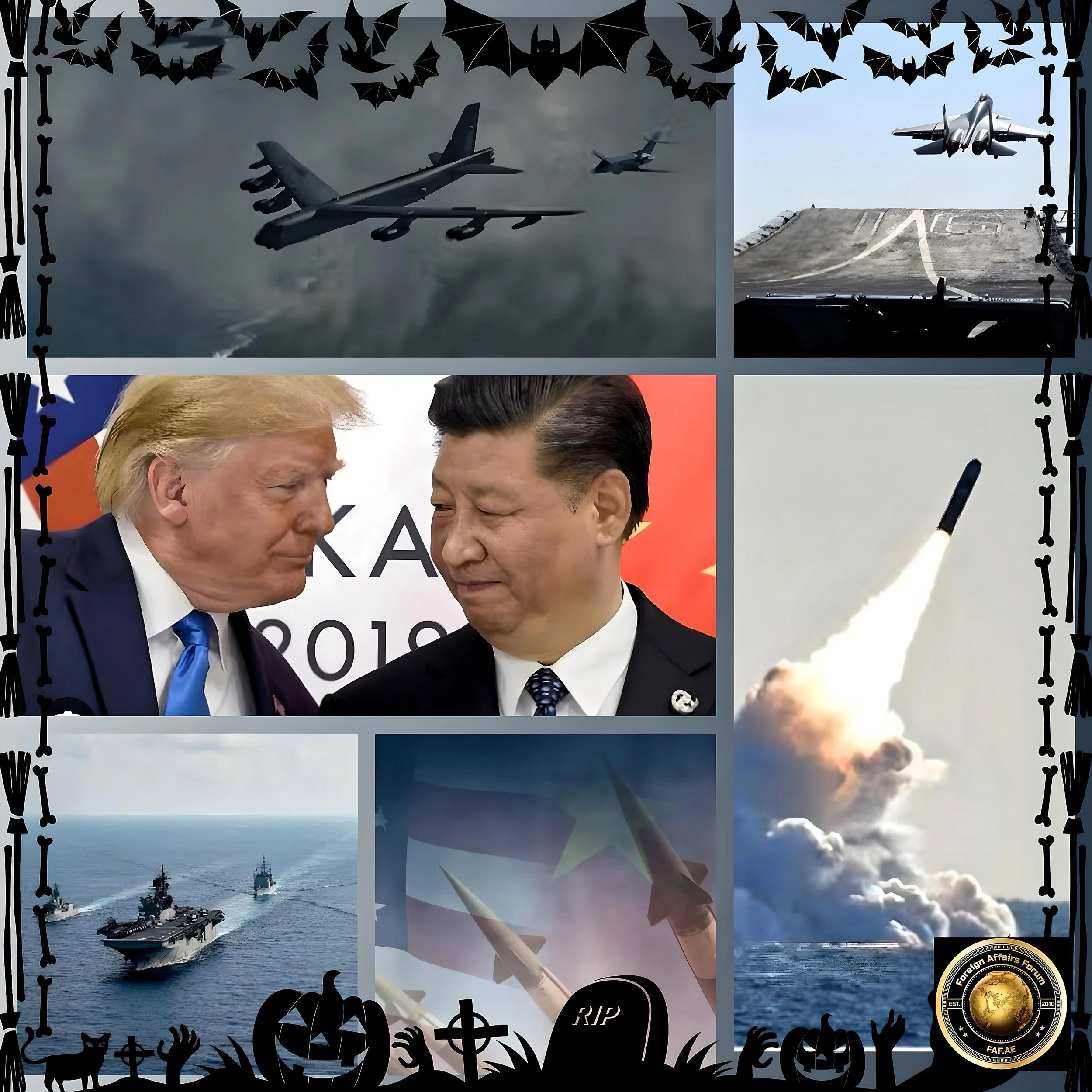
As of January 2026, there are signs that U.S.-China relations might be improving. In October 2025, President Trump met with Chinese President Xi Jinping in South Korea, and they agreed to pause their trade war for 1 year.
This was a significant change because their trade conflict had become very intense—at one point, the U.S. was charging 145% tariffs on Chinese goods. Now the tariffs are around 30-40%, which is still high but much better.
Recently announced plans show that Trump will visit China in April 2026. Xi is expected to visit the United States later in 2026, possibly in December.
These high-level meetings are essential because they show both leaders want to talk and find common ground. When leaders communicate directly and frequently, they can solve problems before minor disputes escalate into major conflicts.
How the Economy Fits In
One reason the war scenario seems less likely now is economics. In the past 10 years, some people feared that China would become much richer than the United States and would use its economic power to dominate the world. However, this is not happening.
China's economy is growing, but more slowly than before. Experts predict China will grow about 4.5%-5% in 2026, then slow to around 3% per year in later years.
The United States and China are likely to be about the same size economically through the 2030s. If China does eventually become richer than the U.S., it would not be until around 2050, and even then, not by much. This means China cannot expect to become so powerful as to dominate the world easily.
Why does this matter?
When rising powers believe they will eventually surpass their rivals, they sometimes take dangerous risks to consolidate power before that happens. But if China understands it will remain roughly equal to the U.S., there is less reason to gamble on a dangerous war. Instead, competing peacefully makes more sense.
Even though tariffs are high and both countries have restricted some trade, bilateral commerce remains essential. The U.S. still exports over $150 billion in goods to China each year, making China the 3rd-largest market for U.S. exports.
China depends on access to American markets to support its workers and economy. This economic connection gives both countries a reason to avoid military conflict that would destroy their trade relationship.
The Military Picture
Risk and Balance
The military situation is more complicated. China is building a powerful military. It now has more ships in its navy than the U.S., and it is building advanced missiles, submarines, and aircraft. China is also creating many nuclear weapons—the U.S. military estimates China could have about 1,500 nuclear warheads by 2035, which is close to what the U.S. has.
This military buildup worries American policymakers, especially regarding Taiwan. Taiwan is an island near China that has its own government but is claimed by China as its territory. The Chinese military has been conducting many exercises around Taiwan that appear to be practice for invading or blockading the island. In January 2026, a Chinese military drone flew over Taiwan-controlled territory for the first time in many years.
However, a peaceful coexistence scenario does not require that China give up the ability to use force against Taiwan. Instead, it requires that China choose not to invade Taiwan and maintain the status quo. This is what has happened for decades—China has the military power to attack Taiwan but chooses not to do so, preferring to wait for eventual unification through peaceful means. If China continues this policy, the situation can remain stable.
The U.S. can help by being clear that it will defend Taiwan, while also avoiding steps that would provoke China. Both sides need military communication channels so that, if accidents occur—such as ships or planes coming too close to each other—leaders can quickly communicate and prevent escalation. These communication channels existed during the Cold War and helped avert nuclear war.
Technology and Trade in the 2030s
One area of conflict is technology, especially semiconductors and artificial intelligence. The U.S. has tried to prevent China from getting advanced computer chips used for AI. China has responded by restricting exports of rare earth elements. However, this competition has limits.
As time passes, both countries will develop the ability to make advanced technology on their own. The U.S. cannot completely stop China from developing advanced technology—it can only slow it down. Once both countries can make what they need domestically, the advantage of export restrictions decreases. A realistic scenario assumes that both countries will accept some limits on technology trade while also stopping the constant arguing.
Trade between the U.S. and China is likely to remain essential but at lower levels than before. Some "decoupling" will happen—both countries will try to depend less on each other for critical goods like semiconductors. However, complete separation is impossible because both countries benefit from trading with each other.
The Path Forward
What Needs to Happen
To achieve peaceful coexistence, several steps are needed.
First, leaders in both countries need to be honest with their citizens about what competition means. Competition does not have to lead to war. Countries can compete in sports, technology, and business without fighting. Leaders should make clear that they will compete fiercely but will not use military force unless their countries are directly attacked.
Second, the military-to-military communication channels must be restored. U.S. and Chinese military officers need to talk regularly about nuclear weapons, military exercises, and how to prevent accidents from becoming wars. The U.S. and the Soviet Union had these channels during the Cold War, and they worked.
Third, economic connections should be maintained. When countries trade with each other, people in both countries benefit from peace. Both the U.S. and China should keep trading and allow businesspeople to visit each other's countries.
Fourth, there should be a new agreement about Taiwan. The current contracts are from the 1970s and 1980s. A new agreement accepted by both sides could make clear that neither side will try to change Taiwan's status by force, while also respecting China's goal of eventual peaceful unification. President Trump's planned April 2026 visit to China would be a good time to negotiate this.
Why This Scenario Could Fail
Nothing is certain. There are reasons the coexistence scenario might not work.
First, the military situation around Taiwan is becoming more tense. China's military is becoming more capable and is practicing more often. An accident or miscalculation could happen.
Second, politicians in both countries face pressure from voters and special interests. In the U.S., many politicians are very suspicious of China. In China, the government faces pressure to appear authoritarian and nationalist. These pressures can make it hard for leaders to choose restraint.
Third, different technologies are advancing very quickly. New military technologies might make leaders in either country feel they have a short window to use force before the other side gets the technology. This pressure for speed can make accidents more likely.
Fourth, if leaders change or new crises arise, the relationship could deteriorate rapidly. The current Trump administration seems willing to work with China, but future administrations might be more confrontational.
Conclusion
A Choice Worth Making
The United States and China do not have to go to war. History shows that even bitter rivals can learn to live together peacefully when leaders choose to do so. The Soviet Union and the United States did it in the 1970s. The benefits were enormous—millions of lives were saved because the leaders chose to reduce nuclear tensions rather than escalate them.
The coexistence scenario outlined here is realistic. It does not require the U.S. to accept Chinese dominance or for China to give up its hopes of unifying with Taiwan. Instead, it requires both countries to assume they will compete for influence and economic advantage without resorting to military force.
The period from 2026 through 2030 is critical. Right now, leaders on both sides seem willing to talk. The Trump administration is engaging diplomatically with China. China has shown a willingness to negotiate trade disputes. This window of opportunity might not stay open forever.
If the United States and China succeed in establishing a framework for peaceful competition by 2030, the 2030s could be a period of stability, economic growth, and cooperation on global challenges. If they fail, the risks of accidents, miscalculation, and, eventually, war increase dramatically.
The choice belongs to the leaders in Washington and Beijing—but history suggests they can make the right choice if they choose to.