China’s 2026 Temptation: The Dangers of Strategic Overreach in a Fragmenting World Order
Executive Summary
China enters 2026 in a position of apparent strength following a strategically successful 2025. President Xi Jinping's leadership successfully insulated the Chinese economy from the Trump administration's aggressive trade war, executed deft retaliatory measures against escalating American tariffs, and benefited substantially from the systematic dismantling of the post-World War II liberal international order by Washington.
With a trillion-dollar trade surplus, rising military capabilities, and mounting global support for China's alternative governance frameworks, the Chinese leadership confronts a critical moment of decision: whether to capitalize on these gains through continued strategic restraint or to pursue more aggressive assertions of Chinese interests.
FAF analysis examines the specific temptations toward overreach in three critical domains—trade, Taiwan, and global governance—and argues that while Xi Jinping's restraint in 2026 would serve China's long-term interests, the domestic and international pressures he faces create genuine risks of miscalculation.
Introduction
The Paradox of Strength Within Fragility
The concept of strategic temptation arises precisely when geopolitical circumstances appear most favorable, yet underlying vulnerabilities remain substantial. China's position in early 2026 exemplifies this paradox.
The rapid erosion of American credibility through Trump's unilateral withdrawal from multilateral institutions, his explicit embrace of "spheres of influence" competition, and his deployment of military force across multiple regions—Venezuela, Syria, Iraq, Yemen, and Nigeria—has created a power vacuum that China is uniquely positioned to occupy. Simultaneously, however, China's economy faces deflation, demographic decline, property sector distress, and mounting public discontent over stagnating incomes.
These contradictory realities create conditions where China's leadership might miscalculate the risks of assertive external action as a means of projecting strength and managing domestic pressures.
Xi Jinping, having consolidated unprecedented personal political power, faces a distinct vulnerability: the absence of trusted advisors willing to counsel caution when nationalism and geopolitical opportunity converge.
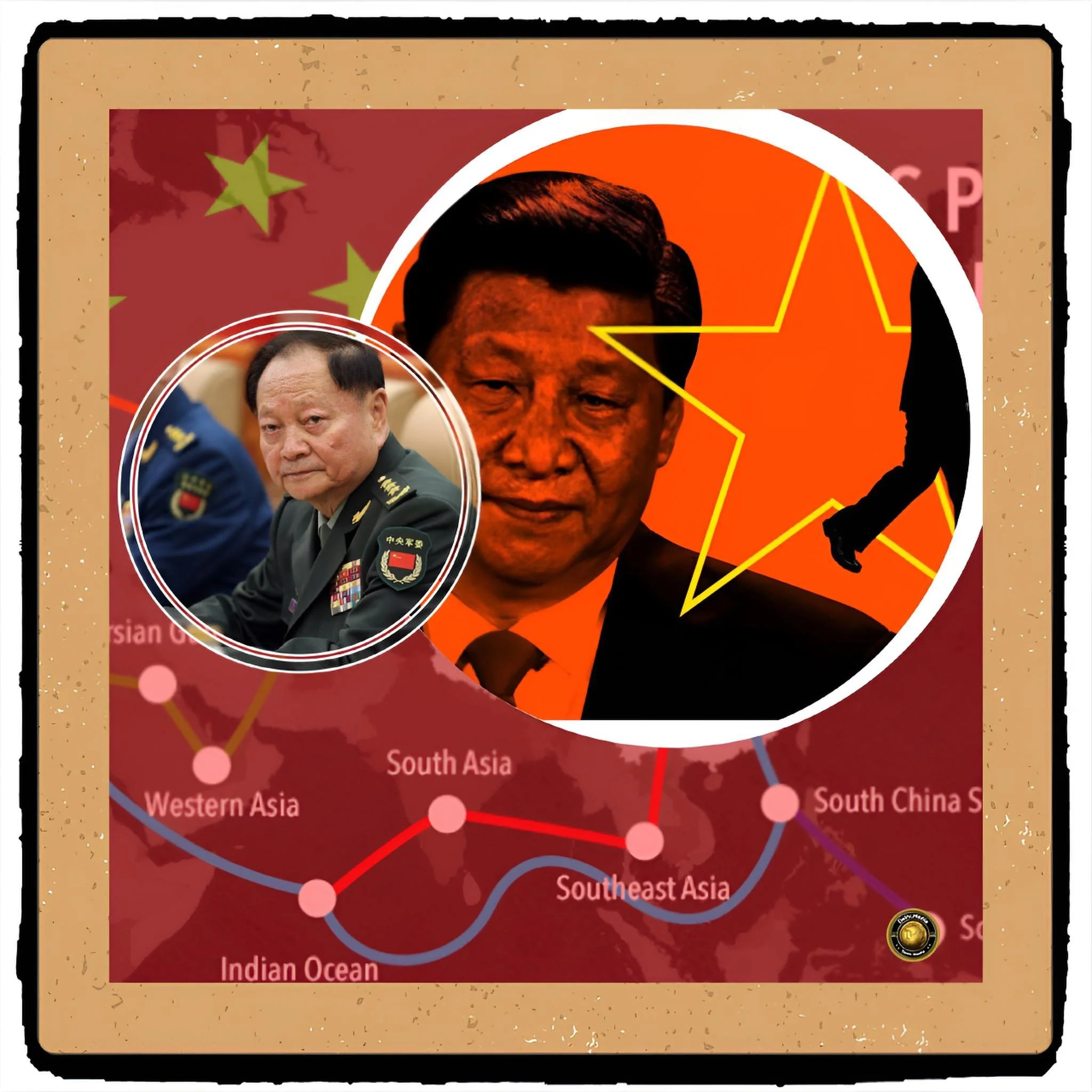
The recent military purge of General Zhang Youxia and other senior commanders, framed publicly as anti-corruption but understood strategically as Xi's assertion of control, suggests deep doubts about the reliability of military reporting and the true readiness of forces purportedly prepared for Taiwan operations by 2027. Yet this same insecurity may paradoxically increase risk-taking, as Xi seeks to demonstrate that the military remains loyal and effective despite the disruptions of internal purges.
The combination of triumphalism about 2025's outcomes with anxiety about domestic stability creates the psychological conditions for costly overreach.
The Historical Context
Strategic Patience and Its Limits
Understanding China's temptation in 2026 requires examining the historical doctrine of strategic patience that has guided Chinese foreign policy since Deng Xiaoping's era. Deng's famous exhortation to "hide capabilities and bide time," offered in the context of a China far weaker than the United States and its allies, established patience as a cardinal virtue of Chinese statecraft.
This doctrine held that time was inherently on China's side—that through sustained economic development over fifty or sixty years, "socialist China will become invincible."
The strategic logic was impeccable: a rising power with demographic and economic advantages should avoid direct confrontation until relative power had shifted sufficiently to guarantee success.
For four decades, successive Chinese leaders adhered to this framework, prioritizing economic development above nationalist assertiveness and sacrificing near-term diplomatic and geopolitical gains for long-term structural advantage.
Xi Jinping has fundamentally reoriented this framework without explicitly rejecting it. His "Chinese Dream" and subsequent global initiatives—the Global Development Initiative, Global Security Initiative, Global Civilization Initiative, and now the Global Governance Initiative—represent not a continuation of Deng's patience but rather an assertion of present leadership masquerading as future-oriented vision. Where Deng counseled waiting for capacity to develop naturally, Xi has actively engineered mechanisms to reshape the international order through Belt and Road investments, institutional reforms within the United Nations system, and the cultivation of alternative frameworks like BRICS.
This represents a subtle but profound departure: from patience waiting for capability to translate into influence, to active construction of influence through institutional innovation and economic coercion.
The danger Xi faces in 2026 is that this new doctrine lacks the humility and cautiousness embedded in Deng's strategic patience. Having successfully navigated the treacherous waters of 2025 with the Trump administration, Xi may believe that the historical moment has arrived when waiting is no longer prudent.
The American withdrawal from global leadership creates a window of opportunity, but windows close. This perception—whether accurate or not—creates pressure to act decisively while circumstances remain favorable.
The Three Domains of Temptation
Trade: The Seduction of Economic Leverage
China's approach to trade in 2025 demonstrated sophisticated economic statecraft. Rather than engaging in tit-for-tat tariff escalation that would have damaged its export-dependent economy, Beijing employed selective retaliation, tariff exclusions, and behind-the-scenes negotiations to reach an agreement in November 2025 that suspended Chinese retaliatory tariffs and temporarily reduced American reciprocal tariffs.
The effectiveness of this approach created in Chinese policymaking circles a sense of economic invulnerability: the American economy, they argued, is fundamentally dependent on Chinese trade and capital flows, while China's diversification through Belt and Road partners and reduced reliance on agricultural imports provides alternative demand sources.
This confidence, however, rests on analytical foundations that prove fragile under scrutiny.
Trump's second-term tariff policy has fundamentally shifted from the economics of trade optimization to the politics of coercion.
Trump's stated intention to move from tariff threats to outright military demonstrations of American power—the Venezuelan operation being a case study in this shift—suggests that economic leverage, however considerable, may no longer constitute the primary language of American international engagement. Chinese policymakers correctly identify that Trump is willing to negotiate and that Xi's April 2026 planned visit to Washington represents an opportunity for dialogue. Yet they may simultaneously underestimate Trump's capacity for sudden reversals and escalation.
The President's history of declaring victory prematurely, then returning to demands he previously abandoned, creates unpredictable risk for any negotiating partner.
The temptation in 2026 will be for China to test American resolve on trade issues, particularly surrounding rare earths processing dominance, technological exports, and the asymmetrical trade surplus that reached one trillion dollars in 2025. Chinese economists and officials have noted that China's technological position in electric vehicles, batteries, and renewable energy has substantially improved, providing leverage that did not exist in earlier confrontations.
The Belt and Road Initiative, now representing cumulative engagement of 1.399 trillion dollars with continued expansion projected for 2026, has created alternative markets and investment opportunities that reduce Chinese dependence on American consumers. These facts are not illusory, but they may be misinterpreted.
The specific danger in trade is that China might overestimate the willingness of developing nations and Global South partners to absorb Chinese goods when Western markets become inaccessible. The trade structures that have enriched both China and the West depended on global supply chains requiring participation from multiple regions.
A bifurcated global economy, with a Chinese-led bloc and an American-led bloc, would impose enormous costs on both. While China would suffer less than the United States in purely economic terms, the damage to growth rates necessary for maintaining CCP legitimacy could prove severe. Xi has promised approximately 5% annual GDP growth to stabilize the domestic situation.
A trade war producing two percent growth would create internal pressures that foreign policy achievements could not offset.
Taiwan:: The 2027 Threshold and Temptations of Action
The most dangerous domain of temptation for China in 2026 is Taiwan. The Economist and multiple defense analysts have identified a critical distinction between the near-term (2026) and medium-term (2027-2030) risk calculus regarding Taiwan.
While early 2026 is unlikely to see a Chinese invasion or blockade attempt, the framing of 2027 as a potential execution date by Xi Jinping himself creates extraordinary pressure within Chinese military and civilian planning establishments.
Chinese military exercises have escalated dramatically, with air incursions into Taiwan's air defense zones increasing over 60%.
The People's Liberation Army is conducting sophisticated training for decapitation strikes against Taiwan's political leadership, drawing tactical lessons from American operations in Venezuela.
Recent technological developments, including demonstrated capabilities for coordinated drone operations, precision missile strikes, and cyber warfare, have convinced Chinese military planners that capability gaps are narrowing.
The PLA's claimed ability to establish "three dominances" (information, maritime, and air) in the Taiwan Strait appears increasingly plausible to analysts assessing the force balance.
Yet precisely because 2027 has been established as a potential threshold year, the temptation in 2026 is subtle and concerning: to conduct operations that progressively raise the baseline of military pressure to the point where a transition to conflict in 2027 appears inevitable rather than chosen.
This process is already visible in the reported January 17, 2026 drone incursion over Pratas, potentially the first violation of Taiwanese airspace in decades. Such incremental violations, combined with expanded naval operations and augmented air exercises, serve multiple purposes: they normalize Chinese military presence, test Taiwanese and American responses, collect intelligence on air defense capabilities, and create a psychological sense that military confrontation is not a dramatic departure but rather a logical extension of existing activity levels.
The economic costs of Taiwan conflict remain catastrophic.
Bloomberg Economics estimates that a successful Chinese invasion would impose approximately $10 trillion of costs on the global economy, representing roughly 10 % of global GDP.
For China specifically, even in an optimistic scenario avoiding direct American military intervention, the disruption to maritime commerce, capital flight, financial sanctions, and technological export controls would impose GDP losses of 25-35 % according to RAND Corporation modeling.
The semiconductor supply disruptions alone—Taiwan producing roughly 60% of the world's advanced semiconductors—would reverberate through global electronics manufacturing for years. For a Chinese economy already struggling with property sector distress and deflationary pressures, such a shock might prove catastrophic to political stability.
Xi Jinping's vulnerability creates the temptation toward Taiwan action despite these economic costs. A successful military seizure of Taiwan would provide an extraordinary domestic political victory, at least in the immediate aftermath, allowing Xi to mobilize nationalist sentiment and pivot attention away from economic failures.
The military purges of January 2026 suggest that Xi doubts his commanders' reliability and potentially questions whether capabilities match optimistic assessments. Demonstrating military effectiveness through dramatic action might serve internal political purposes, reasserting control over an officer corps that Xi suspects harbors resentment toward his centralization of authority.
The danger is that this internal logic, comprehensible within Beijing's political dynamics, does not adequately account for the international response Taiwan conflict would provoke.
Global Governance
The Seduction of Alternative Orders
China's fourth set of global initiatives—the Global Governance Initiative, released alongside the Global Development Initiative, Global Security Initiative, and Global Civilization Initiative—represents the most sophisticated challenge to the Western-led rules-based international order ever articulated by Beijing.
These initiatives, collectively endorsed by over 140 countries and receiving prominent attention from the Global South, offer an alternative vision of international authority: one premised on sovereign equality rather than hegemonic imposition, on multilateralism that genuinely includes all countries rather than concert of major powers, and on governance structures that reflect rather than constrain development-stage differences among nations.
The intellectual architecture of these initiatives is genuinely innovative. They address legitimate grievances about the existing international system—the overrepresentation of Western powers in the UN Security Council, the primacy of dollar-denominated financial institutions, the imposition of democracy and human rights standards as preconditions for trade access.
By framing these initiatives as reforms of the existing system rather than creation of an alternative system, China has positioned itself as a modernizer and pragmatist while portraying the United States as an obstructionist defending an indefensible status quo.
The success of this messaging is evident in the significant support received from African nations, Latin American governments, and other Global South actors who genuinely perceive Western institutions as vehicles of continued domination rather than frameworks for cooperation.
The temptation for China in 2026 is to accelerate institutional innovation and to bind Global South partners more tightly to Chinese-led structures through expanded Belt and Road investments, preferential trade agreements, and joint governance mechanisms.
The 2025 Belt and Road engagement of $128.4 billion in construction contracts represents the highest annual figure in the initiative's history. Projections for 2026 envision continued expansion, particularly in the "New Three" sectors—electric vehicles, batteries, and renewable energy—that combine technological innovation with economic domination in future-oriented industries.
However, this expansion carries distinct risks. Expanding Belt and Road commitments in a global economic environment of uncertainty, heightened protectionism, and capital scarcity creates debt sustainability problems in partner countries that could generate backlash.
As Latin American and African nations have discovered, debt-financed infrastructure projects that fail to generate sufficient returns create long-term resentment and political instability. Chinese creditors then face the choice between accepting losses or enforcing repayment through mechanisms that appear coercive.
The Democratic Republic of Congo's seizure of Chinese assets and the Philippines' periodic tensions with China over South China Sea facilities demonstrate that developing nations increasingly resist what they perceive as economic neo-colonialism masquerading as mutual development.
More fundamentally, accelerating the construction of alternative global governance structures creates the appearance of bifurcation and conflict precisely when China's messaging emphasizes cooperation and reform of existing structures rather than replacement of them.
The more aggressively China advances parallel institutions—the Asian Infrastructure Investment Bank, proposed digital currency alternatives to the dollar, BRICS monetary mechanisms—the more Western nations will pursue countervailing coalitions and the more explicitly the international system fractures.
This fragmentation may ultimately disadvantage China more than the West, given that China remains integrated into global capital markets and supply chains in ways that a fragmented world would disrupt more severely than a Western-dominated unified system.
Domestic Pressures and the Psychology of Overreach
The deepest source of temptation toward overreach in 2026 emerges from Chinese domestic circumstances. Economic growth has decelerated to approximately 5%, substantially below the double-digit rates that sustained the CCP's legitimacy narrative for three decades. Deflation persists, real estate prices remain under pressure despite government support, and underemployment has expanded as the number of workers in "flexible employment" has risen substantially. Youth unemployment and college graduate job placement crises have become significant political sensitivities.
Xi Jinping has personally committed to "high-quality growth" and "common prosperity," but these slogans increasingly ring hollow as inequality persists and social mobility appears to decline.
Moreover, recent intelligence regarding domestic surveillance, censorship, and political repression suggests that Xi's control, while extensive, generates anxiety about its permanence. The military purges, the anti-corruption campaigns that simultaneously serve as instruments of political control, and the intensification of ideological discipline all suggest a leadership that fears rival power centers and potential internal challenges.
When leaders feel insecure in their domestic position, they are historically more prone to dramatic external action as a means of projecting strength and rallying nationalist sentiment. Xi Jinping, despite his unprecedented personal power concentration, may paradoxically face incentives toward risky external behavior precisely because he recognizes that his power, however extensive, rests on performance legitimacy rather than institutional constraints that protect his succession.
The "Year of the Fire Horse," the zodiacal designation for 2026, symbolizes passion, independence, and rapid change in Chinese cultural tradition. Symbolism matters in Chinese political discourse.
A leader who fails to demonstrate dynamism during a "Fire Horse" year opens himself to criticism that he lacks the boldness required for the moment. This cultural dimension, while seemingly minor, contributes to the psychological pressure toward action. A xi who presides over a quiet year of consolidation and patience may be criticized as cautious and unequal to the historical moment, particularly if geopolitical circumstances subsequently shift in America's favor.
The Mechanism of Miscalculation
The most dangerous scenario for 2026 involves not a deliberately reckless decision but rather a cascade of miscalculations that occur in the context of confidence about 2025's outcomes. Specifically, the mechanism operates as follows:
First, overestimation of China's economic resilience leads to misjudgment about the capacity to sustain conflict or confrontation. Chinese planners, correctly noting that China's trade surplus and technological position have improved, may overestimate the degree to which these improvements insulate China from disruption. They fail to adequately model cascading effects of capital flight, sanctions, and supply chain disruption on regions such as Guangdong and Fujian that depend on export-oriented manufacturing.
Second, underestimation of Taiwan's resistance capacity. Multiple assessments, including Taiwan's own military intelligence, note declining public support for unification and rising sense of separate Taiwanese identity.
Chinese planners may interpret this as indicating that Taiwan's population would capitulate rapidly following military pressure. Historical experience with wars, however, suggests that populations often display unexpected resilience and that military campaigns designed to compel capitulation frequently extend far longer than planners anticipate.
Taiwan is not a distant colony but an island of 23 million people, many of whom perceive unification as existential loss of identity and democratic self-governance.
Third, misreading of American commitment and capacity. Xi may believe that Trump's transactional approach and his demonstrated disinterest in traditional alliances indicate that America would permit or accept Chinese military action against Taiwan. However, Trump's willingness to deploy American military force in Venezuela, the Middle East, and Africa demonstrates a strong commitment to demonstrating American power and deterring challenges to American primacy.
A Chinese attack on Taiwan would be precisely the type of geopolitical challenge that Trump, having spent 2025 demonstrating American power, would feel compelled to counter militarily to preserve American credibility.
Fourth, rationalization of escalation. Once military operations begin, the dynamic of armed conflict creates its own momentum. Initial tactical successes may prompt expansion of objectives. Initial setbacks may prompt escalation to prevent reversal. The distinction between blockade and invasion, between limited strikes and full mobilization, becomes blurred in operational reality.
Why Xi Should Resist the Temptation
Despite the substantial pressures toward overreach that accumulate in 2026, Xi Jinping's strategic interests remain aligned with continued restraint. The argument for patience remains compelling, even if the psychological temptation to act is intense. Several factors counsel restraint:
First, the internal consolidation project remains incomplete. Xi's purge of military leadership suggests ongoing concerns about organizational reliability and loyalty.
A major conflict would expose any remaining pockets of resistance or organizational dysfunction. The costs of a failed operation would be substantially higher than the costs of a successful one, and the uncertainty surrounding actual military capabilities creates genuine risk of failure.
Xi's desire to validate his leadership through military success must be tempered by the recognition that military failure would catastrophically undermine his authority. Given the purges, the internal security apparatus may be extensive but it is also newly constituted and untested under stress.
Second, the economic costs of conflict are genuinely prohibitive for a regime whose legitimacy depends on material improvement and growth. A 25-35% GDP contraction would produce unemployment, inflation, and social disorder on a scale that could threaten regime stability.
The CCP's claim to superior governance rests substantially on its capacity to deliver growth and rising living standards. A Taiwan war would shatter this claim for years or decades. Xi's personal authority, which depends on perceptions of strategic competence, would suffer immense damage from an outcome that reduced living standards for hundreds of millions of Chinese citizens.
Third, alternative approaches to the Taiwan question retain viability and potential. The gradual erosion of Taiwan's security through expanding coercive military operations, the cultivation of pro-unification sentiment through economic integration and generational change, and the maintenance of strategic ambiguity about the timeline for military action all preserve options without imposing the massive costs of conflict.
A patient approach requires faith in the demographic and economic trends that favor Chinese integration, but that faith is not unreasonable. Taiwan's population is aging, its defense spending cannot match Chinese increases indefinitely, and the generational gap between young Taiwanese with native identity and older Taiwanese with some residual cross-strait connection creates opportunities for patient strategies.
Fourth, Trump's presidency, while advantageous to China in many respects, is temporally bounded. American presidential terms are four years or eight years. The characteristics that make Trump attractive to Xi—unpredictability, willingness to challenge American alliances, transactional approach to international relations—may reverse with a subsequent administration.
A Chinese move that succeeds under Trump might trigger far more sustained and hostile responses from a post-Trump American administration that has had years to organize counter-responses.
The most durable geopolitical victories are those that exploit temporary advantages while building structures that persist beyond the immediate political moment. Aggressive action in 2026 would trigger counter-coalitions and militarization that would undermine China's longer-term interests.
Finally, the intellectual and diplomatic appeal of China's global initiatives remains underdeveloped. The Global Governance Initiative and parallel frameworks have potential to reshape international institutions in ways favourable to Chinese interests if pursued through sustained diplomatic effort and intellectual development.
This soft power approach, while slower than direct military action, potentially creates lasting changes in international practice and governance. Aggressive military action on Taiwan would undermine this intellectual project by validating Western claims that Chinese initiatives ultimately rest on coercive power rather than moral argument and pragmatic benefit to partners.
Conclusion
The Discipline of Strategic Patience
The central argument of this analysis is that Xi Jinping faces genuine temptations toward aggressive action in 2026, but that his strategic interests remain served by resistance to these temptations.
The apparent strength of China's position—military capacity growing, global institutions being reshaped through initiatives like the Global Governance Initiative, American power apparently in decline—creates powerful psychological pressure toward using force to consolidate advantages.
Yet China's underlying economic fragility, the profound disruption that Taiwan conflict would create, and the uncertain military outcomes of complex operations all counsel restraint.
Deng Xiaoping's doctrine of strategic patience, articulated when China was far weaker, retains validity for a China that has grown in strength but not yet achieved the position of complete security and dominance that would permit riskier strategies.
The historical pattern suggests that great powers overreach at the moment of perceived strength, believing that the window of opportunity is closing. This belief often proves self-fulfilling: the overreach generates resistance that closes windows that remained open to patient strategies. Conversely, the powers that successfully manage relative power transitions are those that maintain the strategic discipline to pursue advantage without recklessness.
Xi Jinping would serve his own interests, the interests of the Chinese people, and the interests of international stability by resisting 2026's temptations toward overreach.
The irony is that a China demonstrating such discipline would position itself more effectively for long-term domination of international affairs than a China that pursued aggressive action driven by short-term political pressures and psychological temptations.