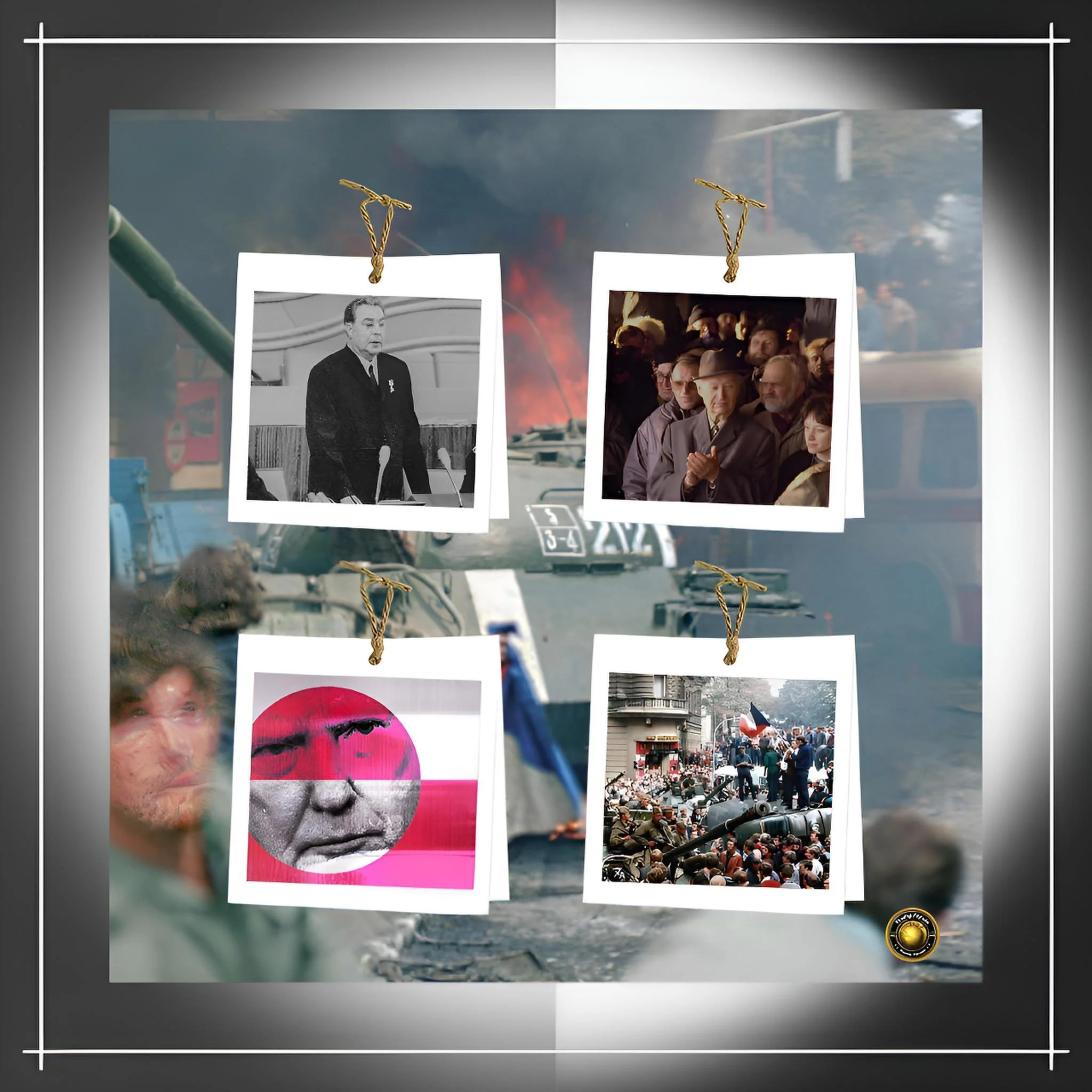
The Soviet Lessons for Trump's Greenland Gambit: Superpower Decline and the Limits of Coercive Power in an Interconnected World
Executive Summary
In August 1968, the Soviet Union deployed approximately 50,000 troops from multiple Warsaw Pact nations to invade Czechoslovakia, successfully suppressing the Prague Spring reform movement and demonstrating overwhelming military dominance.
Two decades later, however, the Velvet Revolution of 1989 witnessed the complete dissolution of communist regimes throughout Eastern Europe and the Soviet sphere of influence, revealing that the military victory of 1968 constituted a strategic defeat whose consequences fundamentally undermined Soviet hegemony.
In January 2026, President Donald Trump initiated an ambitious campaign to acquire Greenland, beginning with rhetorical threats and economic coercion directed toward Denmark and European allies.
As Trump's Greenland strategy evolved from acquisition demands to negotiation frameworks through January 2026, the historical trajectory of Soviet imperial overreach presents a remarkably illuminating precedent. Both episodes reflect the characteristic trajectory of declining superpowers confronting the limits of coercive authority over autonomous populations within interdependent international systems.
FAF analysis examines the structural parallels between Soviet efforts to maintain hegemonic control through force and Trump's contemporary gambit, elucidating how the use of economic and military pressure against alliance partners ultimately accelerates rather than reverses systemic decline.
Introduction
The Paradox of Superpower Dominance and Strategic Defeat
The contemporary moment presents a peculiar historical irony.
The United States, despite maintaining unparalleled military capabilities and economic resources, confronts a fundamentally transformed international environment in which coercive instruments prove increasingly ineffectual for achieving strategic objectives.
President Trump's pursuit of Greenland exemplifies this transformation. The United States possesses the military capacity to occupy the island within days; Denmark and Greenland possess no defensive capabilities capable of resisting American force.
Yet despite this overwhelming material superiority, Trump's initial strategy—demanding outright purchase, threatening military seizure, imposing tariffs on allied nations, and fundamentally rejecting Greenlandic and Danish sovereignty assertions—generated precisely the opposite outcome from that intended.
Rather than accelerating Greenland's transfer to American control, these coercive measures consolidated Greenlandic and Danish determination to resist American absorption, unified European opposition to the American position, strengthened NATO alliance structures through demonstrated solidarity, and ultimately compelled Trump to pivot toward negotiation and framework agreements that conceded fundamental American demands.
This pattern recalls with striking precision the Soviet experience of 1968. The invasion of Czechoslovakia represented a moment of apparent Soviet strength—hundreds of thousands of troops, overwhelming military superiority, demonstrated willingness to employ force against ideological deviants, and successful suppression of reform movements.
Yet historians and contemporary observers now recognize the invasion as the initiation of Soviet decline, a moment from which Soviet power, despite remaining formidable in military terms, experienced inexorable erosion of legitimacy, authority, and capacity to command allegiance from subject populations and allied regimes.
Historical Context
The Prague Spring and the Dynamics of Imperial Control
The Prague Spring emerged within the context of Nikita Khrushchev's destabilization of Soviet orthodoxy. In his 1956 denunciation of Stalin, Khrushchev had inadvertently created ideological space for reform movements throughout the Eastern Bloc.
Czechoslovakia, which had experienced particularly brutal Stalinist subjugation, emerged as the Soviet sphere's most developed economy and most Western-integrated culture.
By January 1968, when Alexander Dubček assumed leadership of the Czechoslovak Communist Party, the preconditions for liberalization had accumulated substantially. Dubček himself was not an anti-communist dissident but rather a reformist communist seeking to implement "socialism with a human face"—economic decentralization, expanded cultural freedoms, and diminished political repression combined with continued loyalty to the Warsaw Pact and Soviet security orientation.
The initial Soviet response to Czechoslovak reform proved remarkably tolerant.
Leonid Brezhnev, who had replaced Khrushchev in 1964, recognized the ideological appeal of Dubček's approach and sought diplomatic resolution rather than military intervention.
Throughout the spring of 1968, Soviet and Czechoslovak leaders engaged in negotiations at Cierna and Bratislava, where Dubček appeared to accept Soviet constraints on liberalization in exchange for Soviet tolerance of reformed governance.
However, the underlying dynamic proved untenable.
Dubček's administrative reforms, even those constrained by Soviet pressure, generated popular enthusiasm throughout Czechoslovakia.
Citizens demanded expanded freedoms, economic reforms increasingly competed with Soviet-imposed command structures, and the Prague media began publishing critiques of Soviet domination.
Conservative Czechoslovak communist leaders, aligned with Soviet hardliners, concluded that Dubček could not constrain the liberalization process within acceptable bounds. Soviet intelligence assessments concluded that Czechoslovakia was sliding toward separation from the Warsaw Pact and potential NATO membership—an outcome the Soviet leadership deemed fundamentally incompatible with Soviet security interests in Europe.
On August 20-21, 1968, approximately five hundred thousand troops from the Soviet Union, Poland, East Germany, Hungary, and Bulgaria invaded Czechoslovakia without Czechoslovak government authorization or invitation.
The invasion achieved its immediate military objectives with remarkable speed. Within hours, Soviet forces occupied Prague, seized Dubček and other reform leaders, and established military control throughout the country.
Current Status and Key Developments
Trump's Greenland Strategy Evolution
The Trump administration's approach to Greenland began in late December 2024 as a purchase demand, escalated through January 2026 into explicit threats of military seizure and economic coercion, and culminated through late January 2026 in negotiation frameworks that renounced force and tariff threats while offering NATO members the prospect of collaborative Arctic security arrangements.
The administration's initial phase emphasized the purported inevitability of American acquisition. Trump asserted that Greenland represented a national security necessity and suggested that American economic resources would ultimately render Danish or Greenlandic resistance futile.
The administration emphasized Greenland's strategic location within the Arctic, its rare earth mineral reserves, and the necessity of preventing Chinese or Russian dominance over the territory. Trump explicitly stated, "One way or the other, we are going to have Greenland," and declared that "the fact that Denmark had a boat land there 500 years ago doesn't mean they own the land."
The escalation phase, initiated in mid-January 2026, introduced explicit economic coercion.
Trump announced that Denmark, Norway, Sweden, France, Germany, the United Kingdom, the Netherlands, and Finland would face 10 % tariff increases on exports to the United States, escalating to 25 % on June 1, 2026, unless Denmark agreed to transfer Greenland's sovereignty to American control.
This represented a fundamental violation of NATO alliance protocols, as the tariffs targeted eight NATO members, including several nations participating in operations supporting American interests globally.
The response from European capitals proved unexpectedly unified. Danish Prime Minister Mette Frederiksen conducted a highly publicized visit to Greenland, publicly reaffirming Danish-Greenlandic solidarity.
She declared that "sovereignty is not for negotiation" and reminded Trump that Denmark had been providing security guarantees to the United States for decades. Leaders from France, Germany, Poland, Spain, Britain, and other European nations issued a joint statement affirming that Greenland "belongs to its people" and that decisions regarding its status must remain with Greenlanders themselves.
Even conservative European political leaders, who might have been expected to accommodate American demands, publicly rejected the American position.
By late January 2026, Trump's strategy had shifted dramatically. At the World Economic Forum in Davos on January 21-23, Trump announced that he and NATO Secretary General Mark Rutte had negotiated "the framework for a future deal" regarding Greenland and the broader Arctic region.
Trump simultaneously withdrew both the threat of military seizure and the announcement of tariff increases, pivoting instead toward language of cooperation and shared Arctic security interests.
The framework announced involved American access to military installations and strategic positioning within Greenland, achieved through negotiated agreement rather than sovereign transfer or coercive acquisition.
Latest Facts and Emerging Concerns
Unresolved Strategic Tensions
Despite the apparent de-escalation represented by the Davos framework, fundamental ambiguities and tensions remain embedded within the American approach. Trump's rhetoric continues to oscillate between acquisition language and cooperative security frameworks. The precise dimensions of American "access" and "authority" within Greenland remain negotiated and contested.
Denmark and Greenland have categorically rejected any language suggesting sovereignty transfer but have demonstrated flexibility regarding enhanced security cooperation and American military presence.
The strategic motivation driving Trump's interest remains contested. The administration emphasizes Arctic security concerns, particularly regarding Russian and Chinese activities in the region. However, Trump has explicitly cited Greenland's rare earth mineral resources as a strategic priority.
The Export-Import Bank's June 2025 letter of interest for financing the Tanbreez rare earth mine through a $120 million loan suggests that resource access constitutes a fundamental American objective.
Conversely, Greenland's government has explicitly prioritized resource development through Western partnerships while simultaneously emphasizing that resource extraction remains under Greenlandic governmental control.
American statements regarding Chinese and Russian Arctic activities have proven empirically questionable. Trump asserted, without substantiation, that Greenland was "teeming with Russian and Chinese ships," and he alleged that China and Russia would inevitably dominate Greenland absent American acquisition.
However, available evidence suggests that while China has pursued Arctic investments, Chinese initiatives in Greenland have been largely unsuccessful, stalled by American and Danish national security objections. Similarly, Russian naval operations in the Arctic, while expanding, do not constitute the threatening dominance Trump described.
Greenlandic public opinion has remained firmly opposed to American acquisition throughout the crisis. Polling data consistently shows approximately 85 % percent of Greenlanders opposing annexation to the United States. Greenland's newly elected government has campaigned explicitly on independence from Denmark, implying that self-determination constitutes the primary Greenlandic objective. The precise mechanisms through which enhanced American presence might align with Greenlandic independence aspirations remain unclear and potentially contradictory.
The European response has introduced a secondary concern: the demonstrated willingness of the Trump administration to subordinate alliance relationships to unilateral strategic objectives.
The threat of tariffs against NATO allies undertaking military operations supporting American interests in Afghanistan, Iraq, and elsewhere conveyed a message that American alliance commitments prove contingent upon deference to American territorial or resource demands.
This has accelerated European discussions regarding strategic autonomy, defense spending independence from American capabilities, and closer European military integration—developments that ultimately reduce rather than enhance American strategic influence over Europe and the Atlantic system.
Cause-and-Effect Analysis
Coercive Power and the Dynamics of Superpower Decline
The Soviet invasion of Czechoslovakia in 1968 offers illuminating parallels to understanding the Trump administration's Greenland strategy. Both episodes reflect attempts by declining superpowers to employ overwhelming military or economic force to compel territorial or hegemonic concessions from populations and allied governments. In both cases, the application of coercive force generated consequences opposite to those intended.
The immediate effect of the Soviet invasion involved military occupation and the suppression of reform initiatives. Dubček and other leaders were imprisoned and released only after signing the Moscow Protocol, which conceded Soviet demands for restored ideological conformity and renewed command-economy structures.
Hard-line communists aligned with Soviet preferences replaced reformers. From a narrow military and immediate political perspective, the invasion achieved its objectives. Soviet troops occupied Czechoslovak territory, reform movements ceased, and the Warsaw Pact remained structurally intact.
However, the longer-term consequences proved catastrophic for Soviet strategic interests. The invasion revealed that Soviet hegemony depended upon military force rather than consensual legitimacy. Czechoslovak elites and populations that had previously accepted Soviet dominance as inevitable now understood Soviet power as ultimately coercive and unstable.
The invasion destroyed whatever residual legitimacy Soviet communism retained among Eastern European intellectuals, workers, and nationalist constituencies. The period of "normalization" that followed, characterized by repression, emigration, and social alienation, created psychological distance between Soviet overlords and subject populations that persisted for two decades.
Critically, the 1968 invasion served as the critical learning moment for other Eastern European populations.
Hungary in 1956 had already experienced Soviet military intervention; Czechoslovakia in 1968 confirmed that Soviet willingness to employ overwhelming force extended across the Warsaw Pact. But the invasion simultaneously communicated that Soviet force, however overwhelming militarily, ultimately depended upon continuous application against resistant populations.
The lesson was encoded in memory: Soviet power, while temporarily dominant militarily, was fundamentally brittle, dependent upon terror, and incapable of generating authentic compliance.
The Trump administration's Greenland strategy exhibited precisely this dynamic. The initial emphasis on American military and economic superiority—the assertion that American power would inevitably prevail, the implicit threat of military seizure, the invocation of American capability to "take" territories—generated resistance rather than compliance.
The threatened tariffs against NATO allies provoked unified European opposition. The suggestion of military seizure unified NATO members in explicit declarations of commitment to defend Greenland as Danish territory. The economic threats accelerated European discussions regarding defense spending and strategic autonomy, generating consequences opposite to American strategic interests.
The underlying dynamic reflects a fundamental reality of contemporary international politics. Territorial acquisition through force or coercion, while possible for militarily dominant powers over defined periods, proves unsustainable in interdependent international systems characterized by alliance structures, international legal norms, and economic integration.
The Soviet Union ultimately discovered that occupying Czechoslovakia was possible but defending such occupation against populations and allied governments seeking independence proved impossible.
Trump's attempt to acquire Greenland confronted analogous constraints: American military capability to seize the territory proved irrelevant given that international law, NATO alliance commitments, and European solidarity rendered seizure diplomatically and strategically catastrophic.
Consequently, the actual mechanisms of superpower decline operate through the cumulative effect of coercive initiatives that provoke alliance fragmentation, accelerate diversification of strategic partners, and demonstrate the limited utility of military and economic coercion within contemporary international systems.
Each coercive initiative erodes rather than reinforces hegemonic authority.
Future Steps
The Path Toward Negotiated Settlement and Strategic Recalibration
The Davos framework announced in late January 2026 presumably establishes the trajectory for future negotiations regarding Greenland and Arctic security. The framework appears to contemplate American enhanced military presence through negotiated base agreements, possible American participation in Arctic resource development projects, and collaborative Arctic security arrangements within the NATO context.
These outcomes, while falling far short of American sovereignty acquisition, may nonetheless advance certain American strategic interests regarding Arctic security and rare earth mineral access.
However, the framework's implementation faces considerable obstacles. Greenlandic public opinion remains firmly opposed to expanded American military presence, particularly if such presence threatens Greenlandic independence aspirations.
The relationship between American base expansion and Greenlandic independence remains ambiguous and potentially contradictory: American military presence might advance Greenlandic security but simultaneously constrain Greenlandic sovereignty during the transition period toward independence.
Danish government support for American military access, while demonstrated through the Davos framework, remains contingent upon Greenlandic consent and continued respect for Danish-Greenlandic sovereignty.
European engagement with the framework appears constructive but cautious. NATO allies have affirmed collective security interest in the Arctic and expressed willingness to collaborate with American security initiatives. However, European nations have simultaneously begun advancing parallel Arctic strategies emphasizing European agency and collaborative rather than unilateral American domination.
The European Union's designation of the Amitsoq graphite project in Greenland as strategically important and the granting of a thirty-year exploitation license to a European company in December 2025 suggests that European nations intend to pursue independent Arctic strategies rather than deferring to American leadership.
The successful negotiation of expanded American Arctic military presence will likely require the Trump administration to make reciprocal concessions regarding tariff threats against European allies, demonstrate sustained commitment to NATO alliance structures, and respect Greenlandic and Danish sovereignty.
The sustainability of such arrangements will depend upon whether the American commitment to collaborative Arctic security truly represents strategic recalibration toward multilateral frameworks or merely a tactical retreat pending renewed unilateral pressure.
Conclusion
The Structural Limits of Coercive Hegemony in Contemporary International Systems
The Soviet invasion of Czechoslovakia and Trump's Greenland gambit represent parallel episodes in superpower behavior during periods of relative decline. Both reflect attempts to employ overwhelming military or economic coercion to compel territorial or hegemonic concessions.
Both demonstrate the fundamental insight that coercive instruments, while militarily effective over limited periods, prove strategically counterproductive when deployed against alliance partners, allied governments, and populations within integrated international systems.
The Soviet Union discovered, too late, that military occupation of Czechoslovakia could be sustained only through permanent garrison forces and permanent repression.
The true cost of 1968 manifested across two decades, as the invasion delegitimized Soviet communism, unified Eastern European populations in their commitment to independence, and created the psychological and political preconditions for the Velvet Revolution.
The lesson, transmitted across Eastern Europe, was that Soviet power was ultimately brittle and dependent upon continuous coercion.
Trump's Greenland initiative demonstrates analogous dynamics. The application of coercive pressure generated unified resistance, alliance strengthening, and reciprocal skepticism regarding American strategic commitments.
The threat of military seizure proved entirely ineffectual given NATO alliance structures and international legal norms. The threat of economic coercion against NATO allies generated European discussions regarding strategic autonomy and defense spending independence—outcomes that ultimately reduce rather than enhance American hegemonic authority.
The fundamental strategic lesson is that in contemporary international systems characterized by alliance structures, economic interdependence, and international legal frameworks, coercive instruments prove ineffectual for achieving territorial acquisition or hegemonic expansion.
The use of coercion against alliance partners simultaneously accelerates the erosion of alliance cohesion and the diversification of strategic alternatives. The Soviet Union learned this lesson through the Czechoslovak experience. Whether the Trump administration absorbs this lesson through the Greenland episode remains to be determined.
What seems evident is that the application of coercive power against autonomous populations and alliance partners, while militarily possible, proves strategically counterproductive—the mark not of superpower strength but of superpower decline.