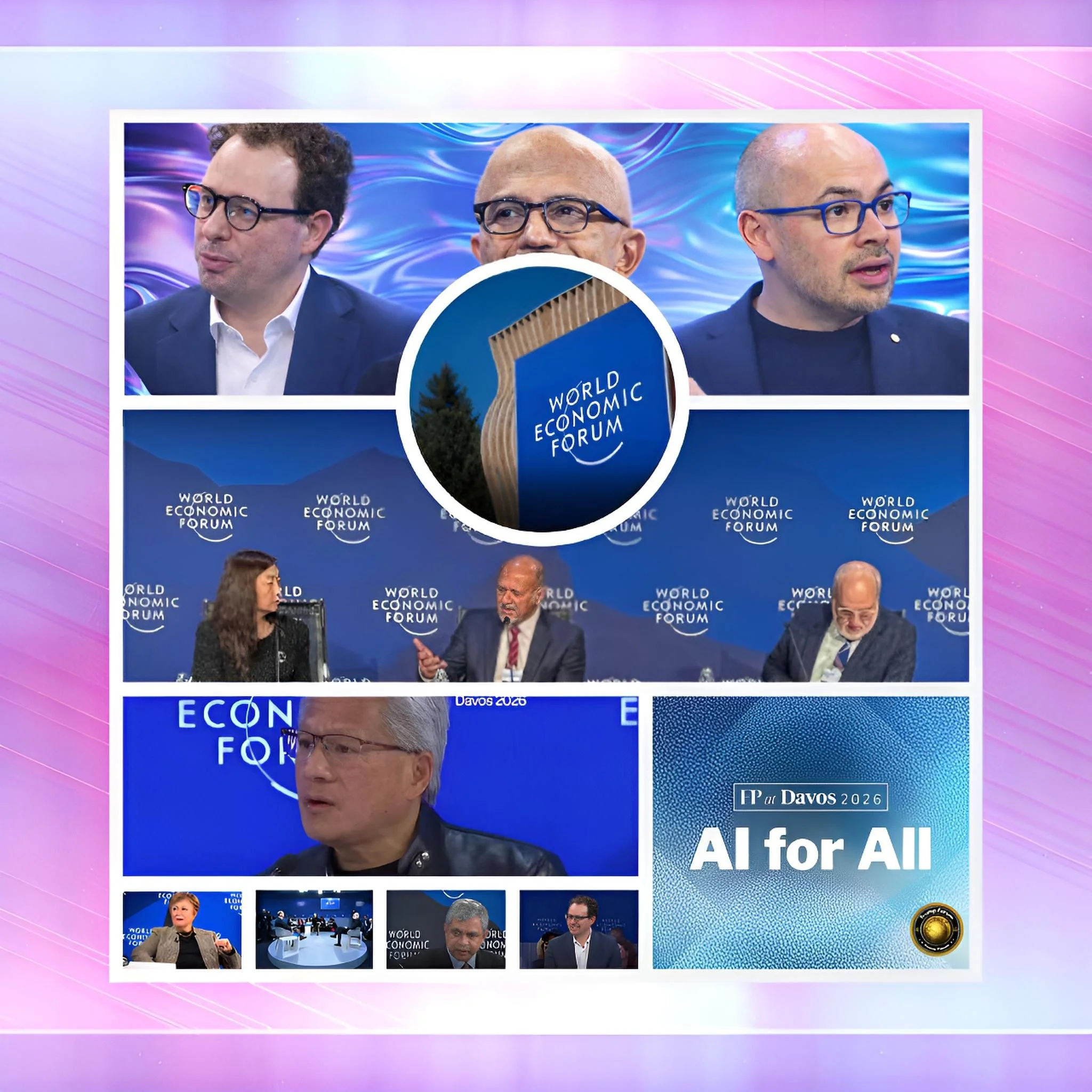
What World Leaders Really Think About Artificial Intelligence: A Plain-Language Guide to Davos 2026
A Clear Look at What Happened in the Swiss Mountains
Introduction: Why This Matters to You
Imagine thousands of the world's most powerful people gathering in the Swiss Alps to talk about the future. That happened in January 2026 at the World Economic Forum in Davos. They talked mostly about artificial intelligence—the computer technology that can write, create images, answer questions, and do many things humans have always done. But here is what is important: these powerful people did not agree with each other. Some thought AI would be wonderful. Others worried it would cause serious problems. This article explains what they said, what they disagreed about, and what it all means for regular people like you.
The History of How We Got Here
Artificial intelligence is not new. Scientists have been working on it since the 1950s. But something changed in recent years. In 2022, a tool called ChatGPT showed that AI could actually do useful work. It could write essays, answer questions, and help people think through problems. Suddenly, companies and governments realized AI was not just a science experiment anymore. It was real technology that could change how we work and live.
Before Davos 2026, other AI tools like Google's Gemini, Meta's Llama, and China's DeepSeek became very powerful. They started replacing some jobs. A company called Anthropic and other AI developers began making tools even smarter. This worried many people. By the time leaders gathered in Davos, AI had become the biggest question everyone wanted to discuss. The earlier questions about whether AI would matter had changed to urgent questions about what happens when millions of jobs disappear.
What the Leaders Actually Said: The Main Disagreements
Here is where things get interesting. The leaders at Davos did not all agree. In fact, their disagreements revealed something important: nobody really knows what will happen next.
Satya Nadella from Microsoft said something simple but powerful: "We will quickly lose social permission to use energy for AI if it is not improving people's lives." Think about what this means. AI uses enormous amounts of electricity. Right now, people accept this because they hope AI will make healthcare better, improve education, and help businesses work more efficiently. But if none of these things actually happen, people will get angry. They will demand that governments stop AI development. Nadella was saying: prove that AI helps real people, or people will force us to stop.
Daria Amodei from Anthropic painted a scary picture. He said AI could wipe out fifty percent of entry-level jobs in professional fields—meaning jobs for people just starting their careers. He gave a specific example: engineers at his company stopped writing code. They just tell AI what to write, and the AI does it. He predicted this would happen across many industries within five to twelve months. His worry was deep: what happens to young people who cannot find first jobs to learn the profession?
However, Demis Hassabis from Google had a different view. He said it would take five to ten more years before AI gets really dangerous. He disagreed with Amodei's timeline. He said AI still has missing ingredients. It is good at some things but not others—like understanding experiments that need to be tested in the real world. This disagreement matters. If Amodei is right, we need to prepare for job losses immediately. If Hassabis is right, we have more time.
Jensen Huang from Nvidia presented a jobs story that sounded more hopeful. He said AI will create the biggest construction project in human history. He explained it like a layer cake. At the bottom is energy. Then semiconductors. Then data centers. Then AI models. Then real applications. Every layer needs workers. Construction workers will build data centers. Electricians will connect them to power grids. Engineers will maintain them. Truck drivers will deliver equipment. So instead of job loss, Huang suggested job transformation. Different jobs, yes. But lots of them. Like how the internet destroyed telephone operator jobs but created web developer jobs.
These disagreements were not just academic. They shaped how leaders thought about what to do. Amodei wanted governments to slow things down and prepare society. Huang wanted governments to speed things up and build infrastructure fast.
What the Experts Warned About
Beyond the disagreements about timing and jobs, several experts warned about specific dangers.
Yuval Noah Harari, a famous historian, said something that made people uncomfortable. He said AI is not just a tool like a hammer or a knife. A hammer does what you want. A knife does what you want. But AI is different. AI can learn. AI can decide on its own. AI can create new things without being told exactly how. He gave this example: imagine a knife that could create new kinds of knives, including sharper knives that could hurt people it was not supposed to hurt. That is AI. Harari worried that governments are not ready for this. Countries have always said they control technology. But with AI, they might not.
Kristalina Georgieva from the International Monetary Fund presented numbers that scared many people. She said forty percent of all jobs in the world could be affected by AI. In rich countries like the United States and Germany, it could be sixty percent. She called it a "tsunami." A tsunami hits fast, and you cannot stop it. She warned that poor countries and poor people would suffer most. Why? Because rich people have money to retrain for new jobs. Poor people often do not.
Brad Smith from Microsoft talked about a practical problem. Communities where Microsoft wants to build data centers do not want them. Why? Because data centers use enormous amounts of electricity. People fear their electric bills will go up. They use huge amounts of water. People in dry areas worry about water shortages. Communities asked reasonable questions: Who gets the jobs from these data centers? Will we have to move from our homes so companies can build them? These questions from regular people showed that even if AI companies say the technology is good, communities might say no.
The Different Views From Around the World
Different countries want different things from AI, and this showed in Davos.
India's Minister Ashwini Vaishnaw said India wants to be an AI power itself, not just a consumer. He pointed out that India has many advantages: millions of smart young people, huge tech companies, and growing talent. He said India is working on all five layers of AI—from semiconductors to real-world applications. He rejected the idea that only America and China can be AI leaders. He wants India to be a genuine creator of AI technology. This is important because it shows emerging countries do not want to be left behind.
China's Vice Premier He Lifeng talked about cooperation and trade. He said China does not see AI as a weapon, but as an opportunity for everyone. He suggested opening China's massive market to the world. This was interesting because it suggested China might be trying to reduce tension about AI competition. However, nobody knows if he was being sincere or strategic.
What the Average Person Should Understand
Here is what matters most for you and people like you:
First, jobs will change. Some jobs will disappear. Some new jobs will appear. The transition will be hard for many people. Workers over forty will have the hardest time retraining. Young people who have not yet chosen careers need to think carefully about what they study. Trades like plumbing and electrical work—jobs that use hands—will probably still be needed.
Second, AI will make some things much better. Healthcare will improve. Education can become personalized. Business will become more efficient. The question is whether these benefits will be shared fairly or concentrated among wealthy people and countries.
Third, energy and electricity matter enormously. The countries with cheap, reliable electricity will win AI competition. This means companies and governments should invest in renewable energy. Solar and nuclear power become strategic advantages, not just environmental choices.
Fourth, international cooperation is weak. Countries are competing, not cooperating. This makes regulation hard. It means safety standards might not be enforced. It suggests we might end up with very different AI systems in different countries that cannot even talk to each other.
What Happens Next: What the Leaders Decided
This is the disappointing part: the leaders did not decide to do much. They acknowledged the challenges. They created some committees to study things. But they did not commit to major new policies or rules. They knew AI was moving fast and that governance—the rules and institutions that control technology—was moving slow. But they did not fix this problem.
Some countries are trying. The European Union created an AI Act with real rules. China is controlling which companies can build AI. The United States is mostly letting companies do what they want. India is trying to catch up and join as an AI creator.
The Real Challenge Ahead
The deepest concern from Davos was this: technology is moving faster than society can adapt. This is not new. The internet moved faster than society expected. Social media moved faster than we could regulate. But AI might be different because it is smarter than previous technologies.
Think about it this way: the internet could not decide on its own what to do. Social media could not think. But AI can think. It can improve itself. This creates a genuine new challenge that we have never faced before. Having smart computers that can improve themselves is different from having dumb tools we control.
The question for your future is: Will we figure out how to manage AI well before it becomes too powerful to manage? Davos 2026 suggested that answer is unclear. Some people think we will figure it out. Others worry we will not. And that uncertainty is perhaps the most honest thing that came out of the whole conference.
A Note on What This Means
The leaders at Davos in 2026 revealed that artificial intelligence represents a genuine inflection point—a moment where the world changes in fundamental ways. They disagreed about how fast it will happen and what the consequences will be. But they all agreed that it matters enormously. Your life, the work you will do, the skills you will need, the communities where you live—all of this will be shaped by how the world manages AI over the next few years.
The fact that leaders are not yet coordinating well suggests the transition will be harder than it needs to be.
The most important thing for you to know: pay attention to AI. Learn about it. Think about how it affects your work and your community. Do not just accept what companies tell you about AI being wonderful. Do not just believe doomsayers who say it will be catastrophic. Think for yourself. Ask questions.
Demand that your leaders make good decisions about AI. The future belongs to people who understand this technology, not people who are confused by it.