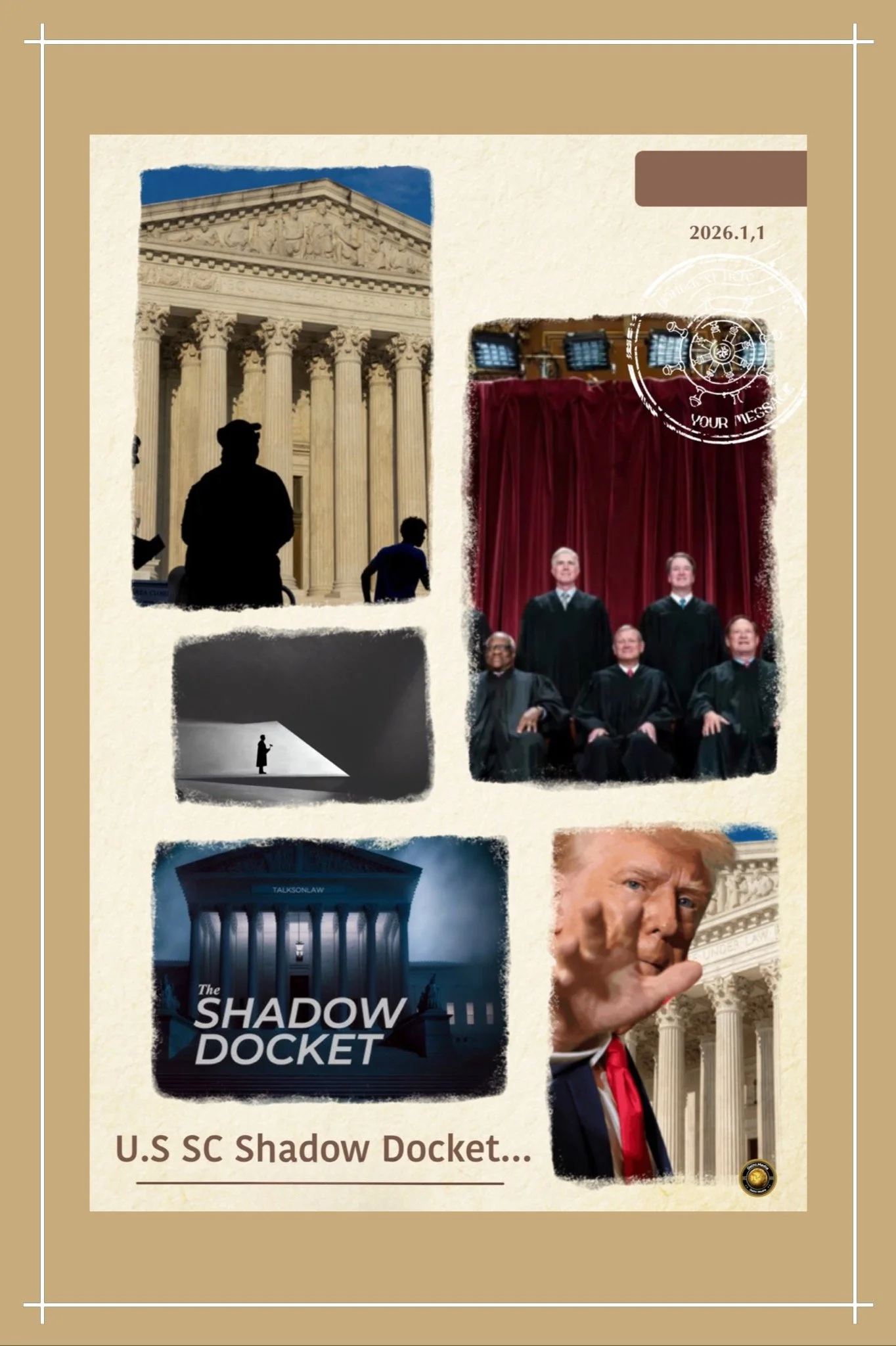
SHADOW JUSTICE: How the United States Supreme Court Quietly Dismantled 236 Years of Constitutional Order
Executive Summary
The Supreme Court’s “shadow docket”—historically an obscure procedural mechanism for emergency relief—has undergone a dramatic transformation across two Trump administrations into a vehicle for reshaping American governance through opaque, expedited rulings.
During Trump’s first presidency from 2017 to 2021, the administration filed forty-one emergency applications seeking temporary relief from lower court orders, succeeding in approximately seventy percent of cases.
By comparison, the Bush and Obama administrations combined filed only eight emergency applications across sixteen years.
In Trump’s second term beginning January 2025, the rate of shadow docket usage has accelerated exponentially. Within the first twenty weeks of the administration, Trump’s legal team filed nineteen emergency applications—approaching the total number Biden’s administration filed across its entire four-year tenure.
The Supreme Court has granted relief at a rate exceeding eighty-four percent, with approximately seventy-five percent of all granted relief producing conservative outcomes that expand presidential authority at the expense of Congressional power and individual rights. The shadow docket, designed as a mechanism of last resort for genuine emergencies such as death row inmates facing imminent execution, has become a routine instrument for the Trump administration to circumvent normal judicial procedures, implement policies blocked by lower courts, and accomplish through expedited shadow docket rulings what would face sustained judicial scrutiny under the Court’s traditional merits docket.
The consequences reverberate across American governance: federal employees have been summarily dismissed, research funding has been curtailed, immigrants have been deported, and constitutional amendments have been effectively reinterpreted—all through unsigned orders offering minimal legal reasoning.
Introduction: The Erosion of Deliberation
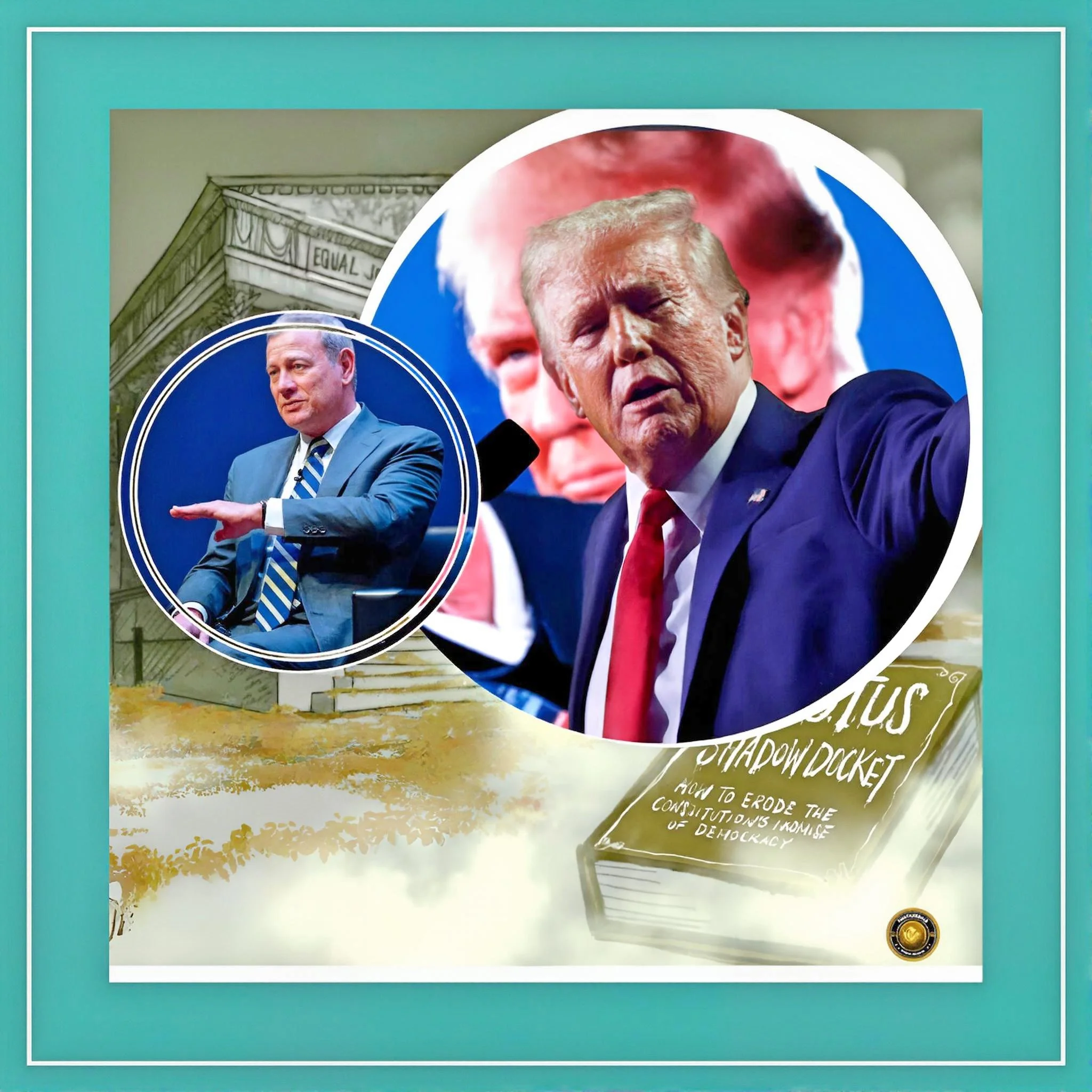
THE DOCKET COUP: Inside the Supreme Court’s Secret Rulings Reshaping America
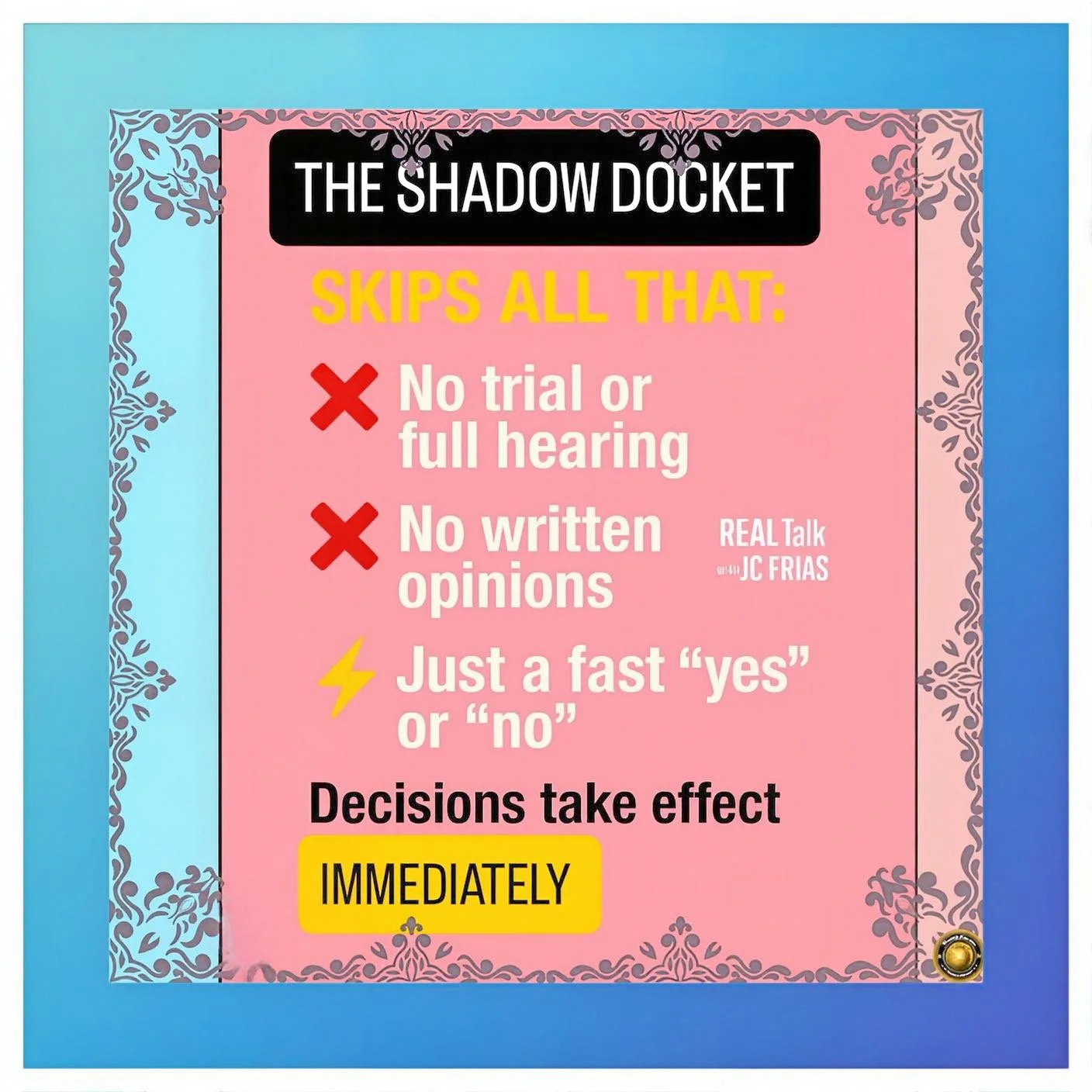
The Supreme Court’s constitutional role rests fundamentally upon deliberation. Cases receive extensive briefing over months, oral arguments allow justices to interrogate counsel’s positions, conference discussions permit genuine exchange among the nine justices, and published opinions articulate reasoning that guides lower courts and establishes legal precedent. This process is necessarily slow; it prioritizes depth over speed, reasoning over expedience, and transparency over secrecy. The shadow docket operates on entirely different principles. Emergency applications—requests for stays of lower court orders, temporary relief, or other interim measures—receive limited briefing, are often decided within days or even hours, typically involve no oral argument, and frequently result in unsigned orders offering no explanation whatsoever for the Court’s decision. Historically, this procedure served a genuine function: death penalty cases where execution dates approached, situations where applicants faced truly irreparable harm, scenarios requiring immediate judicial intervention.
Yet the shadow docket has undergone a fundamental metamorphosis, particularly during Trump’s administrations. What was once an extraordinary measure deployed in marginal circumstances has become a routine vehicle through which consequential constitutional questions are resolved outside the public view and without the procedural safeguards designed to ensure judicial legitimacy. The transformation reveals something profound about contemporary American governance: the erosion of institutional deliberation in favor of administrative speed, the systematic use of formal legal procedures to achieve outcomes that would not survive sustained scrutiny, and the capacity of executive power to bend judicial institutions toward its purposes.
History and Current Status: From Emergency Procedure to Routine Instrument
The shadow docket’s history spans decades, but its contemporary incarnation emerged during Trump’s first term. Between 2001 and 2017, spanning the entire Bush and Obama administrations, the Department of Justice sought emergency relief from the Supreme Court a combined eight times across sixteen years. The success rate was fifty percent—four granted, four denied. The cases involved genuine emergencies: death penalty stays, immigration detention questions, matters genuinely requiring rapid judicial intervention.
Trump’s first presidency transformed this dynamic. Between January 2017 and January 2021, the Trump administration filed forty-one emergency applications to the Supreme Court.
The administration succeeded in approximately twenty-eight cases, yielding a seventy percent success rate that vastly exceeded historical norms. More consequentially, the nature of these applications shifted fundamentally. Rather than genuine emergencies, many involved significant policy questions that would normally receive full merits briefing and oral argument.
In December 2017, the Supreme Court issued a five-sentence order allowing Trump’s third iteration of a travel ban targeting predominantly Muslim-majority nations to take effect pending further appeals. No explanation accompanied the decision. Lower courts had found the ban likely violated equal protection and immigration statutes, but the Supreme Court’s shadow docket order permitted implementation while litigation continued. The Court later upheld the ban on merits in June 2018, but the interim relief had already accomplished the policy objective: the ban had been in effect for months while constitutional challenges proceeded at glacial pace.
Similarly, in January 2019, the Supreme Court issued a four-sentence order allowing Trump’s ban on transgender military service to take effect. Federal courts had issued preliminary injunctions based on equal protection analysis, finding that Trump’s stated justifications—budgetary concerns and military readiness—were pretextual and contradicted military studies. Judge Colleen Kollar-Kotelly noted in her preliminary injunction that “all of the reasons proffered by the president for excluding transgender individuals from the military in this case were not merely unsupported, but were actually contradicted by the studies, conclusions and judgment of the military itself.” The Supreme Court, without explanation, reversed that protection, allowing the military to enforce the ban while litigation continued.
In July 2020, Trump sought to redirect military funds toward border wall construction, a use of funds Congress had not appropriated for that purpose. The Supreme Court issued a one-sentence order granting the request. The brevity itself communicated presidential supremacy: the question of Congressional power over appropriations, one of the Constitution’s most fundamental allocations of authority, was resolved in a single sentence, unsigned, unexplained.
These decisions established a pattern: the shadow docket became the vehicle through which Trump’s most controversial policies were implemented, lower court objections were neutralized through expedited Supreme Court relief, and the administration accomplished through interim measures what might not survive full merits review.
Critically, the lack of written reasoning meant that lower courts received no guidance about the Court’s constitutional analysis. Judge Jennifer Rakoff, a federal judge who has reviewed extensive shadow docket decisions, observed that the lack of reasoning created a cascading jurisprudential problem: without understanding the Supreme Court’s rationale, lower courts could not apply the Court’s logic to similar cases, resulting in inconsistent rulings and uncertainty throughout the federal judiciary.
Trump’s Second Term: An Acceleration Toward Executive Supremacy
Trump’s return to office in January 2025 initiated a shadow docket crisis of unprecedented proportions. Within the first twenty weeks of his second administration—a period roughly corresponding to mid-September 2025—the Trump administration filed nineteen emergency applications to the Supreme Court.
This pace exceeded Biden’s entire four-year administration, which filed approximately seventeen applications across forty-eight months. The acceleration suggests not merely increased litigation but a deliberate strategy to use the shadow docket as the primary vehicle for implementing controversial policies.
The specific cases illuminate the transformation of executive power under shadow docket auspices.
In May 2025, Trump fired Gwynne Wilcox, a career labor attorney serving as a member of the National Labor Relations Board. The NLRB, established during Franklin Roosevelt’s presidency, possessed statutory protection against at-will removal: the president could only fire NLRB members “for cause,” meaning they could not be dismissed based on policy disagreements. This for-cause restriction existed to insulate labor regulation from pure presidential politics. Lower courts immediately enjoined Wilcox’s firing, applying the ninety-year-old precedent of Humphrey’s Executor v. United States, which held that Congress possessed constitutional authority to establish independent agencies with for-cause removal protections.
Trump’s solicitor general appealed to the Supreme Court, requesting that the Court stay the lower court order pending appeal. The Supreme Court granted the request in Trump v. Wilcox through a two-page unsigned decision issued May 22, 2025. Rather than simply granting a temporary stay pending merits review, the Court’s opinion addressed the merits, essentially deciding the case without full briefing or oral argument. The Court held that both the NLRB and Merit Systems Protection Board “exercise considerable executive power” and thus the president likely possessed inherent authority to remove their members without cause. Justice Elena Kagan’s dissent articulated the constitutional catastrophe the majority’s reasoning portended. She noted that “between Humphrey’s and now, 14 different Presidents have lived with Congress’s restrictions on firing members of independent agencies.” She asked: “can it really be said, after all this time, that the President has a crying need to discharge independent agency members right away?” Most devastatingly, she concluded: “In valuing so highly—in an emergency posture—the President’s ability to fire without cause Wilcox and Harris and everyone like them, the majority all but declares Humphrey’s itself the emergency.”
The Wilcox decision exemplified shadow docket dysfunction. Lower courts had applied an established precedent under normal appellate procedures. The Supreme Court, through an expedited process lacking oral argument or full briefing, effectively overturned ninety years of constitutional protection for independent agencies. Subsequent applications regarding Federal Trade Commission commissioners and other independent agency heads followed, all receiving shadow docket treatment.
Beyond agency removal, the shadow docket enabled other transformations of executive power.
In September 2025, the Court issued an order allowing Trump to freeze approximately four billion dollars in foreign aid funds that Congress had appropriated. Lower courts had blocked the freeze as violating statutory spending requirements, but the Supreme Court’s shadow docket order permitted the policy to proceed while litigation continued. Justice Kagan dissented, condemning the decision as transferring Congressional power of the purse to the executive. She argued that the shadow docket “should never be used, as it has been this year, to transfer government authority from Congress to the President, and thus to reshape the Nation’s separation of powers.”
The transgender military ban reappeared in May 2025. In what constituted a reprise of Trump’s first-term strategy, the administration reimposed a ban on transgender military service, which Biden had reversed in 2021. Lower courts immediately enjoined the ban on equal protection grounds, noting that current transgender service members possessed substantial liberty interests and the government’s justifications contradicted military judgments. The Supreme Court, through shadow docket relief granted May 6, 2025, allowed the ban to take effect, enabling the military to begin discharging thousands of transgender service members while litigation proceeded.
The birthright citizenship case represented shadow docket escalation of unprecedented constitutional magnitude. In January 2025, Trump issued an executive order attempting to deny citizenship to children born in the United States to mothers without lawful status or temporary visa holders. The Fourteenth Amendment provides that “all persons born in the United States, and subject to the jurisdiction thereof, are citizens of the United States.” The amendment’s language is unambiguous; it contains no exceptions for children born to immigrants.
Multiple federal courts issued preliminary injunctions blocking enforcement of the executive order on Fourteenth Amendment grounds. Yet the Trump administration filed emergency applications to the Supreme Court, and by fall 2025 the Court had scheduled oral arguments on the merits for spring 2026. The prospect that the Court might use its shadow docket to allow the policy to proceed while considering the constitutional question on the merits represented the ultimate inversion of constitutional hierarchy: the executive could effectively rewrite constitutional amendments through administrative action, with the judiciary providing temporary stays while litigation proceeded.
On passports and gender identity, the Trump administration prohibited the State Department from issuing passports reflecting applicants’ gender identity. The administration blocked passports for transgender individuals seeking documents aligned with their identity. Shadow docket orders allowed this policy to proceed despite lower court injunctions based on constitutional liberty interests.
Perhaps most remarkably, in a rare exception suggesting residual judicial restraint, the Court allowed Federal Reserve Governor Lisa Cook to remain in office through early 2026. When Trump sought to remove Cook based on disputed mortgage fraud allegations, lower courts blocked the removal as violating the Federal Reserve Act’s for-cause requirements and denying due process. Rather than issuing a summary shadow docket order, the Supreme Court scheduled oral arguments for January 2026, suggesting that the Court recognized the Federal Reserve’s unique institutional status might warrant continued statutory protection.
The Cook case offered a glimmer that some justices recognized the catastrophic implications of unlimited presidential removal authority, particularly over the independent central bank.
Cause-and-Effect Analysis: The Mechanics of Executive Expansion
The shadow docket’s transformation into an instrument of executive supremacy resulted from several converging factors. First, the Trump administration developed a deliberate litigation strategy that weaponized the emergency docket. Rather than accepting lower court rulings and litigating fully on the merits, the administration filed immediate appeals to the Supreme Court, requesting emergency stays that would permit implementation of contested policies while judicial review proceeded. This strategy inverted normal appellate hierarchy: policies were implemented despite preliminary judicial findings that they violated law and the Constitution.
Second, the Supreme Court’s ideological composition proved receptive to the administration’s requests. The conservative majority—comprised of six justices appointed by Republican presidents—demonstrated systematic willingness to grant relief favoring Trump administration positions. Data compiled by Georgetown Law Professor Stephen Vladeck, the nation’s leading shadow docket scholar, revealed striking disparities. Justice Brett Kavanaugh, who had criticized executive overreach in some contexts, voted for the Trump administration in eighty-nine percent of shadow docket cases from 2025, compared to only forty-one percent for the Biden administration—a forty-eight-point difference. Across the entire shadow docket, approximately seventy-five percent of all granted relief produced conservative outcomes, establishing a consistent pattern of ideological influence on the Court’s emergency docket.
Third, the lack of written reasoning in shadow docket decisions eliminated accountability mechanisms that normally constrain judicial power. When justices issue merits opinions, they must articulate legal reasoning responsive to precedent and constrained by prior decisions. Shadow docket orders, often unsigned and unexplained, permit the justices to reach outcomes without legal constraint. Justice Kagan’s dissents pointedly noted that the shadow docket, as employed by the Court’s majority in 2025, violated basic principles of the rule of law: decisions affecting millions of people were issued without explanation, preventing lower courts from understanding the Court’s constitutional analysis and preventing the public from evaluating whether legal reasoning or political ideology drove the outcomes.
Fourth, the Court’s own procedures facilitated executive expansion. The Court limited the ability of lower courts to issue “universal injunctions”—orders applying nationwide—which meant that even when federal judges blocked Trump policies in their jurisdictions, the Trump administration could potentially implement the same policies in other federal circuits, creating circuit splits and requiring expedited Supreme Court intervention. Through shadow docket orders, the Court essentially validated a “patchwork implementation” approach that favored executive agility over judicial uniformity.
Finally, the absence of Congressional resistance emboldened both the executive and the judiciary. A Republican-controlled Congress demonstrated minimal willingness to defend Congressional powers being transferred to the executive through shadow docket decisions. When courts ruled that Trump violated Congressional appropriations statutes, Congress did not respond with enforcement actions or defunding threats. Congressional abdication created space for both executive and judicial expansion of presidential authority.
Key Developments and Emerging Constitutional Crisis
By year’s end 2025, the shadow docket had produced a clear constitutional transformation. Independent agencies that had operated under Congressional statutory constraints for nearly a century now faced dissolution or conversion into purely presidential instruments. Congressional appropriations power—allocated explicitly to the legislative branch in Article I—had been substantially transferred to the executive’s discretionary control. Constitutional amendments appeared subject to presidential reinterpretation through executive order, with the shadow docket facilitating implementation while legal challenges proceeded at leisurely pace.
The Court itself provided data on the escalation. In the 2024-2025 term, the shadow docket produced 111 decisions—a 150 percent increase from the 2023-2024 term’s figures. Throughout 2025, written explanations in shadow docket orders became more common than in prior years, with nearly forty percent of granted applications including some written reasoning by 2025 (compared to 11.6 percent during 2014-2021). This paradoxically made the shadow docket’s ideological bias more evident: when the majority explained its reasoning, the reasoning often reflected political rather than legal judgment.
Justice Jackson’s dissent in a federal workforce reduction case crystallized the constitutional stakes. She condemned the Court for “needlessly granting the Government’s emergency application to prohibit universal injunctions,” arguing that this “has cleared a path for the Executive to choose law-free action at this perilous moment for our Constitution—right when the Judiciary should be hunkering down to do all it can to preserve the law’s constraints.”
The shadow docket’s expansion coincided with approximately 225 executive orders issued by Trump in his second term’s first year—nearly double the rate of any president in seventy-five years. The combination of prolific executive action and shadow docket enforcement created a situation where presidential authority expanded faster than any institutional actor could meaningfully challenge it. By the time cases wound through appellate litigation toward Supreme Court merits review, the executive had already achieved its policy objectives through interim shadow docket relief.
Future Projections and Constitutional Implications for 2026
Looking toward 2026, the shadow docket’s institutional role remains uncertain but consequential.
Three major merits cases scheduled for decision in June 2026 will determine whether the shadow docket’s expansion of presidential power receives permanent constitutional blessing.
Trump v. Barbara, addressing birthright citizenship, will determine whether presidents can reinterpret constitutional amendments through executive order.
Trump v. Slaughter (formerly called the FTC removal case) will likely overturn Humphrey’s Executor entirely, completing the juridical destruction of independent agencies.
A third case involving tariff authority under the International Emergency Economic Powers Act will determine whether Congress’s constitutional power to regulate commerce and impose taxes can be transferred to the executive through vague emergency statutes.
The shadow docket will almost certainly continue its expanded use. The Trump administration has demonstrated that emergency docket applications represent an efficient vehicle for implementing controversial policies, and there remains no institutional incentive for restraint.
Congress has not imposed sanctions. The judiciary has not restricted access to the procedure. The executive will logically continue deploying the shadow docket until effective opposition emerges.
Critical questions loom regarding the shadow docket’s legitimacy. Can an institution that decides consequential constitutional questions without written reasoning, without oral argument, without full briefing, and through processes lacking transparency retain public confidence in its neutrality?
The Pew Research Center reported in 2024 that fewer than half of Americans held favorable views of the Supreme Court. The shadow docket’s expansion—through which the public cannot observe the reasoning, cannot evaluate judicial impartiality, and cannot understand the constitutional bases for consequential decisions—will likely further erode confidence in the judiciary. An institution that loses public legitimacy loses capacity to enforce its own decrees. Presidents refuse defiance when court orders lack perceived legitimacy. Lower courts grow uncertain about precedent when the Supreme Court issues decisions without legal reasoning.
Possible reforms have been proposed but face long odds. Requiring written explanations for all shadow docket decisions would impose minimal burden while vastly improving transparency. Limiting shadow docket usage to genuine emergencies and establishing more precise criteria would restore the procedure’s original purpose.
Creating opportunities for oral argument in cases of constitutional significance would restore deliberation. Yet the conservative majority, having benefited enormously from the shadow docket’s expansion, will likely resist reforms. Chief Justice Roberts has not signaled alarm about the shadow docket’s use, despite his general commitment to judicial independence. His silence suggests acquiescence.
Conclusion
MIDNIGHT ORDERS: How Supreme Court’s Shadow Docket Became Trump’s Constitutional Superweapon
Democracy on the Shadow Docket
The Supreme Court’s shadow docket has evolved from a marginal emergency procedure into a constitutional weapon through which executive power expands beyond Congressional reach. Trump’s administration, recognizing the docket’s utility, has weaponized it with systematic effectiveness, filing applications at unprecedented rates and succeeding at rates exceeding eighty percent. The Court’s ideologically divided composition has produced decisions that are difficult to distinguish from political rather than legal judgment.
The implications extend far beyond courthouse dynamics. A constitutional system rests fundamentally upon the assumption that important decisions emerge from deliberative processes constrained by reasoning and precedent. The shadow docket violates that assumption: it enables consequential decisions through expedited processes lacking transparency, reasoning, or institutional oversight. When policies as significant as Congressional appropriations, independent agency authority, and constitutional amendment interpretation can be resolved through unsigned orders issued days after filing, the constitutional system has undergone fundamental transformation.
Historically, constitutional orders collapse not through dramatic revolutionary ruptures but through incremental erosions of institutional constraints. The shadow docket represents such erosion. Each decision without reasoning normalizes opaque judicial processes. Each expansion of presidential authority through interim relief establishes precedent for further expansion. Each Congressional silence signals acceptance of changed constitutional boundaries.
Whether the American constitutional order survives the shadow docket’s transformation depends upon institutional actors recognizing the crisis and mounting resistance.
The 2026 Supreme Court term will prove decisive. If the Court uses the merits docket to bless the shadow docket expansions of executive power, the transformation becomes permanent. If Congress awakens to defend its constitutional prerogatives, institutional correction becomes possible. If the judiciary demonstrates that it retains independence from executive pressure, the Constitution’s separation of powers survives.
But if current trajectory continues uninterrupted, future generations will mark 2025 as the year the American constitutional order fundamentally transformed—not through revolution or coup but through the routine use of shadowy procedures and unexplained judicial orders.