America First Rising: The Strategic Shift in U.S. Foreign Policy During Trump's Second Term
Executive Summary
The Global Implications of a Nationalist Turn
Donald Trump's second administration has fundamentally repositioned the United States within the international system, abandoning the post-Cold War liberal consensus in favor of a transactional, nationalist worldview.
This shift finds its clearest expression through the combination of the President's unvarnished America First doctrine and the appointment of Secretary of State Marco Rubio, whose ideological hawkishness regarding China and the Western Hemisphere serves as the operational embodiment of this larger strategic recalibration.
The administration's 2025 National Security Strategy, released in December, reveals an architecture that prioritizes bilateral deal-making over multilateral commitments, economic coercion over diplomatic engagement, and hegemonic assertion over rules-based international order.
Meanwhile, the administration's handling of China policy—characterized by tariff escalation, technological decoupling, and improvisational negotiations—demonstrates a commitment to competitive dominance rather than institutional collaboration.
The Venezuelan operation in January 2026, orchestrated primarily by Rubio, exemplifies the administration's willingness to employ unilateral military force to reshape hemispheric alignments in line with narrowly defined American interests.
Introduction
Breaking with the Postwar Consensus
The contemporary international system stands at an inflection point. The return of Donald Trump to the presidency in January 2025 initiated a comprehensive departure from the orientations that have animated American statecraft since the conclusion of the Cold War.
The previous framework, what critics termed the liberal international order, constructed institutions of governance, trade regimes, and security architectures predicated upon the notion that American prosperity and security were maximized through the expansion of democratic governance, respect for human rights, and adherence to binding multilateral arrangements. Trump's second administration rejects this formulation entirely.
Instead, the guiding principle animating contemporary American foreign policy proves intensely transactional. Transactions, by definition, presume antagonism—a relationship in which one party's gain constitutes another's loss. The administration's closest advisors regard alliances not as communities of shared values but as arrangements to be perpetually renegotiated, scrutinized for their benefit to the United States, and ultimately evaluated according to whether they advance clearly defined American interests.
This philosophical reorientation has produced measurable consequences across multiple theaters: military interventions in Venezuela, expanded operations against Iran's nuclear infrastructure, renewed emphasis on hemispheric dominance, and an intensifying technological and commercial confrontation with China that borders on systematic decoupling.
The figure of Marco Rubio embodies this transformation with particular clarity. Elevated simultaneously to the positions of Secretary of State, National Security Advisor, and head of the National Archives—offices last held together by Henry Kissinger—Rubio has demonstrated a capacity to channel Trump's most ambitious impulses into sustained policy implementation.
A politician whose career has been defined by adaptation to Trump's gravitational pull, Rubio represents the archetype of the loyalist executive: capable, hawkish, and entirely subordinate to presidential will.
His orchestration of the Venezuelan operation that resulted in the capture of Nicolás Maduro on January 3, 2026, revealed a willingness to pursue regime-change operations on a scale that would have appeared unimaginable during Trump's first administration.
The implications of these developments extend beyond the United States. The administration's China strategy, though characterized by evident improvisational elements, contains within itself the architecture of systematic exclusion—what observers term a China-exclusion global order.
The administration has assembled a team of ideological hawks whose consensus view treats the Chinese Communist Party not as a negotiating partner but as an existential adversary whose influence must be erased from every sector of the international system where American primacy can be asserted.
Historical Context
From Liberal Internationalism to Transactional Nationalism
The postwar American-led international order emerged from the ashes of World War II and the subsequent recognition that American security depended upon the construction of a dense web of multilateral institutions, alliance relationships, and trade arrangements.
The architects of this system—figures such as George Marshall, Dean Acheson, and George Kennan—believed that American prosperity required not isolationism but rather what they termed liberal internationalism: the creation of a rules-based system in which American power would be exercised through institutions rather than force. However, force remained perpetually available as a backstop.
This system functioned with remarkable resilience through the Cold War, adapting itself to the bipolar competition between the United States and the Soviet Union. Following 1991, American policymakers confronted a more complex challenge: how to manage the transition from bipolarity to what they hoped would constitute a unipolar moment.
The 1990s witnessed American power exercised with relative confidence—interventions in the Balkans, the expansion of NATO, and the deepening of economic globalization under American leadership.
The events of September 11, 2001, and the subsequent wars in Afghanistan and Iraq initiated a process of institutional and strategic exhaustion. By the time Barack Obama assumed office in 2009, American power, while still formidable, had accumulated significant liabilities.
The wars in Iraq and Afghanistan consumed vast resources without producing clearly defined strategic outcomes. American financial institutions had precipitated a global economic crisis. The relative economic position of the United States began to decline as Asian economies, particularly China, grew at accelerating rates.
When Donald Trump first assumed office in January 2017, he brought with him a radically different conception of American statecraft. Trump viewed the postwar order as a series of arrangements that had disadvantaged the United States. He viewed alliances as parasitic relationships in which American taxpayers subsidized the defense of wealthy nations. He viewed trade as a zero-sum competition to be won through tactical force.
During his first term, Trump withdrew from the Trans-Pacific Partnership, renegotiated existing trade arrangements, imposed tariffs on multiple trading partners, and reduced the scope of American overseas engagement.
Trump's first term, however, remained constrained by institutional forces. Military commanders such as James Mattis, foreign policy professionals such as Rex Tillerson and Mike Pompeo, and congressional Republicans moderately committed to internationalism ensured that Trump's most extreme impulses encountered meaningful resistance.
The then-President found himself compelled to maintain fundamental commitments to allies, to retain the basic architecture of American military presence abroad, and to continue participation in multilateral arrangements even while publicly criticizing them.
The intervening years—the Biden administration's effort to restore confidence in American commitment to alliances, its explicit focus on great power competition with China, its emphasis on defending democracy and human rights—created a political context in which Trump could return to power with explicit promises to pursue the America First agenda without the institutional constraints of his first term.
The 2024 election appeared to grant Trump something resembling a mandate. He returned to office having secured electoral victory and, crucially, confronted Republican majorities in Congress willing to defer to his authority.
Current Status and Key Developments
The Operational Architecture of American Supremacy
The second Trump administration has unfolded across a compressed timeframe of approximately one year, yet the pace of substantive policy change has been extraordinary.
The National Security Strategy released in December 2025 represents the closest thing to an official articulation of the administration's strategic worldview. That document explicitly rejects the notion that American interests are served by broad commitments to global order maintenance. It argues that previous administrations defined American national interests too expansively, leading to overcommitment and strategic overextension.
The 2025 strategy asserts that American concern for the affairs of other nations should be restricted to those instances where such affairs directly threaten demonstrable American interests.
The geographic reorientation announced in the strategy proves particularly significant. The Trump administration has elevated the Western Hemisphere to the status of foundational region for American security and prosperity.
This reorientation constitutes a dramatic pivot from the Biden administration's Indo-Pacific focus, which treated the strategic competition with China as the primary organizing principle for American statecraft.
The Trump administration has not abandoned Indo-Pacific commitments entirely, but it has repositioned them as secondary to the assertion of American dominance across the Americas.
This reorientation found explicit expression in the Venezuelan operation of January 2026. The capture of Nicolás Maduro followed months of escalating military pressure: naval buildups in the Caribbean, coordinated airstrikes against vessels alleged to be carrying narcotics, and the deployment of American power in a manner that left little doubt regarding American intentions.
The operation itself involved special operations forces descending upon Caracas to remove the sitting president from his residence. The subsequent assertion that the United States would "run" Venezuela through mechanisms of economic coercion represented a stark restatement of the Monroe Doctrine, which the Trump administration has rebranded as the "Donroe Doctrine."
Marco Rubio emerged as the central figure in the Venezuelan operation. The Secretary of State, who holds simultaneous appointments as National Security Advisor and head of the National Archives, orchestrated the military planning, managed the diplomatic implications, and articulated the post-operation strategic vision for the hemisphere.
His role illuminates the nature of Trump's decision-making apparatus: decisions emerge from the preferences of the sitting president, filtered through the counsel of those individuals to whom the president has delegated authority.
In this instance, Rubio's Cold War–inflected hawkishness regarding Latin American strongmen aligned so precisely with Trump's transactional nationalism that the Secretary of State has emerged as perhaps the most influential foreign policy figure in the administration.
The China strategy represents the other major pole of the administration's foreign policy architecture.
The administration assembled an explicit team of China hawks: Rubio at the State Department, Mike Waltz as National Security Advisor, David Perdue as Ambassador to China, Pete Hegseth as Secretary of Defense, and Howard Lutnick at Commerce. The stated goal of this assemblage involves what the administration characterizes as outcompeting China rather than isolating it, though the distinction proves more semantic than substantive.
The actual implementation of China policy has unfolded according to a pattern of tariff escalation followed by temporary truces. In February 2025, the administration imposed a ten percent fentanyl-related tariff on Chinese imports.
By April, following escalations by Beijing, the administration raised tariffs to 34 percent, then to 84 percent, and ultimately to 125 percent on selected categories of Chinese goods. These tariffs were interspersed with reciprocal measures from Beijing: restrictions on rare earth exports, sanctions on American companies, and retaliatory tariffs on American agricultural products.
By November 2025, following a summit between Trump and Chinese President Xi Jinping in South Korea, both sides agreed to a temporary pause. China agreed to suspend retaliatory tariffs, increase soybean purchases, enhance enforcement against fentanyl trafficking, and temporarily suspend restrictions on rare earth exports.
The United States agreed to reduce tariffs from 125 percent to 30 percent, suspend port fee escalations, and delay comprehensive technology restrictions for one year. The agreement was explicitly characterized as temporary, with both sides regarding any accommodations as tactical pauses in a longer strategic competition.
The pattern reveals a fundamental tension within the Trump administration's China strategy. The ideological hawks surrounding the president—Rubio, Waltz, and others—view competition with China as an existential struggle that should culminate in the systematic exclusion of Chinese influence from American and allied technological, economic, and strategic spheres.
Yet Trump himself appears more interested in securing specific concessions through negotiation: soybean purchases, mineral access, enforcement against fentanyl, and what appear to be temporary trade advantages.
This tension remained unresolved as of January 2026, with observers both within the administration and externally uncertain regarding the ultimate direction of administration policy.
Some China hawks in the administration believed that Trump would eventually embrace a more comprehensive decoupling strategy. Others thought Trump might continue pursuing deal-specific arrangements that would satisfy his preference for visible wins while lacking the coherence of a comprehensive strategic doctrine.
Cause-and-Effect Analysis
The Cascading Effects of Nationalist Statecraft
The transactional reorientation of American foreign policy produces a cascade of effects extending across the international system. By treating alliances as contractual arrangements to be perpetually renegotiated, the administration has compelled allied nations to recalibrate their strategic postures.
European nations have responded by substantially increasing defense spending: NATO allies collectively agreed in June 2025 to increase their annual defense-spending target to 5 percent of GDP by 2035, a commitment wrung from reluctant allies through the combination of Trump's explicit threats to reduce American commitment and his demonstrated willingness to impose tariffs on allied nations.
The reorientation toward hemispheric dominance generates corresponding effects on Latin American alignments. The Venezuelan operation signaled unambiguously that the Trump administration will employ military force to reshape hemispheric politics according to American preferences.
Cuba, confronted with the seizure of its Venezuelan ally, faces implicit pressure to accommodate American demands. The broader message to the region proved direct: alignment with American interests produces security and prosperity; resistance produces military intervention, economic strangulation, and political overthrow.
The China strategy, despite its improvisational character, contains within itself a logic of systematic exclusion. Tariffs serve not merely as revenue-generating mechanisms but as instruments to compel the decoupling of American supply chains from Chinese production.
Technology restrictions, implemented through the Commerce Department and export control regimes, aim to prevent Chinese access to advanced semiconductor manufacturing equipment and artificial intelligence capabilities.
Trade agreements, rather than expanding commerce, serve to disadvantage Chinese firms seeking access to American markets while advantaging American firms seeking access to Chinese and third-country markets.
The weakening of traditional American commitments to human rights, democratic governance, and multilateral rule observance produces corresponding effects on the behavior of authoritarian states.
By suspending enforcement of the Foreign Corrupt Practices Act, the administration signaled that American companies would no longer face restrictions based on their willingness to work with corrupt regimes.
By dismantling the foreign aid architecture and reducing USAID funding, the administration eliminated a mechanism through which the United States had historically incentivized democratic reform.
By withdrawing from the World Health Organization and the Paris Climate Accord, the administration rejected participation in mechanisms designed to address collective action problems.
The appointment of Rubio, despite his hawkish ideology, reveals a deeper logic of subordination. Where advisors such as Mattis had enjoyed sufficient institutional authority and professional credibility to occasionally constrain Trump, Rubio's position depends entirely upon Trump's satisfaction with his performance.
This asymmetry of power ensures that whenever Trump's preferences diverge from Rubio's ideological commitments, Trump's preferences prevail. The result is a foreign policy apparatus stripped of the internal checking mechanisms that sometimes restrained Trump during his first term.
Latest Concerns and Future Implications
Navigating Uncertainty in a Fragmented System
The international community confronts a novel situation: an American president whose stated foreign policy doctrine emphasizes restraint, restraint understood as withdrawing from unprofitable commitments, yet whose actual military interventions have escalated dramatically compared to his first term.
The bombing campaigns in Yemen, Iraq, Somalia, Iran, and Venezuela represent a more muscular deployment of American force than occurred during Trump's initial presidency.
This paradox reflects the underlying logic of Trump's America First doctrine: restraint in the sense of refusing to maintain global commitments, but maximum force when American interests are perceived to be directly threatened or when the costs of intervention are deemed manageable relative to potential gains.
The Taiwan question emerges as perhaps the most consequential uncertainty. Trump has made contradictory statements regarding American commitment to Taiwan's security, oscillating between dismissing Taiwan's strategic importance and acknowledging it as perhaps the world's most important semiconductor producer.
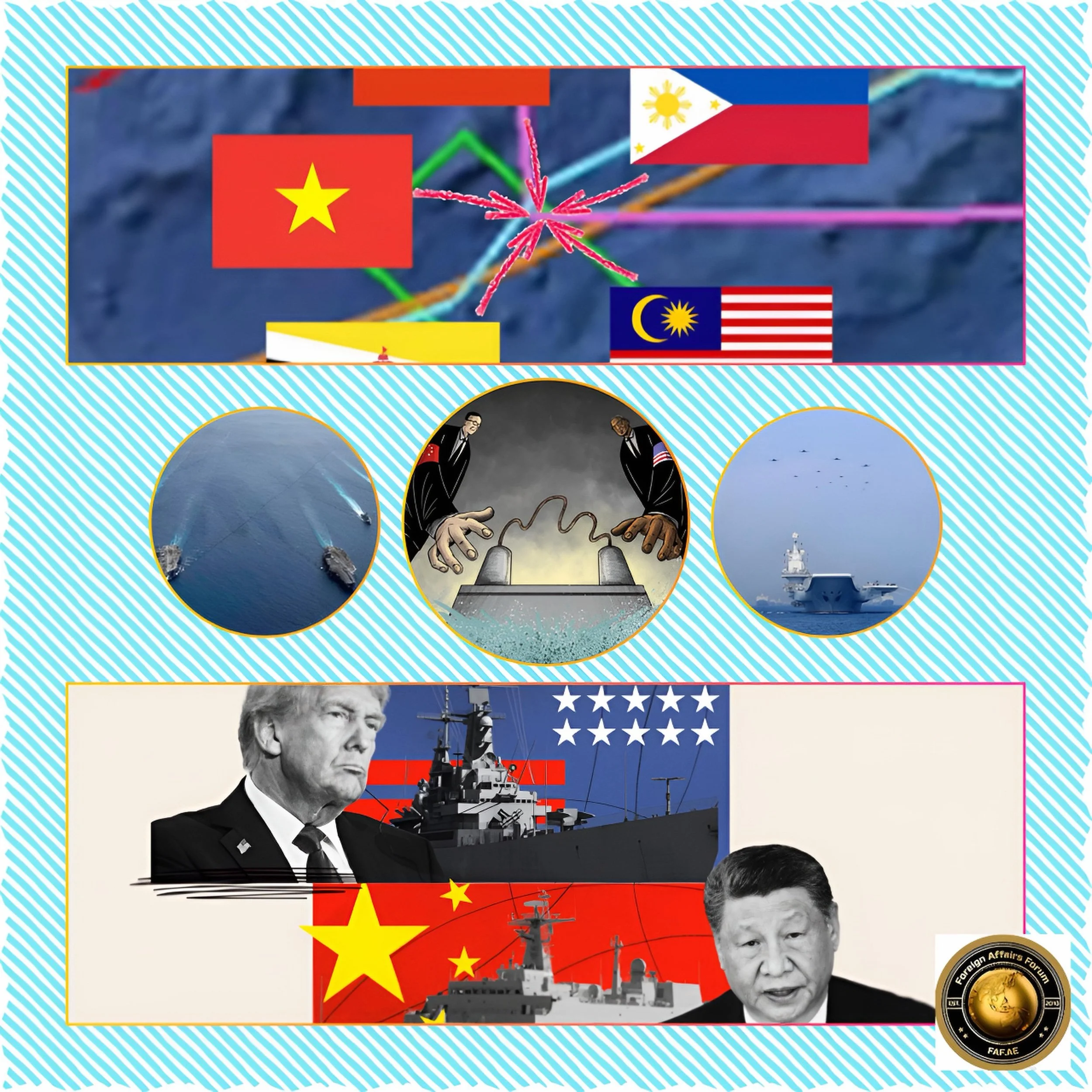
The 2025 National Security Strategy states American opposition to unilateral changes to the Taiwan Strait status quo and endorsement of freedom of navigation in the South China Sea. Yet Trump has also stated that Taiwan is up for negotiation with Beijing, a formulation that Beijing could interpret as American willingness to acquiesce in unification if the political price to China proved high enough.
The durability of the administration's transactional approach to alliance relationships poses another significant question. Traditional alliance partners—Japan, South Korea, Australia, European nations—have begun to recalibrate their strategies in light of American unreliability. Some, such as Japan and South Korea, have responded by dramatically increasing their own military capabilities and armament.
Others, such as several European nations, have moved to reduce their dependence on American security guarantees by strengthening European defense mechanisms. The long-term implication of this reorientation could be a fragmented international security architecture in which American primacy declines not through American action but through the withdrawal of willing followers who can no longer depend upon American commitment.
The China-exclusion strategy, if pursued to completion, would constitute perhaps the most significant restructuring of international economic arrangements since the construction of the postwar Bretton Woods system.
By systematically excluding Chinese firms from advanced technologies, markets, and supply chains, the administration could eventually compel a bifurcation of the global economy: an American-led bloc with allies sharing common technological and economic standards, and an excluded sphere including China and non-aligned nations. The implications for global growth, technological innovation, and poverty reduction remain uncertain but potentially severe.
Conclusion
The Durability Question in American Foreign Policy
Donald Trump's second administration has begun the process of systematically dismantling the post-Cold War international order in favor of a transactional nationalism that prioritizes American primacy and rejects binding multilateral commitments.
The elevation of Marco Rubio to positions of unprecedented authority within the foreign policy establishment reflects the administration's selection of individuals whose ideological commitments align so completely with Trump's nationalist vision that they can be trusted to implement his preferences without the institutional resistance that occasionally constrained him during his first term.
The strategic implications extend across multiple domains. Hemispheric dominance has been reasserted through the Venezuelan operation and the articulation of a Trump-inflected Monroe Doctrine.
China has been designated as the primary strategic competitor, though the administration's strategy remains improvisational, combining tariff escalation with periodic truces and demonstrating Trump's preference for deal-making over comprehensive strategic doctrine.
Alliances have been rendered contingent upon their perceived utility to American interests, a reorientation that has already begun to compel allied nations to adjust their strategic postures.
Whether this approach will successfully advance American interests remains an open question. The administration's defenders argue that it corrects decades of American overcommitment and restores a more sustainable calibration of power.
Critics contend that it undermines the institutional bases of American influence and invites the formation of anti-American coalitions.
The coming years will determine whether Trump's transactional nationalism represents a sustainable strategy for maintaining American dominance or the opening act of American decline.