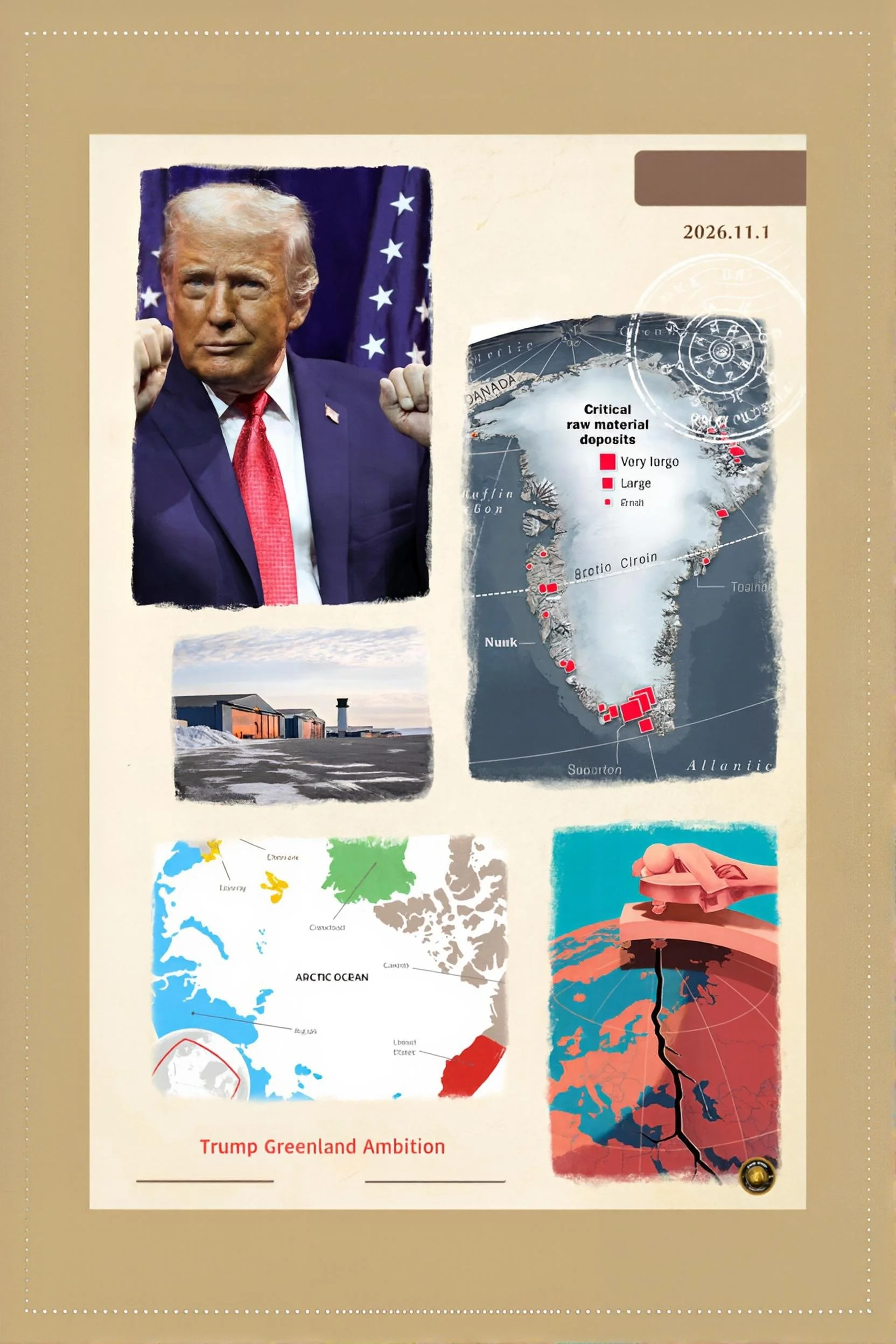
The Arctic Sovereignty Dispute: Examining the Trump Administration's Acquisition Initiative and Its Geopolitical Implications - Part I
Executive Summary
When A Superpower Demands A Frozen Island: Why The Greenland Dispute Threatens The Western Alliance
The January 15, 2026 White House meeting between American leadership and Danish and Greenlandic officials concluded without agreement on the central question of territorial control.
President Trump's insistence that American sovereignty over Greenland represents a non-negotiable prerequisite for national security has catalyzed an unprecedented diplomatic crisis within the North Atlantic alliance 75% of Americans oppose the acquisition initiative. Even Republican senators acknowledge that the proposed approach risks destroying hard-won alliance cohesion that has provided the foundation for American strategic power projection for eight decades.
Both Denmark and Greenland have offered substantial expansions of military cooperation, but have established sovereignty transfer as a fundamental red line. The working group established during negotiations provides potential pathway forward that might accommodate legitimate security concerns while respecting territorial integrity principles.
The fundamental tension underlying the Greenland acquisition controversy reflects a broader strategic reassessment of Arctic security architecture within the Trump administration.
The dispute reveals asymmetries in threat perception between American leadership and allied governments, disagreements about whether existing defense frameworks prove adequate for contemporary security challenges, and fundamental questions about how power operates within alliance relationships.
Resolution will determine whether alliance management proceeds through consensus-building and mutual accommodation or whether great power competition produces subordination of smaller allied nations to larger strategic imperatives.
The Historical Trajectory of Greenland's Political Development
Blueprints For Independence: How Greenland Moved From Colony To Self-Governing Territory
Greenland's political status has evolved substantially across the past century, creating contemporary circumstances that both illuminate and constrain current diplomatic options.
The territory transitioned from colonial status to county-equivalent status within the Danish Kingdom in 1953, a transformation that granted Greenlandic citizens full Danish citizenship and initiated gradual transfer of administrative authority from Copenhagen to Nuuk.
This administrative devolution proceeded cautiously, reflecting Denmark's recognition that Greenlandic society possessed distinct cultural identity, linguistic traditions, and economic interests that diverged significantly from those of metropolitan Denmark.
The trajectory toward greater autonomy accelerated following the 1979 Folketing decision granting Greenland home rule status. This constitutional reform transferred substantial administrative and economic authority to Greenlandic institutions while maintaining Danish responsibility for foreign policy and defense.
The arrangement reflected political recognition that Greenlandic national consciousness had developed sufficiently to warrant self-governance across most domestic policy domains, but that complete independence remained economically impractical given Greenland's dependence upon Danish fiscal transfers and the small size of the Greenlandic economy.
The 2009 agreement between Denmark and Greenland established more explicitly the pathway toward potential independence. The accord recognized Greenlanders' right to self-determination and the possibility of eventual independence while maintaining the existing fiscal arrangement through which Denmark provides annual subsidies covering approximately 20 percent of Greenlandic government expenditures.
This agreement crystallized in formal legal language what had become evident through political practice: all Greenlandic political parties supported eventual independence as aspiration, but economic constraints prevented immediate implementation. The subsidy relationship provided temporal flexibility, allowing Greenlandic independence movements to develop gradually while maintaining fiscal sustainability.
Contemporary Greenlandic politics proceeds from consensus that independence constitutes the ultimate political objective. The question that divides Greenlandic society concerns timing and pathways toward this goal rather than whether independence should occur.
The Danish block grant, distributed annually through mechanisms established following the 2009 agreement, amounts to approximately 477 million dollars, representing roughly 20 percent of Greenlandic government budget.
Greenland's economy remains heavily dependent upon fishing, which generates approximately 23 percent of gross domestic product, and upon tourism and the public sector. Economic growth projections for 2025 amounted to merely 0.2 percent, indicating economic stagnation despite modest recent improvements.
The Current Status of Greenland Within the Kingdom of Denmark
Caught Between Powers: Greenland's Ambiguous Status Within The Kingdom Of Denmark
Greenland occupies ambiguous constitutional status within the Kingdom of Denmark that reflects both its movement toward independence and its continued fiscal integration with metropolitan Denmark.
The 1951 Greenland Defense Agreement grants the United States extensive military access and base-building authority with Danish consent.
American forces currently maintain approximately 150 personnel at Pituffik Space Base on Greenland's northwestern coast, which has served as vital component of American strategic infrastructure since the Cold War period.
This existing military relationship demonstrates that substantial American military presence operates on Greenlandic territory through consensual arrangements rather than through territorial control.
Denmark retains formal responsibility for Greenland's foreign policy and defense while Greenlandic institutions exercise authority over most domestic policy domains.
This divided sovereignty arrangement has functioned effectively across the past decades, creating mechanisms through which both jurisdictions address their respective interests. The arrangement explicitly preserves Danish responsibility for international relations, treaty obligations, and military defense. This constitutional framework means that Greenland cannot unilaterally commit to foreign military arrangements without Danish concurrence, but conversely means that Denmark cannot impose defense arrangements upon Greenland without Greenlandic political acceptance.
Greenland's population of approximately 56,500 people represents one of the smallest national or quasi-national populations in the developed world.
The vast majority of Greenlanders are ethnically Kalaallit, descending from mixed Inuit and Danish ancestry. Greenlandic language constitutes the official language, and Danish is widely spoken as second language. This linguistic and cultural identity reinforces Greenlandic national consciousness and supports political movements toward complete independence from Denmark.
The Role of Greenland Within Arctic Security Architecture
Arctic security has emerged as strategic priority across multiple great powers due to climate change, resource competition, and shifting patterns of military positioning. Russian military modernization and expansion of Arctic bases have generated concern among NATO members and American strategic planners.
Simultaneously, Chinese economic expansion into the Arctic and development of partnerships with Russia have introduced additional complexity to regional strategic calculations. The joint Russian-Chinese bomber patrols observed near Alaska in July 2024 represented symbolic crystallization of emerging Sino-Russian Arctic coordination.
Greenland's geographic position places it at the intersection of these competing interests. The island sits between North America and the Arctic, occupying position that would enable surveillance and early warning capabilities essential for continental defense.
Pituffik Space Base possesses unique atmospheric characteristics—particularly low precipitable water vapor—that enable laser and optical communications unsuitable for locations with greater atmospheric moisture. These technical characteristics explain why the Golden Dome missile defense system, according to Trump administration technical specifications, would benefit from positioning at Greenlandic locations.
The Golden Dome initiative represents ambitious multibillion-dollar program intended to establish comprehensive defense against ballistic, hypersonic, and cruise missile threats.
The system would employ space-based sensors and interceptors to detect and neutralize threats before they reach populated areas. Initial estimates suggest total program costs approaching 175 billion dollars, comparable in scale to major defense acquisition programs conducted across the post-Cold War period.
The system would be implemented in phases, with certain geographic regions receiving priority coverage based upon threat assessments and technical capabilities.
Key Developments Following the January 15 White House Meeting
Days Of Diplomatic Failure: What Happened In The White House Meeting That Changed Everything
The White House meeting on January 15, 2026 proceeded from preliminary diplomatic preparations conducted by American, Danish, and Greenlandic officials across the preceding weeks.
Secretary of State Marco Rubio and Vice President J.D. Vance led American delegation. Danish Foreign Minister Lars Løkke Rasmussen and Greenlandic Foreign Minister Vivian Motzfeldt represented the other parties.
The substantive disagreement that emerged during the meeting reflected fundamental positions on both sides regarding whether Greenland's status within the Kingdom of Denmark could be modified through negotiation.
President Trump's opening position characterized territorial acquisition as essential to American national security and indicated that the administration remained open to exploring what he termed the "hard ways" to accomplish this objective.
The reference to hard ways encompassed military force, economic coercion, or other mechanisms beyond standard diplomatic negotiation. Trump did not rule out military action explicitly, instead indicating that "anything less than US control is unacceptable" and that the administration would continue exploring all available options.
The Danish and Greenlandic responses emphasized fundamental disagreement on the core proposition. Both jurisdictions offered to expand military cooperation substantially.
Denmark announced that it would increase military investment in Greenland, establish rotating NATO military presence with personnel from multiple alliance members, and expand bilateral defense cooperation with the United States. Greenland indicated willingness to discuss expanded American military base capabilities, additional personnel presence, and enhanced joint exercises. However, both delegations established explicit red lines regarding sovereignty: neither would discuss transferring territorial control or altering Greenland's constitutional status.
Greenlandic Foreign Minister Vivian Motzfeldt articulated this position with particular clarity: "That path does not include ownership." Danish Foreign Minister Lars Løkke Rasmussen observed that "we did not succeed in altering the American stance," indicating that American negotiators remained unwilling to accept military cooperation absent territorial transfer as satisfactory resolution.
The meeting concluded with announcement of working group to continue negotiations, with both sides indicating they would meet again within weeks to explore whether creative diplomatic solutions might bridge remaining disagreement.
International Response and NATO Mobilization
NATO's Show Of Force: How America's Allies Deployed Soldiers To Defend Danish Sovereignty
The NATO response to American territorial pressure against Greenland proceeded swiftly and deliberately. Within days of the White House meeting, multiple NATO members deployed military contingents to Greenland with explicit messaging that these deployments represented demonstrations of alliance solidarity with Danish sovereignty.
Germany deployed 13 military personnel for reconnaissance operations. France deployed 15 personnel with announcements that additional forces would follow. Sweden deployed officers to the capital city of Nuuk. Norway, the United Kingdom, and the Netherlands undertook comparable deployments.
These military deployments functioned as countersignaling against American pressure. The visible demonstration of allied military commitment to Greenlandic defense established that territorial pressure would not produce accommodation but rather would trigger unified allied response.
European defense officials explicitly characterized these deployments as responses to Arctic security concerns, though the timing and coordinated nature made clear that primary objective involved demonstrating alliance commitment to Denmark and discouraging American acquisition attempts.
Former Icelandic President Olafur Grimsson offered particularly stark warning regarding consequences of continued American pressure. Grimsson cautioned that American military seizure of Greenland would produce "monumental consequences" for the Western alliance and international order more broadly.
His assessment reflected concerns that unilateral territorial acquisition from an allied nation would establish precedent enabling broader challenges to territorial status quo and would damage the institutional frameworks that have provided foundation for Atlantic security architecture.
American Public Opinion and Congressional Response
Three-Quarters Oppose: Why Americans Reject Trump's Greenland Ambitions
Public opinion data revealed substantial opposition to acquisition initiatives across American population. A CNN poll conducted January 9-12, 2026 demonstrated that 75 percent of Americans oppose attempts by the United States to assume control of Greenland. Only 25 percent expressed support for the proposal. This opposition crossed partisan and demographic lines, though with differential intensity across groups.
Among Republicans, approximately 50 percent supported acquisition while 50 percent opposed it, indicating fundamental division within the party coalition. Democrats demonstrated stronger opposition, with 94 percent opposing the proposal and 80 percent expressing strong opposition.
Notably, independent voters and swing voters opposed the initiative at rates comparable to or exceeding Democratic opposition rates. The polling further indicated that 59 percent of respondents believed the Trump administration had overstepped appropriate bounds in foreign expansion efforts, and 57 percent assessed that current foreign policy had damaged American global reputation.
Congressional response reflected these public opinion trends. Senator Mitch McConnell, though historically aligned with the Trump administration on defense matters, delivered extended Senate floor address explaining why territorial acquisition constitutes strategically counterproductive policy.
McConnell acknowledged that Arctic security represents legitimate strategic priority and that Russian and Chinese activities warrant heightened American attention. However, his critique focused upon means rather than ends. McConnell contended that Denmark and NATO allies have invested substantially in Arctic defense, increased military spending significantly, and demonstrated willingness to strengthen cooperation with the United States.
Pursuing territorial acquisition against this backdrop destroys alliance trust and contradicts strategic logic.
McCollell's precise language articulated the core Republican objection: acquisition would "incinerate" the trust of loyal allies. He noted that Denmark has fought alongside American forces in Afghanistan, Iraq, and other conflict zones.
McCollell questioned what conceivable benefit accrues from territorial control that would justify destroying relationships that took decades to build following World War II.
Senator Chris Coons of Delaware, a Democrat with substantial foreign policy influence, characterized military action as "strategic disaster" that would undermine American interests across multiple dimensions.
Both parties indicated that congressional authorization for acquisition or military force would face insurmountable opposition in Senate and House votes. This domestic political constraint, combined with allied mobilization against American pressure, created situation where American coercive power proved insufficient to achieve stated objectives while incurring substantial costs to broader strategic interests.
The Arctic Security Context and Great Power Competition
Where North Meets Strategy: Greenland's Critical Role In Arctic Defense Architecture
The contemporary Arctic security environment has transformed substantially across recent years, creating genuine basis for heightened American strategic attention to Arctic security architecture. Russia has increasingly militarized the Arctic coastline and expanded ballistic missile capabilities with Arctic-oriented targeting. Moscow has upgraded and expanded military bases, established new Arctic-specific military units, and demonstrated enhanced capability for power projection across Arctic territories.
Simultaneously, China has undertaken systematic economic and strategic penetration of the Arctic, establishing partnerships with Russia that include joint military exercises and coordinated patrols near Alaska.
The joint Russian-Chinese strategic bomber flights observed near Alaska in July 2024 represented symbolic crystallization of emerging Sino-Russian Arctic coordination.
Chinese interest in Arctic affairs has extended beyond military dimensions to encompass economic development, mining partnerships, and long-term strategic positioning in regions likely to become increasingly important as climate change modifies Arctic geography and accessibility.
These developments provide genuine justification for heightened American strategic attention to Arctic defense architecture. However, intelligence analysts dispute whether these developments necessitate territorial acquisition as response mechanism.
Nordic intelligence officials have stated that current intelligence assessments reveal no evidence of Russian or Chinese military vessels or submarine operations proximate to Greenland.
This assessment contradicts the threat characterization that appears to underlie American acquisition pressure and suggests that perceived threat reflects hypothetical future scenarios rather than demonstrated present-day military capabilities requiring preemptive territorial control.
The distinction between legitimate Arctic security concerns and the proposed territorial acquisition response becomes central to evaluating strategic merit of current policy initiatives.
Great power competition in the Arctic constitutes genuine concern warranting elevated American military and diplomatic engagement. Whether this concern necessitates territorial acquisition from an allied nation or whether it might be addressed through expanded military cooperation, enhanced defense partnerships, and strengthened alliance institutions remains the central strategic question dividing American leadership from both allies and domestic constituencies.
Greenland's Mineral Resources and Economic Implications
The Hidden Wealth Of The High North: How Rare Earth Minerals Complicate Strategic Calculations
Greenland possesses substantial mineral endowments that contribute to strategic importance beyond immediate military considerations.
The island ranks eighth globally in rare earth element reserves, hosting approximately 36 million tonnes of resources, with current estimates placing 1.5 million tonnes in economically viable reserves.
The Kvanefjeld deposit represents the third-largest known rare earth reserve globally, containing not merely common rare earth elements but significant concentrations of heavy rare earths currently unavailable from developed sources outside China.
The Tanbreez mine contains comparable heavy rare earth concentrations. Critical minerals including graphite, tungsten, palladium, vanadium, and uranium occur in Greenlandic deposits.
These mineral resources hold genuine strategic significance for American defense and technological manufacturing. Rare earth elements essential for advanced defense systems, renewable energy infrastructure, and electronic devices are increasingly recognized as strategically critical commodities.
Chinese dominance of rare earth processing and supply chains has generated concern among American strategic planners regarding dependence upon potentially adversarial nation for materials essential to defense modernization.
Greenlandic minerals could theoretically provide alternative sources, reducing American dependence upon Chinese supply chains.
However, several factors substantially complicate the mineral acquisition dimension of current policy initiatives. No rare earth mining currently operates on Greenland. Climatic constraints and economic barriers have prevented commercial development of these resources despite decades of exploration and preliminary development efforts.
Development timelines for viable extraction would extend across decades rather than years. Economic feasibility depends upon technological improvements enabling profitable extraction across Arctic conditions and achieving processing capabilities currently concentrated in Asia.
Under the 2009 agreement framework governing revenue sharing between Greenland and Denmark, substantial proportion of mining revenues would accrue to Greenlandic government, with additional revenues reducing Danish subsidies.
This arrangement creates genuine economic incentives for Greenland to develop mining capacity while maintaining the subsidy relationship upon which contemporary budget sustainability depends.
The revenue structure suggests that American interests might be served through partnership agreements, joint development frameworks, investment in mining infrastructure, or long-term supply contracts rather than through territorial acquisition requiring congressional authorization and producing alliance disruption.
The Cause-and-Effect Relationship Underlying Current Disputes
Threats Real And Imagined: Understanding The Arctic Security Fears Driving Policy
The fundamental cause-and-effect relationship shaping current disputes flows from asymmetries in threat perception and strategic interpretation.
The Trump administration views Arctic security through lens emphasizing vulnerability and Russian-Chinese competition, interpreting current defense architectures as inadequate for contemporary and projected future threat environments.
This assessment rests partially upon hypothetical projections of future threats rather than present-day demonstrable capabilities threatening American territories.
The administration argues that without territorial control enabling full optimization of defense system positioning and operations, American vulnerability to Arctic-originating threats remains unacceptably high.
Greenland and Denmark, by contrast, perceive a different threat calculus. They acknowledge Arctic security importance while questioning whether level of American military force projection that territorial control would enable represents appropriate response to current threats.
They further advance arguments grounded in principles of territorial integrity, sovereignty, and self-determination. These values have been historically central to American foreign policy doctrine, creating tension between administration objectives and established principles of international law and practice.
The cascading consequences of threat perception asymmetry proceed through multiple dimensions. First, the threat asymmetry produces divergent strategic prescriptions:
if threats are as severe as American officials contend, territorial control becomes rational response
if threats are as modest as Nordic intelligence analysts assess, territorial acquisition appears excessive and alliance-destructive.
Second, the disagreement about appropriate response generates domestic political opposition within United States itself, with 75 percent of Americans and substantial Republican majorities opposing acquisition.
Third, the pressure against an allied nation triggers allied mobilization defending territorial integrity and demonstrating unified resistance to coercion.
Fourth, the prospect of American military action against NATO member produces explicit warnings that such action would violate NATO treaty obligations and trigger alliance-destabilizing consequences.
The cause-and-effect sequence thus proceeds from disagreement about threat magnitude through divergent strategic assessments, generating public opposition, triggering allied mobilization, and ultimately producing situation where American ability to coerce territorial transfer confronts unified domestic and allied opposition creating political and strategic costs exceeding any conceivable benefits from acquisition itself.
Future Steps and Potential Resolution Pathways
Negotiating The Ice: What Comes Next In The Quest For Arctic Resolution
The working group established during January 15 White House meeting provides potential diplomatic pathway that acknowledges legitimate security concerns while respecting red lines identified by Denmark and Greenland.
The framework explicitly permits discussions regarding enhanced American base capabilities, expanded personnel presence, joint exercises, and integrated defense architecture without requiring sovereignty transfer.
Both Danish and Greenlandic authorities have indicated openness to such arrangements, suggesting that substantive security cooperation remains achievable through negotiation within existing institutional frameworks.
Potential resolution scenarios might include expanded American military presence at Pituffik and other Greenlandic locations under bilateral agreements; establishment of rotating NATO military presence with personnel from multiple alliance members stationed in Greenland on continuous basis; integration of Greenlandic defense infrastructure with broader NATO command and control systems; joint development of Arctic surveillance and detection capabilities; enhanced bilateral defense spending and capabilities development; and formalized security arrangements ensuring American access and priority placement of defense systems.
These arrangements would accomplish substantial proportion of security objectives that American planners have articulated as necessary to address Arctic security concerns. The question becomes whether administration views such cooperation as adequate satisfaction of strategic requirements or whether acquisition represents a non-negotiable objective independent of whether security outcomes might be achieved through alternative arrangements.
The trajectory of these negotiations will determine whether Arctic security competition unfolds through mechanisms reinforcing alliance cohesion or through processes fragmenting Atlantic-oriented cooperation.
Alternatively, continued pressure for acquisition could trigger escalatory responses including NATO invocation of mutual defense provisions, congressional prohibition of administration actions through budget appropriations clauses, or international legal challenges to American territorial claims.
The extent to which administration commits to acquisition objectives will shape the intensity of these potential responses and the ultimate outcomes of the dispute.
Conclusion: Alliance Management and the Distribution of Power
Power, Sovereignty, And Alliance: What The Greenland Dispute Reveals About The Modern World
The Greenland dispute represents not merely a technical disagreement about territorial control but a test of whether alliance management can proceed through consensus-building and mutual accommodation or whether great power competition within allied structures produces subordination of smaller powers to larger strategic imperatives.
The fundamental resolution required acknowledges that security concerns and sovereignty principles need not exist in binary opposition. American national security interests in Arctic defense architecture are legitimate, genuine, and increasingly urgent given evolving threat environments.
Simultaneously, the rights of Greenlandic self-determination, Danish territorial integrity, and NATO institutional cohesion represent values to which American strategic doctrine has historically committed itself.
The diplomatic challenge consists of developing frameworks satisfying legitimate security requirements while respecting these foundational principles.
The current trajectory suggests this resolution remains achievable through expanded military cooperation, enhanced bilateral defense agreements, and institutional innovations accommodating American strategic objectives within existing frameworks of sovereignty and alliance governance.
The extent to which the Trump administration pursues this diplomatic pathway or maintains pressure for territorial acquisition will determine whether the Arctic security competition between Russia, China, and the West unfolds through mechanisms reinforcing alliance coherence or through processes fragmenting Western institutional architecture.
The Greenland dispute will thus serve as precedent shaping not merely Arctic security arrangements but broader patterns of great power behavior across comparable domains where military and economic power intersects with competing claims to territory and authority.
This fundamental question deserves careful analysis and strategic foresight that extends beyond immediate policy preferences to encompass consequences for alliance stability and international order.