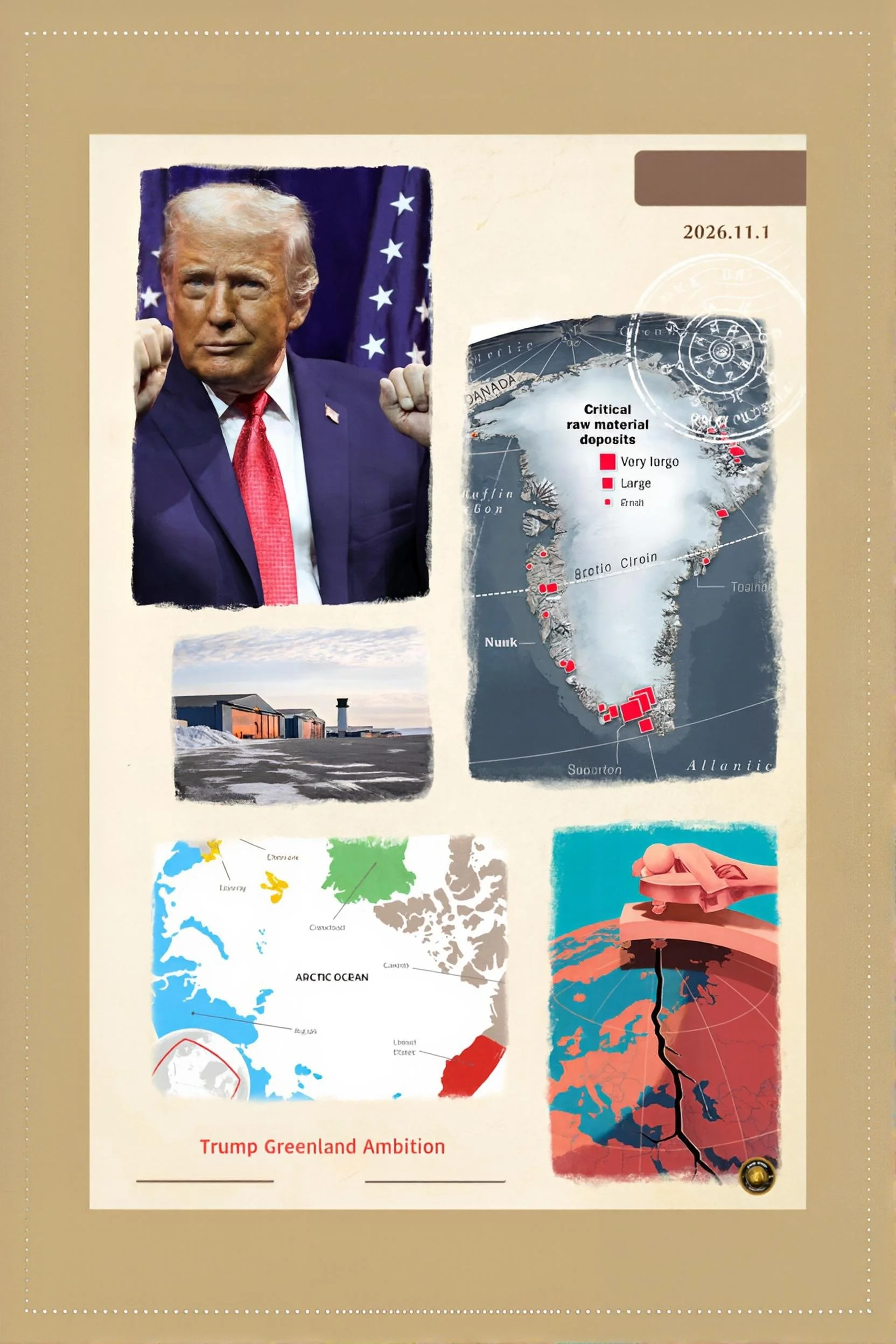
Exploring the Arctic Sovereignty Dispute: Unraveling the Trump Administration's Acquisition Plans and Their Global Impact - Part II
Summary
Bridging National Security Interests and Allied Cohesion in the High North
The fundamental tension underlying the Greenland acquisition controversy reflects a broader strategic reassessment of Arctic security architecture within the Trump administration.
The January 2026 White House meeting between American leadership, Danish officials, and Greenlandic representatives concluded without agreement on the central question of territorial control. President Trump's stated position—that American sovereignty over Greenland represents a non-negotiable prerequisite for national security—has catalyzed an unprecedented diplomatic crisis within the North Atlantic alliance, directly challenging post-Cold War assumptions about territorial integrity and the sanctity of NATO commitments.
The dispute emerged from a convergence of technological ambition, geopolitical competition, and strategic vulnerability. Trump administration officials have explicitly linked Greenland's acquisition to the Golden Dome missile defense initiative, a multibillion-dollar program designed to establish comprehensive coverage against ballistic and hypersonic threats.
The strategic logic underlying this position rests upon geographic considerations: Greenland's position in the High North provides optimal positioning for surveillance and interception assets, notably the Pituffik Space Base on the island's northwestern coast. This facility possesses unique atmospheric characteristics—specifically low precipitable water vapor—that enable laser and optical communications essential for the Golden Dome system's operational architecture.
Defense strategists contend that without territorial control, the United States faces an unacceptable vulnerability gap in missile defense coverage across the North American Arctic.
Yet this security calculus confronts both historical precedent and political reality.
The 1951 Greenland Defense Agreement grants the United States extensive military access and base-building authority, subject to Danish consent. American forces currently maintain approximately 150 personnel at Pituffik, and both Danish and Greenlandic authorities have publicly offered to consider expanding the American military footprint through enhanced cooperation and expanded bilateral negotiations.
This existing framework presents a paradox that has become central to political opposition within the Republican Party itself: if Denmark and Greenland are willing to grant unprecedented military access for security purposes, what tangible additional benefit accrues from territorial acquisition that justifies the alliance-destabilizing costs?
The historical trajectory of Greenland's political status provides essential context for understanding both contemporary ambitions and the constraints they encounter. Greenland transitioned from colonial status to county-equivalent status within the Danish Kingdom in 1953, a transformation that granted Greenlandic citizens full Danish citizenship.
Subsequent constitutional developments, culminating in a 2009 agreement explicitly recognizing Greenlandic rights to independence, established a trajectory toward self-determination that now extends across all political parties within Greenlandic society.
The population's economic dependence on Danish subsidies—approximately 20 percent of gross domestic product—has thus far constrained independence movements, but growing resource nationalism and aspirations for sovereignty have intensified an already complex relationship.
The current geopolitical configuration presents Greenland as a territory of competing claims and interests, each grounded in legitimate strategic concerns. The Trump administration advances security arguments centered upon Arctic defense architecture and the perceived inadequacy of Denmark's commitment to military modernization.
However, Nordic intelligence analysts dispute the factual premises underlying these claims, noting that intelligence assessments reveal no current evidence of Russian or Chinese military vessels or submarine operations in the vicinity of Greenland. This intelligence assessment contradicts the administration's public justifications and underscores the extent to which threat perception rather than demonstrated threat drives current policy initiatives.
The Arctic security environment has indeed transformed over recent years. Russia has increasingly militarized the Arctic coastline and expanded ballistic missile capabilities with Arctic-oriented targeting. Simultaneously, China has undertaken systematic economic and strategic penetration of the Arctic, establishing partnerships with Russia that include joint military exercises and coordinated patrols near Alaska.
The NORAD intercept of Russian and Chinese bombers flying together near Alaska in July 2024 represented a symbolic crystallization of this emerging axis of Arctic competition. These developments provide genuine justification for heightened American strategic attention to Arctic security architecture and the geographic assets that support deterrence postures.
Greenland's mineral endowment intersects these security considerations in ways that complicate straightforward geopolitical assessment. The island ranks eighth globally in rare earth element reserves, hosting approximately 36 million tonnes of resources, with 1.5 million tonnes currently classified as economically viable.
The Kvanefjeld deposit represents the third-largest known rare earth reserve globally, and the Tanbreez mine contains substantial heavy rare earth concentrations currently unavailable from developed sources outside China.
Critical minerals essential for defense systems, renewable energy infrastructure, and advanced technological manufacturing constitute Greenland's principal long-term economic value. This resource orientation explains considerable, though not exclusive, interest from multiple great powers in the island's future political trajectory.
Yet mineral acquisition offers insufficient explanation for the intensity of Trump administration pressure. No rare earth mining currently operates on Greenland due to climatic constraints and economic barriers. Development timelines for viable extraction extend across decades rather than years.
Commercial mining operations would generate revenue that, under the current 2009 agreement framework, would reduce Danish subsidies by 50 percent of proceeds exceeding 75 million Danish kroner annually, eventually eliminating Denmark's fiscal transfer entirely. This arrangement provides Greenland with genuine incentives to develop mining capacity while maintaining the subsidy relationship upon which contemporary budget sustainability depends.
The economic logic of this arrangement suggests that American interests might be better served through investment partnerships, joint development frameworks, or supply chain agreements than through territorial acquisition requiring congressional authorization and alliance-destroying military action.
The domestic political response to Trump administration initiatives reveals substantial constraints upon potential unilateral action. Senate Minority Leader Mitch McConnell, historically aligned with the administration on defense matters, delivered an extended Senate floor address articulating why Greenland acquisition constitutes strategically counterproductive policy.
McConnell's argument proceeds from a position of acknowledged legitimacy: Arctic security constitutes a genuine strategic priority, and Russian and Chinese activities warrant heightened American attention. His critique focuses upon means rather than ends. Denmark and its NATO allies have invested substantially in Arctic defense capabilities, increased military spending, and demonstrated willingness to strengthen cooperation with the United States.
McConnell contends that pursuing territorial acquisition destroys hard-won alliance cohesion and establishes precedent enabling great power competition through territorial pressure rather than diplomatic engagement.
Democratic senators, including Chris Coons of Delaware, articulated parallel positions, emphasizing that territorial acquisition or coercive purchasing would require congressional authorization that shows no inclination toward approval.
Public opinion data reinforces these political constraints. A CNN poll conducted January 9-12, 2026, demonstrates that 75 percent of Americans oppose American attempts to assume control of Greenland.
Support extends across partisan and demographic divides only to limited degree, with approximately 50 percent of Republicans supporting acquisition compared to 94 percent of Democrats opposing it and 80 percent of Democrats expressing strong opposition. These numbers represent not marginal preference but fundamental public rejection of the policy initiative.
The polling further indicates that 59 percent of respondents believe the Trump administration has overstepped appropriate bounds in foreign expansion efforts, and 57 percent assess that administration foreign policy has damaged American global reputation. Notably, these sentiments reflect broader skepticism about foreign military interventions advanced during the current administration, including controversial military actions in Venezuela.
The working group established during the January 15 White House meeting provides a potential diplomatic pathway that acknowledges legitimate security concerns while respecting the red lines identified by Denmark and Greenland.
Both jurisdictions have explicitly stated openness to expanded American military presence, enhanced defense cooperation, and strengthened bilateral security arrangements. The framework of existing 1951 defense agreements provides legal and institutional mechanisms through which such expanded cooperation might be formalized.
Danish Defense Minister Troels Lund Poulsen has announced plans for establishing a rotating military presence with NATO allies, expanding defense capabilities substantially, and coordinating joint exercises in Arctic waters.
This trajectory moves toward the substantive security outcomes the United States seeks without crossing the threshold of territorial acquisition that alliance partners have explicitly designated as unacceptable.
The fundamental cause-and-effect relationship shaping current disputes flows from asymmetries in threat perception and strategic interpretation. The Trump administration views Arctic security through a lens emphasizing vulnerability and Russian-Chinese competition, interpreting current defense architectures as inadequate.
FAF assessment rests partially upon hypothetical projections of future threats rather than present-day demonstrable capabilities threatening American territories. Greenland and Denmark, by contrast, perceive a different threat calculus. They acknowledge Arctic security importance while questioning whether the level of American military force projection that territorial control would enable represents appropriate response to current threats.
They further advance arguments grounded in principles of territorial integrity, sovereignty, and self-determination—values historically central to American foreign policy doctrine.
The discourse surrounding Greenland has proceeded from strategic necessity through humanitarian and historical considerations, finally arriving at fundamental questions about the distribution of power within alliances and the rules governing competitive state behavior in the contemporary international system.
Former Icelandic President Olafur Grimsson warned that American military seizure of Greenland would produce "monumental consequences" for the Western alliance and the international order. His assessment reflects concerns that unilateral territorial acquisition, even from an allied nation, establishes precedent enabling broader challenges to territorial status quo and alliance institutional arrangements.
The European response—deploying military contingents to Greenland specifically to demonstrate commitment to Danish sovereignty—represents deliberate countersignaling that territorial pressure will not produce favorable outcomes.
Future developments depend substantially upon whether the Trump administration pivots toward the diplomatic compromise framework outlined during White House negotiations or maintains pressure for territorial acquisition. The working group structure provides time for additional consultations and the development of mutually acceptable frameworks that address security concerns without crossing sovereignty thresholds.
Alternatively, continued pressure could trigger escalatory responses including NATO invocation of mutual defense provisions, congressional prohibition of administration actions through budget appropriations clauses, or international legal challenges to American territorial claims. The trajectory of these negotiations will determine whether the Arctic security competition proceeding between Russia, China, and the West unfolds through mechanisms reinforcing alliance cohesion or through processes fragmenting Atlantic-oriented cooperation.
The fundamental resolution required acknowledges that security concerns and sovereignty principles need not exist in binary opposition. American national security interests in Arctic defense architecture are legitimate, genuine, and increasingly urgent given evolving threat environments.
Simultaneously, the rights of Greenlandic self-determination, Danish territorial integrity, and NATO institutional cohesion represent values to which American strategic doctrine has historically committed itself. The diplomatic challenge consists of developing frameworks satisfying legitimate security requirements while respecting these foundational principles.
The current trajectory suggests this resolution remains achievable through expanded military cooperation, enhanced bilateral defense agreements, and institutional innovations accommodating American strategic objectives within existing frameworks of sovereignty and alliance governance.
The Greenland dispute, represents not merely a technical disagreement about territorial control but a test of whether alliance management can proceed through consensus-building and mutual accommodation, or whether great power competition within allied structures produces subordination of smaller powers to larger strategic imperatives.
This fundamental question will shape not merely Arctic security architecture but broader patterns of international behavior across comparable domains in which military and economic power intersects with competing claims to territory and authority.