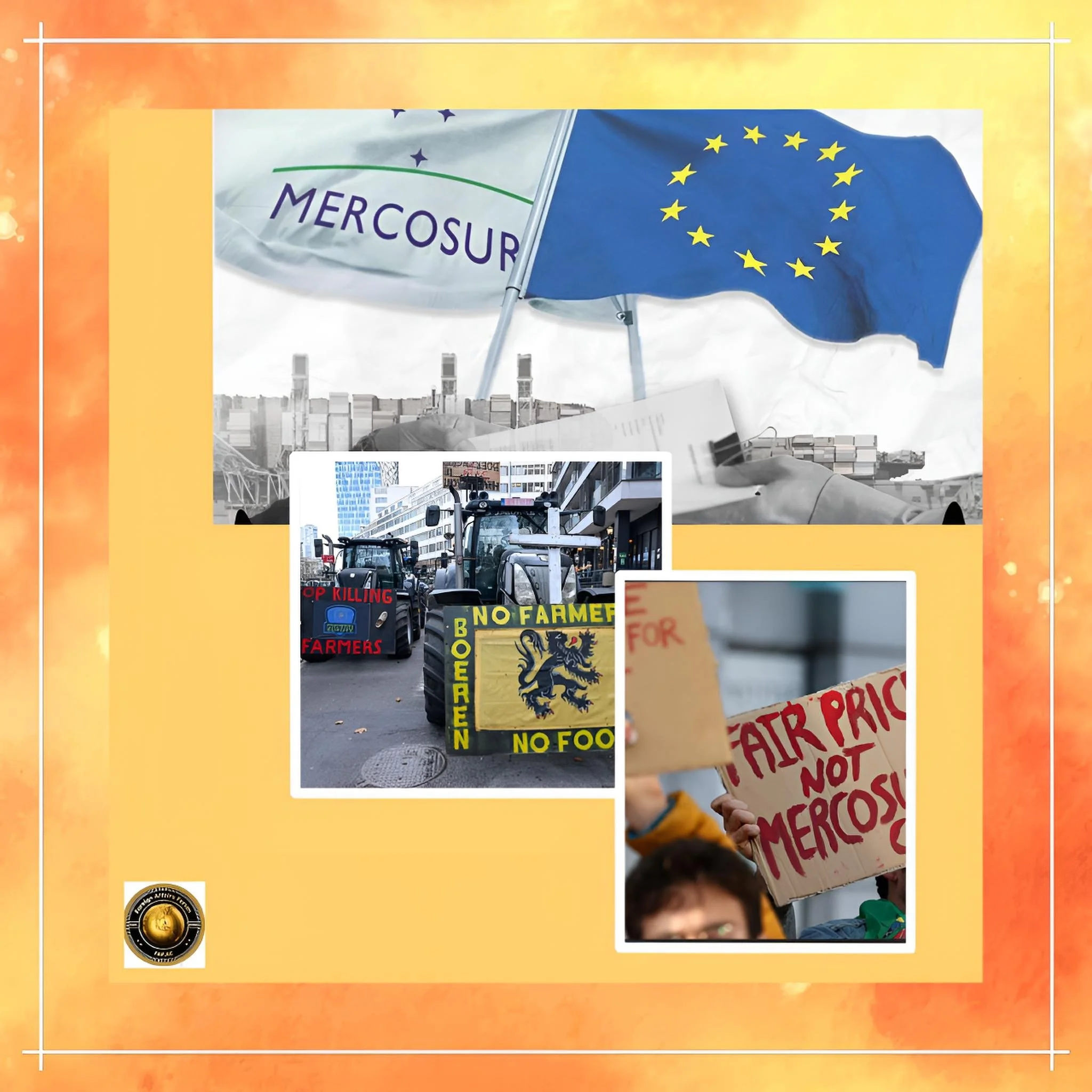
The Mercosur Paradox: Agricultural Liberalization and the Structural Incompatibility of Hemispheric Trade with European Agrarian Sustainability - Part I
Executive Summary
The Myth of Safeguards: How Mercosur’s Promises Endanger European Farming
The European Union's approval of the Mercosur trade partnership agreement on 9 January 2026 represents a culminating moment in twenty-five years of negotiations between Brussels and the Latin American trading bloc comprising Argentina, Brazil, Paraguay, and Uruguay.
The agreement, provisionally applicable following European Council authorisation and forthcoming European Commission signature scheduled for 17 January 2026, subsequently requires European Parliament ratification anticipated in April or May 2026.
The accord establishes one of the world's largest free trade zones, encompassing more than seven hundred million consumers across both hemispheres. However, the agreement manifests profound contradictions regarding European agricultural interests, environmental sustainability commitments, and labour standards protection.
Specifically, whilst the agreement purports to protect sensitive European agricultural sectors through limited import quotas and bilateral safeguard mechanisms, structural vulnerabilities and enforcement ambiguities create substantive risks that European farmers face market destabilisation from cheaper South American agricultural imports produced under standards substantially divergent from European requirements.
Concurrently, the agreement privileges agricultural commodity exports from Mercosur countries, simultaneously incentivising deforestation, labour exploitation, and environmental degradation across South American ecosystems, thereby undermining European climate commitments and creating irreconcilable tensions with the European Union's deforestation regulation framework.
The agreement's approval occurred notwithstanding intense farmer protests across multiple European nations, constituting among the most significant agrarian mobilisations since the initial 2020 rejection of the accord's preliminary text.
Historical Context and Negotiation Genesis
25 Years of Talks, One Week of Betrayal: How a Political Deal Fell Apart
The Quarter-Century Negotiation and Shifting Political Foundations
Mercosur trade negotiations commenced in 1999, coinciding with the emergence of Latin American democratic governance and early globalisation enthusiasm. Initial negotiation phases assumed convergence between European and Latin American regulatory frameworks, presaging simplified trade harmonisation.
However, successive decades witnessed divergent development trajectories: European agricultural governance progressively implemented more stringent environmental regulations, animal welfare requirements, pesticide restrictions, and labour protections, whilst Mercosur countries maintained comparatively permissive regulatory regimes favouring agricultural commodity export expansion.
Early negotiation phases foundered upon fundamental disagreements regarding intellectual property protection, pharmaceutical patent extension, public procurement market opening, and agricultural sector liberalisation. The 2008 global financial crisis interrupted negotiations, redirecting governmental priorities toward domestic stabilisation.
Subsequent resurrection of negotiations encountered resistance from environmentalist constituencies increasingly aware of Amazonian deforestation trajectories and concerns regarding indigenous land rights.
The 2020 Brazilian government transition from Jair Bolsonaro to Luiz Inácio Lula da Silva fundamentally recalibrated environmental policy positioning, though the subsequent Javier Milei government transition in Argentina created renewed political uncertainty regarding commitment sustainability.
Political support for Mercosur agreements within the European Union exhibited significant fluctuation. German and Spanish governments consistently advocated rapid agreement conclusion, positioning Mercosur market access as essential for European industrial competitiveness amid United States tariff escalation under Trump administrations and increasing Chinese economic competition within Latin America.
Conversely, French governmental positions evolved from cautious scepticism toward absolute opposition, particularly following agricultural sector mobilisations highlighting farmer concerns regarding market destabilisation.
Italian governmental preferences remained contingent upon agricultural protections adequacy, exercising its veto authority to extract additional concessions prior to agreeing to qualified majority vote participation.
The 2019 Agreement Foundation and Subsequent Environmental Renegotiation
The fundamental Mercosur agreement architecture was negotiated and essentially concluded by 2019, creating the foundational text upon which subsequent modifications built. However, this preliminary agreement encountered unexpectedly fierce opposition from French, Italian, and Polish constituencies, necessitating renegotiation of environmental provisions.
The intervening years witnessed intensified European environmental consciousness regarding deforestation, climate change acceleration, and biodiversity collapse, generating political pressure for agreement reinforcement through enhanced environmental protection mechanisms.
The 2024-2025 renegotiation phase introduced environmental reciprocity mechanisms, deforestation-linked product restrictions, and Paris Climate Agreement compliance requirements codified as "essential elements" enabling partial or complete agreement suspension upon environmental commitment violations.
These modifications responded to European environmentalist demands that agricultural commodity imports contributing to Amazonian deforestation constituted incompatibility with European climate neutrality objectives.
The Trump Geopolitical Catalyst and January 2026 Acceleration
The election of Donald Trump to the American presidency in November 2024 and subsequent inauguration on 20 January 2025 fundamentally accelerated Mercosur agreement conclusion.
Trump's national security strategy explicitly identified Latin America as contested geopolitical territory requiring American strategic engagement to counter Chinese economic influence.
European Commission leadership, particularly President Ursula von der Leyen, internalised the Trump administration's positioning that European disengagement from Latin American trade relationships constituted strategic vulnerability in intensifying great-power competition.
The parallel American military intervention in Venezuela on 3 January 2026, resulting in President Nicolás Maduro's capture, created immediate geopolitical pressure upon European decision-makers to demonstrate hemispheric commitment through rapid Mercosur agreement ratification.
European diplomatic actors reasoned that American military intervention and resource appropriation in Venezuela necessitated European economic engagement with stable Latin American partners to maintain influence and prevent American unilateral domination of regional affairs.
Current Status and the January 2026 Council Vote
From Political Halls to Farmer Anger: The January 9 Vote That Ignored Rural Europe
The Qualified Majority Authorization
On 9 January 2026, representatives of European Union member states assembled in Brussels to determine whether a qualified majority would authorise the European Commission to sign the Mercosur agreement and provisionally implement trade provisions pending formal parliamentary ratification.
The resulting vote reflected profound internal European divisions: 21 member states voted in favour, encompassing approximately 65 percent of the European Union's population, whilst five member states—France, Poland, Austria, Hungary, and Ireland—voted against, and Belgium abstained.
The qualified majority threshold required support from 55 percent of member states representing 65 percent of the total European Union population.
The achieved vote configuration satisfied both requirements, conferring upon the European Commission explicit authorisation to proceed toward agreement signature. Italian affirmative participation proved crucial; Italy had initially expressed reservations and threatened to exercise its veto authority.
However, intensive European Commission negotiations offering €45 billion in accelerated Common Agricultural Policy funding distribution beginning 2028 and lowering tariffs on fertilizer imports secured Italian agreement participation, transforming a potential blocking minority into an endorsement coalition.
The Provisional Implementation Mechanism and Parliamentary Ratification Requirements
The European Council's authorisation functions within a compressed institutional framework whereby trade agreement provisions may be provisionally implemented following Council signature and European Parliament ratification, without formal conclusion through national legislative ratification processes.
This compressed timeline reflects European Commission determination to advance agreement implementation whilst circumventing lengthy national parliamentary procedures that could generate alternative blocking coalitions and protracted delays.
However, the European Parliament retains constitutive authority over agreement ratification. The Parliament's consent proves essential for formal conclusion, though the Commission's provisional implementation authority suggests that agreement trade provisions could become operationally effective prior to obtaining explicit parliamentary consent.
This temporal divergence creates ambiguity regarding the status of agreement provisions: traders operate under provisional arrangements whilst the Parliament maintains theoretical authority to retroactively withdraw consent, potentially generating significant disruption and legal uncertainty.
Parliamentary ratification is anticipated in April or May 2026, following what European institutions characterise as a "consultation period" wherein MEPs deliberate agreement implications.
However, the European Parliament exhibits profound divisions regarding agreement merits, with left-wing, environmentalist, and farmer-advocate constituencies aligned against the accord, whilst centre-right and centre-left political groupings demonstrate cautious support predicated upon safeguard mechanisms functioning as predicted.
The Signing Ceremony and Interim Trade Agreement Activation
European Commission President Ursula von der Leyen is scheduled to travel to Asunción, Paraguay on 17 January 2026 to execute the agreement signature ceremony with Mercosur country representatives.
This signature ceremony constitutes political rather than legal conclusion, formally committing the European Union to agreement implementation processes whilst conferring upon the Commission explicit authority to commence provisional trade provisions application.
The agreement architecture encompasses two parallel instruments: the comprehensive EU-Mercosur Partnership Agreement and a standalone Interim Trade Agreement designed to accelerate trade benefits pending the Partnership Agreement's formal ratification and entry into force.
The Interim Trade Agreement contains expedited provisions addressing tariff elimination and quota implementation across most product categories, enabling the Commission to commence commercial liberalization without awaiting complete Partnership Agreement ratification processes.
Key Developments and Agricultural Sector Implications
The False Promise of Protection: Why Mercosur’s Safeguards Won’t Save Europe’s Farmers
The Safeguard Clause Mechanism and Trigger Sensitivity
The agreement incorporates bilateral safeguard provisions permitting the European Union to temporarily suspend tariff preferences upon evidence of serious injury to domestic agricultural sectors. The safeguard mechanism establishes specific trigger thresholds designed to activate protective measures before catastrophic market disruption occurs.
The critical safeguard trigger identifies "serious injury" upon evidence of import price decreases of at least 10 percent relative to preceding-year levels, concurrent with import volume increases surpassing 10 percent from the preceding year.
Alternatively, investigations may commence upon member state requests if credible evidence demonstrates that prices for sensitive agricultural products have declined by at least 5 percent relative to baseline benchmarks.
Upon confirmation of serious injury or serious injury threat, the European Commission possesses authority to provisionally suspend tariff preferences within 21 days, subsequently maintaining suspension pending formal investigation completion anticipated within four months.
However, substantial critique questions whether these trigger thresholds represent realistically achievable protective barriers. Agricultural stakeholders argue that EU market price volatility frequently exceeds these thresholds independent of trade agreement influences, thereby rendering safeguard mechanisms ineffectual in distinguishing agreement-generated injury from ordinary market fluctuations.
Additionally, the 10 percent import volume threshold implies that Mercosur market share penetration could substantially expand prior to safeguard activation, generating irreversible market restructuring that subsequent preference suspension cannot reverse.
Notably, Italy successfully pressured the European Commission to lower the safeguard trigger to 5 percent import volume increases in the final agreement revision, ostensibly providing earlier protective activation.
However, critics contend that even this modified threshold remains insufficiently sensitive to protect smaller or less robust agricultural sectors facing rapid import volume expansion.
Beef, Poultry, and Dairy Import Quotas
The agreement imposes specific tariff-rate quotas for sensitive animal protein sectors, attempting to limit market disruption through graduated liberalisation over extended implementation periods.
For beef imports, the agreement establishes an annual quota of 99,000 tonnes subject to a reduced tariff rate of 7.5 percent, replacing the standard duty of 40-45 percent applied to non-quota beef. This quota structure comprises 55 percent fresh or chilled meat representing higher-value cuts and 45 percent lower-value frozen meat.
The 99,000-tonne quota represents approximately 1.5 percent of total European Union beef production, which commentators characterise as demonstrating limited market penetration.
However, Irish and Polish agricultural representatives emphasise that fresh beef constitutes the most lucrative market segment, and that preferential tariff rates for this category disproportionately impact premium European producers unable to compete against lower-cost Mercosur production.
Brazilian beef imports are anticipated to increase substantially following agreement implementation, as current tariff barriers rendering Mercosur beef commercially uncompetitive become reduced through preferential tariff rates.
Energy industry analysts project that Mercosur beef production capacity could support substantially expanded exports, implying that the quota ceiling represents artificial constraint upon potential Brazilian export expansion rather than representing optimal Mercosur productive capacity deployment.
For poultry, the agreement establishes a duty-free quota of 180,000 tonnes annually, representing European Union consumption growth anticipated from demographic and income expansion.
The European Commission argues that this quota merely accommodates expected consumption increase rather than generating market displacement. However, poultry sector representatives contest these projections, noting that consumption growth estimates rely upon assumptions regarding price trajectories that may prove inaccurate if preferential tariff access enables aggressive Mercosur export pricing strategies.
Additionally, recent concerns emerged regarding sanitary standards in Mercosur countries. Brazilian chicken imported into the European Union has been subject to previous decontamination with chlorine washes—a practice banned within European animal processing protocols.
The Food Safety Authority in Ireland recently confirmed the identification of hormone residues in Brazilian beef, identifying products that entered Irish food distribution chains prior to subsequent official recall procedures.
Sugar and Rice Liberalization Provisions
Sugar import provisions generated particular controversy, as Brazil maintains substantial sugarcane production capacity with significant global export orientation.
The agreement does not establish new sugar quotas for Brazilian imports, instead maintaining existing World Trade Organization-negotiated tariff-rate quotas. However, the elimination of most other tariffs renders sugar imports economically more attractive to European refiners, potentially stimulating demand for Mercosur sugar inputs despite nominally static quotas.
Rice quota liberalisation established a duty-free import allowance of 60,000 tonnes phased across five years. This represents substantial reduction from current Mercosur rice imports of 211,000 tonnes, suggesting that the agreement actually constrains rice liberalisation relative to existing trade flows. However, implementation mechanics and enforcement of quota ceilings remain ambiguous, creating uncertainty regarding whether the stated reduction would be practically achieved.
The Reciprocity Mechanism and Environmental Standard Verification
The agreement incorporates provisions permitting the European Commission to initiate safeguard investigations where evidence demonstrates that imported products do not meet environmental, animal welfare, health, food safety, or labour protections equivalent to European requirements.
This reciprocity mechanism ostensibly enables the Commission to investigate potentially non-compliant imports without awaiting market injury manifestation.
However, implementation challenges substantially limit reciprocity mechanism effectiveness. Product traceability systems in Mercosur countries remain incomplete, particularly for beef, rendering definitive determination of production compliance difficult.
The mechanism lacks explicit verification procedures or enforcement protocols specifying how environmental and labour standards compliance would be demonstrated. Furthermore, the reciprocity mechanism functions within trade law frameworks permitting defending countries (Mercosur nations) to challenge reciprocity investigations before international dispute settlement bodies, creating legal and diplomatic complications deterring Commission reciprocity mechanism invocation.
Environmental and Deforestation Concerns
Profits Over Forests: The Hidden Deforestation Agenda Behind the Mercosur Deal
The Amazon Deforestation Trajectory and Agreement Incentive Effects
The Amazonian rainforest confronts unprecedented existential threat from deforestation, with approximately 17 percent of forest cover already eliminated and scientific analysis suggesting that 20-25 percent deforestation constitutes a potential tipping point beyond which irreversible climatic transition becomes probable.
Deforestation acceleration in recent years reflects primarily cattle pasture expansion and soybean cultivation for animal feed production, with pastures occupying approximately 77 percent of deforested areas in 2020.
The Mercosur agreement significantly increases market incentives for agricultural commodity production expansion, particularly beef and soy, across Latin American territories including vulnerable forest ecosystems.
Economic incentive structures reward maximum production expansion within available land areas; the agreement's elimination of tariffs on most agricultural products effectively subsidises commodity production expansion by increasing export revenue potential.
Environmental organisations contend that agreement-generated price signals will incentivise the conversion of additional forest acreage to pasture and crop production, thereby accelerating deforestation trajectories in territories including the Amazon, Cerrado, Pantanal, and Gran Chaco biomes.
The Brazilian government's demonstrated commitment to Amazon protection under the Lula administration notwithstanding, powerful agricultural lobbies within Brazil continue advocating for expanded commodity export capacity and frontier land development.
Preferential access to European markets constitutes precisely the market incentive needed to overcome remaining governmental reluctance regarding forest conversion.
The Deforestation Regulation Incompatibility and Rebalancing Mechanism Threats
The European Union adopted the Deforestation Regulation in 2023, mandating that products entering the European market must originate from deforestation-free supply chains, with deforestation status assessed relative to forest coverage existing on 30 December 2020.
The regulation encompasses beef, soy, cocoa, coffee, timber, rubber, and derivative products, requiring importers to demonstrate supply chain compliance through detailed traceability and due diligence documentation.
The Mercosur agreement's rebalancing mechanism theoretically permits Mercosur countries to request compensatory measures if future European legislation generates material reduction in Mercosur export revenues.
This mechanism enables Mercosur nations to challenge the Deforestation Regulation as an impediment to agreement-guaranteed market access, potentially referring disputes to international arbitration for determination regarding whether European environmental legislation violates trade agreement obligations.
Environmental legal experts identify this rebalancing mechanism as fundamentally threatening to Deforestation Regulation enforcement.
If interpreted expansively, rebalancing provisions could facilitate Mercosur challenges to EU environmental legislation, potentially preventing the Commission from implementing enforcement procedures or creating legal liability for restrictive deforestation-related trade measures.
Structural Analysis and Impact Projections
Farming on the Brink: How the Mercosur Deal Could Reshape Europe and Ruin Rural Livelihoods
Implications for European Farmers
The agreement presents multifaceted challenges to European agricultural productivity and profitability. Farmers across the European Union operate under regulatory requirements increasingly stringent regarding environmental protection, animal welfare, food safety, and labour standards.
These regulatory frameworks generate operational costs and productivity constraints that competitors operating in permissive regulatory environments escape.
South American agricultural producers, particularly those in Brazil, operate with substantially reduced regulatory burdens.
Beef production involves lower animal welfare standards, more permissive pesticide utilisation, limited traceability requirements, and labour conditions potentially involving forced labour or wage depression below European standards.
Soybean cultivation permits genetically modified organism utilisation prohibited within European agriculture.
These regulatory divergences translate into cost advantages enabling Mercosur producers to undercut European producers on price.
The agreement's import quotas attempt to limit market disruption through constrained preferential access volumes. However, the quotas represent absolute ceilings, and Mercosur producers operating at maximum efficiency can readily supply quota volumes at prices undercutting European production.
The resulting market segmentation would likely position lower-cost Mercosur products in mass market segments, displacing European production from supermarket supply chains whilst European producers retreat into premium market niches offering differentiation through quality, animal welfare, or environmental certifications.
For sectors lacking premium market differentiation opportunities—notably basic commodity grain and sugar production—the agreement creates structural vulnerability to displacement. Polish and French grain farmers confronted with Mercosur price competition possess limited differentiation mechanisms, facing potential market abandonment.
The European Commission's pledge of €45 billion in accelerated Common Agricultural Policy funding constitutes partial compensation but cannot restore lost market access or prevent producer exit from affected agricultural sectors.
Implications for Environmental Sustainability Objectives
The agreement creates irreconcilable tension with European climate neutrality commitments. The European Union has pledged to achieve climate neutrality by 2050 and to reduce greenhouse gas emissions by 55 percent by 2030 relative to 1990 baselines.
Achieving these objectives requires reducing agricultural production intensity, including reducing livestock population through lower consumption and substitution toward plant-based proteins.
However, the agreement creates economic incentives for expanded Mercosur livestock production precisely contrary to European sustainability objectives. By granting preferential market access to beef and poultry, the agreement encourages production expansion in territories where forest conversion economics render agricultural expansion particularly destructive.
The apparent compatibility between deforestation-free commitments and market-access provisions masks fundamental incompatibility: providing preferential access to agricultural commodities from forest-rich regions simultaneously provides incentive for forest conversion into commodity production.
Implications for Labour Rights and Human Rights
The agreement incorporates provisions referencing adherence to International Labour Organisation conventions and human rights commitments. However, these provisions lack enforceability mechanisms, sanction procedures, or binding obligations beyond political commitments.
In practice, labour exploitation remains endemic throughout Mercosur agricultural sectors. Brazilian labour authorities rescuded 2,575 workers from forced labour conditions in 2022, predominantly within cattle farming and sugarcane production.
Worker rights monitoring organisations document systematic violations of freedom of association, collective bargaining rights, and strike protection across all Mercosur countries except Uruguay. Wage depression and workplace safety violations remain common within commodity production sectors.
The agreement creates no mechanism to penalise labour standard violations or to prevent importation of products manufactured under exploitative conditions.
European consumers purchasing products marketed as Mercosur-origin commodities encounter no guarantee that production involved fair labour practices or human rights respect.
This asymmetry—wherein European producers operate under binding labour regulations whilst Mercosur producers face unenforceable labour commitments—enables labour-cost competition that disadvantages European producers and perpetuates labour exploitation in Mercosur production systems.
Cause-and-Effect Analysis
How U.S. Pressure Broke Europe’s Farmers: When Geopolitics Beat Sustainability
Causal Pathways to Agreement Conclusion
The agreement's conclusion reflects convergence of multiple causal factors operating across distinct timeframes and institutional levels. Long-term causation flows from European Union enlargement toward agricultural liberalisation, reflecting broad consensus that reducing trade barriers generates economic efficiency gains and consumer benefits.
However, these long-term liberalisation trends encountered increasing resistance from constituencies concerned about environmental sustainability, labour rights, and food security implications of unrestrained agricultural trade.
Intermediate causation originated in European agricultural regulatory intensification during the 2010s-2020s period, wherein environmental consciousness and climate change urgency prompted European governance institutions to impose progressively stringent agricultural standards.
Simultaneously, Mercosur countries maintained permissive regulatory regimes, creating regulatory divergence that manifested as competitive asymmetry.
By the 2020s, European farmers explicitly contended that agreement acceptance would expose them to unfair competition from producers operating under substantially lower regulatory burdens.
Immediate causation flows from American geopolitical repositioning under Trump administration leadership. Trump's explicit identification of Latin America as contested strategic territory and his military intervention in Venezuela created European perceptions of immediate strategic necessity regarding rapid Mercosur engagement.
European leadership internalised threat perceptions regarding American unilateral Latin American dominance, viewing Mercosur agreement ratification as necessary for maintaining European hemispheric influence.
Additionally, immediate causation involves Italian political dynamics. Italy's December 2025 veto threat was overcome through intensive Commission negotiation offering substantial agricultural subsidy acceleration and fertiliser tariff reduction.
These concessions, whilst politically consequential within Italy, represent marginal modifications insufficient to address underlying agricultural sector concerns regarding agreement implications.
Effects on Agricultural Markets and Food System Sustainability
Direct effects of agreement implementation encompass tariff elimination across 90 percent of traded products, with agricultural products receiving modest tariff protection through quotas rather than tariff maintenance.
These tariff reductions immediately improve Mercosur exporters' competitive positioning within European markets, potentially generating price depression for agricultural commodities subject to liberalised trade.
Secondary effects flow through market restructuring processes whereby retailers and food processors reorganise supply chains to exploit lowest-cost inputs now accessible through tariff-reduced Mercosur imports.
Supermarket sourcing strategies would likely shift toward cheaper Mercosur beef, poultry, and dairy products, simultaneously displacing European producer relationships and exerting downward price pressure upon remaining European production.
Tertiary effects would manifest through agricultural producer exit and land utilisation restructuring. European farmers unable to compete against Mercosur price competition would exit production sectors, abandoning agricultural land to alternative uses.
This producer exit concentrates remaining European production within premium market segments, potentially accelerating agricultural consolidation whereby larger producers survive whilst smaller family farms exit agriculture.
Environmental effects extend toward Mercosur deforestation acceleration. Improved market access to European consumers provides precisely the economic incentive needed to overcome Brazilian governmental hesitation regarding frontier forest conversion.
The combination of preferential tariff access, commodity price signals, and expanding export opportunities creates powerful incentive structures for converting additional forest acreage into pasture and cropland.
Ratification Uncertainties and Future Political Trajectories
European Parliament Dynamics and Expected Vote Outcomes
The European Parliament exhibits profound internal divisions regarding the agreement, with support concentrated within centre-right European People's Party and centre-left Progressive Alliance constituencies, whilst opposition mobilises among Green, left-wing, and some liberal parliamentary groupings.
The parliament's agriculture and trade committees demonstrate cautious agreement support predicated upon safeguard mechanism functionality, though full parliamentary sentiment remains subject to political mobilisation.
Proponents within the Parliament emphasise that the agreement strengthens European strategic autonomy against Chinese economic competition and American trade protectionism. They contend that agricultural safeguards provide adequate protection for European farmers and that climate provisions represent sufficient environmental protection.
They anticipate Parliament would grant consent in April or May 2026 following procedural consultations regarding potential constitutional challenges involving the controversial rebalancing mechanism.
Opponents mobilise around deforestation concerns, labour rights violations, competitive equity arguments, and systemic critiques that the agreement privileges agribusiness interests whilst subordinating small-holder farmer livelihoods to corporate profit maximisation.
Opposition constituencies argue that the agreement fails to protect climate commitments and represents capitulation to geopolitical pressure at the expense of substantive environmental and social protections.
The anticipated parliamentary vote margins remain uncertain. Early analyses suggest that agreement approval remains likely but not inevitable, with potential vote outcomes within 15-20 votes of the 361-vote simple majority requirement.
This narrow anticipated margin creates political vulnerability whereby unexpected parliamentary constituency mobilization could potentially shift sufficient votes to generate agreement rejection.
Potential Constitutional Challenges and Court Referrals
The rebalancing mechanism embedded within the agreement's Trade and Development provisions has attracted explicit constitutional scrutiny from multiple MEPs questioning whether the mechanism creates excessive impediments to future European legislation.
The mechanism could theoretically prevent the Commission from implementing environmental regulations without triggering Mercosur compensation claims or enable Mercosur countries to challenge environmental legislation as trade agreement violations.
Parliament consideration of whether to refer the rebalancing mechanism to the European Court of Justice for preliminary ruling represents a potential avenue through which agreement implementation could be substantially delayed.
Court referral would suspend provisional agreement implementation pending judicial determination regarding whether the mechanism creates unconstitutional legislative impediments. However, Commission indications suggest that court referral would not necessarily prevent provisional implementation continuation, instead creating parallel legal processes in which agreement trade provisions remain operative whilst constitutional validity remains judicially undetermined.
Synthesis and Conclusion
The EU-Mercosur agreement represents a profound contradiction between declared environmental commitments and institutional trade liberalisation momentum.
The agreement ostensibly protects European farmers through import quotas and safeguard mechanisms whilst simultaneously creating economic incentives for Mercosur deforestation and labour exploitation through commodity price signals and market-access preferences.
European farmers confront genuine competitive threats from Mercosur agricultural imports produced under substantially more permissive regulatory regimes.
The safeguard mechanisms, whilst containing meaningful protective provisions, remain insufficient to prevent gradual market displacement and accelerated agricultural consolidation favouring larger producers. The €45 billion in accelerated agricultural subsidy funding partially compensates but cannot reverse structural market shifts inherent in expanded Mercosur market access.
Environmental sustainability objectives face fundamental contradiction from the agreement's agricultural liberalisation provisions.
The European Union's climate neutrality commitments require agricultural intensity reduction, yet the agreement creates market incentives for precisely the opposite: expanded commodity production within forest-rich territories where conversion economics render deforestation particularly attractive to producers seeking to expand production capacity.
The agreement's advancement followed American geopolitical pressure and European perception that rapid Mercosur engagement constituted necessary strategic response to American interventionism. However, this geopolitical calculation involved subordinating substantive environmental and agricultural concerns to perceived strategic necessity, creating precedent for allowing trade-offs between sustainability commitments and great-power strategic competition.
Parliamentary ratification in April or May 2026 will determine whether the agreement enters formal force, though provisional implementation would likely continue regardless of parliamentary consent given Commission commitment to rapid agreement operationalisation.
Successful ratification would represent institutional victory for free-trade constituencies prioritising market liberalisation and strategic engagement, but would simultaneously codify profound institutional contradictions between environmental commitments and agricultural liberalisation policies.
troubling precedent whereby trade agreements containing fundamentally incompatible environmental and agricultural liberalisation provisions, gain approval through combining safeguard mechanisms insufficient to prevent displacements, with environmental rhetoric inadequate to the acceleration of deforestation.
Mercosur ratification likely ensures that future trade negotiations will similarly incorporate environmental language lacking substantive enforcement provisions, thereby perpetuating pattern of institutional contradiction whereby sustainability rhetoric masks continued prioritization of commodity liberalization over environmental protection.