Ghana’s Deportations Controversy - US deportees
Executive Summary
Ghana's Controversy Over Deportations: The Situation of U.S. Deportees
The issue of deportations from the United States to Ghana has sparked significant controversy and debate.
Many Ghanaians who have been living in the U.S. for years, often having established careers and families, are facing the distressing reality of being sent back to a country they may no longer recognize.
This situation has raised questions about the legal and social complexities surrounding the deportation process.
Reports highlight that numerous individuals have been subjected to detention and subsequent removal, often without proper legal representation or the opportunity to contest their status.
The impact on these deportees is profound; they confront not only the trauma of separation from their loved ones but also the daunting task of reintegrating into a society that may have changed significantly since their departure.
Additionally, this controversy has sparked discussions about the responsibilities of both the U.S. and Ghana in managing immigration policies and human rights obligations.
As communities in Ghana grapple with the influx of returnees, various organizations and advocacy groups are calling for a reassessment of the policies that govern deportations, emphasizing the need for compassion and understanding in dealing with those affected.
Introduction
Ghana has become embroiled in a major human rights controversy after accepting U.S. deportees from multiple West African nations, only to promptly re-deport them despite legal protections and safety concerns.
The case highlights the Trump administration’s aggressive expansion of “third-country deportations” and the complex pressures facing African nations caught between U.S. diplomatic coercion and humanitarian obligations.
The Deportation Timeline
From Detention to Double Deportation
On September 5, 2025, fourteen West African migrants were forcibly removed from U.S. detention facilities and flown to Ghana aboard a U.S. military cargo plane.
The group included four Nigerians, three Togolese, two Malians, one Liberian, and one Gambian, none of whom were Ghanaian citizens.
According to court documents and witness accounts, the deportees were awakened in the middle of the night and not informed of their destination until hours into the flight.
Several were reportedly restrained in straitjackets for 16 hours during the journey, highlighting the coercive nature of the removals.
Upon arrival in Ghana, the migrants were detained at the Bundase military camp on the outskirts of Accra under what their lawyers described as “squalid conditions surrounded by armed military guards”.
The deportees reported suffering from malaria due to “bad water and bad food” at the facility.
Legal Protections Violated
The controversy deepened when it emerged that at least eight of the eleven deportees held U.S. court orders specifically prohibiting their removal to their home countries due to fears of torture, persecution, or death.
Immigration judges had previously granted these individuals fear-based protection relief, recognizing legitimate threats to their safety.
One particularly concerning case involved a bisexual man from Gambia, who had already been returned to his home country where same-sex relationships can result in life imprisonment.
His lawyers argued he now lives in hiding, facing severe legal and social persecution.
U.S. District Judge Tanya Chutkan sharply criticized the Trump administration’s approach, accusing officials of trying to do an “end-run” around legal obligations to protect people fleeing persecution.
However, she ultimately ruled her “hands are tied” once migrants are removed from U.S. jurisdiction.
Ghana’s Contradictory Statements and Weekend Re-Deportations
Ghana’s handling of the situation was marked by confusion and contradictory official statements.
Initially, government spokesperson Felix Kwakye Ofosu claimed all fourteen deportees had been “sent to their home countries”, while lawyers and the deportees themselves confirmed eleven remained detained in Ghana.
Over the weekend of September 21-22, Ghana resolved this contradiction by forcibly re-deporting the remaining eleven migrants.
According to their lawyer Oliver Barker-Vormawor, at least six were sent to neighboring Togo (despite only three being Togolese nationals), while the whereabouts of five others remain unknown.
Barker-Vormawor told the court: “This is exactly the harm we were trying to avert”, as the rapid deportations occurred while the migrants were actively suing the Ghanaian government for unlawful detention.
The U.S.-Ghana Agreement Under Pressure
Ghana’s decision to participate in third-country deportations came under intense U.S. pressure.
President John Mahama revealed that 150 Ghanaians were detained in the United States awaiting deportation in March 2025.
When negotiations stalled, the Trump administration imposed major visa restrictions on Ghanaians in July 2025.
The visa restrictions were severe: all non-diplomatic Ghanaian visa holders were limited to single-entry visas valid for only three months, a dramatic reduction from previous multi-year, multiple-entry arrangements.
This policy shift effectively held Ghana’s citizens hostage to secure deportation cooperation.
Mahama explained his government’s capitulation: “We were included in 36 countries that were going to be placed on a visa ban.
We just could not continue to take the suffering of our fellow West Africans”.
However, Ghana’s Foreign Minister Samuel Okudzeto Ablakwa emphasized the country receives no financial compensation from the United States for accepting deportees, framing the decision as purely humanitarian.
The Broader Third-Country Deportation Strategy
Ghana represents the latest addition to Trump’s expanding network of third-country deportation partners.
The administration has secured agreements with at least a dozen countries including El Salvador, Rwanda, South Sudan, Eswatini, Uganda, Honduras, and Paraguay.
This strategy allows the U.S. to circumvent legal protections by deporting individuals to countries where they have no ties rather than home countries where courts have recognized persecution risks.
The approach has been characterized by immigration lawyers as an attempt to “do their dirty work” through proxy nations.
Cameron Hudson of the Center for Strategic and International Studies noted: “Countries see this as an opportunity to curry favor with the Trump administration, which has made clear this is a priority for them”.
The administration has approached at least 58 governments about accepting deportees, often coupling requests with threats of tariffs, aid cuts, or visa restrictions.
African Nations’ Mixed Response
The response across Africa has been decidedly mixed, revealing the complex calculus facing developing nations under U.S. pressure.
Countries Accepting Deportees
Ghana, Rwanda, South Sudan, Eswatini, and Uganda have all agreed to various arrangements.
Each appears motivated by different combinations of diplomatic favor-seeking, financial incentives, and coercive pressure.
Countries Resisting
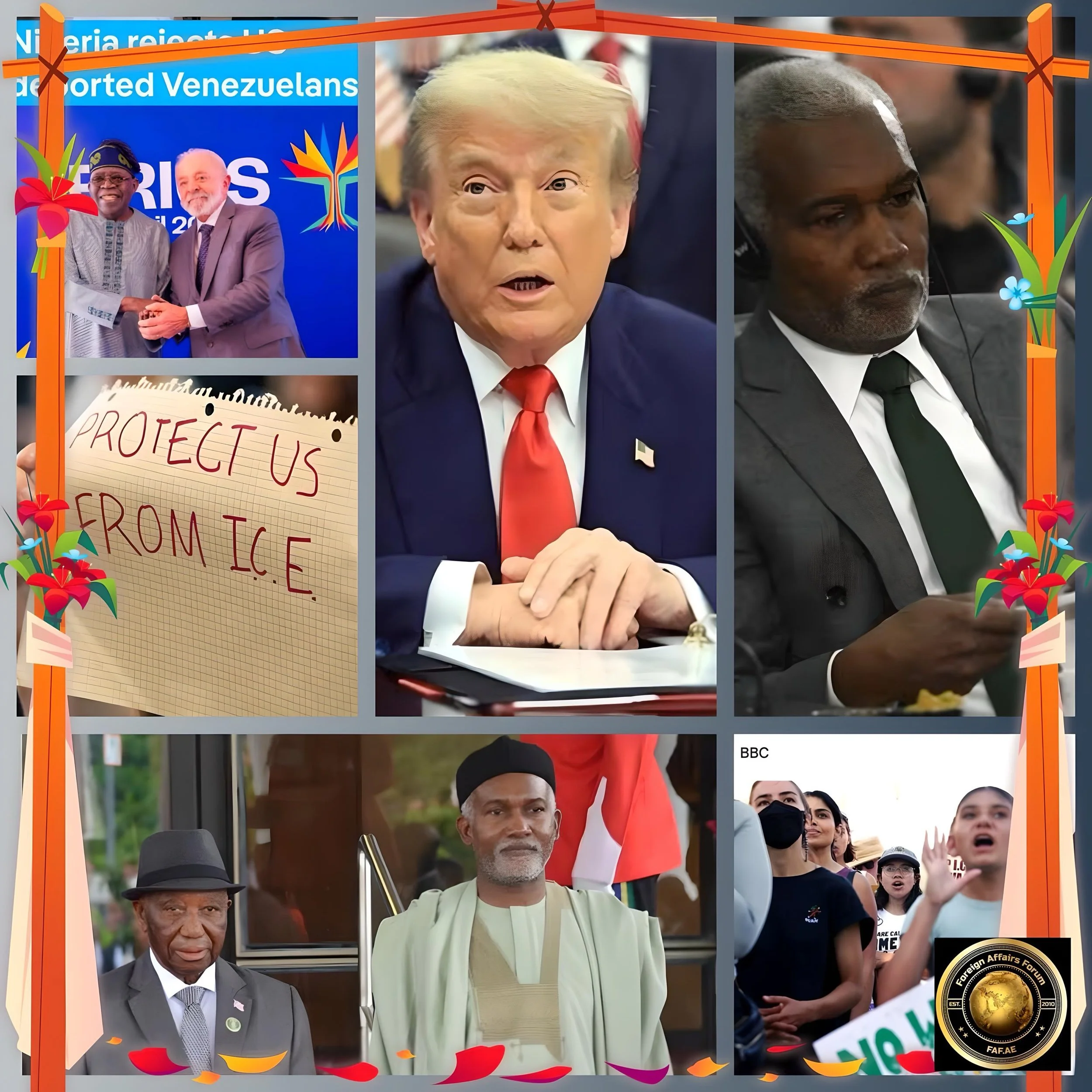
Nigeria has explicitly rejected third-country deportations, with Foreign Minister Yusuf Tuggar stating: “We already have over 230 million people… I can’t do nothing for you, man”
Nigeria insists it will only accept its own citizens, not deportees from other nations.
Diplomatic Calculations
Experts suggest African leaders hope accepting deportees will improve relations with Washington and potentially secure concessions on trade, aid, or migration policies.
However, this strategy risks domestic political backlash and international criticism.
Parliamentary Opposition and Constitutional Concerns
Ghana’s opposition lawmakers have condemned the deportation agreement as unconstitutional, arguing that President Mahama’s administration failed to consult parliament as required by Ghanaian law.
They have demanded Immediate suspension of the U.S.-Ghana deportation deal until parliamentary ratification.
Complete transparency about the agreement's terms and scope.
Accountability measures for officials involved in the arrangement.
Opposition figures warn that the deal risks "Ghana being perceived as aligning itself with the U.S. government's current immigration enforcement regime, one which has been criticized as harsh and discriminatory".
International Legal and Human Rights
Concerns
United Nations human rights experts have condemned third-country deportations, noting they result in individuals being "stranded in distant locations, subjected to arbitrary detention for prolonged periods, and at risk of torture".
The U.N. has urged the U.S. to Cease all further removals to third countries.
Ensure effective access to legal support for deportees.
Subject all procedures to independent judicial oversight.
Amnesty International has characterized third-country deportations as reflecting "a disregard for immigrant lives and a calculated effort to dismantle the right to seek asylum"
Conclusion
Looking Ahead: More Deportees Expected
Despite the controversy, Ghana’s Foreign Minister has confirmed that an additional 40 deportees are expected to arrive from the United States.
This suggests the arrangement will continue despite legal challenges and human rights concerns.
The Ghana case exemplifies the Trump administration’s systematic approach to externalizing immigration enforcement through coercive diplomacy and proxy deportations.
By leveraging visa restrictions, trade threats, and aid cuts, the administration has successfully pressured multiple countries to accept deportees they have no obligation to receive.
For the migrants caught in this system, the consequences are severe: separation from legal protections, detention in unfamiliar countries, and ultimate deportation to places where they face documented risks of persecution or death.
The Ghana controversy thus represents not just a bilateral dispute, but a fundamental challenge to international human rights norms and the principle of non-refoulement that prohibits returning individuals to countries where they face persecution.
As this policy expands across Africa and beyond, it raises critical questions about the limits of U.S. diplomatic pressure and the responsibility of international institutions to protect vulnerable migrants from what advocates increasingly characterize as a systematic violation of their fundamental rights.