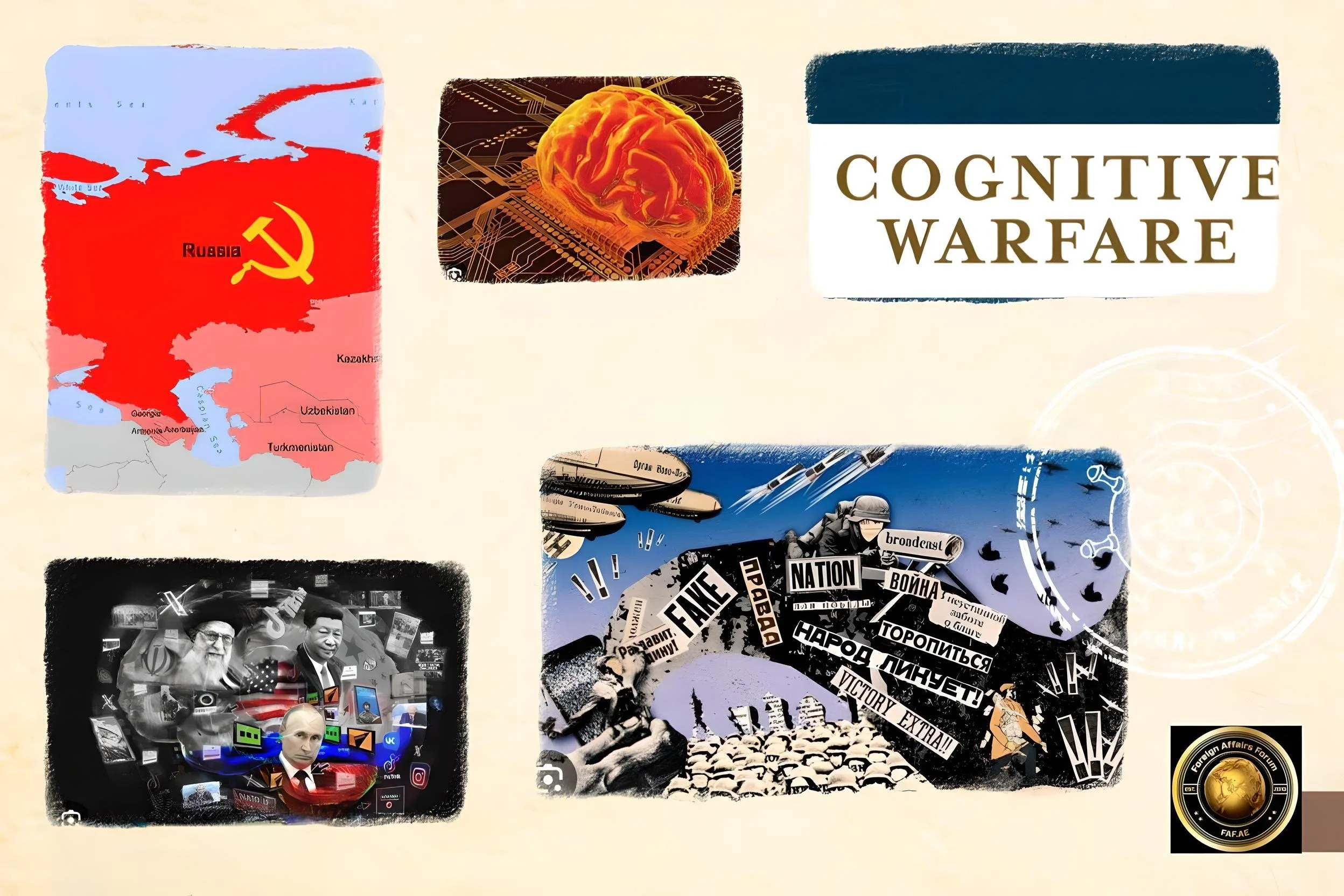
Russia’s Edge in Cognitive and Hybrid Warfare: A Comprehensive Analysis
Executive Summary
FAF analysis delves into Russia's multifaceted strategies in cognitive and hybrid warfare, emphasizing the nation's ability to manipulate perceptions, influence behavior, and employ unconventional tactics.
By leveraging a combination of psychological operations, disinformation campaigns, and the strategic use of social media platforms, Russia has cultivated a distinctive edge in shaping narratives domestically and internationally.
The study explores how Russia's hybrid warfare transcends traditional military engagements, incorporating state-sponsored cyberattacks, misinformation dissemination, and grassroots propaganda efforts to achieve its geopolitical objectives.
This approach enables Russia to destabilize targeted nations while maintaining plausible deniability, complicating the responses of adversaries.
The analysis also highlights key case studies illustrating Russia's tactics in action—such as the 2016 U.S. elections and conflicts in Eastern Europe.
These examples underscore the effectiveness of Russian strategies in eroding trust in democratic institutions and creating societal divisions.
Overall, this comprehensive examination sheds light on Russia's strategic advancements in cognitive and hybrid warfare, detailing the implications for global security and the challenges nations face in countering these insidious tactics.
Introduction
Russia presently holds a significant competitive edge over the United States and China in cognitive and hybrid warfare.
However, this advantage is gradually diminishing as these rival nations actively adapt and enhance their strategies and technological capabilities.
Russia’s strategic prowess is rooted in decades of institutional learning and operational practice during the Soviet era.
This foundational knowledge has been meticulously developed through extensive theoretical exploration and tactical refinement.
The lessons learned from various modern conflicts have further honed Russia’s approach, allowing it to integrate diverse methods of warfare that effectively combine psychological tactics, disinformation campaigns, and other non-traditional military strategies.
As a result, Russia is capable of influencing public perception and manipulating information environments in ways that have proven to be both innovative and impactful.
Historical Foundation and Theoretical Sophistication
Russian Mastery of Cognitive Warfare
Russia's preeminence in cognitive and hybrid warfare is rooted in a systematic evolution that spans nearly a century.
The genesis of this sophisticated approach can be traced back to the Soviet Union in the 1920s, which pioneered the concept of “active measures” (aktivnye meropriyatiya).
This foundational framework for information warfare included a comprehensive suite of tactics such as disinformation, propaganda, sabotage, and psychological operations, all designed to manipulate perceptions and behaviors on a global scale.
The KGB's establishment of Department D, later known as Service A, was pivotal in institutionalizing these methodologies.
This department became the nexus for hundreds of specialists dedicated to crafting and executing global disinformation campaigns, aiming to construct narratives that would alter perceptions and influence political environments beyond Soviet boundaries.
Central to Russian cognitive warfare is a sophisticated theoretical paradigm, prominently featuring the concept of reflexive control.
This strategy, delineated by Soviet mathematician Vladimir Lefebvre in 1967, remains foundational in contemporary Russian military and intelligence frameworks.
Reflexive control entails the strategic dissemination of customized information to manipulate adversarial decision-making processes.
By astutely shaping the informational terrain, Russian strategists endeavor to guide opponents toward decisions that seem autonomous, yet are subtly directed to align with Russian interests.
This nuanced form of manipulation transcends traditional propaganda; rather than merely disseminating false narratives, it actively reshapes the cognitive frameworks of adversaries, engendering an illusion of choice while ensuring that outcomes favor the initiator's objectives.
The Gerasimov Doctrine, named after Chief of the General Staff Valery Gerasimov, has synthesized these foundational ideas into a cohesive strategic framework.
It acknowledges the escalating significance of nonmilitary means—such as economic sanctions, cyber operations, and manipulating public sentiment—in fulfilling political and strategic objectives.
The doctrine asserts that these nonmilitary endeavors have outstripped conventional military actions in effectiveness, suggesting a strategic preference ratio of 4:1 in favor of nonmilitary measures.
This shift underscores Russia's relentless quest for cognitive dominance and its commitment to harnessing hybrid tactics to advance its geopolitical aspirations.
China’s Systematic Approach
China has developed a complex strategic framework known as the Three Warfares (sānzhǒng zhàn fǎ), officially implemented in 2003.
This strategy comprises three interconnected components: psychological warfare, public opinion warfare, and legal warfare (lawfare). It effectively integrates information operations with broader national objectives, reflecting a holistic approach to contemporary conflict.
The strategy is firmly grounded in the ancient military philosophy of Sun Tzu, particularly the concept of "winning without fighting."
Over time, the Three Warfares has evolved, adapting to contemporary security challenges, and demonstrating China's capacity to refine its tactics in response to an ever-changing global landscape.
A significant development in China's military organization is the recent restructuring that replaced the Strategic Support Force with the Information Support Force.
This transition signals Beijing's commitment to prioritizing information warfare as a critical component of its national defense strategy.
By enabling the Information Support Force to report directly to the Central Military Commission, Chinese leadership highlights the strategic importance of achieving information superiority across both military and civilian domains.
Noteworthy is the sophistication of China's cognitive warfare operations, particularly regarding Taiwan. Since 2011, the 311 Base in Fujian Province has been actively engaged in targeted cognitive operations.
These initiatives effectively merge military intimidation tactics, influence campaigns, religious propaganda, and advanced disinformation strategies, all aimed at shaping public perception and eroding the confidence and resolve of Taiwanese society.
American Challenges and Adaptation in Cognitive Warfare
The United States grapples with notable structural disadvantages in the realm of cognitive warfare, despite its advanced technological capabilities.
Historically, American information operations have been perceived largely as supplementary to kinetic military actions, lacking an independent strategic significance.
This traditional view hampers the effectiveness of these operations in a contemporary landscape where cognitive warfare increasingly serves as a primary mechanism for achieving strategic objectives.
Prominent military leaders have candidly observed that “the United States is being strategically defeated in the information environment,” indicating a critical need for reevaluation of current tactics.
The diffusion of American information operations across numerous agencies complicates coordination, especially when paired with the legal and ethical restrictions inherent within democratic systems. Adversaries are quick to exploit these coordination weaknesses to further their own narratives and strategies.
On a more positive note, the U.S. has exhibited remarkable adaptability in particular scenarios. A salient example can be found in the declassification and public dissemination of Russian intelligence regarding its invasion plans for Ukraine.
This strategic transparency represents an innovative tactic in information warfare, compelling Russia to alter its operational approaches and undermining its predetermined propaganda narratives.
Operational Excellence and Global Reach in Cognitive Warfare
Russian Tactical Mastery
Russia's operational history illustrates both the effectiveness and constraints of cognitive warfare. The 2008 conflict in Georgia is a case in point, where Russia adeptly fused cyber and information operations with conventional military tactics.
This strategy sowed confusion and severely disrupted Georgian command and control capabilities, highlighting the disruptive potential of coordinated operations.
The manipulation of media narratives during this engagement laid the groundwork for future strategies, wherein fabricated atrocity tales were strategically timed to justify military interventions and garner both domestic and international support.
The crisis in Ukraine that began in 2014 marked the pinnacle of Russian hybrid warfare, encapsulating a fusion of unconventional military tactics, such as the employment of “little green men,” along with diplomatic and economic pressures.
This multifaceted approach facilitated the seamless annexation of Crimea with minimal direct combat, illustrating how adept cognitive warfare can create conditions favorable for territorial acquisition while maintaining plausible deniability.
However, the subsequent invasion of Ukraine in 2022 revealed critical shortcomings in Russian cognitive warfare strategies.
Despite prolonged efforts to undermine Ukrainian national identity and bolster internal discontent through pervasive information campaigns, Russia ultimately failed to meet its strategic aims.
The unexpected resilience displayed by Ukrainians underscored the limits of cognitive warfare, demonstrating that determined populations with a strong sense of national identity can successfully resist manipulation.
The operations of the Wagner Group in Africa also offer insights into Russia's strategic adaptability.
By tapping into local influencers and exploiting anti-colonial sentiments, Wagner has been able to positively shape public perception of Russian involvement while simultaneously eroding Western influence.
Their operations exemplify a nuanced understanding of local political economies, intertwining information operations with military support and resource extraction.
Chinese Precision and Integration in Cognitive Warfare
China's approach to cognitive warfare increasingly showcases both sophistication and an integrated strategy aligned with broader geopolitical objectives.
The Chinese government's application of military intimidation, coupled with economic incentives, is vividly illustrated in its operations against Taiwan.
Utilizing the Three Warfares concept—psychological, legal, and media—Beijing systematically reinforces its narrative while undermining Taiwanese autonomy.
Moreover, China’s utilization of platforms like TikTok to spread pro-Beijing information reflects a tactical innovation that exploits Taiwan’s commitment to free expression, effectively drowning out dissenting voices.
In the context of the South China Sea, China has adeptly employed cognitive warfare tactics to fortify its strategic foothold.
Through a blend of “gray zone” activities, such as the construction of artificial islands and legal maneuvers, China has managed to create a status quo that avoids outright military confrontations.
This incremental approach, often referred to as “salami-slicing,” manipulates perceptions and normalizes territorial encroachments without triggering robust counteractions.
The potential impact of advanced artificial intelligence capabilities within cognitive warfare is a looming game-changer.
Chinese advancements in areas like “brain-machine interfaces” and “cognitive control” signal preparations for unprecedented levels of psychological manipulation.
The fusion of personal data collection through popular platforms like TikTok with AI-driven influence operations paves the way for targeted cognitive attacks on an individual scale, raising ethical implications and strategic concerns.
American Technological Advantages and Constraints
Despite facing significant structural hurdles, the United States retains considerable strengths in its cognitive warfare capabilities.
Prominent American technology firms dominate global information platforms, presenting vast opportunities for influence operations that can be harnessed in a competitive context.
Moreover, the sophistication of American artificial intelligence and data analytics capabilities frequently surpasses those of its Russian and Chinese counterparts in a variety of domains.
Recently, there has been a critical pivot towards prioritizing “cognitive dominance,” with military leaders increasingly acknowledging that effective deterrence hinges on an adversary's awareness of an adversary’s capability and willingness to impose repercussions.
This evolving doctrine emphasizes the importance of information operations as a strategic priority, indicating a significant shift in how cognitive effects are understood and utilized in contemporary military strategy
Strategic Implications and Recommendations
The Russian Advantage
Currently, Russia enjoys significant strategic advantages in the realms of cognitive and hybrid warfare, which stem from several critical factors:
Institutional Experience
Decades of systematic development have fostered a profound reservoir of institutional knowledge, alongside refined operational procedures. The continuity and evolution from Soviet-era active measures to contemporary information operations endow Russia with an unmatched depth of historical insight.
Strategic Integration
The Russian approach to cognitive warfare is seamlessly intertwined with military, diplomatic, and economic strategies. This holistic whole-of-government model allows for coordinated campaigns that maximize effectiveness across diverse domains.
Adaptability
Russian operations exhibit a remarkable capacity for rapid adaptation to emerging technologies and context shifts. The swift transition from traditional media manipulation to social media strategies, and now to AI-powered targeting, exemplifies an ongoing learning process and flexibility.
Minimal Constraints
The authoritarian structure of the Russian government removes many legal or ethical constraints prevalent in democratic nations, permitting state-sanctioned operations to pursue objectives vigorously and without significant limitations.
Historical Lessons and Modern Applications in Cognitive Warfare
Learning from the Past
An analysis of historical developments illustrates the evolving tactics in cognitive warfare.
The Soviet Union’s active measures during the Cold War serve as a foundational case study for contemporary strategies.
By employing techniques such as forgery production, front organization creation, and extensive agent deployment, the KGB established operational frameworks that modern campaigns now adapt, enhanced by the capabilities afforded by technological advancements.
The KGB's structured approach to active measures—spanning “black” propaganda (deliberately deceptive), “gray” propaganda (a mix of truth and falsehood), and “white” propaganda (truthful information)—demonstrates the significant impact of layered information campaigns.
This legacy is mirrored in present-day Russian operations, which integrate overt messaging through state-controlled media (e.g., RT and Sputnik) with covert tactics involving social media manipulation and hidden influence networks designed to sway public opinion.
In a parallel evolution, China has assimilated Soviet methodologies while incorporating elements of traditional Chinese strategic thought.
This hybrid approach leverages age-old principles articulated by Sun Tzu, merging historical wisdom with state-of-the-art technology to establish a comprehensive framework for modern cognitive warfare.
Contemporary Battlegrounds
The current domain of cognitive warfare predominantly unfolds on digital platforms, offering an unprecedented scope of reach and targeting accuracy.
A notable example of this dynamic was evident during the 2016 U.S. presidential election, where Russian operatives executed a far-reaching disinformation campaign through social media channels that significantly affected democratic processes.
Across platforms like Facebook, Twitter, Instagram, and YouTube, Russian entities reached millions of American users, disseminating coordinated disinformation that capitalized on societal fractures.
Likewise, the COVID-19 pandemic acted as a proving ground for cognitive warfare techniques, allowing adversaries to exploit public fear and confusion, erode trust in governmental institutions, and amplify social divisions.
This period underscored cognitive warfare's efficacy in shaping public sentiment during crises, achieving strategic goals without traditional military interventions.
The advent of deepfake technology and AI-generated content marks a seismic shift into a new phase of cognitive warfare.
The capability to generate realistic simulations of political figures—complete with fabricated audio and video—opens new avenues for deception that were once considered the realm of speculative fiction.
The accessibility of these technologies democratizes cognitive warfare, empowering non-state actors to conduct sophisticated influence operations.
Emerging Threats and Future Trajectories
The integration of artificial intelligence within cognitive warfare introduces a transformative era characterized by enhanced operational effectiveness.
China's strides in personalized influence operations, leveraging AI to exploit individual psychological vulnerabilities, indicate a future proliferation of cognitive tactics that are increasingly precise and potent.
By employing mass data collection and machine learning algorithms, the identification and manipulation of public sentiment can be executed at an unprecedented scale.
The rise of platforms like TikTok emphasizes this trend; with over 150 million American users, TikTok provides deep insights into American thoughts and behaviors, functioning as a tool for influence operations.
Its dynamic algorithms have the ability to shape user engagement and emotional responses, creating potent mechanisms for cognitive manipulation.
The convergence of cognitive warfare with other domains—including cyber aggression, economic coercion, and diplomatic strategies—signals a paradigm shift where future conflicts will be multifaceted and integrated.
This "hybrid world war" encapsulates the evolving nature of conflicts, in which the distinctions between peace and warfare increasingly blur.
China’s Evolving Warfare Capabilities
China is rapidly closing the gap with Russia in cognitive and hybrid warfare capabilities, with the potential to outpace Russian proficiency in this domain
Systematic Investment
China’s strategic commitment to informationized warfare is evident through substantial resource allocation and significant structural reorganization.
The creation of dedicated Information Warfare and Psychological Operations institutions highlights this evolution, enabling a focus on cognitive influence strategies that not only parallel but may occasionally exceed Russian initiatives.
The integration of historical insights with cutting-edge technological developments is transforming the cognitive warfare environment, presenting formidable challenges for nations worldwide.
Tackling these threats necessitates an astute understanding of the evolving tactics and strategic foresight.
Technological Advancements
China has made notable advancements in artificial intelligence, data analytics, and information technology, which bolster its capabilities for cognitive manipulation.
This technological strength facilitates a sophisticated approach to information warfare, leveraging precision tools to shape public perception and influence behaviors at scale.
Additionally, the seamless alignment of civilian technological innovations with military objectives cultivates powerful synergies that enhance operational efficacy.
This dual-use paradigm allows for rapid repurposing of advancements from civilian sectors for military applications, significantly expediting the development of strategies aimed at achieving technological superiority.
Economic Integration
China’s strategic fusion of economic power with cognitive warfare tactics provides it with distinctive advantages on the global stage.
Initiatives such as the Belt and Road Initiative (BRI) not only enhance trade but also serve as platforms for the dissemination of information and influence.
These efforts extend China’s reach beyond its immediate borders, establishing a vast global network that facilitates information distribution, making it challenging for competitors to counter effectively.
Strategic Patience
The character of China’s cognitive warfare is marked by a long-term strategic vision, as illustrated by its extended campaign concerning Taiwan.
This strategic patience exemplifies a disciplined methodology that supports sustained operations over considerable periods.
By employing gradual tactics and a nuanced understanding of regional dynamics, China can exert consistent pressure on its objectives while minimizing immediate backlash.
American Challenges and Opportunities
Despite the complex geopolitical landscape, the United States retains several crucial advantages that can be leveraged in cognitive warfare:
Technological Superiority
The U.S. remains at the forefront of advanced technology development, particularly in artificial intelligence and data analytics.
This ongoing dominance equips American entities with sophisticated tools that can eclipse adversary capabilities, facilitating more nuanced and impactful cognitive warfare operations.
Global Platforms
The U.S. controls numerous major global information platforms, including leading social media networks and digital communication tools. These platforms offer inherent advantages for conducting influence operations.
However, legal and corporate governance constraints may hinder the capacity to fully exploit these advantages without careful ethical and strategic considerations.
Alliance Networks
The extensive alliance networks cultivated by the U.S. over decades add significant strength.
These alliances provide not only global reach but also local legitimacy to operations that would be more challenging to execute in isolation.
Coordinated cognitive warfare initiatives with allies could markedly amplify the effectiveness of influence strategies, creating a robust counter to adversarial efforts.
Adaptation Capacity
Despite bureaucratic constraints, U.S. institutions have exhibited commendable adaptability and innovation when effectively motivated.
Rapid responses to challenges—illustrated by the swift development of COVID-19 vaccines and remarkable achievements in space exploration—highlight America’s capacity to mobilize resources and innovate effectively with a clear focus.
This suggests a potential for similar agility in the realm of cognitive warfare.
Conclusion
Russia stands at the forefront of cognitive and hybrid warfare, leveraging a rich tapestry woven from nearly a century of military evolution, historical insights, and advanced theoretical frameworks.
This extensive experience has shaped a sophisticated institutional approach that blends traditional tactics with cutting-edge strategies. Central to Russia's capabilities is its foundation in "active measures"—a strategy cultivated during the Soviet era—adapted to current digital landscapes and modern conflict scenarios.
This evolution has endowed Russia with an unparalleled depth of expertise in manipulating information and psychological tactics.
However, this significant advantage is not set in stone nor insurmountable. In fact, China's methodical implementation of the Three Warfares strategy—consisting of psychological, legal, and media warfare—combined with massive investments in resources and technological innovation, positions it to potentially eclipse Russian capabilities within the next ten years.
The incorporation of advanced artificial intelligence into cognitive warfare strategies could enable China to achieve remarkable efficiencies in targeting and an unprecedented scale of operations, presenting a formidable challenge to current power dynamics.
On the other hand, the United States grapples with considerable structural obstacles that could impede its efforts in this arena.
Nevertheless, it still boasts key advantages, including cutting-edge technology, extensive global reach, and a robust network of international alliances.
To excel in cognitive warfare, America must undergo vital institutional reforIn contemporary military strategy, there is a marked shift towards prioritizing information warfare as a core component, rather than treating it merely as an auxiliary tactical element.
Looking forward, the dynamics of international conflict are increasingly shaped by cognitive strategies. Nations adept at shaping perceptions, influencing decision-making processes, and controlling narratives will secure significant advantages over their adversaries, thereby driving their strategic objectives.
The current Russian approach to cognitive warfare exemplifies not only tactical proficiency but also a deep comprehension of the modern battlefield: the capacity to influence opponents' cognitive frameworks and decision-making processes transcends traditional kinetic engagements.
This evolution underscores the importance of psychological and informational dimensions in warfare, solidifying their role as pivotal in achieving operational success.