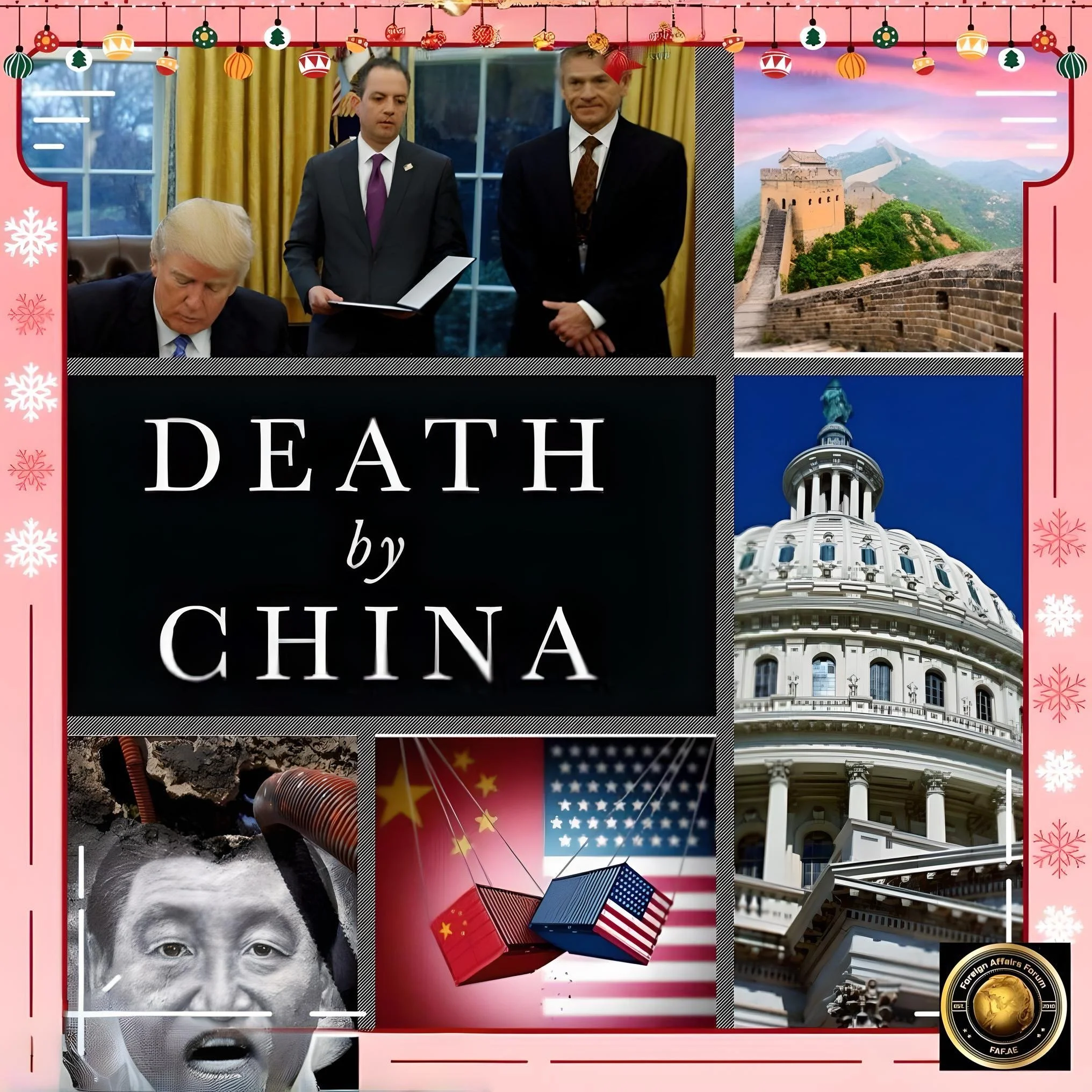
Genesis of Tariffs During the Trump Administration: Death by China - A Critical Analysis of China's Economic Impact and Historical Context
Introduction
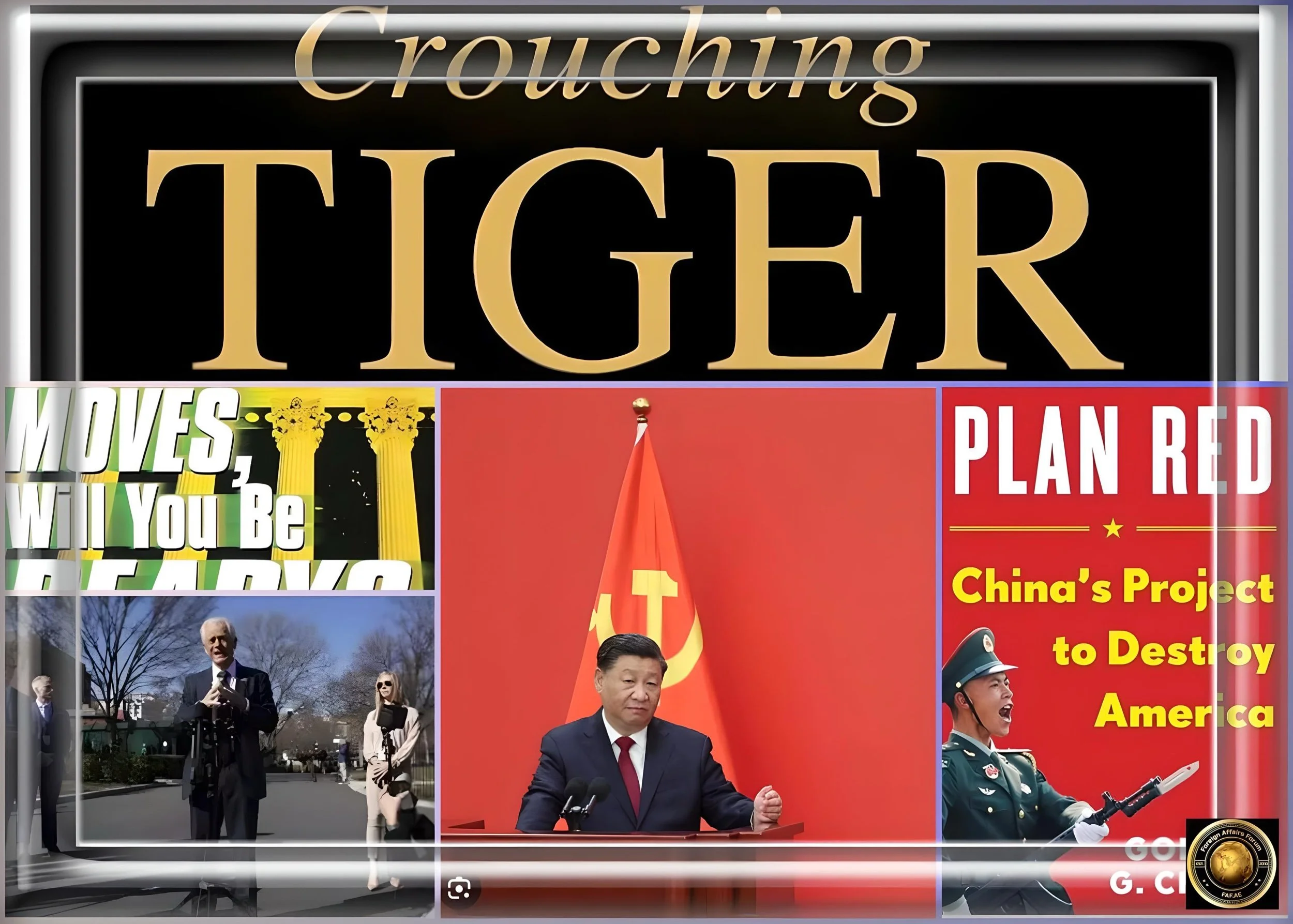
"Death by China" articulates a crucial argument positing that China's accelerated economic ascent—fueled by currency manipulation, exploitative trade practices, and insufficient regulatory oversight—represents an existential threat to U.S. economic and national security.
FAF's comprehensive analysis reveals that the book's incisive, data-driven narrative has notably influenced contemporary U.S. trade policy, particularly leading to enacting extensive tariffs, and has significantly altered the geopolitical dynamics between Washington and Beijing.
Foreward
Peter Navarro and Greg Autry co-authored "Death by China: Confronting the Dragon—A Global Call to Action" in 2011.
The book characterizes China as a "heavily armed, totalitarian regime" with aspirations for regional hegemony and global supremacy.
The authors contend that this regime systematically infiltrates U.S. markets through various unscrupulous methods, including:
Illegal export subsidies and currency manipulation distort fair market pricing and competition dynamics.
Intellectual property infringement, counterfeiting, and coerced technology transfers undermine American innovation and the protection of intellectual assets.
The dumping of goods below market value destabilizes local industries and fosters dependency.
Subpar environmental and labor standards permit the production of Chinese goods at reduced costs that undercut domestic manufacturing.
Navarro's assertion that America's reliance on Chinese imports equates to "buying the rope that will be used to hang us" underscores the peril of economic complacency amidst vulnerabilities.
Historical Narrative of China
While the book primarily addresses economic issues, it interlaces critical historical context that underscores the lineage of the Chinese Communist Party (CCP) and its evolving industrial strategies.
Maoist Legacy and Tiananmen
Chapters such as “Death by Chinese Pogrom” detail the 1989 Tiananmen Square protests, illustrating the authoritarian resilience of the Chinese regime, unafraid to deploy violence to suppress dissent in pursuit of its growth model.
Resource Colonialism
Sections labeled “Death by Colonial Dragon” examine China's significant investments in Africa and Latin America, framing these actions as contemporary manifestations of historical imperialism aimed at securing essential raw materials.
Cyber and Military Modernization
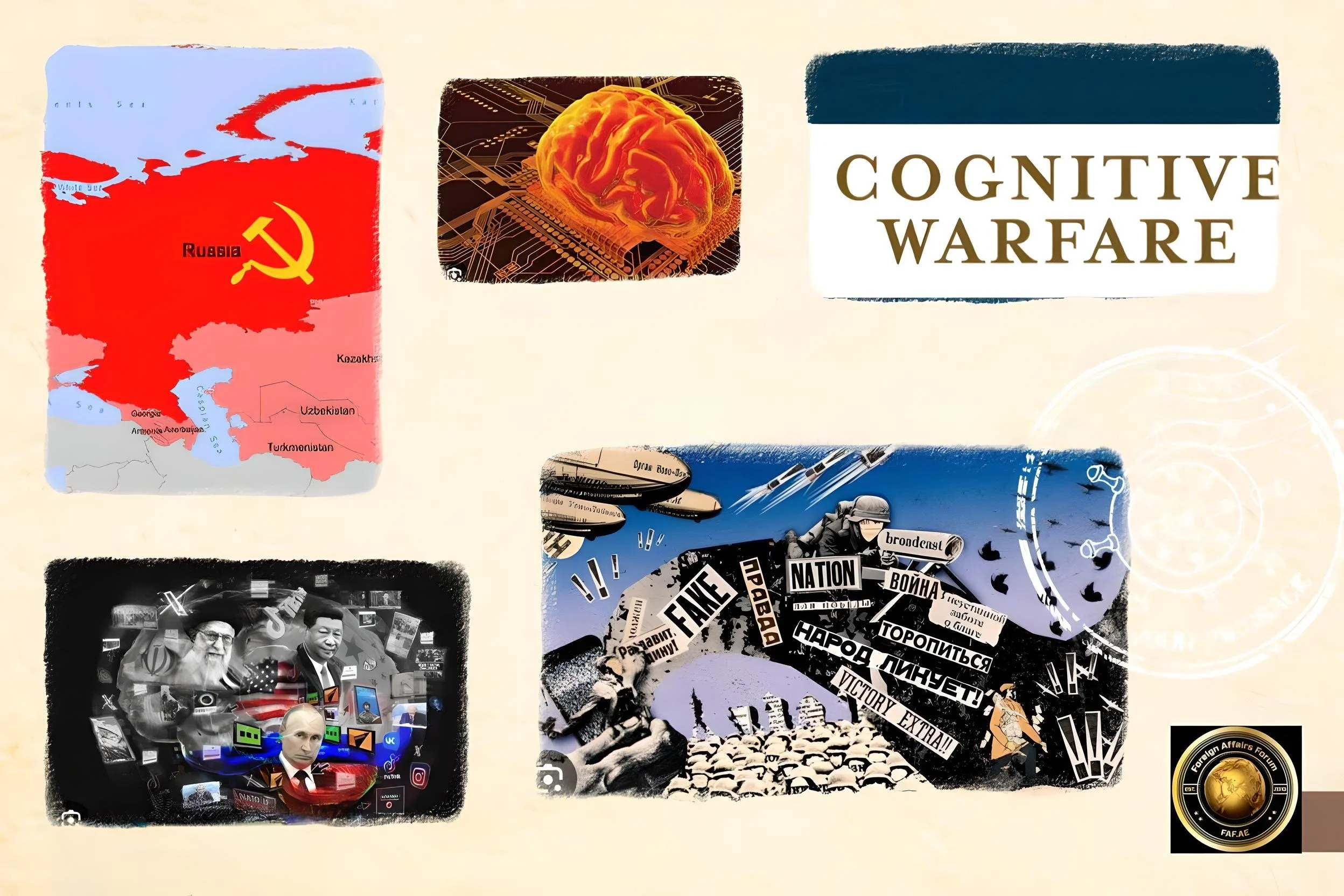
"Dark Visitors" discusses the augmentation of China's naval capabilities and cyber-espionage, revealing how central planning has fostered military expansion alongside technological advancements.
These historical insights bridge previous political strategies, from Mao's industrial initiatives to Deng Xiaoping's economic reforms, and inform China’s global ambitions.
Tariffs and Trade Remedies
Navarro advocates for a comprehensive suite of countermeasures to recalibrate trade imbalances, including:
Section 301 Tariffs
The unilateral imposition of U.S. tariffs on hundreds of billions of dollars of Chinese goods is designed to penalize unfair trade practices.
Import Quotas and Subsidy Adjustments
Proposals for retaliatory duties and domestic subsidies intended to bolster the domestic manufacturing sector.
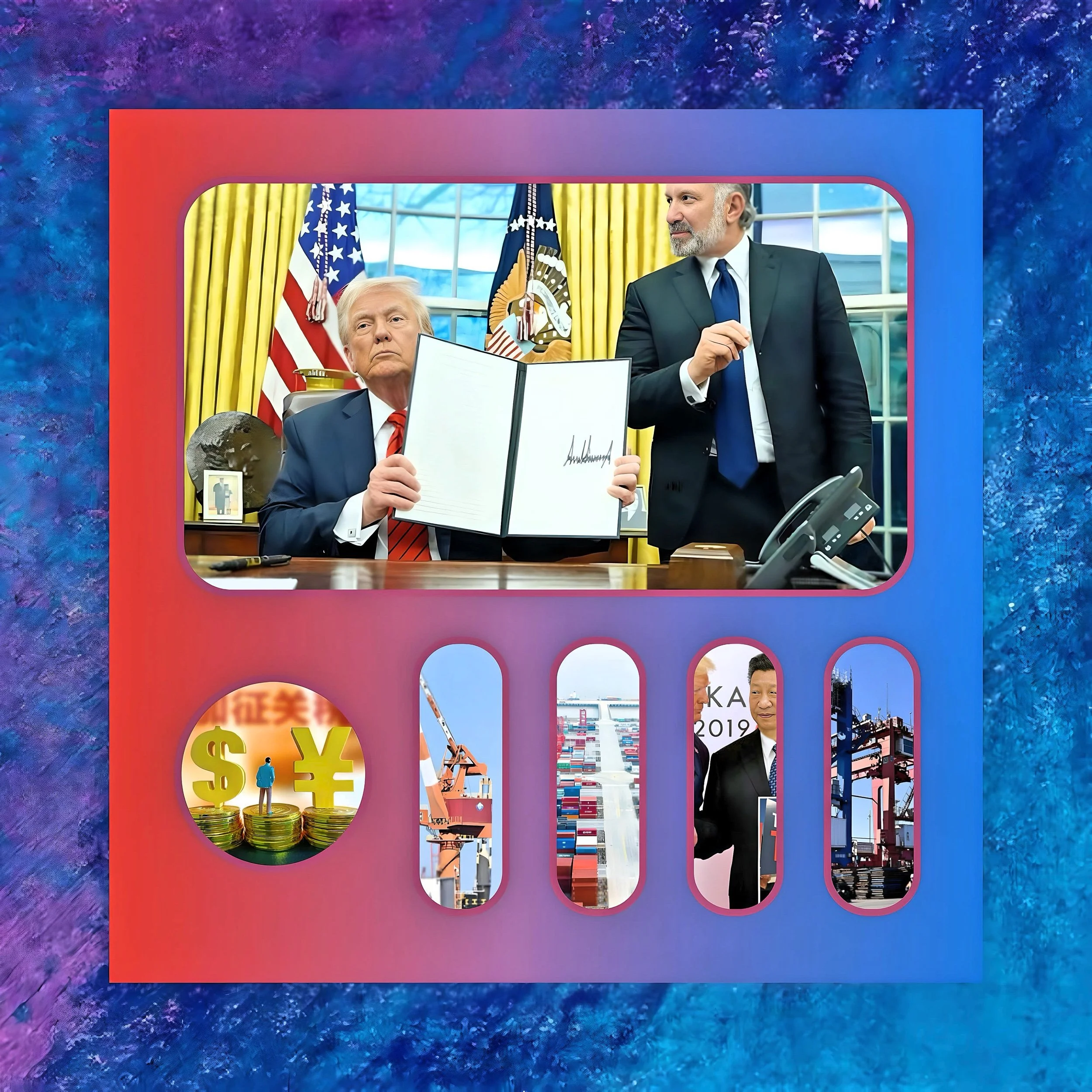
This strategic framework significantly influenced President Trump’s trade agenda between 2018 and 2020, resulting in a dramatic spike in average tariffs on Chinese imports—which at times exceeded 50% in key sectors—aimed at addressing trade deficits and pressuring China for structural economic reforms.
Trump 2.0’s Adoption of Navarro-Style Policies
In his second term, President Trump has re-elevated Navarro as Senior Counselor for Trade and Manufacturing, signaling a continued embrace of “Death by China” prescriptions.
Notable actions reflecting Navarro’s influence include the following.
Imposition of 25% reciprocal tariffs on imports based on bilateral trade deficits, echoing Navarro’s Project 2025 proposals.
Elimination of the de minimis duty exemption for Chinese parcels under $800, curbing low-value e-commerce imports.
Revival of aggressive supply-chain decoupling rhetoric, with plans to pressure allied nations to limit trade with China in critical sectors.
These measures demonstrate that Trump 2.0 has indeed integrated Navarro’s playbook—shifting from engagement toward a protectionist framework aimed at reasserting U.S. economic sovereignty and reshaping the global order in line with “America First” nationalism.
Impact on Today’s Geopolitical Landscape
The "Death by China" paradigm has catalyzed a pivotal policy transition in the United States, shifting from a strategy of engagement to one emphasizing strategic competition:
Economic Decoupling
Increased initiatives to diversify supply chains away from China, especially in sectors critical to national security, such as semiconductors and strategic minerals.
Alliance-Building
The U.S. has bolstered partnerships within the Indo-Pacific through collaborations like the Quad and AUKUS, aimed at countering Chinese regional ambitions and influence.
Technological Containment
Implementing rigorous export controls on advanced technologies seeks to constrain military advances by the People's Liberation Army (PLA).
These strategic responses illustrate the book’s advocacy for aligning economic policy with national security priorities, thereby reshaping the geopolitical landscape between the U.S. and China.
Critical Reception and Legacy of "Death by China
"Death by China" has received significant attention for its focus on pressing trade and security issues, but has also faced substantial criticism regarding:
Unilateral Tone
FAF contend that the book's alarmist narrative undermines a more sophisticated discourse surrounding intricate economic realities.
Questionable Credibility of Sources
The fictional character “Ron Vara” has raised alarms about the veracity of the anecdotes and claims used to support Navarro’s arguments.
Narrow Focus on Solutions
Although the book advocates for tariffs as a primary remedy, it fails to present comprehensive strategies for innovation or workforce adaptation in response to economic shifts.
Despite these concerns, the empirical data regarding manufacturing job losses, currency manipulation, and intellectual property risks remain relevant in today’s policy debates.
Conclusion
"Death by China" can be interpreted as both a polemical stance and a strategic framework responding to the challenges associated with China's economic ascendance.
Its emphasis on tariffs and economic decoupling has become a critical facet of U.S. trade policy, reshaping trade relations and integrating national security considerations into economic strategy.
The book's dramatic and polarizing style continues to stimulate discussion, while its impact on current tariff policies and geopolitical strategies underscores its enduring relevance.
FAF Comprehensive Analyses of "Death by China”
The Foreign Affairs Forum (FAF) critically examines Navarro’s work, outlining three interrelated fault lines: its polemical tone and exaggerated rhetoric, selective evidence and methodological flaws, and departure from mainstream economic principles.
Polemical Style and Alarmism
FAF observed that Navarro’s militaristic diction and apocalyptic framing—marked by terms like “Death by China,” “the Dragon,” and “economic warfare”—diminish the book's credibility as an academic work.
Rather than facilitating balanced policy examination, the narrative tends to evoke populist reactions intended to stoke fear.
Further critique characterized its tone as “inflated, macho, and juvenile,” arguing it reads more like a youthful manifesto than an erudite economic analysis.
Selective Evidence and Methodological Flaws
Fabricated Authority
Navarro’s use of the pseudonymous “Ron Vara” to lend credence to his claims represents a significant breach of academic integrity.
The reliance on a non-existent figure casts doubt on all his sourced assertions.
Overstated Employment Claims
Empirical research indicates that a minority of U.S. manufacturing job losses can be attributed to Chinese imports; the majority arise from automation and productivity improvements—nuances that Navarro's narrative obscures.
By disproportionately assigning job losses to China, the book misaligns with labor-market analyses that indicate the limited overall impact of Chinese competition on U.S. employment.
Disregarding Counter-Evidence
FAF doscusons with trade economists highlight that the consumer benefits derived from lower-cost imports have enhanced real incomes, a point Navarro neglects, thus violating the balanced cost-benefit analysis expected in economic discourse.
Deviation from Established Trade Theory
Navarro's rejection of comparative-advantage principles—claiming that “unfair,” state-backed competition invalidates free trade—diverges from mainstream economic literature.
The book suggests that while state intervention can distort markets, appropriate responses involve targeted enforcement of trade regulations and intellectual property protections, rather than sweeping protectionist measures.
Academic analyses advocate for multilateral dispute resolution (e.g., through the WTO) and enhanced enforcement of subsidy regulations in preference to unilateral tariffs.
Policy Implications and Empirical Outcomes
Subsequent evaluations of the Trump–China tariff conflict, which heavily drew on Navarro’s recommendations, illustrate that tariffs served as regressive taxes impacting American consumers, triggered retaliatory actions, and yielded minimal leverage in renegotiating Chinese industrial policies.
The cost-benefit analyses conclude that the overall economic detriment to U.S. companies and supply chains outweighed any potential security or employment benefits.
Concluding Remarks of FAF Appraisal
While "Death by China" raised awareness regarding genuine issues—such as intellectual property theft and coercive technology transfers—its alarmist tone, methodological inadequacies, and departure from established economic theory position it more as a polemic than a sound basis for policy.
FAF recommendations suggest the necessity of strengthening rule-based trade enforcement, implementing targeted antidumping measures, and fostering alliance-based responses, in contrast to the broad protectionism advocated by Navarro.