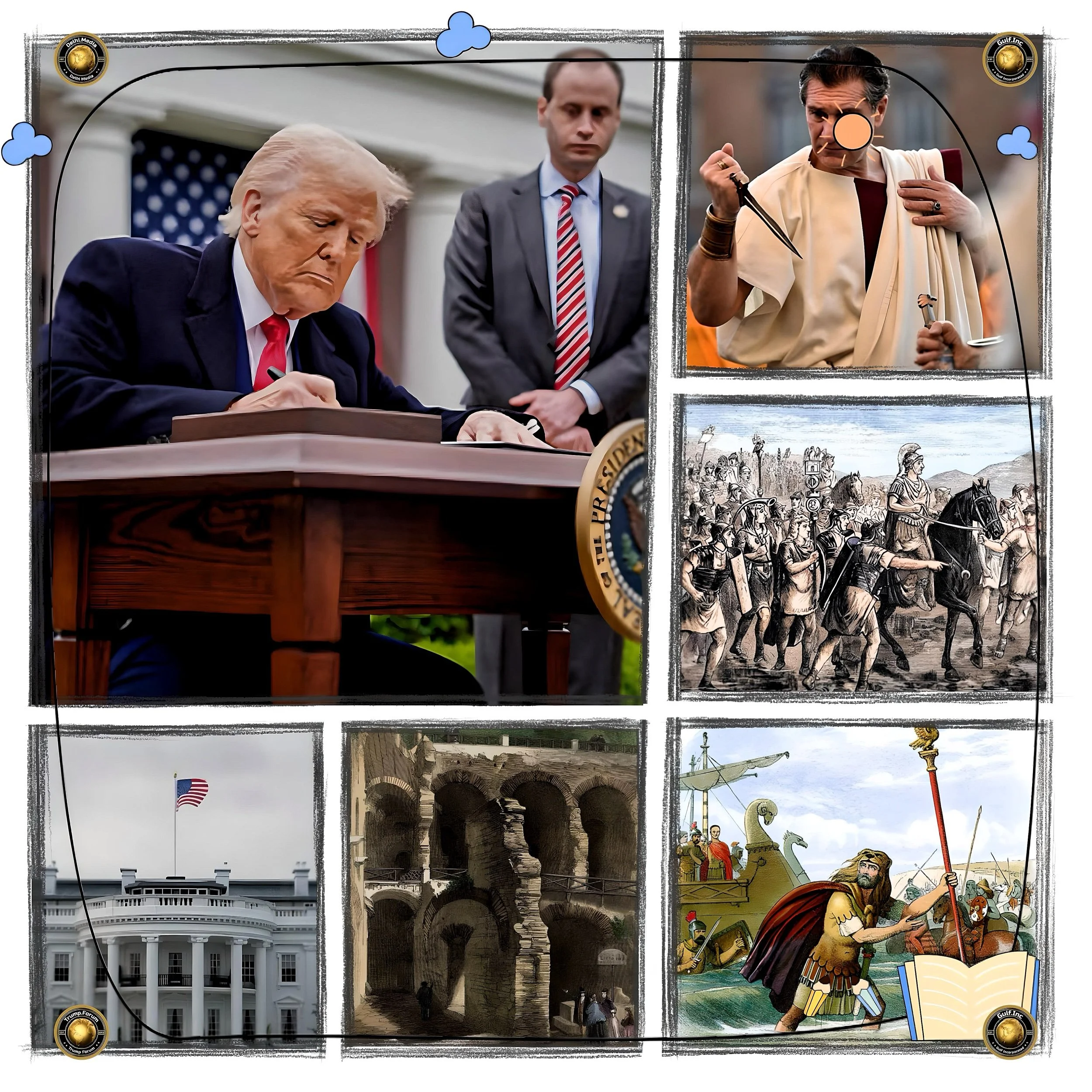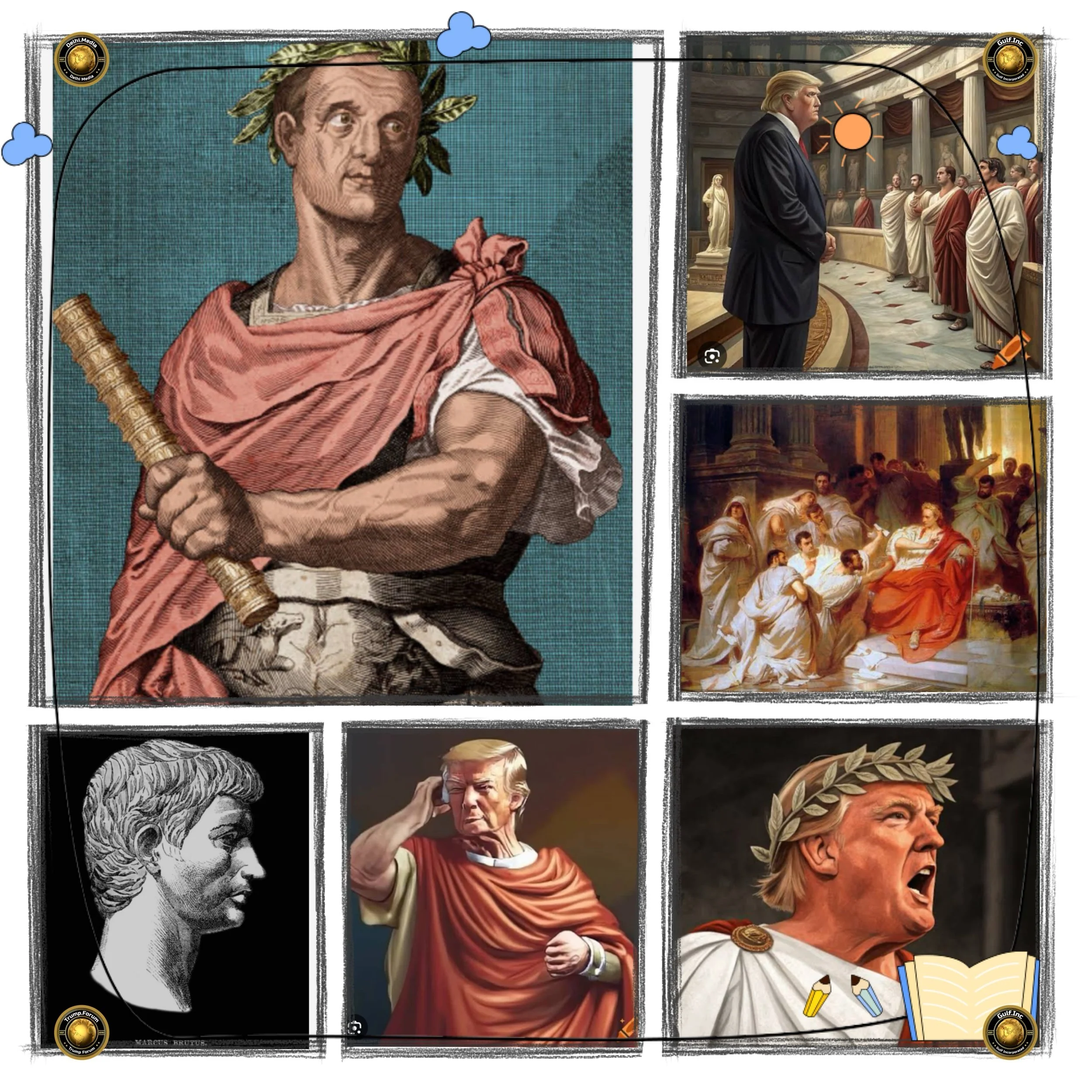
Trump- Caesar or Brutus? Comparing Trump and Ancient Roman Archetypes
Introduction
Drawing parallels between contemporary leaders and figures from ancient Rome provides a nuanced perspective on the interplay of power, populism, and political crises in shaping the destinies of republics.
Donald Trump's presidency has frequently been contrasted with Julius Caesar's transformative and often tumultuous influence on the Roman Republic.
This raises an important inquiry: within the unfolding narrative of American democracy, should Trump be viewed as the ambitious Caesar or the destabilizing Brutus?
Comparing Caesar and Trump
Geopolitical Contexts
Julius Caesar emerged from a Rome rife with social discord, military expansionism, and a weakening republic.
His military triumphs in Gaul solidified his status as a popular hero, while simultaneously rendering him a significant threat to the established Senate.
His crossing of the Rubicon represented a decisive rejection of established norms in favor of personal power, culminating in a dismantling of the republican legal order and the ascendance of imperial dominance.
Similarly, Donald Trump ascended to political prominence in an era marked by profound political polarization, economic uncertainty, and widespread distrust toward established institutions.
He harnessed populist rhetoric to position himself as a bulwark against entrenched elites, frequently challenging constitutional conventions.
Notably, his refusal to concede the 2020 election and his rhetoric surrounding the January 6 Capitol insurrection are perceived as direct threats to the peaceful transfer of authority, a cornerstone of American democracy.
Trump as Caesar, Not Brutus
From a political and historical standpoint, Donald Trump bears a more substantial resemblance to Caesar than to Brutus.
Like Caesar, Trump demonstrated a readiness to exploit institutional frailties and harness popular discontent to augment his personal power.
Their political strategies were characterized less by a commitment to reform and more by an assertion of will that undermined established traditions.
While Caesar's actions dismantled the republic's checks and balances, Trump's behaviors have raised serious questions about the endurance of American democratic principles.
Why Not Brutus?
Brutus is emblematic of opposition, serving as both an adversary to Caesar and a purported defender of the republican order.
Symbolically, the Brutus archetype resists the encroachment of authoritarianism and seeks the restoration of pre-existing norms.
In the framework of American democracy, Trump’s maneuvers align more closely with those of a would-be Caesar than a Brutus; he consolidated power and transgressed institutional constraints, employing rhetoric and actions that challenged republican norms and inspired a contingent of loyalists to contest the established order.
In contemporary contexts, the role of "Brutus" is not personified by Trump but rather by a coalition of institutional guardians.
These include
Government officials committed to preserving legal frameworks, such as judges and nonpartisan election administrators.
Lawmakers from various political backgrounds who have stood against assaults on democratic norms (e.g., Liz Cheney, Adam Kinzinger, and members of congressional investigative committees).
Civil Society entities, including journalists, watchdog organizations, civic groups, and engaged citizens working to promote democratic practices.
International stakeholders, comprising allies and global organizations that articulate concerns over democratic backsliding.
Geopolitical Implications
In Caesar's Rome, international mechanisms to check power grabs were minimal; in contrast, modern America is embedded within a complex web of alliances and institutions (e.g., NATO, the United Nations) that elevate the stakes—and visibility—of democratic decline.
Erosion of democratic norms within a superpower like the U.S. reverberates globally, undermining confidence in democratic governance among international peers and potentially prompting similar authoritarian tendencies in other nations.
Conclusion
Trump is often analogized to Caesar due to his capacity to destabilize foundational democratic norms through the mechanics of populist authority, direct confrontations with institutional boundaries, and appeals to collective grievance.
Conversely, his adversaries across various branches of government and societal sectors embody the essence of Brutus, defending a beleaguered republic.
In the contemporary landscape, the role of "Brutus" is dispersed but imperative, reflected across a spectrum of civic and institutional actors rather than concentrated within a singular conspiratorial figure.