Threat Evaluation of the "Good Trouble Lives On" National Mobilization: Analyzing Civil Rights and Democratic Governance in Modern America
Introduction
The “Good Trouble Lives On” national mobilization represents a significant civil rights response to what organizers characterize as systematic attacks on democratic institutions and civil rights protections during the Trump administration’s second term.
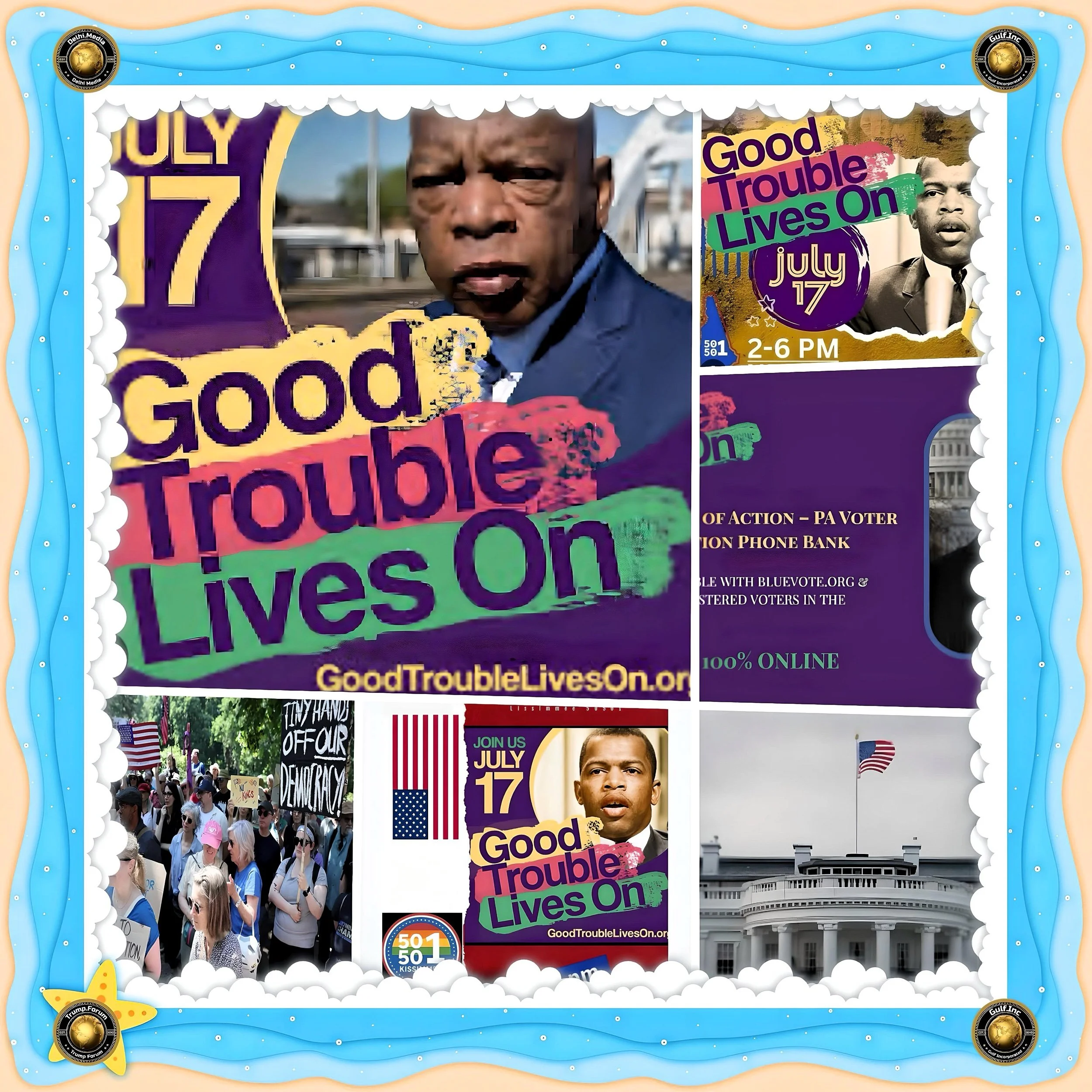
This movement, scheduled for July 17, 2025, emerges against a backdrop of unprecedented rollbacks of civil rights protections and democratic safeguards, positioning itself as a continuation of the civil rights legacy established by Congressman John Lewis and other freedom fighters.
Historical Context and Movement Origins
The Legacy of John Lewis and “Good Trouble”
The term “Good Trouble” was coined by civil rights leader and Congressman John Lewis, who defined it as “the action of coming together to take peaceful, non-violent action to challenge injustice and create meaningful change”.
Lewis, who died on July 17, 2020, embodied this philosophy throughout his life, from his role as a Freedom Rider to his leadership in the march across the Edmund Pettus Bridge during “Bloody Sunday” in 1965.
His concept of “good trouble” emphasized that “meaningful change often requires disruption, confrontation, and a willingness to challenge unjust systems”.
The selection of July 17, 2025, as the date for this national mobilization is deliberately symbolic, marking the fifth anniversary of Lewis’s death.
This timing reflects the organizers’ intention to honor Lewis’s legacy while confronting what they perceive as a rollback of the civil rights achievements he helped secure.
The movement’s rallying cry, “March in Peace. Act in Power,” directly echoes Lewis’s philosophy of nonviolent resistance combined with decisive action.
Organizational Structure and Scope
A coalition of established civil rights organizations, including the Transformative Justice Coalition, the Leadership Conference on Civil and Human Rights, Black Voters Matter, the Declaration for American Democracy Coalition, and Indivisible, coordinates the mobilization.
This broad coalition represents traditional civil rights organizations and newer grassroots movements, indicating a multi-generational approach to civil rights activism.
The scale of the planned mobilization is substantial, with organizers reporting that over 56,000 people had RSVP’d for more than 1,500 events across all 50 states as of mid-July 2025.
The movement has attracted support from diverse constituencies, including labor unions, faith communities, student organizations, and professional associations, suggesting broad-based concern about the current trajectory of civil rights policy.
Contemporary Civil Rights Challenges
Systematic Rollback of Civil Rights Protections
The Trump administration’s second term has been characterized by what civil rights organizations describe as “the biggest rollback” of civil rights protections since the post-Reconstruction era.
Within the first 100 days of Trump’s second presidency, the administration implemented a series of executive orders and policy changes that fundamentally altered the federal government’s approach to civil rights enforcement.
One of the most significant changes has been the transformation of the Department of Justice’s Civil Rights Division, which was established by the Civil Rights Act of 1957 to defend Americans’ rights.
Under new leadership, the division has shifted focus from defending the rights of marginalized groups to targeting what the administration describes as “woke ideology” and “anti-Christian bias”.
This has resulted in an exodus of over 100 attorneys from the Civil Rights Division, with attorneys ordered to abandon voting rights cases and senior civil servants in the voting rights section being removed.
The administration has also implemented comprehensive attacks on diversity, equity, and inclusion (DEI) programs across federal agencies.
Trump signed executive orders abolishing DEI initiatives throughout the federal government and mandating that federal agencies recognize only two genders: male and female.
These changes extend beyond federal agencies to impact government contractors, educational institutions, and state and local governments that receive federal funding.
Voting Rights and Electoral Integrity
The mobilization occurs against sustained attacks on voting rights, with civil rights organizations documenting numerous attempts to restrict ballot access and undermine electoral integrity.
The Supreme Court’s 2013 decision in Shelby County v. Holder, which struck down key provisions of the Voting Rights Act of 1965, has created an environment where jurisdictions with histories of voting discrimination no longer require federal approval for changes to their voting procedures.
The John Lewis Voting Rights Advancement Act, which would restore and strengthen voting rights protections, has been repeatedly blocked in Congress despite having majority support.
Civil rights advocates argue that this legislation is essential for preventing discriminatory voting practices and ensuring equal access to the ballot box, particularly for communities of color.
Immigration Enforcement and Human Rights
Immigration enforcement has become a particular focus of civil rights concerns, with the Trump administration implementing what has been characterized as a “mass deportation campaign”.
ICE data reveals that 72% of people currently detained have no criminal convictions, contradicting the administration’s rhetoric about targeting “the worst of the worst”.
The administration’s immigration policies have included raids on sanctuary cities, expanded use of expedited removal procedures, and the reversal of previous policies that limited immigration enforcement in schools, hospitals, and places of worship.
Organizations including Human Rights Watch and Amnesty International have documented the human rights implications of these policies, describing Trump’s first 100 days as creating “a human rights emergency.”
Particular concerns have been raised about family separations, detention conditions, and the treatment of asylum seekers.
Threat Assessment: Challenges to Democratic Governance
Institutional Erosion and Rule of Law
The current political environment challenges democratic governance and the rule of law.
Democracy scholars have identified several concerning trends that mirror patterns observed in countries that have transitioned from democracy to authoritarian rule.
These include the erosion of press freedom, the politicization of the judiciary, the dismantling of independent bureaucracy, and the use of law enforcement against political opponents.
The Trump administration’s approach to civil rights enforcement represents a fundamental departure from the consensus on federal civil rights policy after the 1960s.
The administration has explicitly targeted what it characterizes as “woke ideology” while simultaneously rolling back protections for historically marginalized groups.
Civil rights organizations have described this approach as an attempt to “dismantle the foundational compact established by the Civil Rights Act, a compact that has endured for 60 years.”
Economic and Social Implications
The rollback of civil rights protections has significant economic and social implications that extend beyond the immediate targets of policy changes.
Research demonstrates that civil rights protections are essential for economic growth, social stability, and democratic governance.
The dismantling of these protections threatens to undermine the social cohesion and economic dynamism that have characterized American society since the civil rights era.
The impact on educational institutions has been particularly significant, with the administration threatening to withdraw federal funding from universities that maintain DEI programs.
This has chilled academic freedom and research, with potential long-term consequences for scientific and educational advancement.
International Implications
The erosion of civil rights protections in the United States has significant international implications, given America’s traditional role as a global advocate for human rights and democratic values.
International observers have characterized the Trump administration’s approach to civil rights as part of a broader retreat from multilateral institutions and human rights commitments.
This retreat has implications for global stability and democracy promotion, as authoritarian regimes worldwide may interpret America’s civil rights rollbacks as validation of their repressive policies.
The potential for these policies to create “contagion effects” on democracy in other countries represents a significant concern for international stability.
Movement Response and Mobilization Strategy
Nonviolent Resistance and Civil Disobedience
The “Good Trouble Lives On” mobilization explicitly embraces the tradition of nonviolent resistance that characterized the civil rights movement of the 1960s. Organizers have emphasized that “a core principle behind our Good Trouble Lives On actions is a commitment to nonviolence in all we do”.
This approach reflects strategic calculation and moral commitment, recognizing that nonviolent resistance has historically generated public support and political change.
The movement’s emphasis on nonviolence is particularly significant given the current political climate, where protests and civil disobedience face increased criminalization and surveillance.
The Trump administration has implemented policies restricting the right to protest and assembly, making nonviolent resistance more challenging and necessary.
Coalition Building and Grassroots Organization
The mobilization represents a sophisticated coalition-building approach, combining traditional civil rights organizations with newer grassroots movements, labor unions, faith communities, and professional associations.
This broad coalition reflects the recognition that effective addressing of civil rights challenges requires diverse expertise and resources.
The movement has also emphasized the importance of local organizing, with events planned in communities across all 50 states.
This approach recognizes that civil rights challenges manifest differently in different localities and that effective resistance requires national coordination and local adaptation.
Legal and Legislative Strategy
Beyond mass mobilization, the movement has emphasized the importance of legal and legislative strategies to restore civil rights protections.
This includes support for the John Lewis Voting Rights Advancement Act, challenges to discriminatory policies in federal court, and efforts to strengthen civil rights protections at the state and local levels.
The movement has also emphasized the importance of voter education and mobilization, recognizing that electoral participation is essential for long-term policy change.
This approach reflects the understanding that while protests and civil disobedience can generate attention and pressure for change, sustained political transformation requires electoral engagement and legislative action.
Implications for American Democracy
Democratic Resilience and Institutional Strength
The “Good Trouble Lives On” mobilization tests American democratic resilience and institutional strength.
The movement’s success in organizing across diverse constituencies and maintaining commitment to nonviolent resistance suggests that democratic institutions and civil society retain significant capacity for self-correction and renewal.
However, the scale and scope of the challenges facing American democracy should not be underestimated.
The systematic rollback of civil rights protections, combined with attacks on voting rights, press freedom, and judicial independence, represents a fundamental challenge to democratic governance.
The movement’s ability to generate sustained pressure for change while maintaining nonviolent discipline will be crucial for determining whether American democracy can successfully navigate this crisis.
Historical Precedents and Lessons
The current moment bears significant similarities to previous periods of democratic crisis and civil rights rollback in American history, particularly the post-Reconstruction era and the McCarthy period.
In each case, sustained grassroots organizing, legal challenges, and electoral mobilization were essential for restoring democratic norms and civil rights protections.
The civil rights movement of the 1960s provides a particularly relevant model for contemporary organizing.
It demonstrated how sustained nonviolent resistance can generate political change even in the face of significant institutional resistance.
The movement’s emphasis on moral clarity, strategic discipline, and coalition building offers essential lessons for contemporary civil rights organizing.
Conclusion
The “Good Trouble Lives On” national mobilization represents a significant response to what civil rights organizations characterize as unprecedented attacks on democratic institutions and civil rights protections.
The movement’s emphasis on nonviolent resistance, coalition building, and sustained organizing reflects the lessons of historical civil rights struggles and the particular challenges of the contemporary political moment.
The success of this mobilization will depend on its ability to generate sustained pressure for change while maintaining commitment to nonviolent discipline and democratic values.
The movement faces significant challenges, including increased criminalization of protest, systematic rollbacks of civil rights protections, and attacks on democratic institutions more broadly.
However, the movement’s broad-based support and sophisticated organizational approach suggest that American civil society retains significant capacity for democratic renewal and civil rights advancement.
The ultimate impact of the mobilization will depend on its ability to translate protest energy into sustained political engagement and policy change, following the model established by previous generations of civil rights activists who understood that “good trouble” requires both moral courage and strategic discipline in the pursuit of justice and democratic renewal.