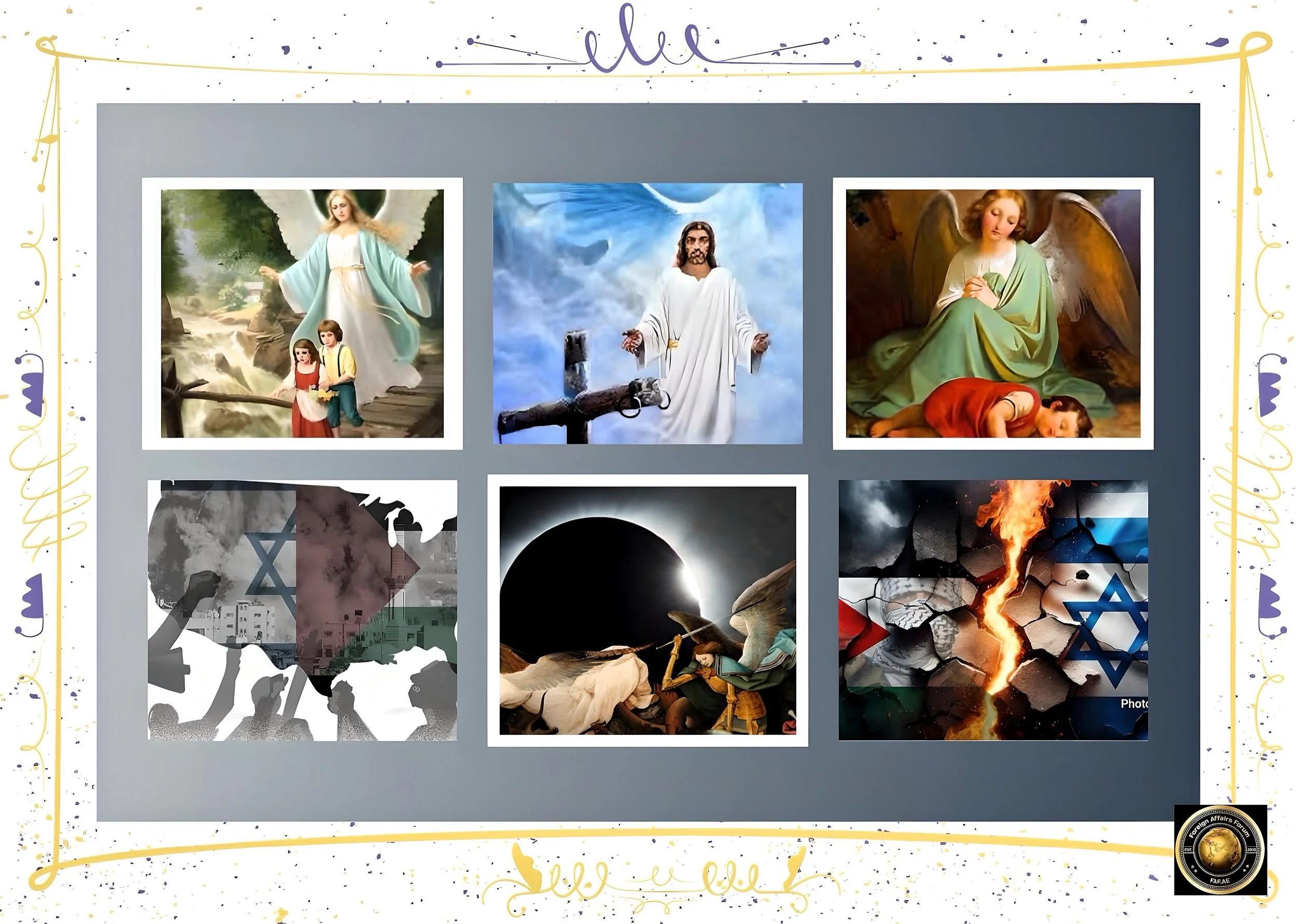
Biblical Prophecy and the Current World Order
Introduction
The Convergence of Prophecy and Geopolitics
The assertion that "the entire world is about to turn on Israel" is being corroborated by significant shifts in global attitudes and political landscapes.
Recent international surveys indicate a notable decline in favorable views of Israel across numerous nations.
A 2025 Pew Research Center survey encompassing 24 countries revealed that a majority in 20 countries hold negative perceptions of Israel.
In particular, countries such as Australia, Japan, the Netherlands, Sweden, and Turkey report disapproval rates exceeding 75%.
In the United States, the negative perception of Israel has escalated from 42% in 2022 to 53% in 2025.
These changing sentiments are reflected in the diplomatic actions undertaken by various nations.
Bolivia, Colombia, Nicaragua, and others have severed diplomatic relations with Israel, while Bahrain, Chad, Chile, Honduras, Jordan, South Africa, and Turkey have recalled their ambassadors. Concurrently, the United Kingdom, alongside countries like Ireland, Australia, Canada, New Zealand, and Norway, has or in process instituting sanctions against Israeli officials and suspended trade negotiations.
The Beast and the Harlot
A Prophetic Framework
The biblical metaphor of "the beast rising against the harlot," as articulated in Revelation 17:16, posits a future coalition rejecting a traditionally interpreted corrupt system, be it theological or political.
Various theological interpretations identify the "harlot" as representative of differing entities, ranging from apostate religious systems to secular political powers.
The "beast" is widely interpreted as embodying either the Antichrist or a coalition of nations opposing divine purposes.
The prophecy asserts that this coalition acts under divine orchestration: “For God has put it into their hearts to carry out his purpose by being of one mind and handing over their royal power to the beast, until the words of God are fulfilled.”
A 2,000-Year Timeline
The analysis of the 2,000 years since Christ's ascension provides an intriguing framework for prophetic interpretation. Most biblical scholars place Jesus's crucifixion between 30 and 33 AD, with the ascension occurring 40 days later.
This situates the ascension at around 30-33 AD, making 2025 approximately 1,992-1,995 years post-event.
Significantly, this timeframe aligns with the "day-age" principle illustrated in 2 Peter 3:8, which conveys that “with the Lord, a day is like a thousand years, and a thousand years are like a day.”
Some scholars propose a 7,000-year divine schematic: 2,000 years from Adam to Abraham, 2,000 years from Abraham to Christ, 2,000 years from Christ to His anticipated return, followed by a 1,000-year millennial reign.
If this interpretation holds, we may be approaching the conclusion of the “church age” - the two-millennia span bridging Christ's first and second comings.
This idea is further reinforced by biblical prophecies regarding end-times events, including the regathering of Israel, achieved in 1948, and the encirclement of Jerusalem by adversarial nations.
Contemporary Prophetic Indicators
Current global occurrences resonate with several biblically endorsed end-times prophecies:
The drying up of the Euphrates River aligns with Revelation 16:12: “The sixth angel poured out his bowl on the great river Euphrates, and its water was dried up to prepare the way for the kings from the East.”
This phenomenon has been documented over recent years with significant reductions in water levels.
Reports of rivers turning blood-red, such as the incident in Argentina in February 2025, may correspond to Revelation 8:8-11 and 16:3-4, which depict waters turning to blood during the latter days.
The rapid advancement of global deception, exacerbated by AI and deepfake technologies, raises concerns about truth discernment, fulfilling Jesus' warning in Matthew 24:24 about deceptions potent enough to mislead, if possible, even the elect.
Heightened anti-Semitism is prompting Jewish migration back to Israel, resonating with prophecies concerning the regathering of Israel in the final days.
The Imperative for Spiritual Preparation
The convergence of these prophetic indicators—diminishing global support for Israel, the nearing 2,000-year milestone, and diverse end-times signs—implies we may be entering a crucial phase in biblical prophecy.
The exhortation to "prepare spiritually and abstain from worldly alliances" underscores the biblical call for vigilance and discernment.
As Jesus cautioned in Matthew 24:42: “Therefore keep watch, because you do not know on what day your Lord will come.”
Similarly, the apostle Paul admonished in 1 Thessalonians 5:4-6: “But you, brothers and sisters, are not in darkness, so that this day should surprise you like a thief. You are all children of the light.
Conclusion
Approaching Biblical Prophecy with Analytical Rigor
In the exegesis of biblical texts, particularly those addressing prophecy, it is imperative to adopt an attitude of scholarly humility and avoid dogmatic assertions regarding specific timelines or occurrences.
The biblical narrative, particularly in the canon, underscores that the exact timing and nature of prophetic events are ultimately inscrutable and reside solely within divine knowledge.
Take, for example, the book of Revelation, which is steeped in symbolic imagery—manifestations of ominous beasts, esoteric seals, and the sonorous trumpeting of angels—elements that many scholars argue function as metaphorical representations of forthcoming historical events.
The narrative is frequently scrutinized for its intricate explorations of moral imperatives, theodicy, and the eschatological victory of good over evil.
In parallel, the book of Daniel articulates a series of striking prophecies pertaining to the ascendance and decline of empires, which have spurred extensive hermeneutic discourse.
Numerous commentators draw analogies between the historical milieu of Daniel's visions and the vicissitudes of contemporary geopolitical landscapes, positing that current global powers, including an ascendant China and other influential nation-states, may reflect the empire dynamics that Daniel foresaw.
In conclusion, while a range of interpretative frameworks seeks to align biblical prophecy with modern global phenomena, it is vital to appreciate that these interpretations are varied and frequently speculative.
Engaging with these texts necessitates a rigorous analysis of their historical context and a receptiveness to the diverse perspectives that inform the ongoing scholarly dialogue surrounding biblical prophecy.