American Shame-Silencing the lioness :sanctioning of UN Special Rapporteur Francesca Albanese, examining its implications for international justice, diplomatic relations, and accountability frameworks
Introduction
The American shame - Voice of a lioness
This analysis delves into the recent sanctions imposed on UN Special Rapporteur Francesca Albanese, evaluating their ramifications for international justice, diplomatic relations, and accountability frameworks. The move invites a critical examination of the complex interplay between geopolitics and human rights advocacy, particularly concerning the integrity of institutions and the protection of independent voices within the realm of international legal discourse.
The sanctions enacted by the Trump administration against Albanese mark a significant intensification of tensions between the United States and established global human rights mechanisms.
This unprecedented measure aimed at a UN-appointed expert has sparked intense debate regarding fundamental principles of international law, the limits of diplomatic immunity, and the strategies through which sovereign states engage with dissent regarding their foreign policy positions.
Background and Profile of Francesca Albanese
Francesca Albanese, an eminent Italian legal scholar and human rights advocate, has established herself as a key figure in international dialogues regarding the Israeli-Palestinian conflict.
Born on March 30, 1977, she possesses an honors law degree from the University of Pisa and a Master of Laws in human rights from SOAS University of London.
Complementing her academic credentials, Albanese boasts a decade of practical expertise within the United Nations system, having held roles with the Office of the UN High Commissioner for Human Rights and the UN Relief and Works Agency for Palestine Refugees.
In May 2022, she made history by becoming the first woman to serve as the UN Special Rapporteur on the occupied Palestinian territories.
She assumed a pivotal role in investigating and reporting on human rights violations in territories occupied since 1967, a mandate that has positioned her at the nexus of one of the globe’s most volatile geopolitical crises.
In addition to her UN responsibilities, Albanese is an Affiliate Scholar at Georgetown University’s Institute for the Study of International Migration and is a senior advisor on Migration and Forced Displacement with the Arab Renaissance for Democracy and Development.
Her scholarly works are substantial, including the co-authorship of "Palestinian Refugees in International Law" (2020, Oxford University Press), which has become a key legal reference in refugee rights and international law discussions.
Albanese has continuously focused on the rights of vulnerable populations, particularly refugees and migrants, thereby solidifying her reputation as an authority in international human rights law.
The Gaza Conflict and Albanese’s Genocide Allegations
The recent crisis following the Hamas incursion on October 7, 2023, and Israel’s corresponding military offensive in Gaza has significantly raised Albanese’s profile and drawn the international community’s attention to her expertise.
In the immediate aftermath, Albanese called for an urgent ceasefire, highlighting the peril that Palestinians in Gaza faced, which she characterized as ethnic cleansing.
Her subsequent assessments, growing increasingly dire, culminated in her formal presentation to the UN Human Rights Council on March 26, 2024, where she asserted that Israel’s actions in Gaza constituted genocide.
These allegations are grounded in what she identifies as “reasonable grounds” to conclude that Israel is deliberately carrying out, according to the Genocide Convention, at least three acts of genocide against Palestinians in Gaza: “killing members of the group,” “causing serious bodily or mental harm,” and “deliberately inflicting conditions of life calculated to bring about the group’s physical destruction in whole or in part.”
Albanese’s analysis extends beyond immediate military engagements to encompass broader settler colonial practices aimed at achieving the “destruction and replacement of Indigenous peoples.”
She has meticulously documented extensive casualties and property destruction, reporting approximately 57,000 Palestinian deaths and 96,000 injuries, including at least 13,000 children among the deceased. Moreover, she emphasizes systematic assaults on civilian infrastructure, such as hospitals and schools, framing these as elements of a methodologically planned campaign of destruction.
Her findings suggest these violent patterns also permeate the West Bank, where increased instances of ethnic cleansing and apartheid are evidenced, particularly in East Jerusalem.
Corporate Complicity and Economic Dimensions
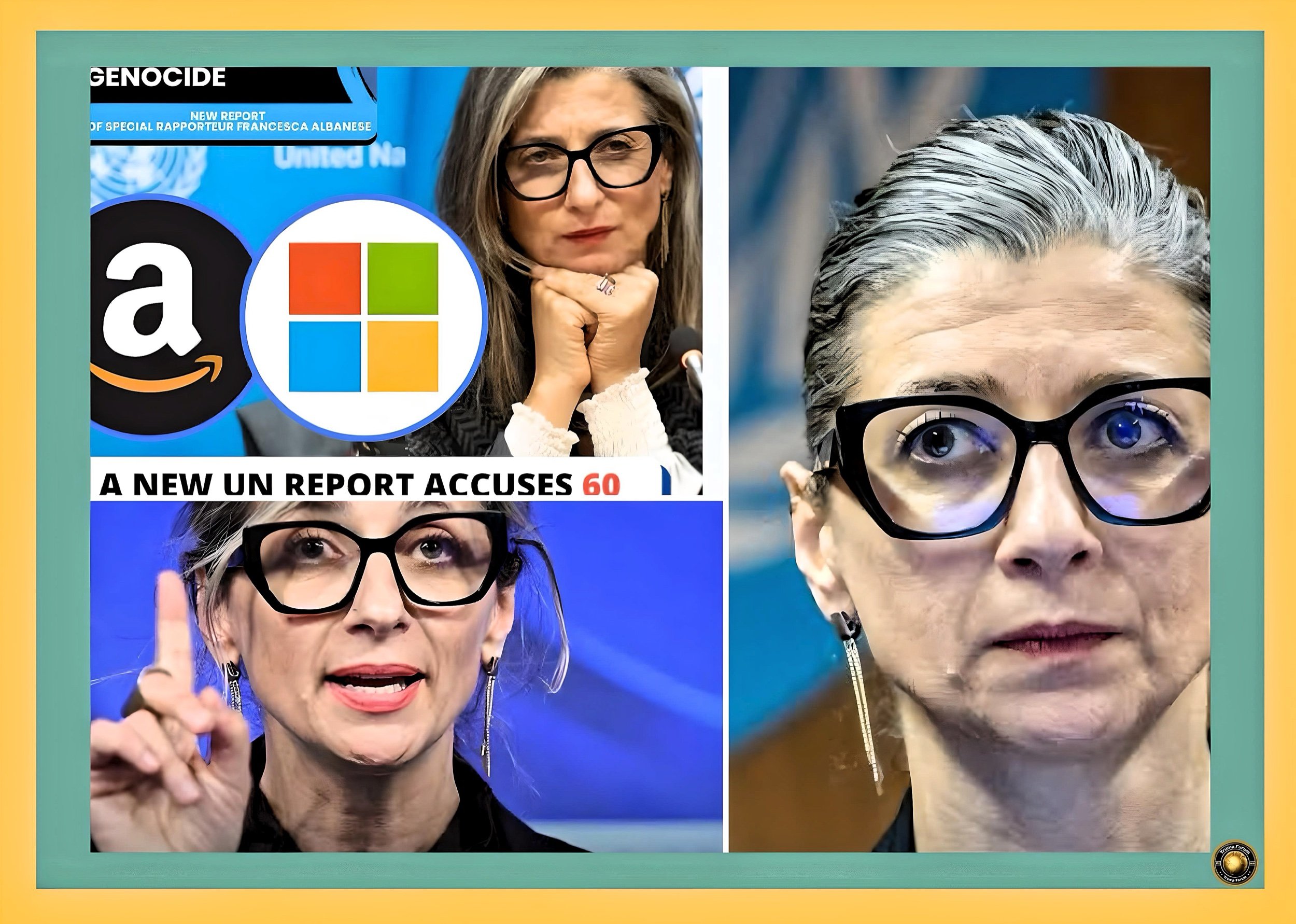
A noteworthy focal point of Albanese’s recent scholarship is her examination of what she terms the “economy of genocide” — the corporate framework that facilitates and profits from Israel's military actions in Gaza.
In her June 2025 report, “From Economy of Occupation to Economy of Genocide,” Albanese identified 48 corporate entities spanning multiple sectors, including defense contractors, technology firms, financial institutions, and construction and energy companies.
Her report explicitly cites major American corporations such as Microsoft, Alphabet Inc. (Google’s parent), and Amazon, alleging their complicity in the displacement of Palestinians in violation of international law.
Albanese's analysis reveals that “For some, genocide is profitable,” evidenced by a 213% surge in the Tel Aviv stock exchange in USD over 21 months, culminating in $225.7 billion in market gains.
She contends that these corporations have egregiously neglected their fundamental legal responsibilities, asserting that they are “deeply entwined in the system of occupation, apartheid, and genocide in the occupied Palestinian territory.”
This economic lens of her analysis seeks to trace the financial networks that purportedly underpin what she classifies as genocidal practices.
The report’s methodology involved a thorough review of over 200 submissions from states, human rights advocates, corporations, and scholars, resulting in a comprehensive database covering over 1,000 corporate entities.
Albanese's scope extends beyond military suppliers, encompassing technology providers involved in surveillance, financial institutions facilitating transactions, and construction firms engaged in settlement development.
Her findings suggest that Palestine has emerged as “the epicenter of a global reckoning,” highlighting deficiencies in international business and legal frameworks to uphold even the most basic rights of one of the world’s most marginalized populations.
US Sanctions and Official Justifications
The sanctions imposed by the Trump administration on Albanese mark a significant escalation in the U.S. response to global criticism concerning its support for Israel.
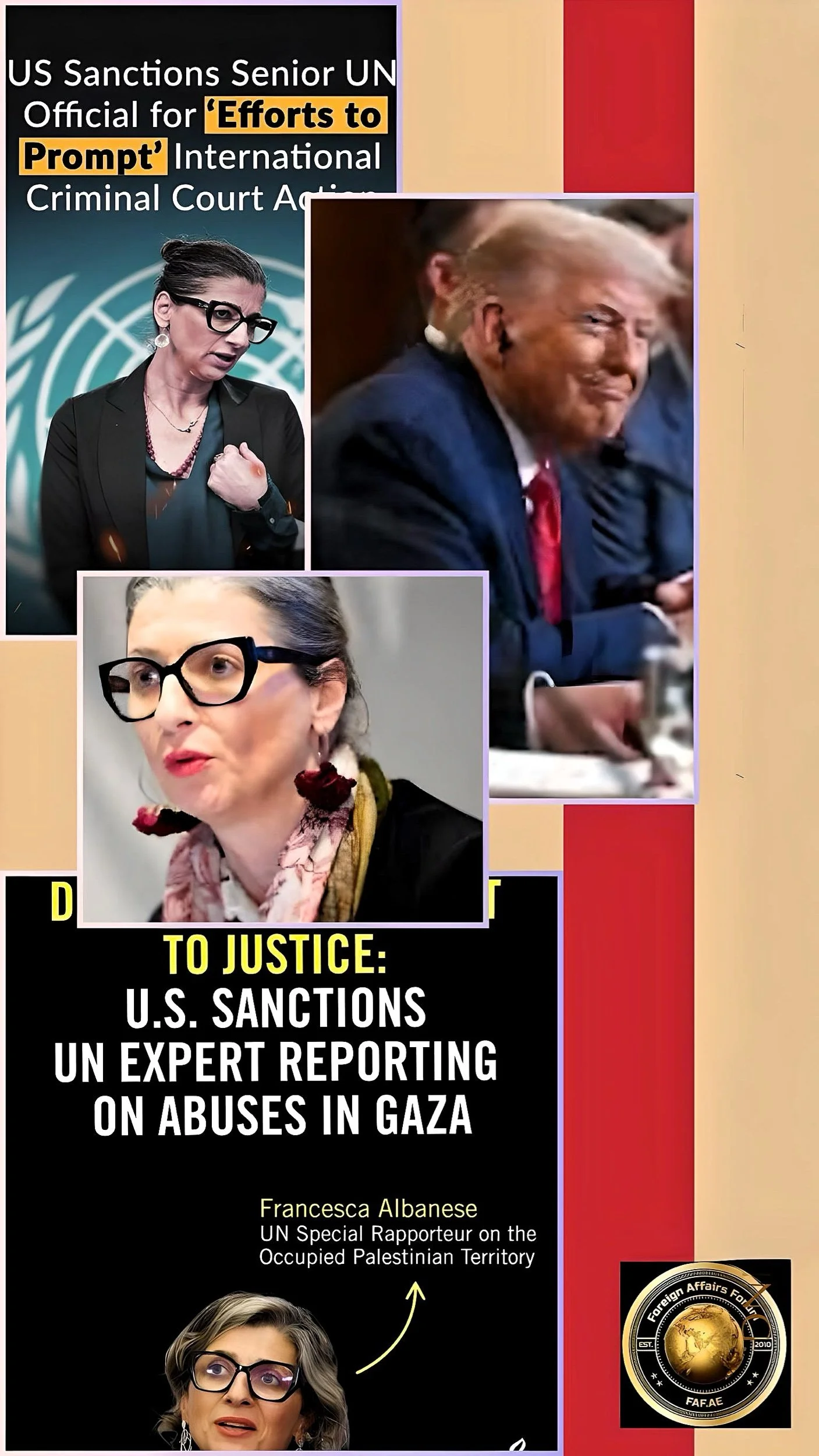
Secretary of State Marco Rubio announced these sanctions on July 9, 2025, attributing them to Albanese’s “illegitimate and shameful efforts” to instigate proceedings at the International Criminal Court (ICC) against U.S. and Israeli officials, corporations, and executives.
Implemented under Executive Order 14203, these sanctions designate Albanese as a “specially designated national,” thereby restricting all U.S. persons and entities from engaging in business dealings with her.
Rubio characterized Albanese’s activities as a “campaign of political and economic warfare against the United States and Israel,” asserting that such actions “will no longer be tolerated.”
The administration justifies the sanctions by highlighting Albanese’s promotion of ICC investigations and her recent report assessing American corporations' roles.
U.S. officials further contend that the sanctions respond to what they describe as “threatening letters” sent by Albanese to various U.S. corporations, wherein she purportedly made “unfounded allegations” and urged the ICC to initiate legal proceedings against these firms and their executives.
The timing of the announcement is particularly noteworthy. It coincides with Israeli Prime Minister Benjamin Netanyahu’s diplomatic visit to Washington, during which he received significant honors.
This alignment suggests a tactical maneuver to reinforce U.S. support for Israel while simultaneously sending a signal to international bodies and figures critiquing Israeli policies.
These sanctions represent the latest actions by the Trump administration aimed at undermining the ICC and affiliated institutions. They follow earlier sanctions against four ICC judges in response to the court’s issuance of arrest warrants for Netanyahu and former Defense Minister Yoav Gallant.
International Response and Institutional Support
The international reaction to these U.S. sanctions has been markedly critical, with prominent human rights organizations and UN entities denouncing the measures as an affront to international justice frameworks.
Agnès Callamard, Secretary General of Amnesty International, has labeled the sanctions a “shameless and transparent attack on the fundamental principles of international justice,” asserting that “Special Rapporteurs are not appointed to please governments or to be popular but to fulfill their mandate.”
The organization underscores that Albanese’s role is to advocate for human rights and uphold international law, particularly at a juncture when the very survival of Palestinians in the besieged Gaza Strip is in jeopardy.
In solidarity, the UN system has mobilized to support Albanese, with various institutional voices condemning the sanctions.
The Coordination Committee of the Special Procedures of the Human Rights Council issued a robust statement denouncing the sanctions as “not only a direct affront to one independent human rights advocate.”
The Coordination Committee of the Special Procedures of the UN Human Rights Council issued a robust statement condemning the sanctions imposed on UN-appointed expert Francesca Albanese.
The Committee characterized these sanctions not merely as a punitive measure against a specific independent human rights expert, but rather as an ongoing assault by the current US administration on the broader UN framework and its foundational principles of human rights, justice, accountability, and the rule of law.
In its statement, the Committee highlighted that Albanese was merely executing her UN Human Rights Council mandate and commended her for her bravery in “speaking truth to power.”
UN Secretary-General spokesperson Stéphane Dujarric labeled the sanctions as “a dangerous precedent,” emphasizing that the unilateral imposition of sanctions on a Special Rapporteur or any UN official is “unacceptable.”
This institutional backing underscores significant concerns regarding the implications of sanctioning UN experts and their potential chilling effect on international human rights advocacy.
Jurg Lauber, President of the UN Human Rights Council, expressed dismay over the sanctions, urging all UN member states to fully cooperate with the Council’s Special Rapporteurs and mandate holders, while calling for an end to acts of intimidation or reprisal against these individuals.
Scholarly and Academic Perspectives
The academic community has substantially defended Albanese, garnering notable institutional support from experts in antisemitism, Holocaust studies, and international law.
In December 2022, a coalition of sixty-five scholars issued a statement asserting that the campaign targeting Albanese is not centered on combating contemporary antisemitism; instead, it primarily seeks to silence her and undermine her role as a senior UN official documenting Israel's human rights violations.
This defense from the scholarly community extends beyond personal support for Albanese and includes rigorous academic scrutiny of the situation in Gaza.
A May-June 2024 survey by the Brookings Institution involving 758 Middle East scholars indicated that 75% viewed Israel's actions in Gaza as either “genocide” (34%) or “major war crimes akin to genocide” (41%). This academic consensus contextualizes Albanese's work within broader discussions encompassing international law and genocide studies.
Moreover, institutions have contributed to genocide discourse through detailed reports and analyses.
The University Network for Human Rights, with participation from researchers at Boston University School of Law’s International Human Rights Clinic, Cornell Law School, the University of Pretoria, and Yale Law School, concluded that "Israel has committed genocidal acts" by engaging in killing, inflicting harm, and creating conditions meant to destroy the Palestinian population in Gaza physically.
Such scholarly efforts illustrate Albanese's work within a significant academic dialogue about international law violations in Gaza.
Broader Implications for International Law and Diplomacy
The sanctions against Albanese are pivotal in international law and diplomacy, particularly concerning the interplay between sovereign states and global mechanisms.
The unprecedented action of sanctioning a UN-appointed expert raises critical issues surrounding the autonomy of international human rights institutions and the ability of UN officials to execute their mandates without fear of retaliation.
This incident occurs amid a backdrop of decreasing multilateralism and growing challenges to the post-World War II international order.
The consequences extend beyond Albanese's specific case to broader inquiries about accountability frameworks in international law.
Liz Evenson, international justice director at Human Rights Watch, articulated that the sanctions fundamentally aim to silence a UN expert engaged in her duties, accurately depicting Israeli violations against Palestinians and advising against complicity by governments and corporations.
This interpretation frames the sanctions as part of a larger strategy to erode accountability mechanisms for international crimes.
Moreover, the timing and context of these sanctions reflect broader geopolitical tensions and the evolving landscape of international relations.
The Trump administration’s withdrawal from various international organizations and agreements, coupled with a staunch pro-Israel stance, situates criticisms of Israeli policies as direct challenges to US interests.
This dynamic prompts critical reflection on the future of international human rights law and the capacity of global institutions to uphold their independence and integrity.
Conclusion
The imposition of sanctions on Francesca Albanese marks a pivotal moment in international relations, underscoring the friction between state sovereignty and mechanisms designed for international accountability.
The unusual step of sanctioning a UN-appointed expert raises profound concerns regarding the integrity of the international legal framework and challenges the autonomy of international human rights bodies.
This action sets a concerning precedent regarding the environment in which UN officials operate, particularly regarding the expectation that they can carry out their mandates without coercive repercussions from dominant state actors.
The immediate ramifications of these sanctions remain uncertain; however, their symbolic implications are pronounced: they directly confront the foundational principle that UN personnel should execute their roles without the threat of punitive measures from powerful nations.
The international community's reaction—marked by robust institutional backing from the UN and widespread denunciation from human rights advocates—suggests that the sanctions may have inadvertently bolstered Albanese's position, enhancing her credibility and amplifying the issues she has addressed.
The academic support she has garnered strengthens the validation of her work among critical discourse and expert circles.
As the humanitarian situation in Gaza continues to evolve, the ongoing dialogue surrounding Albanese’s contributions and the U.S. response will likely play a crucial role in shaping discussions on international law, accountability, and the future trajectory of multilateral institutions.