FAF Assessment of the UN World Drug Report 2025: Examining the Interplay of Global Instability and its Amplifying Effects on Social, Economic, and Security Expenditures
Introduction
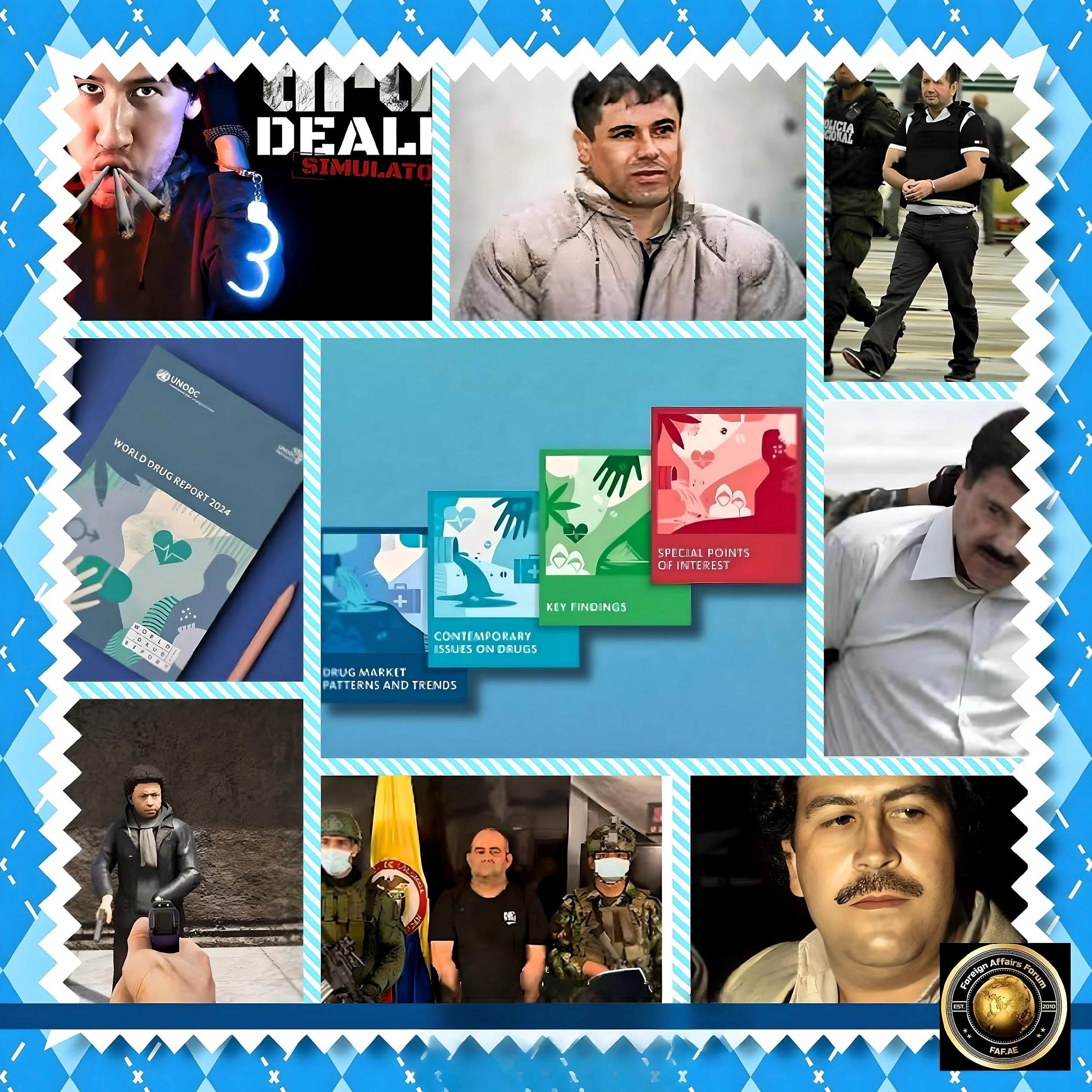
The United Nations Office on Drugs and Crime (UNODC) World Drug Report 2025 presents a sobering assessment of the global drug landscape, revealing how contemporary geopolitical instability is intensifying the world drug problem and creating unprecedented challenges for international drug control efforts.
The report, launched on June 26, 2025, demonstrates that global instability has empowered organized crime groups, pushed drug use to historically high levels, and significantly compounded the social, economic, and security costs of the illicit drug trade.
Unprecedented Scale of Global Drug Use
The 2025 report documents a dramatic escalation in global drug consumption, with 316 million people aged 15-64 using drugs (excluding alcohol and tobacco) in 2023, representing 6% of the worldwide population of this age group.
This marks a substantial increase from 5.2% in 2013, outpacing global population growth and representing over 20% growth in absolute numbers since 2013.
Cannabis remains the most widely used drug globally, with 244 million users, followed by opioids (61 million), amphetamines (30.7 million), cocaine (25 million), and ecstasy (21 million).
The report warns that new groups of vulnerable people fleeing hardship, instability, and conflict could increase these numbers further.
Cocaine Market Breaking All Records
The cocaine market has emerged as the world’s fastest-growing illicit drug market, with production, seizures, and consumption all reaching unprecedented levels in 2023.
Illegal cocaine production skyrocketed to 3,708 tons, representing nearly a 34% increase from 2022 and more than quadrupling production levels from a decade ago.
This surge is primarily attributed to expanded coca bush cultivation in Colombia and updated yield data.
Global cocaine seizures reached a record high of 2,275 tons, marking a 68% rise over the 2019-2023 period.
Meanwhile, cocaine use has grown from 17 million users in 2013 to 25 million users in 2023. The report notes that “cocaine has become fashionable for the more affluent society,” creating a “vicious cycle” of increased use and production.
Particularly concerning is the geographic expansion of cocaine trafficking networks, with traffickers breaking into new markets across Asia and Africa.
The violence and competition that once characterized the illicit cocaine trade in Latin America are now spreading to Western Europe as organized crime groups from the Western Balkans increase their market influence.
Synthetic Drug Market Expansion
The synthetic drug market continues its global expansion, dominated by Amphetamine-type stimulants (ATS) like methamphetamine and amphetamine, including captagon.
Seizures of ATS reached a record high in 2023 and accounted for almost half of all global seizures of synthetic drugs, followed by synthetic opioids, including fentanyl.
The report highlights the emergence of nitazenes, a new group of synthetic opioids that can be even more potent than fentanyl.
These substances have appeared in several high-income countries, resulting in increased overdose deaths. Thirteen different nitazenes were reported to UNODC in 2023, compared to just one in 2019.
The fall of the Assad regime in Syria has created uncertainty around the opium trade, which had become Syria’s largest export under the previous government.
However, the latest seizure data from 2024 and 2025 confirm that captagon continues to flow primarily to countries of the Arabian Peninsula, possibly indicating the release of previously accumulated stockpiles or continued production in different locations.
Devastating Health and Social Costs
The human cost of the global drug problem remains staggering. An estimated 64 million people suffered from drug use disorders in 2023, representing a 13% increase over 2013.
The report documents nearly half a million deaths and 28 million healthy years of life lost due to disability and premature deaths in 2021.
Perhaps most alarming is the treatment gap: just one in 12 people with drug use disorders received any form of drug treatment in 2023.
This represents a massive failure in global health systems to address what the report characterizes as a preventable and treatable health condition.
Organized Crime Networks and Global Instability
The report emphasizes how organized drug trafficking groups continue to adapt, exploit global crises, and target vulnerable populations.
These criminal networks generate hundreds of billions of dollars per year and constantly innovate through boosting production, finding new ways to conceal drugs chemically, and using technology to enhance communications and distribution.
Criminal groups capitalize on chaos, with geopolitical instability providing opportunities for syndicates to operate where institutions have failed.
From Ukraine to Myanmar, Latin America to West Africa, conflict zones have become production sites and trafficking routes that fuel further instability.
The report notes that while these criminal networks are resilient, they can be disrupted through a deeper understanding of their aims and structures.
Mapping criminal groups can highlight vulnerabilities, key actors, enablers, and pinpoint possible intervention areas.
Environmental Consequences
The 2025 report includes significant attention to the environmental impacts of drug production and trafficking.
The report finds that drug cultivation, trafficking, and policy responses are all impacting the environment, particularly in Europe.
Cocaine cultivation is destroying rainforests in the Andes, while every pound of methamphetamine generates five pounds of toxic waste, often unregulated and harmful to ecosystems.
The number of dismantled clandestine drug laboratories increased in Europe between 2013 and 2023, producing significant amounts of waste and resulting in considerable cleanup and ecosystem restoration costs.
However, the report criticizes that environmental harm is not a priority when designing and implementing drug policy responses, with much waste and ecological impact remaining unaccounted for.
Vulnerable Populations and Displacement
The report highlights how vulnerable populations fleeing hardship, instability, and conflict are particularly at risk for substance use.
Forcibly displaced populations experience elevated vulnerability to substance use disorders due to greater exposure to risk factors such as family disruption, elevated stress levels, and absence of protective factors.
Research shows that displaced populations’ substance use patterns are heterogeneous, with individuals potentially developing resilience to drug use, carrying over patterns from their origin, adapting to new locations, or intensifying existing use.
Adolescents displaced without their families are particularly susceptible to higher drug use.
Policy Responses and Technology Solutions
The report calls for comprehensive, coordinated approaches that leverage technology, strengthen cross-border cooperation, provide alternative livelihoods, and target key actors driving criminal networks.
UNODC emphasizes investing in prevention and addressing root causes of the drug trade at every point of the illicit supply chain.
Alternative development programs remain crucial. UNODC supports small farmers in reducing dependency on opium and coca cultivation by developing alternative livelihoods for legitimate income generation.
These efforts focus on health, education, basic infrastructure, community development, and food security, with special attention to environmental protection.
Technology advances are transforming drug policy enforcement, with modern surveillance systems, data analysis, forensic science, and digital platforms providing new tools for combating illegal drug trade.
However, the report notes that criminal groups innovate constantly, using technology to conceal communications and increase distribution.
Funding Constraints and Multilateral Challenges
A critical concern raised in the report is the rising turn away from multilateralism and reallocation of resources, which could intensify drug problems.
UNODC Executive Director Ghada Waly warned that “we cannot deliver ‘more with less’ when the illicit drug market has more and more at its disposal every day”.
The report emphasizes that factors such as policies and the availability of evidence-based health and social services can help mitigate the health impact of drug use on people and communities.
However, achieving this requires sustained international cooperation and adequate funding for comprehensive responses.
Conclusion
The UNODC World Drug Report 2025 highlights a pressing reality: the convergence of global instability and advanced drug-related issues necessitates immediate and coordinated international intervention.
Analysis within the report indicates that conventional strategies are inadequate for addressing the vast complexity and scale of today’s illicit drug markets.
The intricate relationships between global instability, organized crime, and drug trafficking demand robust, multifaceted strategies that not only tackle these issues at their core but also enhance law enforcement capabilities.
As UNODC Executive Director Ghada Waly emphasized, “Through a comprehensive, coordinated approach, we can dismantle criminal organizations, bolster global security, and protect our communities.”
Key Recommendations
A comprehensive strategy to mitigate the pervasive impacts of the global drug trade involves an integrated approach balancing enforcement, international collaboration, and systemic reforms
Enforcement and Supply Chain Disruption
Targeting Financial Networks
Employ financial tools like the Foreign Narcotics Kingpin Designation Act to freeze assets and effectively pursue money laundering networks associated with drug trafficking organizations (DTOs).
Disruption of Drug-Terror Linkages
Enhance intelligence-sharing protocols and carry out coordinated operations to dismantle drug-arm-terror nexuses, particularly in regions like West Africa, where these connections significantly undermine governance.
Strengthening Border Security
Implement rigorous measures to interdict illicit drugs, arms, and cash flow through established bilateral agreements and deployment of forward assets.
Combatting Synthetic Drugs
Regulate precursors and manufacturing equipment for synthetic drugs by fostering industry collaborations through platforms like the INCB public-private partnership.
International Cooperation
Demand Reduction
Implement evidence-based prevention and treatment programs tailored to vulnerable demographics, especially children, to reduce global drug demand.
Judicial Capacity Enhancement
Invest in capacity-building initiatives to fortify judicial systems within partner nations, enabling effective prosecution of traffickers and asset seizures and tackling corruption.
Establishing Regional Response Networks
Create networks for rapid information exchange concerning emerging trafficking routes and the evolving threat of synthetic drugs.
Systemic and Economic Reforms
Alternative Livelihood Programs
Develop sustainable agricultural initiatives in drug-producing areas to diminish the economic reliance on illicit cultivation and ensure these programs align with enforcement strategies.
Addressing Economic Drivers
Focus on alleviating poverty and curtailing corruption that enable DTOs to exploit local communities, recognizing that profits from the drug trade exacerbate instability while leaving producers in dire economic straits.
Public Health-Centric Policies
Promote harm reduction strategies, overdose prevention, and alternatives to incarceration as mechanisms to mitigate the social impacts of drug crimes.
Moving Forward
Intelligence-led enforcement strategies aimed at high-value targets must be prioritized, along with investments in economic development and public health initiatives.
The Global Coalition advocates for the adoption of “human rights-centered” policies to counteract the corruption and violence that stymie economic growth, estimated to deter investments up to $1.6 billion annually in regions severely affected by the drug trade, such as Mexico.
Ultimately, sustained success in addressing the global drug challenge requires a balanced approach that reconciles supply reduction with demand management while systematically addressing the root causes of instability.
The recommendations and analysis presented signal both a cautionary warning and an urgent call to action, reinforcing the necessity for unprecedented international cooperation, innovative strategies, and a steadfast commitment to evidence-based solutions prioritizing human health, security, and environmental sustainability.