Defense.Forum : The future landscape of uranium mining, processing, and enrichment: The usage for benefit and destruction - A Global concern
Introduction
Finding and Estimating Uranium Reserves
Uranium Exploration Methods
The discovery of uranium deposits relies on sophisticated exploration techniques, with radiometric surveys being the most effective approach.
The combination of aerial radiometric surveys, ground examination of detected anomalies, and gamma logging of drilled holes has resulted in the discovery of many known uranium resources.
Uranium exploration follows a systematic sequence starting with regional reconnaissance and progressing to detailed investigation.
The process typically begins with airborne radiometric surveys that measure gamma rays emitted by natural radioactive elements, followed by ground-based scintillometer surveys to identify specific anomalies.
Geological mapping, geochemical surveys, and electromagnetic surveys complement these radiometric methods.
Estimating Global Uranium Resources
Uranium is relatively abundant in the Earth’s crust, with an average concentration of 2.8 parts per million.
It is more abundant than gold, silver, or mercury, and about as common as tin.
The world’s identified uranium resources are substantial, and estimates of their reserves vary based on extraction costs and exploration efforts.
As of 2023, global uranium resources are recoverable at costs of up to $130 per kilogram, totaling approximately 5.9 million tonnes.
Australia holds the most significant reserves, at 1.67 million tonnes (28% of the world total), followed by Kazakhstan with 814,000 tonnes (14%) and Canada with 582,000 tonnes (10%).
When considering higher extraction costs up to $260 per kilogram, total recoverable resources increase to nearly 8 million tonnes.
The amount of ultimately recoverable uranium depends significantly on market prices, as large, low-grade deposits become economically viable at higher prices.
As of 2015, 646,900 reserves were recoverable at $40 per kilogram, while 7.6 million tonnes became recoverable at $260 per kilogram.
Uranium Mining and Extraction Methods
Mining Techniques
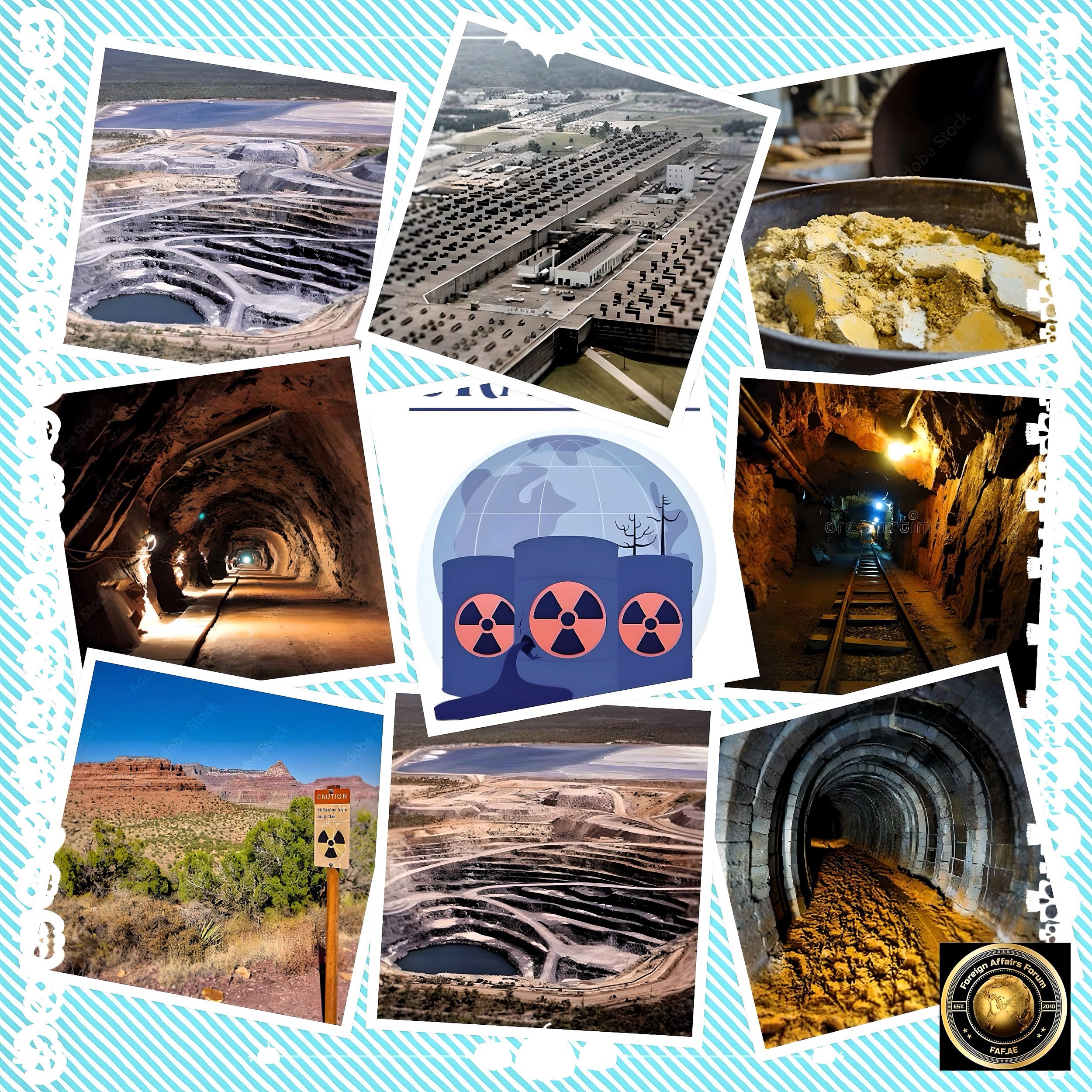
Uranium extraction employs three primary methods based on deposit characteristics.
In-situ leaching (ISL) accounts for 49.7% of global uranium production, followed by underground mining (30.8%) and open pit mining (12.9%).
Open Pit Mining is used when uranium deposits lie close to the surface.
The process involves removing overburden through drilling and blasting, then extracting ore using loaders and dump trucks.
Workers operate from enclosed cabins to limit radiation exposure, and water is extensively used to suppress airborne dust.
Underground Mining accesses deeper deposits through shafts and tunnels.
The process involves sinking shafts near ore veins, driving horizontal crosscuts at various levels, and creating drifts along ore veins.
Three primary stop mining methods are employed: cut and fill, shrinkage, and room and pillar.
In situ leaching is the most modern approach, extracting uranium without significant ground disturbance.
Water injected with oxygen or other oxidizing solutions circulates through uranium ore, dissolving the uranium, and is then pumped to the surface.
Converting Raw Uranium to Refined Nuclear Fuel
Initial Processing to Yellowcake
The uranium processing cycle begins with converting mined ore into uranium concentrate, commonly called “yellowcake”.
The raw ore is first crushed and ground into fine particles, then mixed with water to create a slurry.
This slurry undergoes leaching with sulfuric acid or alkaline solutions to dissolve uranium while leaving other minerals undissolved.
The resulting uranium solution is separated, filtered, and dried to produce yellowcake, which typically contains 70-90% triuranium octoxide (U₃O₈).
Despite its name, modern yellowcake often appears brown or black rather than yellow, depending on drying temperature and impurities.
Conversion to Uranium Hexafluoride
Yellowcake must be converted to uranium hexafluoride (UF₆) for enrichment processes
Yellowcake is processed and reacted with fluorine at conversion facilities to create UF₆ gas.
The UF₆ exits as gas, is cooled to a liquid form, and is drained into 14-ton storage cylinders. Over five days, it transitions from liquid to solid for transport to enrichment facilities.
Uranium Enrichment Process
Natural uranium contains only 0.7% uranium-235, the fissile isotope needed for nuclear reactions.
The enrichment process increases this concentration through isotopic separation techniques.
Gaseous Diffusion forces UF₆ gas through semi-permeable membranes, with lighter U-235 passing through more easily than heavier U-238.
This process requires over 1,000 passes to produce commercial nuclear fuel enriched to 3-5% U-235.
Gas Centrifuge methods use rapidly rotating cylinders to separate isotopes by centrifugal force.
Heavier U-238 moves outward while lighter U-235 concentrates toward the center.
Centrifuge methods are more energy-efficient and produce over 50% of today’s enriched uranium.
Final Fuel Fabrication
After enrichment, UF₆ is converted to uranium dioxide (UO₂) powder.
This powder is pressed into pellets under several tons of pressure, then heated in ovens to remove pores and increase density.
Each uranium pellet, roughly the size of a peanut, contains energy equivalent to 800 kilograms of coal. These pellets are loaded into zirconium fuel rods for use in nuclear reactors.
Uranium Enrichment Levels for Nuclear Weapons
Classification of Enrichment Levels
Uranium enrichment levels are classified into distinct categories based on U-235 concentration
Low-Enriched Uranium (LEU)
Below 20% U-235, used in most commercial nuclear reactors at 3-5% enrichment
Highly Enriched Uranium (HEU)
Above 20% U-235, considered weapons-usable
Weapons-Grade Uranium
Typically, an 85% or higher U-235 concentration
Optimal Enrichment for Nuclear Weapons
While nuclear weapons can theoretically be constructed with as little as 20% U-235 (highly enriched uranium), such weapons would be impractical, requiring hundreds of kilograms of material.
Countries with nuclear weapons typically use approximately 90% enriched, weapons-grade uranium to minimize weapon size and weight.
The relationship between enrichment level and required material is critical: higher U-235 concentrations allow for smaller, lighter weapons.
Most uranium used in current nuclear weapons is approximately 93.5% enriched uranium-235. This high enrichment level enables the creation of compact, deliverable weapons suitable for ballistic missiles.
Enriching uranium from 60% to 90% U-235 is significantly easier than the initial enrichment from natural uranium to 60%, representing about 90% of the total enrichment effort.
This technical reality makes the 20% enrichment threshold particularly significant from a proliferation standpoint.
Uranium Grades Used by the US and European Nuclear Powers
United States Nuclear Arsenal
The United States maintains strict standards for weapons-grade uranium enrichment. The US's standard enrichment level for bomb-grade uranium is 93.5% U-235.
This high enrichment level ensures optimal weapon performance and minimal size requirements.
Historical data shows variation in US nuclear weapons: the Little Boy atomic bomb dropped on Hiroshima contained 64 kilograms of uranium with an average enrichment of 80% U-235.
Most of this material was enriched to 89%, but some portions were only 50% U-235, resulting in an 80% average.
The explosive yield would likely have been twice as high if the same quantity had been enriched to 90%.
The US produced military HEU primarily through gaseous diffusion processes and received additional supplies through international agreements.
Current US nuclear weapons typically contain 93% or more U-235 to ensure reliable performance and compact design.
European Nuclear Powers
United Kingdom
The UK produced military HEU at the Capenhurst Gaseous Diffusion Plant between 1952 and 1962.
The UK’s total military HEU stock was reported as 21.86 tonnes in 2002, though average enrichment levels were not disclosed.
The UK received approximately 13 tonnes of U-235 in HEU from the United States.
France
While specific enrichment levels for French nuclear weapons are not publicly disclosed in the available sources, France operates uranium enrichment facilities and maintains an independent nuclear deterrent.
French naval reactors use fuel below 20% enrichment, contrasting with US submarine reactors that use approximately 90% enriched fuel.
Future of Uranium
Nuclear Power, Medical Isotopes, Nuclear weapons, DU munitions, and armor plating
The future of uranium is shaped by its dual-use nature—serving both peaceful energy generation and military applications—and is influenced by global trends in energy demand, climate policy, geopolitical dynamics, and technological innovation.
Nuclear Power Generation
Growth and Expansion
Uranium is the primary fuel for nuclear reactors, which provide a significant share of the world’s low-carbon electricity.
The International Energy Agency (IEA) projects record nuclear energy generation in 2025, driven by new reactor startups and the restart of previous reactors in China, France, Japan, India, and possibly Iran.
They are expected to play a significant role in the future.
They offer flexibility for deployment in remote areas or industrial settings and potentially accelerate the adoption of nuclear energy for decarbonization.
Sustainability and Supply
There is enough uranium to meet global demand for decades, but substantial investment in new mining projects is required to avoid future supply disruptions.
Advanced reactor designs and closed fuel cycles could extend uranium resources for centuries.
Other Civilian Applications
Medical and Scientific Research
Uranium isotopes are used in neutron sources, radiation therapy, and dating geological formations.
Industrial Uses
Depleted uranium is used for counterweights in aircraft and yachts, as well as radiation shielding in medical and industrial settings.
Wartime and Military Uses of Uranium
Nuclear Weapons
Weapons-Grade Uranium
Highly enriched uranium (HEU, typically >90% U-235) is used in nuclear weapons. The first atomic bomb dropped on Hiroshima used enriched uranium.
Diversion Risks
International safeguards, such as those enforced by the IAEA and bilateral agreements between uranium-exporting countries (e.g., Australia, Canada) and importers, aim to prevent the diversion of uranium for military purposes.
Conversion of Military Stocks
Surplus weapons-grade uranium from disarmament treaties has been downblended and used as fuel for civilian reactors, reducing the risk of proliferation.
Conventional Military Uses
Depleted Uranium (DU)
DU, a byproduct of uranium enrichment, is used in armor-piercing munitions and tank armor because of its high density and pyrophoric properties.
Neutron Reflectors and Tamper
DU can also be used as a tamper or neutron reflector in fission bombs to increase the efficiency of the explosion.
Examples of Current and Future Trends
Peaceful Uses
China: Rapidly expanding nuclear capacity, with new reactors coming online and plans for significant future growth.
Europe and North America
Reactivation of retired plants, investment in SMRs, and renewed interest in nuclear as a clean energy source.
Saudi Arabia
Plans to enrich uranium and expand its nuclear program, including uranium enrichment for civil purposes.
Medical Isotopes
Uranium-derived isotopes are essential for diagnosing and treating cancer and other diseases.
Wartime/Military Uses
Nuclear Weapons Programs
Countries like North Korea and Iran (with ongoing debates and negotiations) continue to develop or maintain enrichment capabilities, raising proliferation concerns.
Conventional Weapons
Use of depleted uranium in munitions and armor by militaries, such as the U.S. and others, remains controversial due to health and environmental concerns.
Changing Nuclear Deterrence: Why It’s a Global Concern
Overview
Nuclear deterrence—the idea that the threat of nuclear retaliation prevents nuclear war—has been a cornerstone of global security since the Cold War.
However, the concept and its effectiveness are now under increasing scrutiny and challenge due to shifts in international politics, technological developments, and evolving military doctrines. These changes have made nuclear deterrence a pressing global concern.
Key Reasons for Global Concern
Sheer Destructive Power and Proliferation Risks
There are currently over 12,000 nuclear weapons worldwide, each far more powerful than those used in World War II.
The potential for catastrophic destruction remains, and the spread of nuclear know-how means more countries could potentially acquire these weapons if their security calculations change.
This thin margin of security is worrisome, as it relies on the intentions of states, which can shift rapidly.
Shifting Mindsets and Political Use
A significant change is the way leaders now view nuclear weapons—not just as a last-resort deterrent, but as tools for political leverage. Recent rhetoric and threats from leaders in Russia regarding Ukraine, or the U.S. in the context of Taiwan, illustrate a willingness to consider limited nuclear use for political gains. This undermines the old consensus that any use would inevitably escalate to global catastrophe.
Erosion of Traditional Deterrence
The effectiveness of nuclear deterrence is no longer taken for granted. Even major nuclear powers like Russia have struggled to achieve conventional military objectives despite their arsenals, highlighting the limits of deterrence in modern conflicts.
The rise of regional nuclear powers (e.g., India, Pakistan, North Korea) and the ambiguous status of others (e.g., Israel) have added complexity to the global order.
Multipolarity and New Security Dynamics
The Cold War was characterized by a bipolar nuclear standoff. Today’s world is multipolar, with several nuclear-armed states and shifting alliances.
This increases the risk of miscalculation and circumvention of deterrence, especially in regional conflicts where the stakes may not justify nuclear escalation, but the risk of accidental or unauthorized use persists.
Technological and Doctrinal Shifts
Advances in missile defense, cyber capabilities, and precision conventional weapons have changed the calculus of deterrence.
Some states may feel emboldened to challenge nuclear-armed adversaries, believing they can limit damage or retaliate in new ways.
This has led to adjustments in nuclear strategies, as seen in recent U.S. and NATO policy reviews.
Non-Proliferation and Disarmament Challenges
The Treaty on the Non-Proliferation of Nuclear Weapons (NPT) remains a central pillar, but its effectiveness is under strain.
Technical barriers to acquiring nuclear weapons have eroded, and the commitment of nuclear-armed states to disarmament is questioned by non-nuclear states.
Only irreversible and verifiable disarmament steps can address the underlying global threat.
Conclusion
Uranium Utilization, Nuclear Deterrence, and Trends
Energy Transition
Amid a global push for decarbonization, nuclear energy is increasingly recognized as a reliable and low-carbon power source. Several nations have set ambitious goals to triple their nuclear output by 2050, signaling a significant shift towards sustainable energy technologies.
Geopolitical Shifts
China's aggressive expansion in nuclear energy is poised to dramatically alter the global energy landscape, potentially recalibrating power dynamics within the nuclear sector and affecting international energy policy.
Technological Innovation
Advancements in reactor technology, such as innovations in fuel recycling and the development of small modular reactors (SMRs), are expected to improve the safety, efficiency, and adoption rates of nuclear energy.
These innovations are essential for integrating nuclear energy into the broader array of low-carbon solutions
Nonproliferation and Safety
The international community remains committed to implementing stringent safeguards, export controls, and disarmament initiatives to mitigate the proliferation risks associated with uranium's military applications.
While there is an escalating reliance on uranium for clean energy, it unfolds against a backdrop of rigorous safety protocols aimed at limiting military proliferation.
The interplay between the risks of proliferation and rising geopolitical tensions presents significant challenges to achieving both energy security and nonproliferation aims.
The technology required to produce weapons-grade uranium involves sophisticated enrichment processes, leveraging advanced centrifuge cascades and substantial industrial capabilities.
Achieving enrichment levels exceeding 90% U-235 enhances the compactness and efficiency of nuclear warheads, optimizing compatibility with modern delivery systems and maximizing explosive yield.
As we look forward, significant increases in nuclear energy generation are anticipated, accompanied by heightened investments in uranium extraction and associated technologies.
The key challenge will be navigating the fine line between energy security and nonproliferation objectives, especially if Western geopolitical aspirations can be moderated to minimize perceived threats from other states.
The evolving landscape of nuclear deterrence raises global concerns regarding the risk of nuclear engagement—whether through deliberate use, accidents, or miscalculations—which undermines the tenuous security frameworks that have, thus far, prevented nuclear conflict.
Addressing these urgent challenges will require an adaptation of deterrence strategies, fortifying nonproliferation efforts, and pursuing meaningful disarmament measures to mitigate the existential dangers posed by nuclear arsenals.