FAF.Live: Damascus Church Attack: What We Know About the Deadly Bombing
Introduction
On Sunday, June 22, 2025, a devastating suicide bombing at a Greek Orthodox church in Damascus, Syria, killed at least 22 people and wounded 63 others, marking one of the deadliest attacks in the Syrian capital in recent years.
The attack occurred at the Mar Elias Church in the Dweila neighborhood on the outskirts of Damascus during a packed Sunday service.
The Attack Details
Timeline and Method
The assault began when a masked gunman entered the church while approximately 350 people were attending mass.
Witnesses described how the attacker opened fire on worshippers before detonating an explosive vest when congregants attempted to stop him.
According to eyewitness accounts, the gunman fired at people for nearly two minutes before the crowd charged at him, prompting him to detonate his explosives at the church entrance.
Church Bishop Moussa Khoury reported that the attacker also threw a grenade into the church during the afternoon mass.
Some witnesses and church officials suggested there may have been a second gunman involved, though this remains under investigation.
Casualties and Damage
The official death toll stands at 22 people killed, including the perpetrator, with 63 others injured.
Some reports suggest the death toll could be as high as 30, with varying casualty figures from different sources.
Local media reported that children were among the casualties.
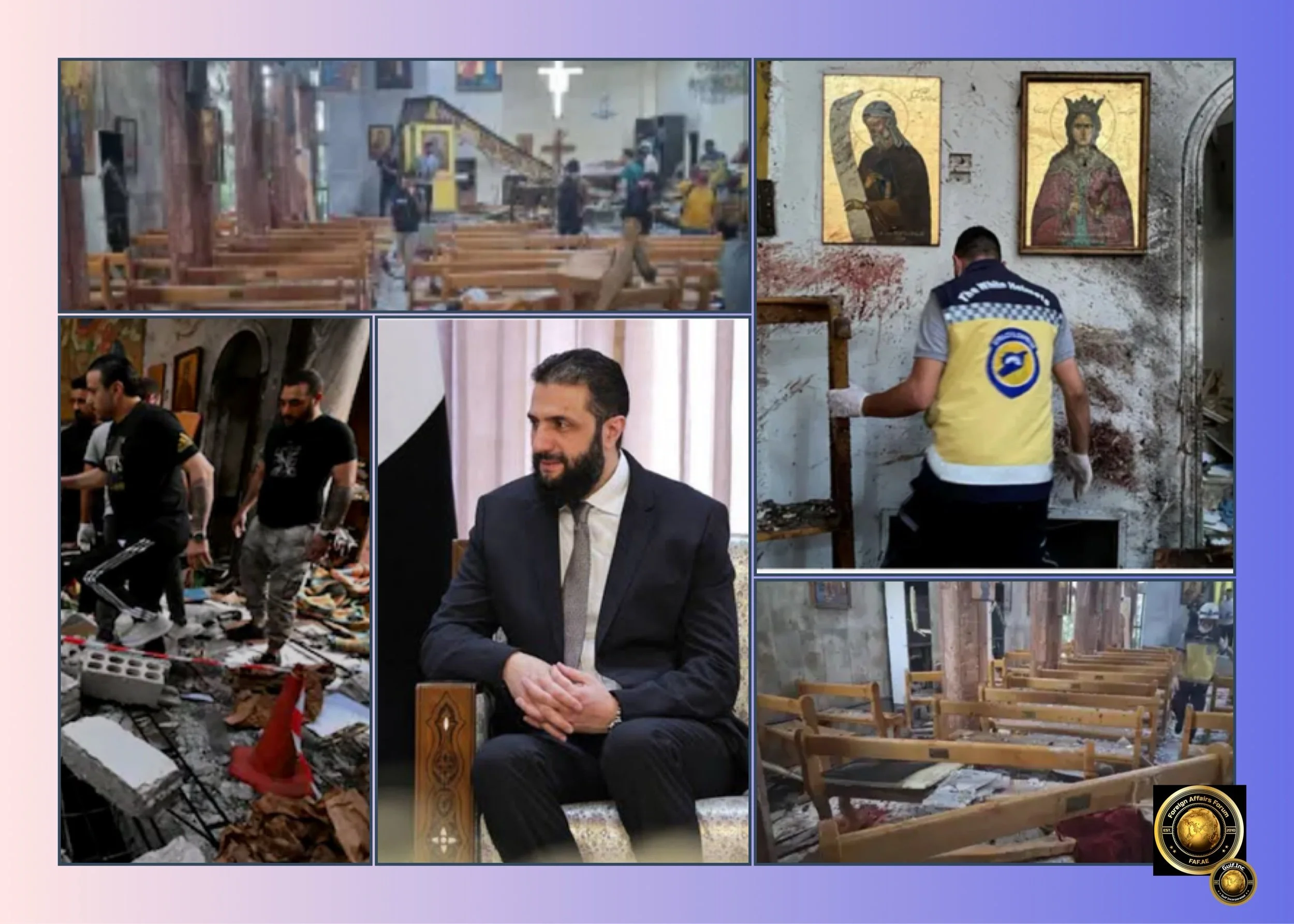
The explosion caused extensive damage to the church interior, with shattered pews, fallen icons, pools of blood on the floor, and debris scattered throughout the worship area.
First responders worked to transport victims to nearby hospitals while security forces cordoned off the area.
Attribution and Investigation
ISIS Connection
While no group immediately claimed responsibility for the attack, Syrian authorities have attributed it to the Islamic State (ISIS).
Syria’s Interior Ministry stated that “a suicide attacker affiliated with the Daesh (IS) terrorist group entered the Saint Elias church… opened fire, then blew himself up with an explosive belt”.
Interior Ministry spokesman Noureddine Al-Baba declared that “the security of places of worship is a red line,” and blamed both ISIS and remnants of the former Assad government for attempting to destabilize Syria.
Government Response
Syrian Information Minister Hamza Mostafa condemned the attack as a terrorist act, stating it “goes against the civic values that bring us together”.
Interior Minister Anas Khattab emphasized that “these terrorist acts will not deter the Syrian state’s efforts to achieve civil peace”.
The attack prompted investigations by Syrian authorities, with officials launching efforts to enhance security at religious sites across the country.
Context and Significance
First Major Attack Since Assad’s Fall
This bombing represents the first major terrorist attack in Damascus since the fall of Bashar al-Assad’s regime in December 2024.
It also marks the first attack inside a Syrian church since the country’s civil war began in 2011.
The timing is particularly significant as Syria’s new transitional government, led by President Ahmed al-Sharaa (formerly associated with Hay’at Tahrir al-Sham), has been working to gain support from religious minorities and establish security throughout the country.
Challenges for Syria’s New Government
The attack highlights ongoing security challenges facing Syria’s interim authorities.
Despite efforts by the new government to protect minorities and maintain stability, sleeper cells of extremist groups like ISIS continue to pose threats in the war-torn nation.
Syria’s transitional government has pledged to protect religious minorities, with al-Sharaa previously stating that Christians are “an essential part of the fabric of Syrian society”.
However, this attack demonstrates the vulnerability of minority communities amid the ongoing political transition.
International Condemnation
The attack drew widespread international condemnation. UN Special Envoy for Syria Geir Pedersen expressed “outrage” over the “heinous crime” and urged unity against terrorism.
The United States Special Envoy to Syria, Thomas Barrack, called the attack an act of “cowardice” that has no place in Syria’s future.
Multiple countries, including Turkey, Jordan, Iraq, Greece, Cyprus, and several European nations, issued statements denouncing the attack.
Broader Security Concerns
Pattern of Threats
This attack follows other attempted attacks on Christian sites in Syria, including a failed bombing attempt at a Melkite Greek Catholic Church in April 2025.
Syrian authorities have reported thwarting multiple attack plots in recent months, including some specifically targeting Christian establishments.
Minority Protection Challenges
The bombing underscores broader concerns about the protection of Syria’s religious minorities during the country’s transition period.
Recent assessments have highlighted significant protection barriers facing minority communities, including restricted freedom of movement, exposure to violence, and family separation.
The attack occurred amid ongoing sectarian tensions, with reports of violence against other minority groups, including Alawites and Druze communities, in various parts of Syria.
Moving Forward
As Syria continues its political transition under the new government, the Damascus church bombing serves as a stark reminder of the security challenges that remain.
The incident has reinforced calls for enhanced protection of religious sites and minority communities while highlighting the ongoing threat posed by extremist groups operating in the country.
The international community continues to monitor the situation closely, emphasizing the need for Syria’s new authorities to fulfill their commitments to protecting all citizens regardless of their religious or ethnic background.