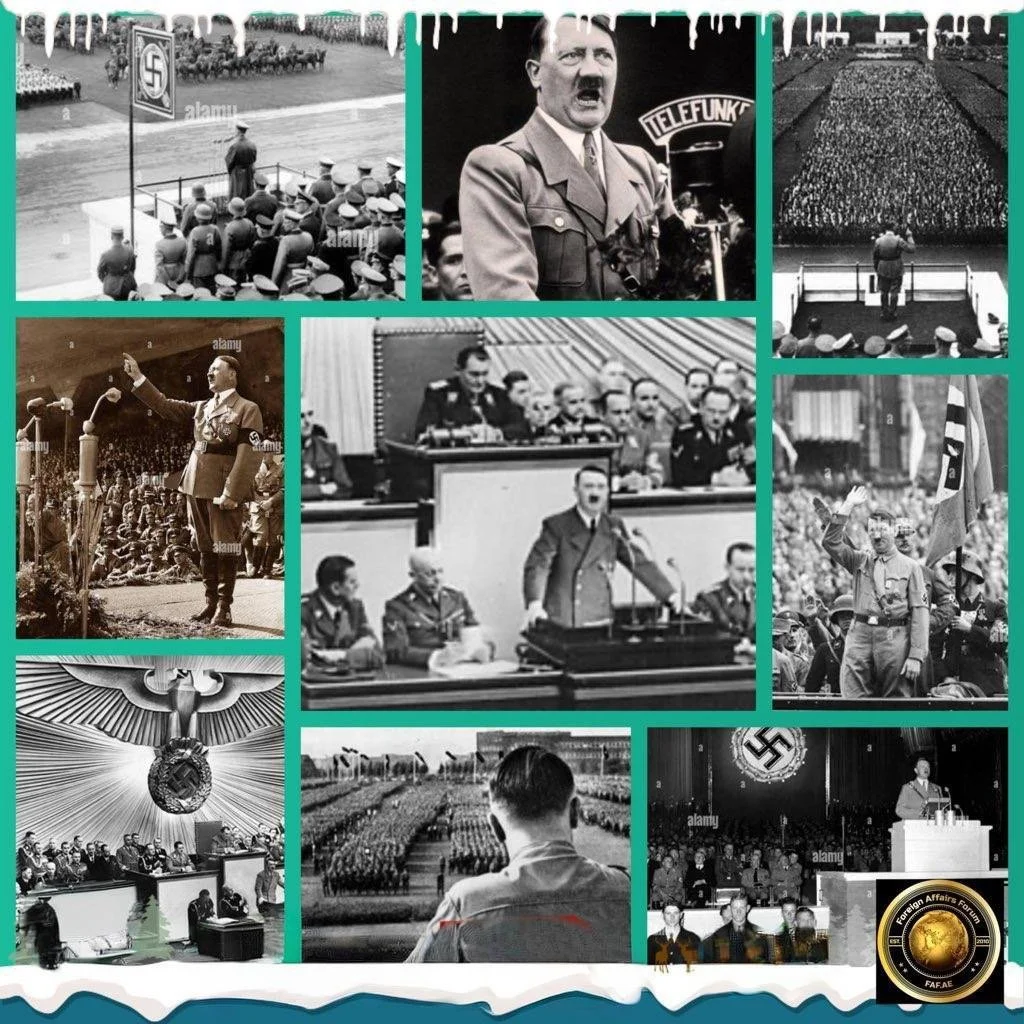
Hitler’s Most Memorable and Provocative Speeches That Made History
Introduction
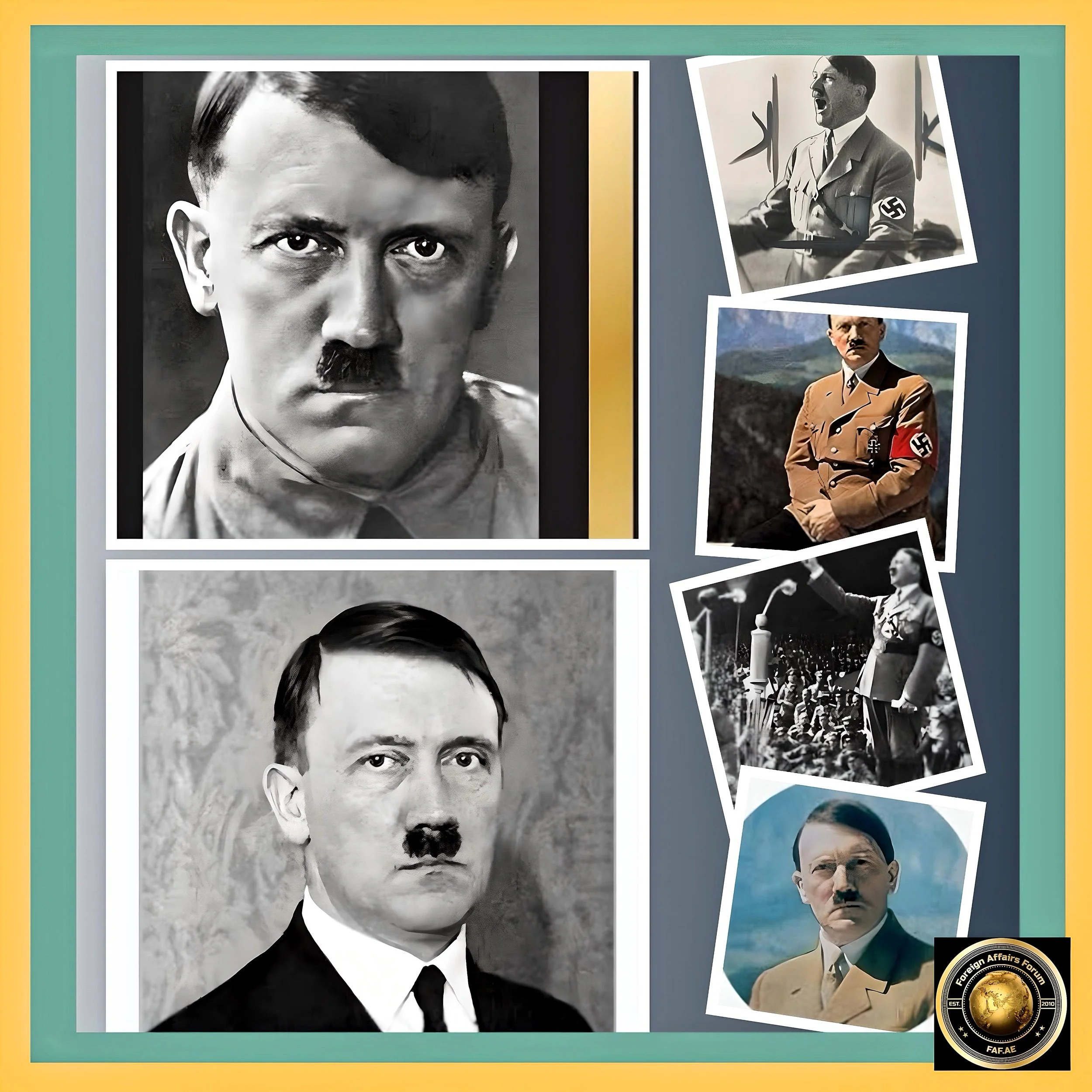
Adolf Hitler’s rise to power and his subsequent control of Nazi Germany were inextricably linked to his abilities as an orator.
His speeches served as crucial instruments of propaganda, political mobilization, and ideological indoctrination, shaping 20th-century history.
FAF, Imperialism.Forum analyzes the need to understanding these speeches provides essential insights into how extremist rhetoric can be weaponized for political gain and mass manipulation in the new world.
Early Political Speeches (1919-1923)
The 25-Point Program Speech (February 24, 1920)
Date, Time, and Location: February 24, 1920, Munich Hofbräuhaus
Context
This speech marked the formal presentation of the Nazi Party’s 25-point program to approximately 2,000 people.
Hitler delivered this address as the newly formed National Socialist German Workers’ Party sought to define its political platform and attract supporters.
Historical Significance
This speech is often regarded as the foundation of Nazism, as it publicly articulated the party’s core antisemitic, nationalist, and expansionist ideology.
The 25-point program included demands for German unification, the abolition of the Treaty of Versailles, the exclusion of Jews from German citizenship, and the concept of Lebensraum (living space).
Historians consider this speech crucial because it demonstrated Hitler’s early ability to synthesize existing German grievances into a coherent, if destructive, political program
The Beer Hall Putsch Speech (November 8, 1923)
Date, Time, and Location: November 8, 1923, approximately 8:45 PM, Bürgerbräukeller beer hall, Munich
Context
Hitler interrupted a political meeting at which Bavarian state commissioner Gustav Ritter von Kahr spoke to approximately 3,000 people.
Surrounded by SA stormtroopers, Hitler fired a pistol into the air and declared, “National revolution is underway!”
Historical Significance
This failed coup attempt, though ultimately unsuccessful, catapulted Hitler to national prominence.
The subsequent trial allowed Hitler to use the courtroom as a platform for his political message, transforming his defeat into a propaganda victory.
His final speech during the trial lasted two hours and established him as a nationalist martyr figure.
Rise to Power Speeches (1929-1933)
Munich Speech on German Militarization (March 15, 1929)
Date, Time, and Location: March 15, 1929, Munich
Context
This speech was delivered to German citizens and military personnel as Hitler sought to build support for Nazi rearmament policies.
Historical Significance
Hitler’s declaration that “One is either the hammer or the anvil. We confess that it is our purpose to prepare the German people again for the role of the hammer” became a defining metaphor for Nazi aggression.
The speech explicitly called for violating the Treaty of Versailles and rebuilding German military strength, foreshadowing the militarization that would follow.
The Enabling Act Speech (March 23, 1933)
Date, Time, and Location: March 23, 1933, Kroll Opera House, Berlin
Context
Due to the Reichstag fire, this speech occurred in the Opera House rather than the parliament building.
Hitler spoke to intimidated parliamentarians surrounded by SA and SS members.
Historical Significance
This approximately 50-minute speech led to the passage of the Enabling Act, which suspended the separation of powers and effectively abolished democracy in Germany.
Historians view this as the legal foundation for Hitler’s dictatorship, as it granted his cabinet the power to enact laws without parliamentary involvement.
Propaganda and Expansion Speeches (1935-1939)
Nuremberg Rally Speech (September 14, 1935)
Date, Time, and Location: September 14, 1935, Nuremberg
Context
This speech was delivered at a Hitler Youth rally during the annual Nuremberg Party Rally.
Historical Significance
Hitler’s emphasis on absolute obedience - “Nothing is possible unless one will commands, a will which has to be obeyed by others” - articulated the authoritarian structure of the Nazi state.
This speech helped establish the cult of personality around Hitler and the principle of unquestioning loyalty that would characterize Nazi Germany.
Austrian Anschluss Speech (April 9, 1938)
Date, Time, and Location: April 9, 1938, Austria (the day before the referendum)
Context
To justify the annexation of Austria, Hitler called for a public vote on the unification.
The speech was part of a massive propaganda campaign following the German military occupation of Austria on March 12, 1938.
Historical Significance
This speech marked the first successful implementation of Hitler’s expansionist policies and demonstrated how he combined military aggression with pseudo-democratic legitimization.
The referendum, held under occupation, resulted in a 99.7% approval rate, showing the effectiveness of Nazi propaganda and coercion.
The “Prophecy” Speech (January 30, 1939)
Date, Time, and Location: January 30, 1939, Kroll Opera House, Berlin (Reichstag session)
Context
This speech was delivered on the sixth anniversary of Hitler’s rise to power and lasted approximately two hours. Nazi propaganda minister Joseph Goebbels helped write the speech.
Historical Significance
This speech is historically significant for Hitler’s ominous “prophecy” that if international Jewish financiers succeeded in plunging the world into war, “the annihilation of the Jewish race in Europe” would follow.
Historians consider this speech a crucial precursor to the Holocaust, as it publicly articulated the genocidal intentions that would later be implemented.
Wartime Speeches (1939-1945)
Declaration of War on Poland (September 1, 1939)
Date, Time, and Location: September 1, 1939, approximately 11:00 AM, Kroll Opera House, Berlin
Context
This speech followed the German invasion of Poland, which had begun at 4:48 AM that morning.
Hitler addressed an extraordinary session of the Reichstag to declare war on Poland publicly.
Historical Significance
This speech marked the official beginning of World War II and contained what historians describe as “an astonishing catalog of lies” about the diplomatic events preceding the invasion.
Hitler’s declaration that “from now on bombs will be met by bombs” signaled the beginning of total warfare.
The speech also established Hitler’s identification with the war effort when he declared, “I am from now on just first soldier of the German Reich.”
The Total War Speech Context (February 18, 1943)
Date, Time, and Location: February 18, 1943, Berlin Sportpalast
Context
While propaganda minister Joseph Goebbels delivered this famous “Total War” speech, it was made with Hitler’s approval following the devastating defeat at Stalingrad.
The speech was delivered to a carefully selected audience of 14,000 Nazi officials and broadcast nationwide.
Historical Significance
Though not delivered by Hitler personally, this speech represented his regime’s response to military defeats and marked the transition to total war mobilization.
The speech’s famous question, “Do you want total war?” demonstrated how Nazi propaganda attempted to rally public support even as Germany’s military position deteriorated.
Final Period Speeches (1944-1945)
Hitler’s Final Military Message (April 24, 1945)
Date, Time, and Location: April 24, 1945, Hitler’s bunker, Berlin
Context
This was Hitler’s last signed military message, sent as a radiogram to Field Marshal Ferdinand Schörner in response to pleas that Hitler leave Berlin.
Historical Significance
Hitler’s message declared, “I shall remain in Berlin to take part, in an honorable fashion, in the decisive battle for Germany.”
This final communication, written with a shaky hand in red indelible pencil, demonstrates Hitler’s determination to remain in Berlin until the end.
Six days after signing this message, Hitler committed suicide in his bunker.
Hitler’s Political Testament (April 29, 1945)
Date, Time, and Location: April 29, 1945, late evening, Hitler’s bunker, Berlin
Context
Hitler dictated his political testament to his secretary, Gertrude Junge, around 11 p.m., knowing Russian troops were only 1,000 yards away.
Historical Significance
This final political statement represented Hitler’s last attempt to justify his actions and blame others for Germany’s defeat.
The testament was dictated the night before Hitler’s suicide and represents his final words to history.
Why These Speeches Are Important to Historians
Historians study Hitler’s speeches for several critical reasons:
Propaganda Analysis
These speeches demonstrate sophisticated techniques of mass manipulation, emotional appeal, and ideological indoctrination that continue to inform studies of extremist rhetoric.
Historical Documentation
The speeches provide direct evidence of Nazi intentions, policies, and decision-making processes, particularly regarding the Holocaust and aggressive war.
Understanding Totalitarian Systems
Hitler’s oratory reveals how authoritarian leaders use language to consolidate power, eliminate opposition, and mobilize populations for destructive purposes.
Contextual Understanding
The speeches help historians understand the broader social, economic, and political conditions that enabled Hitler’s rise and the Nazi regime’s policies.
Educational Importance
Studying these speeches within proper academic frameworks helps societies recognize and resist similar patterns of extremist rhetoric and political manipulation.
The academic study of Hitler’s speeches requires careful contextualization and critical analysis to understand their historical significance without amplifying their propagandistic effects.
These speeches remain essential primary sources for understanding one of history’s most destructive political movements and the power of rhetoric in shaping human events.