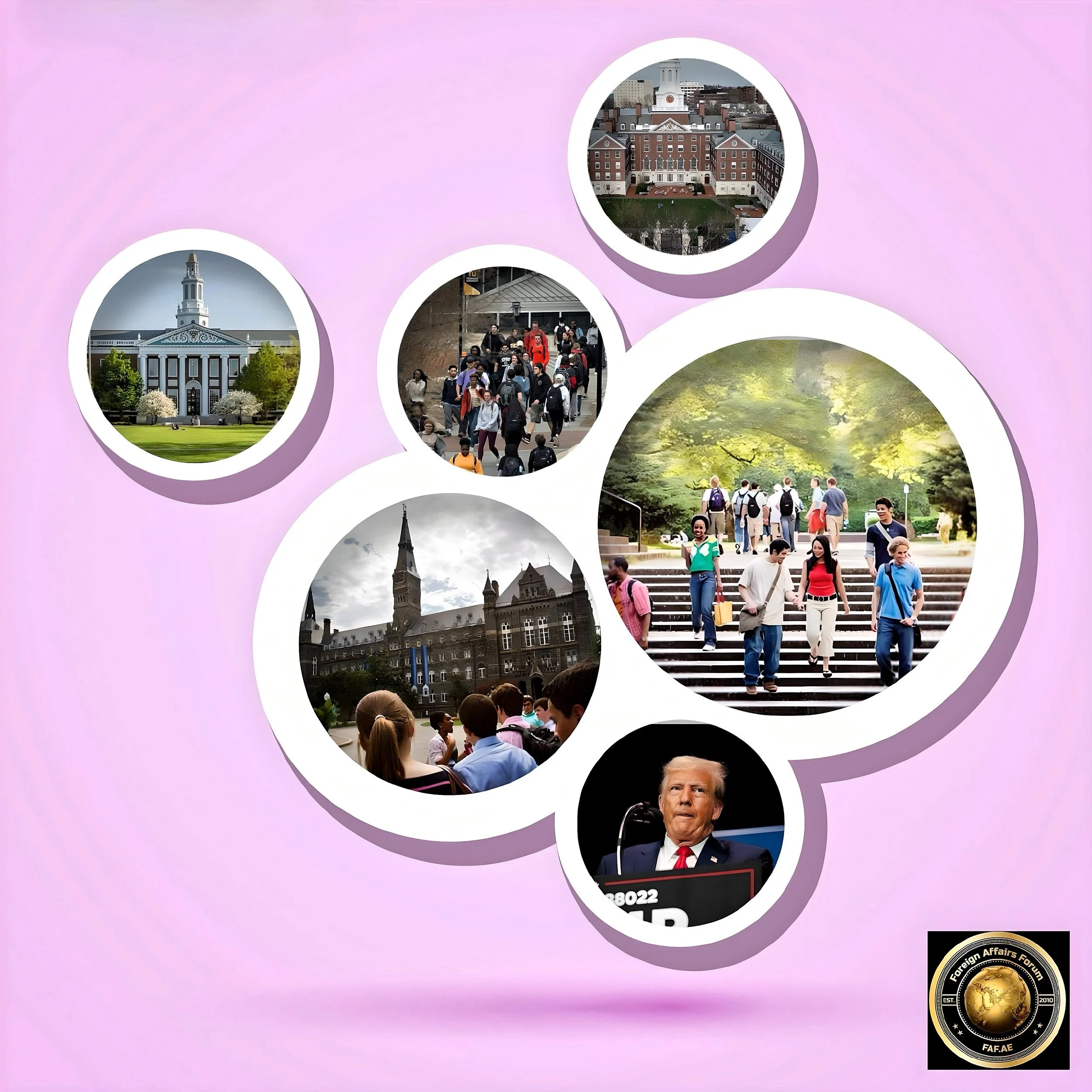
The Multifaceted Costs of Restricting International Students in U.S. Higher Education
Introduction
The Trump administration’s recent policy directives targeting Chinese international students—including visa revocations for those with alleged Chinese Communist Party connections or studying critical technologies—threaten to unravel a cornerstone of American academic and economic vitality.
FAF, Beijing.Forum analyzes Chinese students constituting nearly 25% of all international enrollees and contributing $15.5 billion annually to the U.S. economy; these measures risk collateral damage across educational institutions, local economies, and global scientific collaboration.
The policy shift exemplifies the complex trade-offs between national security priorities and the sustaining role of international educational exchange, with costs distributed unevenly across stakeholders.
Economic Consequences for Universities and Local Communities
Tuition Revenue and Institutional Budgets
International students pay premium tuition rates that effectively subsidize domestic student education and research infrastructure at public universities.
At institutions like the University of Illinois Urbana-Champaign and Purdue University, Chinese students contribute over $150 million annually through tuition and living expenses.
The abrupt withdrawal of this revenue stream could force immediate budget cuts to faculty positions, research funding, and student services.
Public universities in midwestern states are particularly vulnerable due to their reliance on international enrolments to offset declining state funding.
Local Economic Multiplier Effects
Beyond campus budgets, international students support 455,000 U.S. jobs through off-campus spending on housing, retail, and services, according to NAFSA estimates.
College towns like Ann Arbor, Michigan, and College Station, Texas, derive 12-18% of their local GDP from university-related activities, with international students disproportionately contributing through higher spending on premium housing and discretionary purchases.
Restrictions could trigger commercial vacancy spikes in these communities while reducing municipal tax bases that fund public services.
Academic and Scientific Impacts
Research Workforce Disruptions
International students constitute 56% of graduate enrolments in electrical engineering and 44% in computer science—fields directly implicated in the new visa restrictions.
At the Massachusetts Institute of Technology, 42% of 2023 doctoral graduates in artificial intelligence and quantum computing held Chinese passports, with most entering U.S. tech sectors.
The policy risks immediate talent shortages in critical research areas, delaying projects ranging from semiconductor innovation to biomedical discoveries.
Intellectual Diversity Erosion
The proposed restrictions threaten homogenizing academic environments that rely on cross-cultural exchange to drive innovation.
A 2024 Stanford study found that research teams with international members produce 23% more high-impact patents and 34% more citations than domestic-only teams.
By narrowing the pipeline of global perspectives, U.S. universities may lose their competitive edge in developing transformative technologies and addressing international challenges like climate change mitigation.
Student and Diplomatic Fallout
Chilling Effects on Global Talent Flows
Beyond direct visa revocations, the policy creates psychological deterrence for prospective students worldwide.
A 2024 Institute of International Education survey showed 68% of Chinese parents now consider the U.S. “less welcoming” compared to 2021, with Australia and the UK gaining preference.
This perception shift could permanently alter global talent migration patterns, diverting future innovators to competing innovation hubs in Toronto, Berlin, and Singapore.
Diplomatic Friction and Reciprocity Risks
China’s Ministry of Education has warned of “reciprocal measures” affecting U.S. students and scholars in China, potentially jeopardizing access to critical field research sites and archaeological archives.
The escalating restrictions mirror Cold War-era academic boycotts, threatening to bisect global scientific networks along geopolitical lines.
Joint research initiatives on pandemic preparedness and renewable energy storage now face dissolution due to mutual distrust.
Policy Alternatives and Mitigation Strategies
Precision Vetting vs. Blanket Bans
Rather than broad prohibitions, targeted security audits of sensitive research projects could address legitimate technology transfer concerns without wholesale exclusion.
The Defense Department’s existing trusted insiders program for defense contractors—featuring continuous monitoring and compartmentalized access—offers a model for academia.
Implementing such systems would require federal investment in university security infrastructure, estimated at $240 million annually.
Diversification of International Enrollments
Institutions like the University of Southern California have successfully reduced Chinese student concentration from 42% to 33% of international enrolments through aggressive recruitment in India, Vietnam, and Brazil.
This strategy requires expanding consular processing capacity in emerging markets and revising visa interview protocols, which currently reject 53% of African applicants and 15% of East Asian applicants.
Conclusion
The Trump administration’s student visa restrictions exemplify a false dichotomy between national security and academic openness.
While preventing technology leakage remains imperative, blunt instruments like blanket visa revocations impose disproportionate costs on American innovation capacity and local economies.
A 2025 Congressional Budget Office analysis estimates that reducing Chinese STEM enrolments by 30% would lower U.S. GDP growth by 0.4% annually through 2035—a cumulative $1.2 trillion loss.
Sustainable solutions require nuanced risk management frameworks that protect sensitive research while preserving universities’ role as talent incubators and cultural bridges.
Maintaining this balance as geopolitical tensions escalates will prove crucial to sustaining American scientific leadership and global soft power influence.