Franklin D. Roosevelt: His Wartime Leadership and Legacy
Introduction
Franklin Delano Roosevelt, the 32nd president of the United States, stands as one of America’s most consequential leaders who guided the nation through two monumental crises: the Great Depression and World War II.
While many seek his autobiography, it is worth noting that unlike his wife Eleanor, FDR never wrote a formal autobiography documenting his remarkable life and presidency.
Roosevelt’s Written Legacy
Despite being one of America’s most studied presidents, Roosevelt did not leave behind an autobiography.
The search for “FDR’s autobiography” reveals an interesting fact - he never wrote one.
Instead, what exists is “The F.D.R. Memoirs” (1973) by Bernard Asbell, which represents a speculative work described as “the ‘memoirs’ F.D.R. might have written, based on Roosevelt’s papers and letters, and presented as a draft for Roosevelt’s use.”
Asbell spent six years analyzing Roosevelt’s private papers, diaries of White House associates, and interviews to construct this hypothetical memoir.
Roosevelt's author, “Looking Forward,” contains his thoughts and perspectives, but this was not a comprehensive autobiography.
For those interested in firsthand accounts of the Roosevelt administration, the Diaries of Henry Morgenthau Jr., Roosevelt’s Treasury Secretary, provide valuable insights into FDR’s presidency spanning from April 1933 to July 1945.
In contrast, Eleanor Roosevelt wrote several memoirs, including “This Is My Story” (1937), “This I Remember,” “On My Own,” and “The Autobiography of Eleanor Roosevelt”.
Roosevelt’s Contributions to World War II
Leading the Arsenal of Democracy
One of Roosevelt’s most significant contributions to the Allied victory in World War II was transforming the United States into what he termed the “Arsenal of Democracy.”
In a radio broadcast on December 29, 1940, while the U.S. was still neutral, Roosevelt signaled that America would use its “immense industrial capacity to build the weapons of war needed by the last struggling democracies to save themselves.”
This concept became a reality when the U.S. entered the war, and Roosevelt led the complete transformation of American industry to support the war effort.
Under Roosevelt’s leadership, American industry achieved phenomenal production levels, eventually outproducing all Axis countries combined.
Companies from every sector pivoted to military production - automobile manufacturers produced aircraft, tanks, armored vehicles, and critical military components instead of civilian cars.
The Lend-Lease Program
Roosevelt’s innovation in international support came through the Lend-Lease Act, signed into law on March 11, 1941.
This program supplied the United Kingdom, Soviet Union, France, China, and other Allied nations with essential war materials.
By the war's end, the United States had provided approximately $50.1 billion (equivalent to $672 billion in 2023) in supplies through this program.
The distribution was substantial: $31.4 billion to the United Kingdom, $11.3 billion to the Soviet Union, $3.2 billion to France, $1.6 billion to China, and $2.6 billion to other Allies.
This massive supply effort was crucial in keeping Allied forces equipped and fighting, especially during the early years when they faced significant setbacks against Axis powers.
Forging the Grand Alliance
Roosevelt demonstrated remarkable diplomatic skill in building and maintaining the Grand Alliance between the United States, Great Britain, and the Soviet Union.
Despite significant ideological differences between these nations, Roosevelt worked to keep this crucial partnership intact throughout the war.
His relationship with British Prime Minister Winston Churchill was especially close. The two leaders had worked together before America officially entered the war in 1941.
Roosevelt believed a British victory over the Axis was in America’s best interests, while Churchill recognized such a victory was impossible without American assistance.
The relationship with Soviet Premier Joseph Stalin was more complex.
Stalin was “deeply suspicious, to the point of paranoia” of both Roosevelt and Churchill.
Despite these challenges, Roosevelt maintained the alliance, understanding that defeating Nazi Germany required Soviet participation and sacrifice.
The Atlantic Charter
In August 1941, Roosevelt met with Churchill aboard naval vessels in Placentia Bay, off the coast of Newfoundland, to develop what would become the Atlantic Charter.
Though not an official treaty, this document expressed the shared war aims and principles of the two countries, one technically neutral and the other at war.
The Charter outlined principles including self-determination, freedom from fear and want, freedom of the seas, and the abandonment of force in international relations.
Historians consider this agreement one of the first significant steps toward forming the United Nations, demonstrating Roosevelt’s vision for the post-war world.
Planning for the Post-War World
Roosevelt not only focused on winning the war but also on building a stable post-war order.
He worked “with the other Allied leaders to lay the groundwork for the United Nations and other post-war institutions.”
Roosevelt coined the term “United Nations,” showing his commitment to creating international structures to prevent future global conflicts.
Development of the Atomic Bomb
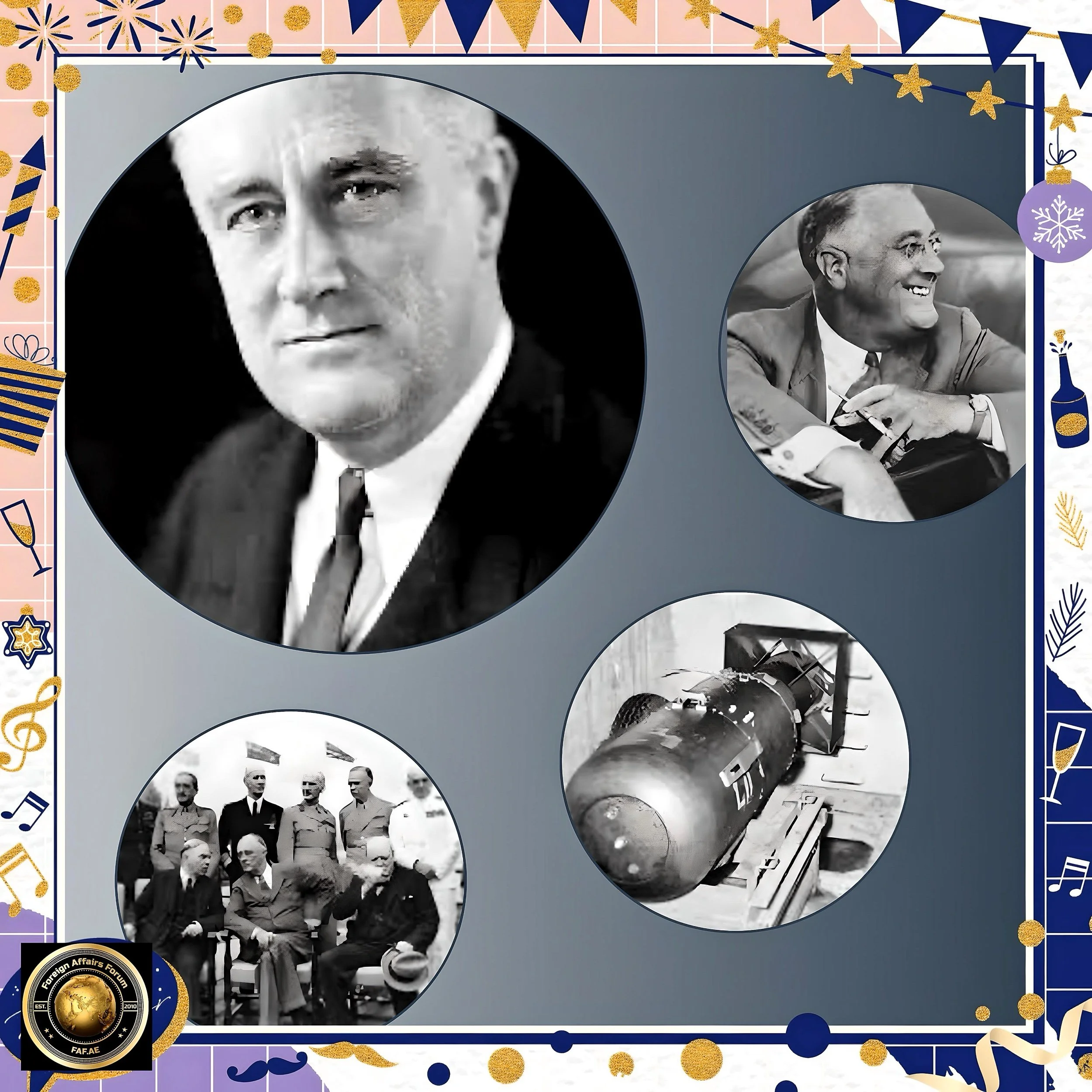
Among Roosevelt’s most consequential wartime decisions was initiating “the development of the first atomic bomb.”
This secret Manhattan Project would ultimately lead to the weapon that ended the war in the Pacific, though Roosevelt did not live to see its completion or use.
Roosevelt, Churchill, and Stalin
The Big Three
A Complex Partnership
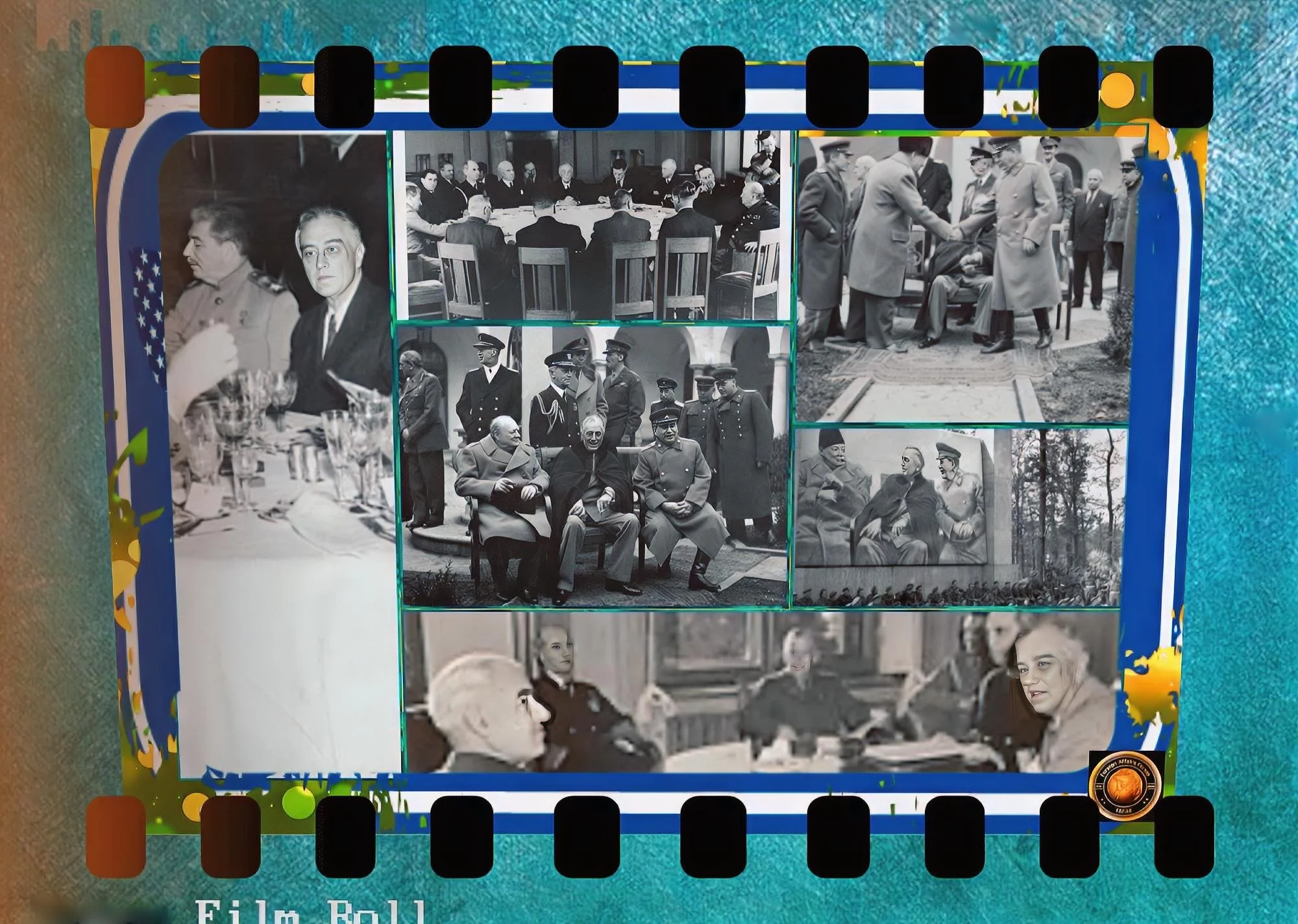
Roosevelt, Churchill, and Stalin formed what came to be known as the “Big Three” - the leaders of the primary Allied powers fighting the Axis.
Their relationship was vital to the war effort but faced significant challenges.
As noted in the search results, “The Big Three faced considerable challenges in coordinating their efforts.
Thousands of miles separated their capitals, which meant essential decisions often had to be made by telephone or telegraph”.
Despite these logistical difficulties and political differences, they coordinated the largest military effort in history.
Interestingly, “Roosevelt, Stalin, and Churchill only met twice in person” during the entire war, making their accomplishments in alliance maintenance all the more remarkable.
Comparative Standing
Whether Roosevelt “rose to fame” over Churchill and Stalin is complex and somewhat subjective.
Each leader had tremendous influence in their respective nations and world stage. Objectively, Roosevelt was the leader of what became the most powerful Allied nation, with unmatched industrial capacity and military potential.
Roosevelt’s accomplishments have secured his place as one of America’s most revered presidents.
Historical rankings “consistently place him among the three greatest American presidents.”
His four electoral victories (the only president elected to office four times) demonstrate his extraordinary domestic popularity.
However, it would be an oversimplification to suggest that any of the Big Three eclipsed the others in global significance during the war years.
Each played a crucial and distinctive role in the Allied victory.
Roosevelt’s Leadership Style and Legacy
Roosevelt’s administrative style was distinctly hands-on.
As president, he “made all of his administration’s major decisions himself, regardless of any delays, inefficiencies, or resentments doing so may have caused.”
His leadership combined formal authority with personal charisma and political skill.
One analysis of Roosevelt’s style notes that he maintained control “by drawing fully on his formal and informal powers as Chief Executive; by raising goals, creating momentum, inspiring a personal loyalty, getting the best out of people…by deliberately fostering among his aides a sense of competition and a clash of wills”.
This management approach, while sometimes creating internal friction, proved effective in mobilizing the nation for war.
Conclusion
Franklin D. Roosevelt’s contributions to the Allied victory in World War II were immense and multi-faceted. From transforming America into the Arsenal of Democracy to establishing the framework for the post-war international order, his decisions shaped the outcome of the conflict and the world that followed.
While he never wrote an autobiography, his legacy lives on through his actions, speeches, and the numerous biographical works that study his extraordinary life and presidency.
Roosevelt’s leadership during World War II exemplifies how personal determination, political skill, and strategic vision can combine to meet history’s most significant challenges.
While sometimes strained, his partnership with Churchill and Stalin demonstrated his diplomatic abilities and pragmatism in pursuing victory.
Roosevelt’s death on April 12, 1945, came just weeks before the German surrender in Europe.
Though he did not live to see the final Allied victory, his leadership made that victory possible and laid the groundwork for America’s emergence as a global superpower in the post-war era.