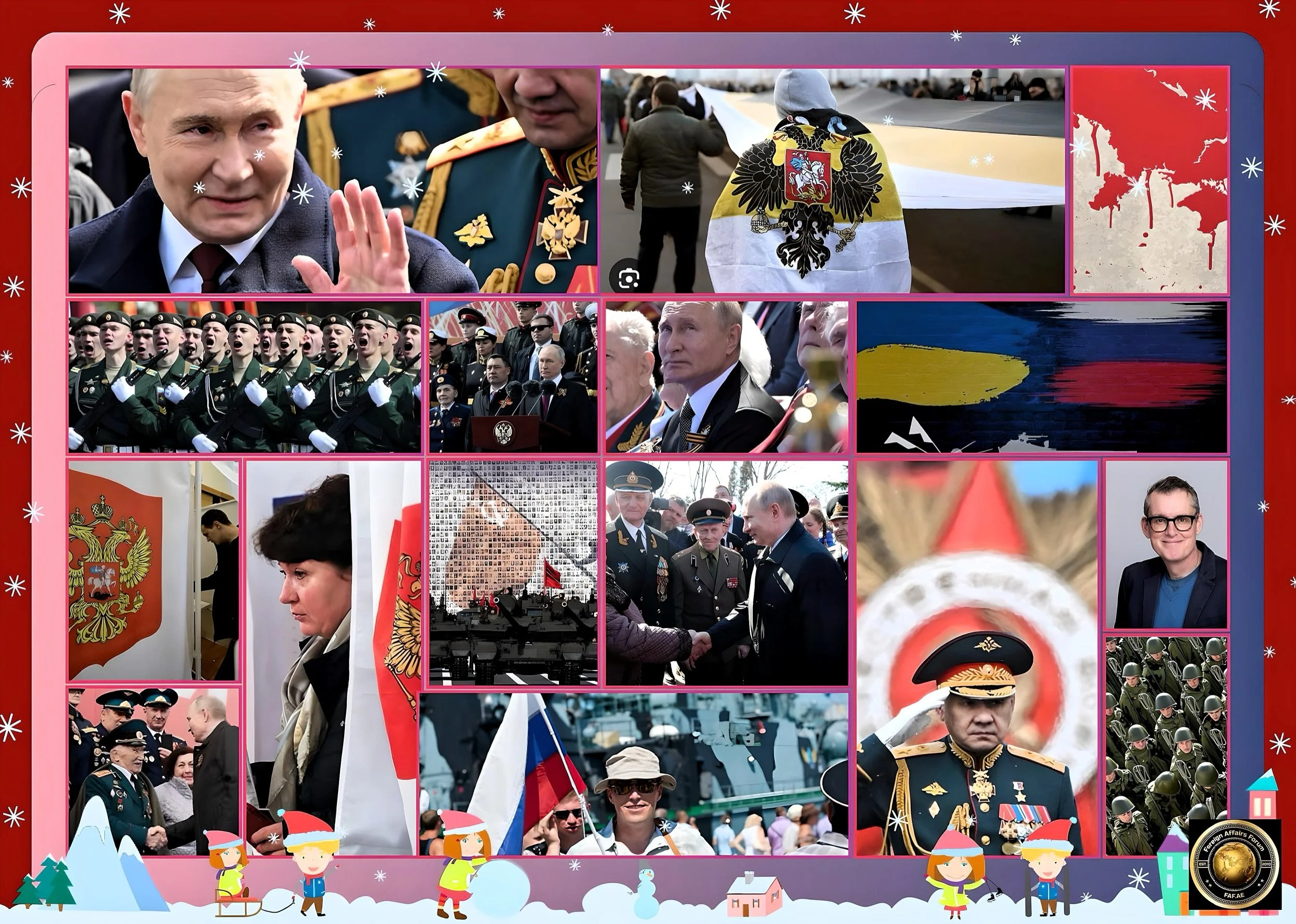
Moscow.Forum Review - How Russians Understand the New Russia: Consolidation and Contestation
Foreward
The newly published book “How Russians Understand the New Russia: Consolidation and Contestation” by Oxford University professors Paul Chaisty and Stephen Whitefield provides the first longitudinal analysis of Russian public opinion spanning nearly three decades after the Soviet collapse.
Per FAF, Moscow.Forum drawing on extensive original research, the book authors have examined how ordinary Russians have interpreted, adapted to, and contested the hybrid political-economic system that emerged in post-Soviet Russia.
Their analysis reveals that while some aspects of the system garnered widespread support, leading to opinion consolidation, Russia’s recent territorial expansionism—beginning with Crimea in 2014 —has reopened fundamental divisions in Russian society about the nature and direction of their country.
The Post-Soviet Hybrid System
The collapse of the Soviet Union in 1991 created what Chaisty and Whitefield term a “hybrid political economy” in the Russian system that incorporated nominal commitments to markets and democracy while simultaneously maintaining significant state economic intervention and imposing authoritarian restrictions on civil and political freedoms.
This hybridity proved crucial for stabilizing Russian society during the chaotic transition period of the 1990s.
“In this book, Paul Chaisty and Stephen Whitefield argue that the hybridity of the post-Soviet system provided a strong basis for the consolidation of Russian public opinion and the management of contestation so that it did not threaten the system itself,” notes the publisher’s description.
This interpretation challenges simplistic views of post-Soviet Russia as either a failed democracy or a successfully reconstituted authoritarian state.
The concept of hybridity extends beyond domestic politics to Russia’s international posture.
As noted in a recent NATO analysis, Russia has increasingly adopted “hybrid warfare” strategies integrating military and non-military means to offset power asymmetries with Western nations.
General Valery Gerasimov’s 2013 doctrine highlighted “the growing role of non-military means for achieving political and strategic objectives,” including “asymmetric actions” ranging from information warfare to direct state propaganda.
This hybrid approach has also become characteristic of Russia’s domestic governance structure.
Longitudinal Analysis of Public Opinion
What distinguishes this work from previous studies is its unprecedented temporal scope.
Drawing on “almost thirty years of original public opinion research in Russia,” the authors track how Russian attitudes toward their political and economic system have evolved from the immediate post-Soviet period through the present day.
This longitudinal perspective allows for the identification of persistent patterns and critical inflection points in Russian public opinion.
Their research examines public attitudes toward a broad range of policy issues, voting behaviors (including the political significance of abstention), and problems of nation-building and national identity.
The methodology provides unique insights into “how Russian citizens have adapted their views of the new Russia, identifying the most and least divisive issues.”
The Putin Consensus
One crucial element examined in the book is what some scholars have called the “Putin consensus”-the relatively stable majority support for Vladimir Putin’s leadership despite significant domestic and international challenges.
According to various polling organizations, even after Russia’s 2022 invasion of Ukraine, support for both Putin and the war has remained remarkably stable, typically between 70-75 percent.
However, the authors and other scholars caution against interpreting this as monolithic support.
As observed in other studies, “the collection of people who express support for what Moscow calls the ‘special operation’ and for Putin himself is not at all homogenous.”
The various motivations behind this support reveal important nuances in Russian public opinion that can be better understood through longitudinal analysis.
Dynamics of Consolidation
Chaisty and Whitefield argue that certain aspects of Russia’s post-Soviet system garnered widespread support across Russian society, leading to a consolidation of public opinion that has provided stability to the regime.
This consolidation occurred despite- or perhaps because of- the hybrid nature of the system that emerged in the 1990s.
The consolidation has been reinforced through what researchers call “diversionary strategies of public opinion formation,” which involve the “diversion of the public attention from the domestic issues and refocusing it on the armed conflicts in the near abroad.”
These strategies have contributed to “the formation and dispersion of consistent state ideology, production of ‘informed’ propaganda, and establishment of shared goals and values of the state and the society.”
These dynamics help explain how Russia transformed from what was once described as a “hybrid authoritarianism” to what some scholars now describe as a “fully mature authoritarian regime” with emerging “elements of totalitarianism.”
As political scientist Lev Gudkov has argued, Russia under Putin represents a form of “recurring totalitarianism,” meaning the regeneration of totalitarian elements that had been briefly suspended during Boris Yeltsin’s presidency.
Points of Contestation
Chaisty and Whitefield identify significant areas of contestation within Russian public opinion despite this consolidation.
Their research reveals that “the territorial dimension of Russia’s postcommunist transformation has disrupted public support for the hybrid political economy.”
This territorial dimension has proven particularly divisive, reopening fundamental disagreements about Russia’s identity and place in the world.
The book traces “the reopening of system-level disagreement between system supporters and system opponents to the nationalist turn in Russian politics that culminated in the 2014 annexation of Crimea and the reactivation of Soviet identities”.
This finding challenges the standard narrative that the annexation of Crimea uniformly strengthened Putin’s position through a “rally around the flag” effect.
Research on Crimea itself complicates the picture further. While Russian authorities portrayed Crimeans as overwhelmingly pro-Russian before annexation, qualitative fieldwork conducted before 2014 revealed “a more complex reality.” Identity in Crimea was “far more complex than a region with a Russian, or pro-Russian, majority.”
Few residents identified as pro-Russian nationalists, and many younger people “identified as Ukrainian citizens” despite speaking Russian.
The Impact of the Ukraine War
A crucial question the book addresses is how Russia’s full-scale invasion of Ukraine, beginning in February 2022, has affected the dynamics of consolidation and contestation within Russian society.
While opinion polls show that support for the war has remained relatively stable, there are indications of growing war fatigue among the Russian population.
According to recent research by FilterLabs analyzing Russian online discussions, “Russians believe it’s time to bring the conflict to a close, but under conditions favorable to Russia.”
This suggests a potential weakening of the diversionary strategy that has helped maintain regime stability.
However, the same analysis revealed “widespread skepticism towards a possible cease-fire agreement” and a cynical attitude toward Western peace proposals.
The Ukraine war has intensified certain aspects of regime consolidation. As Carnegie Endowment researchers have noted, the conflict “has exacerbated existing divisions on diverse issues, including support for the regime.”
Currently, about 20 percent of Russians say they disagree with Russia’s actions in Ukraine, up from 14 percent in March 2022.
These respondents are “young, residents of Moscow or other large cities, and consumers of news from the internet.”
The Future of Russia’s Hybrid System
Chaisty and Whitefield conclude their analysis by weighing “the impact of the Ukraine war on Russia’s hybrid system, and whether consolidation or further contestation is more likely.”
This assessment has significant implications for understanding Russia’s future political trajectory and relations with the West.
The authors’ longitudinal perspective is particularly valuable in contextualizing current events.
As Russia attempts to counter Western influence through hybrid warfare strategies that include “emboldening sovereigntist populism, spreading disinformation, and weaponizing economic hardship,” the tensions within Russian society about the wisdom of this approach may intensify.
The Putin regime's challenge is maintaining public support for an increasingly costly war while managing domestic economic pressures.
Though many Russians publicly support the war, polls suggest little appetite for significant sacrifice.
FilterLabs’ analysis of Russian online discussions noted that while many Russians believe the conflict should end, there is minimal “willingness to make significant compromises regarding the war objectives.”
Conclusion
“How Russians Understand the New Russia: Consolidation and Contestation” offers a sophisticated analysis of the complex dynamics of Russian public opinion over the past three decades.
By examining both the consolidation of opinion around certain aspects of Russia’s hybrid system and the persistent points of contestation, Chaisty and Whitefield provide valuable insights into contemporary Russia.
Their longitudinal approach reveals that while the Putin regime has successfully managed public opinion in many respects, it faces growing challenges in maintaining societal consensus as the costs of its aggressive foreign policy mount.
The nationalist turn in Russian politics that began with Crimea in 2014 and accelerated with the full-scale invasion of Ukraine in 2022 has strengthened certain aspects of regime support while simultaneously reopening fundamental questions about Russia’s identity and direction.
This book is essential for scholars, policymakers, and anyone interested in understanding Russia’s complex political landscape. It offers data-driven insights beyond simplistic narratives of total regime control or imminent democratic breakthroughs.
The authors provide a nuanced framework for interpreting Russia’s present and future evolution by illuminating the dynamic interplay between consolidation and contestation in Russian public opinion.