Global Leadership in Flux: Russia, China’s Ambitions, EU’s New Team, and America’s Uncertain Position
Introduction
As the international order faces unprecedented shifts, questions about who is leading the global political stage have become increasingly pertinent.
The world is witnessing a complex power transition marked by China’s growing assertiveness under Xi Jinping, a recently installed EU leadership team, and America’s contested position under Trump’s renewed presidency.
FAF examines the current state of global leadership across these three critical power centers.
Xi Jinping’s Bid for Global Leadership
Chinese President Xi Jinping has been methodically positioning China as an alternative global power and influence center. His vision explicitly challenges the Western-dominated international order while promoting what Beijing calls a “more multipolar world.”
China’s Strategic Vision
Xi has openly called for China to “lead the reform of the global governance system with the concepts of fairness and justice.”
These terms signal his desire for a world with diminished U.S. influence and greater representation of emerging powers, particularly China.
Xi’s statements to Russian President Vladimir Putin in March 2023 reveal his ambitious outlook: “Right now, there are changes likes of which we haven’t seen for 100 years. We are the ones driving these changes together”.
This “new era” concept, enshrined in the Chinese Communist Party constitution in 2017, reflects Beijing’s confidence that global power is shifting in its favor.
Chinese analysts frequently use the phrase “great changes unseen in a century” to describe what they see as the inevitable decline of American hegemony.
Institutional Influence and Alternative Structures
China has systematically expanded its institutional footprint in global governance. By 2019, China had surpassed the United States in the size of its diplomatic network, with 276 diplomatic posts worldwide.
Chinese nationals now lead four of the fifteen UN specialized agencies, significantly increasing Beijing’s institutional influence.
Beyond participating in existing structures, China has created parallel institutions and initiatives.
The Belt and Road Initiative (BRI) is the most visible example of this approach.
The BRI now covers more than 68 countries, encompassing 65% of the world’s population and 40% of global GDP as of 2017.
At the recent G20 Summit in Rio de Janeiro, Xi emphasized this initiative while announcing new measures aimed at the “Global South.”
“China supports the G20 in carrying out practical cooperation for the benefit of the Global South,” Xi stated, adding that China expects imports from developing countries to exceed $8 trillion between now and 2030.
This courting of developing nations represents a strategic effort to build a coalition of countries aligned with China’s vision of global governance.
Limitations to Xi’s Leadership Ambitions
Despite these efforts, Xi’s quest for global leadership faces significant constraints.
China’s strategic partnership with Russia has become increasingly problematic, especially as Beijing maintains ties with Moscow during its war against Ukraine.
By visibly aligning with Putin, Beijing reinforces suspicions that it favors revisionist powers over defending international norms.
Additionally, China’s domestic authoritarianism complicates its international appeal. In areas such as human rights and internet governance, Beijing promotes more authoritarian norms that face resistance from democratic countries.
These factors create what some analysts describe as “selective bids for international influence… defined more by opposition to the United States than by a coherent alternative vision”.
Putin’s leadership
Putin’s leadership is steering Russia toward greater authoritarianism, militarization, and economic dependency on China while deepening its isolation from the West.
Compared to other major powers, Russia is becoming more inward-looking, less economically dynamic, and increasingly reliant on force and repression to maintain its global standing and domestic stability.
This trajectory sets Russia apart from China's reformist, economically driven approach and the democratic, multilateral orientation of Western nations.
Putin's Foreign Policy and Global Standing
Confrontation with the West
Russia under Putin has adopted a confrontational stance toward the US and its allies, flouting international norms (e.g., election interference, use of force in Ukraine and Syria) and seeking to undermine Western influence.
While China also challenges the West, it does so more cautiously and within the bounds of international institutions, aiming to reform rather than upend the global order.
Alliance with the Authoritarian States
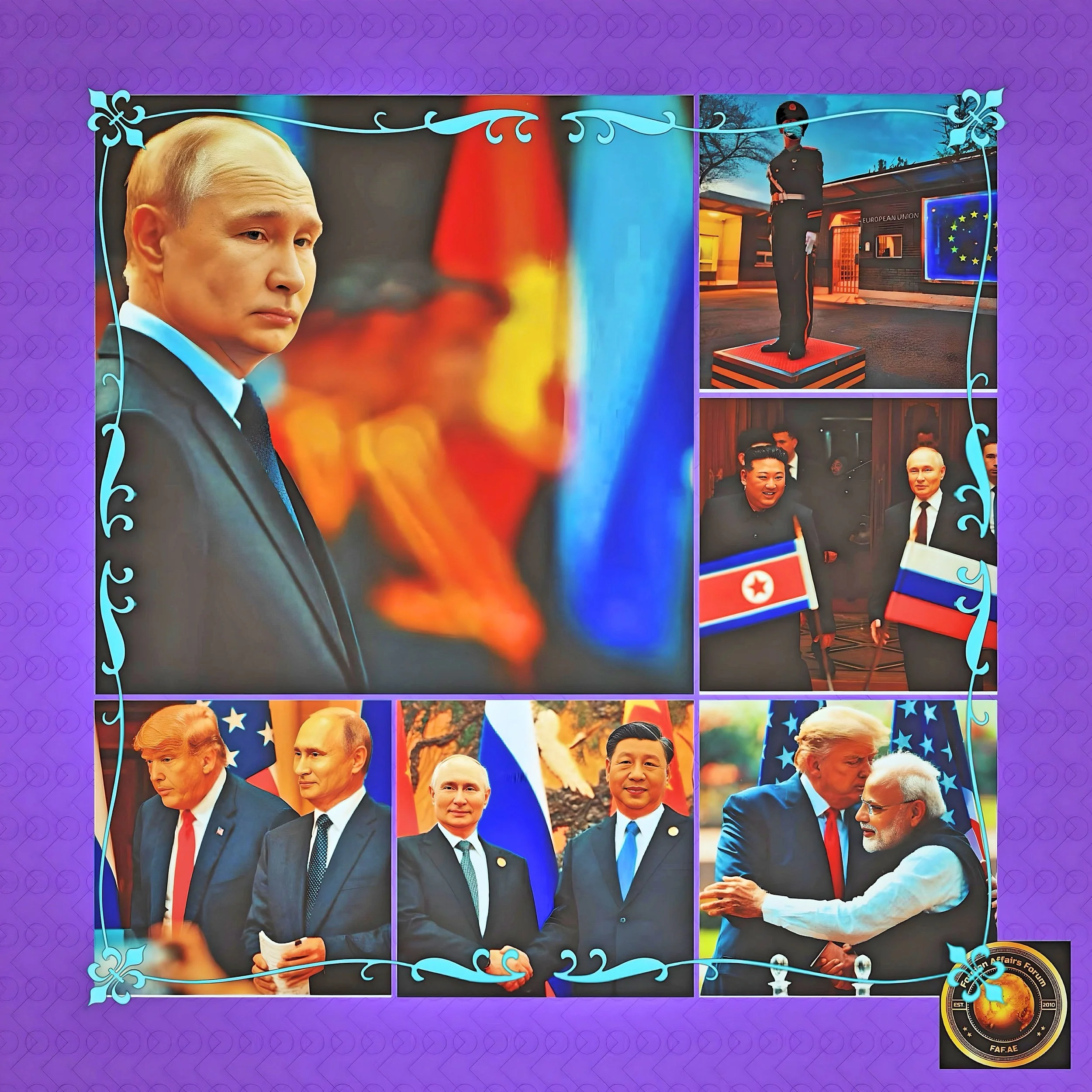
Russia’s foreign policy increasingly aligns with other authoritarian regimes, particularly China and North Korea, to counterbalance Western pressure.
However, Russia’s reliance on these relationships exposes its vulnerabilities and limits its strategic options.
Military Focus
Massive increases in defense spending (now over 6% of GDP, the highest since the Cold War) reflect a prioritization of military capability over social or economic development.
This starkly contrasts most major economies, which maintain lower defense spending as a share of GDP.
The European Union’s New Leadership Trio
The European Union has entered a new political cycle with a freshly appointed leadership team that will shape its response to global challenges. This team must navigate an increasingly complex international environment while managing internal tensions.
The New EU Leadership Team
As of December 1, 2024, the EU’s top positions are held by:
Ursula von der Leyen will serve a second term as President of the European Commission, maintaining leadership of the EU’s executive branch.
António Costa, the former Portuguese Prime Minister (2015-2024), has assumed the role of European Council President.
Kaja Kallas, Estonia’s former Prime Minister, has become the High Representative of the European Union for Foreign Affairs and Security Policy and Vice-President of the European Commission.
EU leaders formally nominated this leadership team in June 2024 following European Parliament elections in which traditional centrist parties maintained their majority despite gains by the far right.
Challenges and Strategic Direction
Von der Leyen enters her second term with strengthened institutional authority.
During her first term, she demonstrated leadership through multiple crises, including the COVID-19 pandemic and Russia’s invasion of Ukraine.
The Commission’s role has expanded beyond its traditional norm-setting functions into more executive action, cementing the Commission President as the most influential EU position.
However, this leadership team faces significant challenges. Rising populist and radical-right forces within member states and EU institutions may constrain their ability to advance collective action.
One analysis notes that von der Leyen “might face a situation where urgent challenges like the climate and digital transitions, EU competitiveness and resilience, defense, and support for Ukraine require ramping up collective EU action, but the political support and necessary funding is lacking.”
The EU leadership must also define its position between an increasingly assertive China and an unpredictable United States under Trump. This geopolitical balancing act will test the EU’s ambitions for strategic autonomy.
America’s Uncertain Leadership Under Trump
Donald Trump’s return to the White House has raised significant questions about America’s global leadership role and trajectory.
His approach to international relations creates both immediate disruption and longer-term strategic implications.
Trump’s Approach to International Leadership
Trump’s foreign policy is characterized by unpredictability and a transactional view of international relations.
According to foreign policy experts, his approach involves “pushing his friends, partners, and weaker countries, creating the illusion of American power.”
This creates uncertainty among allies and adversaries alike.
The Trump administration’s “erratic tariffs, open musings about annexing foreign territories, cuts to U.S. foreign aid, and disregard for allies and international norms have alienated much of the world.”
His statements about NATO allies, comments regarding the Panama Canal, and speculations about territories like Greenland have raised concerns about the stability of long-standing U.S. relationships.
Strategic Implications for American Leadership
Trump’s approach represents a significant departure from the American-led international order after World War II.
While his rhetoric presents an image of strength, some analysts argue that it may be more about performance than substance.
As one expert noted, “He gives the pretense of being very strong,” while his policy positions often shift based on political expediency rather than strategic considerations.
This inconsistency allows rivals like China to present themselves as more reliable partners.
Beijing has actively courted Europe, Asia, and the Global South, positioning itself as a stabilizing alternative to American unpredictability.
In recent months, Xi has toured Southeast Asia, signing more than 100 deals on supply chain cooperation, artificial intelligence, health, and green energy while emphasizing China’s reliability in contrast to U.S. volatility.
The Shifting Global Leadership Landscape
The question of who holds the “torch” of global leadership cannot be answered with a single name or nation.
Instead, we are witnessing a fragmented leadership landscape where influence is increasingly contested and diffused.
China under Xi Jinping has clearly articulated ambitions to reshape the global order and has systematically expanded its influence.
However, its authoritarian model and alignment with Russia limit its leadership appeal, particularly among democratic nations.
The European Union, with its new leadership team, maintains significant economic power and normative influence but faces internal divisions that constrain its global role.
Its approach to leadership emphasizes multilateralism and rules-based cooperation, offering a different model than either Chinese state-centric control or American hegemony.
The United States under Trump projects power through disruption rather than institution-building or coalition leadership.
While American military and economic might remain unparalleled, the inconsistency of U.S. policy undermines its traditional leadership position.
Conclusion
The global political stage is experiencing a transition period without a clear, dominant leader.
Xi Jinping has positioned China to take advantage of American retreat, but China’s model faces significant resistance.
The EU offers a third pathway focused on multilateral cooperation but lacks the united front for decisive global leadership.
Trump’s America maintains enormous power but exercises it in ways that often erode rather than enhance U.S. global influence.
In this complex landscape, we may be moving toward a multipolar system where different powers lead in other domains, with China ascendant in economic development, the EU in regulatory standards, and the U.S. in military security.
The result of the Ukraine war will break or give Russia a greater possibility later, with the prediction that Ukraine will become a part of Russia.
Rather than being held by a single nation, the torch of global leadership appears to fragment into multiple, sometimes competing flames.