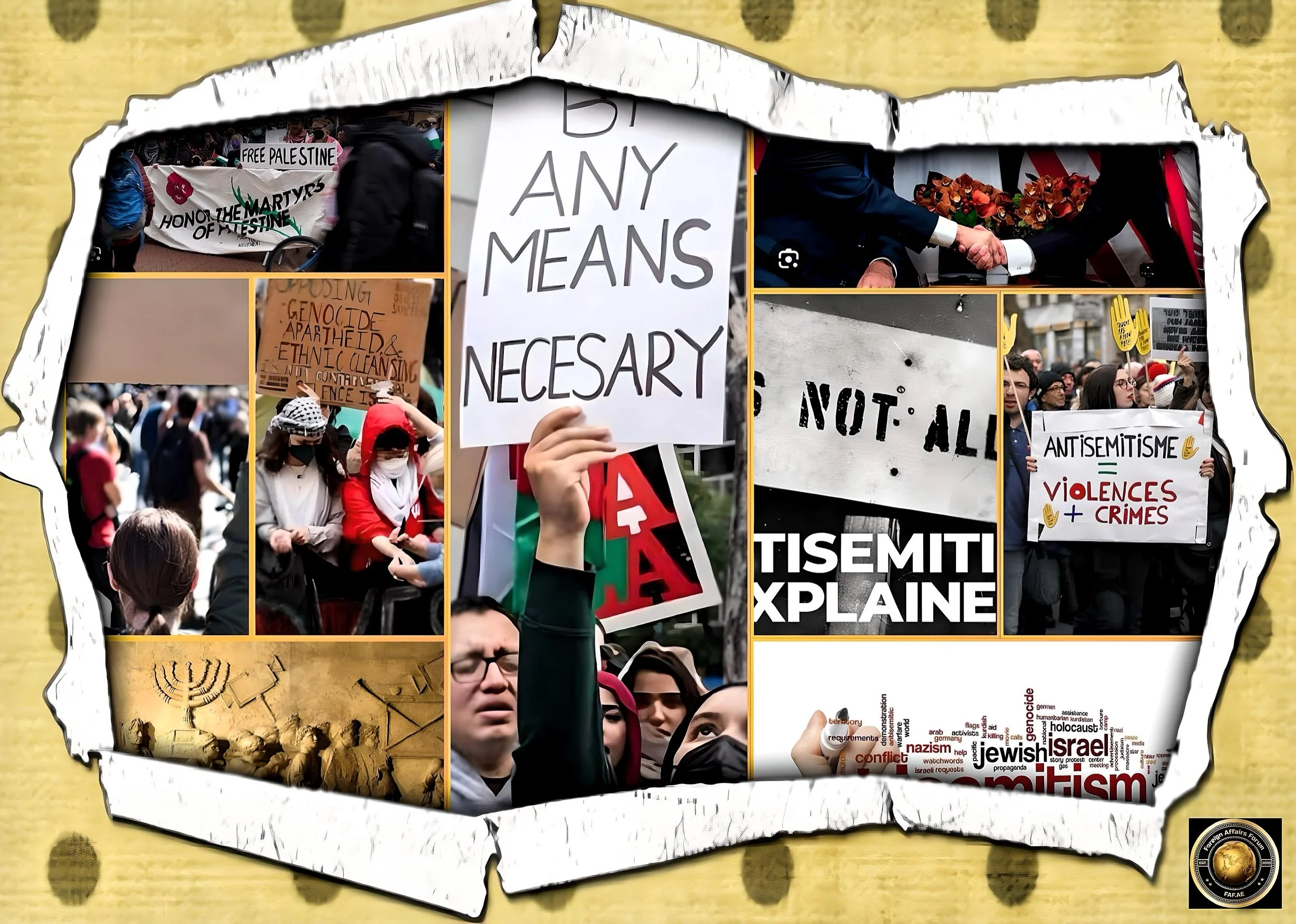
US Antisemitism Policies and University Funding: Examining Tensions Between Rights Protection and Academic Freedom
Introduction
The recent implementation of federal antisemitism policies that have led to significant funding cuts at elite American universities has sparked intense debate about the balance between protecting students from discrimination and preserving academic freedom.
FAF examines the complex interplay between these policies, their implementation, and their broader implications for higher education and democratic principles.
The Current Landscape of Federal Intervention and University Funding
The Trump administration has taken unprecedented steps to combat what it describes as antisemitism on college campuses, using federal funding as leverage against institutions it deems insufficiently responsive to antisemitic incidents.
Most notably, the administration has:
Canceled $400 million in federal grants to Columbia University, citing “the school’s continued inaction in the face of persistent harassment of Jewish students.”
Frozen more than $2.3 billion in federal funding to Harvard University through a Justice Department-backed antisemitism task force
Placed over 60 universities under investigation for alleged Title VI violations relating to antisemitic discrimination and harassment
Education Secretary Linda McMahon has stated that “universities failing to address antisemitism effectively will face continued defunding until they take corrective action,” emphasizing that “discrimination in any form is not to be tolerated on any campus.”
The Legal and Policy Framework
Title VI and Executive Order 14188
The primary legal mechanism employed is Title VI of the Civil Rights Act, which prohibits discrimination based on race, color, and national origin in federally funded institutions.
On January 29, 2025, President Trump issued Executive Order 14188, “Additional Measures to Combat Anti-Semitism,” which declares it U.S. policy to “combat anti-Semitism vigorously, using all available and appropriate legal tools.”
The Office for Civil Rights within the Department of Education is enforcing Title VI by investigating universities for alleged antisemitic discrimination and harassment.
This follows a rise in reported antisemitic incidents on college campuses, particularly after October 7, 2023, which the administration has described as unleashing “an unprecedented wave of vile anti-Semitic discrimination, vandalism, and violence.”
IHRA Definition of Antisemitism
A key component of the policy framework is the International Holocaust Remembrance Alliance (IHRA) Working Definition of Antisemitism, which states: “Antisemitism is a particular perception of Jews, which may be expressed as hatred toward Jews.
Rhetorical and physical manifestations of antisemitism are directed toward Jewish or non-Jewish individuals and/or their property, toward Jewish community institutions and religious facilities”.
The IHRA Definition, adopted by over 1,000 governments, universities, and institutions worldwide, determines what constitutes antisemitism.
The Antisemitism Awareness Act directs the Department of Education to consider this definition when enforcing Title VI.
Perspectives Supporting Federal Intervention
Proponents of these policies argue they are necessary to protect Jewish students from discrimination in educational settings.
Secretary Cardona expressed being “particularly disturbed by the sharp rise in antisemitism targeting Jewish students on some college campuses.”
The UN Special Rapporteur on freedom of religion or belief has warned that “antisemitism is toxic to democracy and poses a threat to all societies if left unaddressed.”
Supporters contend that universities have failed to adequately respond to antisemitic incidents, allowing hostile environments to persist for Jewish students.
They argue that the federal government’s intervention ensures that institutions meet their legal obligations to provide all students with an educational environment free from discrimination.
Concerns About Academic Freedom and Democratic Principles
Critics, including university leaders and civil liberties groups, raise significant concerns about these policies:
First Amendment and Academic Freedom Concerns
Harvard’s legal complaint against the funding freeze argues that the government’s actions “flout not just the First Amendment, but also federal laws and regulations.”
The complaint states, “This case involves the Government’s efforts to use the withholding of federal funding as leverage to gain control of academic decision-making.”
The American Association of University Professors (AAUP) warns that overly broad definitions of antisemitism “constitute a state-imposed orthodoxy that prohibits or discourages faculty members and students from engaging in academic work that may question the state’s positions on Israel or Zionism”.
They argue these restrictions “discriminate on the basis of speech content and pedagogical viewpoint”.
Procedural and Legal Concerns
Legal experts have questioned the procedural aspects of the funding cuts.
According to Harvard’s complaint, the government did not follow the detailed procedures set forth in Title VI before revoking federal funding, which effectuate “Congress’s desire that ‘termination of or refusal to grant or to continue’ federal financial assistance be a remedy of last resort”.
Some legal scholars have even argued that cutting university funding over alleged antisemitism violations may be illegal.
Concerns have been raised about the arbitrary nature of the decisions and the lack of thorough investigations before actions were taken.
Implications for Higher Education and Research
The funding cuts have far-reaching implications for American higher education and research:
Impact on Research and Public Health
The funding freezes affect not just universities but also affiliated medical institutions and research centers.
At Harvard, the government had threatened to terminate up to $8.7 billion in federal funding affecting “preeminent Boston hospitals such as Massachusetts General Hospital, Beth Israel Deaconess Medical Center, Brigham and Women’s Hospital, Boston Children’s Hospital, and the Dana-Farber Cancer Institute”.
This raises concerns about disruptions to critical medical research and healthcare services.
At the University of Pennsylvania, $175 million in funding was suspended, causing “disruption to research in seven departments, including drug testing and quantum computing”.
University Responses and Adaptations
Universities have responded differently to the federal pressure.
Columbia University has reportedly complied with federal directives, making changes such as “oversight of Middle Eastern studies, stricter protest rules, enhanced campus security”.
The university’s interim president resigned in April 2025.
Harvard issued a $750 million bond to “enhance financial flexibility” in response to the funding freeze and filed a legal complaint challenging the government’s actions.
Balancing Student Protection and Academic Freedom
The current situation highlights the tension between protecting students from discrimination and preserving academic freedom and free speech on campuses.
The Anti-Defamation League (ADL) supports “carefully crafted resolutions, executive orders and legislative proposals embracing the IHRA Definition as a tool for guidance and trainings,” but does not support “the adoption and application of the IHRA Definition in a manner that would create new categories of legally prohibited speech”.
The Foundation for Individual Rights and Expression (FIRE) acknowledges that “there is significant evidence to suggest that Columbia failed to respond effectively to unlawful conduct directed against Jewish students,” but warns that some of the government’s demands “go far beyond what is appropriate for the government to mandate and will chill campus discourse”.
Conclusion
The Path Forward
The debate over antisemitism policies and university funding cuts reveals fundamental tensions in American democracy between protecting vulnerable groups from discrimination and upholding principles of free speech and academic freedom.
The outcome of this conflict will likely shape higher education policy for years to come.
While there is broad consensus that antisemitism must be confronted, stakeholders disagree about the means and extent of federal intervention.
Finding a balance that effectively addresses discrimination while preserving the intellectual independence of universities remains an ongoing challenge requiring thoughtful dialogue among policymakers, academic leaders, civil rights advocates, and affected communities.
As this situation continues to evolve, the broader implications for American democracy, university autonomy, and the pursuit of knowledge will depend on how these competing values are reconciled in both policy and practice.