Comparative Analysis of the Saudi’s Rise Tower’s Design Against Global Megastructures
Introduction
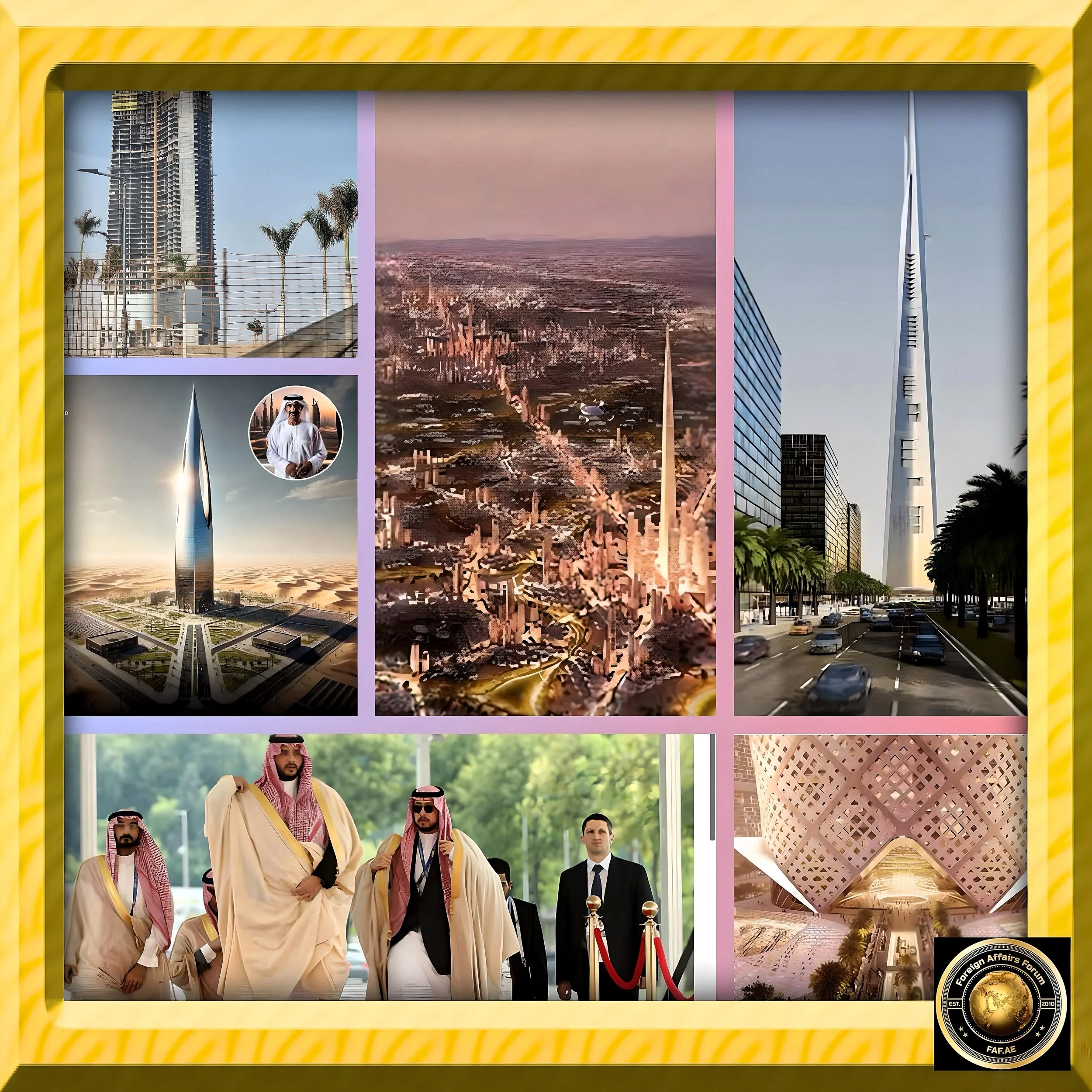
The proposed Rise Tower, a 2 km (6,562 ft) superstructure in Riyadh, Saudi Arabia, represents a quantum leap in architectural ambition.
FAF analysis contextualizes its design by comparing it to iconic megastructures such as Burj Khalifa, Jeddah Tower, and Shanghai Tower, as well as conceptual projects like Tokyo’s Sky Mile Tower.
The evaluation spans structural systems, material innovation, wind resistance, sustainability, and socio-economic implications.
Structural Systems and Load Management
Buttressed Core vs. Vertical Cluster Design
The Burj Khalifa (828 m) pioneered the buttressed core system, featuring a hexagonal central core with three wings arranged in a Y-shape to resist wind loads and torsion.
This design redistributes stress through interconnected shear walls and hammerhead terminations, allowing efficient load transfer.
In contrast, the Rise Tower’s structural blueprint remains partially undisclosed, but early renders suggest a vertical cluster design with multiple interlinked legs anchored to a central core.
Unlike Burj Khalifa’s tapered wings, the Rise Tower’s legs may incorporate mega-braced concrete shear walls and steel trusses at overlapping floors to manage unprecedented gravitational and lateral forces.
The Jeddah Tower (under construction, 1,000 m) shares similarities with Burj Khalifa. It uses a continuous tapered Y-shaped plan to minimize wind exposure.
However, the Rise Tower’s 2 km height demands radical innovations, such as pressurized oxygen cabins on upper floors to address atmospheric challenges.
Foundation Engineering
Burj Khalifa’s foundation, a 3.7 m thick concrete mat supported by 1.5 m diameter piles driven 43 m deep, exemplifies conventional high-rise engineering.
For the Rise Tower, engineers must contend with double the load and Riyadh’s distinct geological conditions. Preliminary reports indicate a hybrid raft-pile system with deeper pilings (estimated 60–80 m) and advanced soil stabilization techniques.
The North Pole Project’s location on reclaimed land may necessitate liquefaction mitigation, akin to Tokyo’s Sky Mile Tower concept.
Wind Resistance and Aerodynamic Innovations
Tapered Forms and Open-Air Decks
Wind load management is critical for supertalls. Burj Khalifa’s tapered profile reduces wind pressure by 30% compared to a rectangular prism.
The Shanghai Tower (632 m) employs a twisted, asymmetric form to disrupt vortex shedding, lowering wind loads by 24%.
The Rise Tower’s design, per Foster + Partners, includes vertical slots and open-air sky decks along its facade, a strategy mirrored in the Sky Mile Tower’s conceptual slots to allow wind passage.
These features reduce lateral sway while providing communal spaces at extreme heights.
Damping Systems
Burj Khalifa uses a tuned mass damper to mitigate oscillations, while the Shanghai Tower integrates a 1,000-ton active damper.
The Rise Tower’s height necessitates multi-stage damping systems, potentially combining active mass dampers with distributed viscous dampers across its 678 floors.
Engineers speculate that its structural legs could act as independent damping units, dynamically counteracting wind-induced vibrations.
Material and Construction Innovations
High-Performance Concrete and Composites
Burj Khalifa utilized 80 MPa concrete at upper levels, pumped to record heights.
To reduce weight, the Rise Tower’s scale demands 120–150 MPa ultra-high-performance concrete (UHPC) reinforced with carbon fiber or basalt rebar.
Composite materials, such as glass-fiber-reinforced aluminum panels, may clad the facade to withstand thermal expansion and sand abrasion.
Modular Construction and Robotics
Traditional slip-forming techniques, used for Burj Khalifa’s core, would be impractical for the Rise Tower.
Instead, 3D-printed modular components and autonomous robotic assemblers are likely candidates, enabling precision at scale.
The North Pole Project’s timeline (completion ~2060) allows for maturation of these technologies, which are already being tested in NEOM’s infrastructure.
Vertical Transportation and Habitability
Elevator Systems
Burj Khalifa’s 57 elevators include double-deck cabins traveling at 10 m/s. The Rise Tower’s 2 km height requires multi-stage magnetic elevators with mid-way transfer lobbies and AI-driven traffic management to prevent congestion.
Proposals include inclined elevators traversing the tower’s exterior slots, reducing shaft space.
Human-Centric Design
Upper floors above 1,500 m will require pressurized oxygen systems and UV-shielded glazing to maintain habitability. The tower’s mixed-use program-hotels, residences, offices-demands biophilic design elements, such as sky gardens and vertical green walls, to offset psychological stress from altitude.
Sustainability and Urban Integration
Energy Efficiency
The Shanghai Tower’s double-skin facade reduces HVAC loads by 21%. The Rise Tower aims to surpass this with integrated photovoltaic cladding and wind turbines embedded within its sky decks.
The North Pole Project’s master plan emphasizes net-zero water use via condensate recovery and greywater recycling.
Urban Connectivity
Unlike Burj Khalifa’s standalone presence, the Rise Tower is the centerpiece of a 2,040-hectare “city of the future” featuring underground hyperloop stations and drone taxi hubs.
This contrasts with Tokyo’s Sky Mile Tower, which envisions a self-contained vertical city for 500,000 residents.
Economic and Cultural Context
Vision 2030 and Global Signaling
Saudi Arabia’s Rise Tower symbolizes technological sovereignty, aligning with Vision 2030’s goals to diversify beyond oil.
While Burj Khalifa bolstered Dubai’s global tourism, the Rise Tower aims to attract FDI into Riyadh’s nascent tech and finance sectors.
However, the project’s $5 billion budget-likely ballooning to $10 billion-faces scrutiny amid NEOM’s financial setbacks.
Cultural Adaptations
Unlike Dubai’s secular approach, the Rise Tower must accommodate Saudi cultural norms, such as gender-segregated amenities and prayer spaces.
Its design avoids overtly Islamic motifs, instead embracing a universal aesthetic to appeal to global tenants.
Conclusion
Redefining the Limits of Verticality
The Rise Tower’s design synthesizes lessons from past megastructures while pushing engineering into uncharted territory. Its structural cluster system, advanced materials, and climate-responsive features set a new benchmark for supertalls.
However, the project’s success hinges on resolving unprecedented challenges-from atmospheric habitability to funding logistics-that dwarf those faced by Burj Khalifa or Shanghai Tower.
If realized, it will epitomize humanity’s capacity to reimagine urban landscapes, albeit at a scale that tests the boundaries of physics, economics, and human endurance.
This comparative analysis underscores the Rise Tower’s role as both a technical marvel and a geopolitical statement, reflecting Saudi Arabia’s resolve to lead the next era of urban innovation.