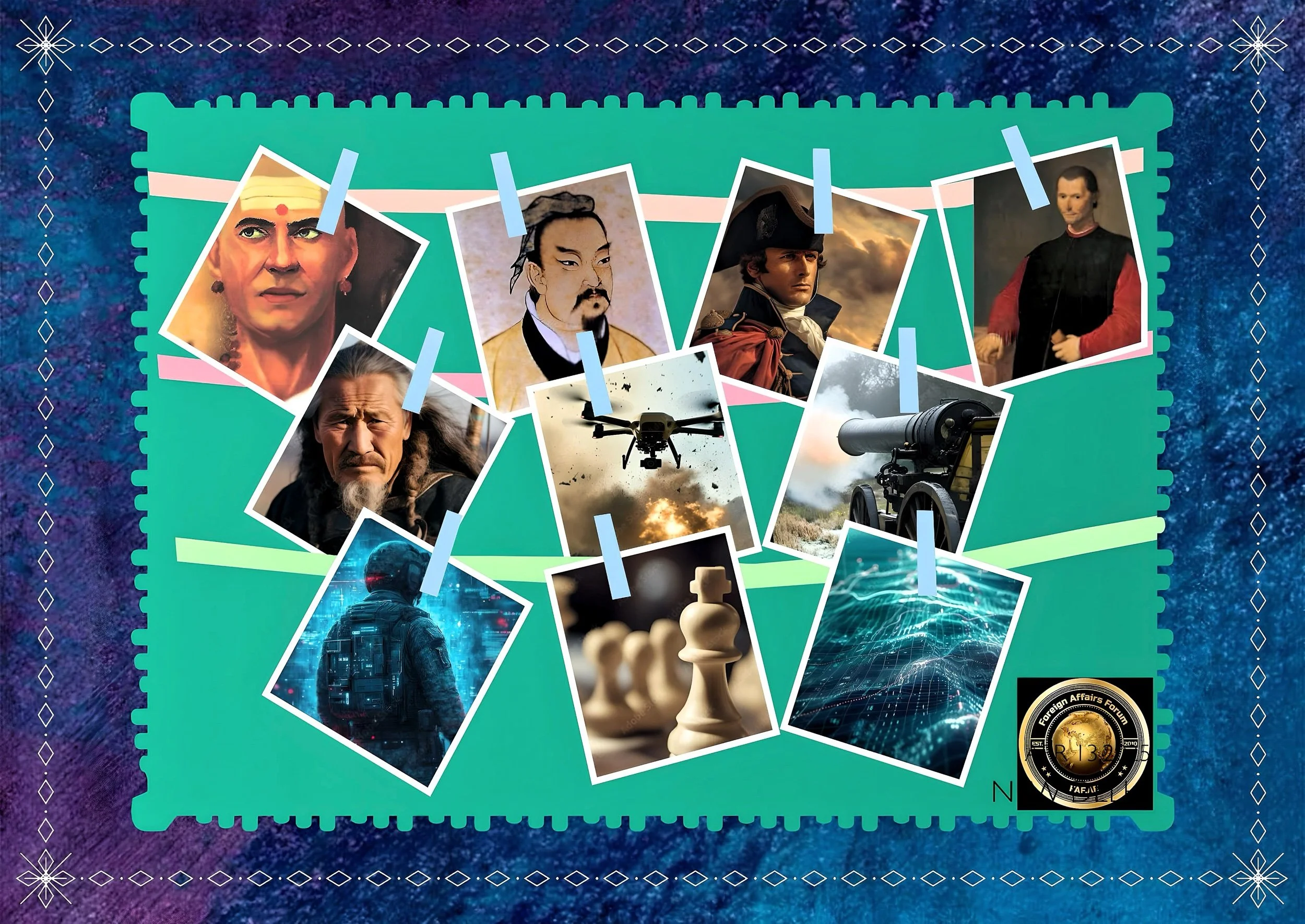
The Timeless Military Strategists: Sun Tzu, Machiavelli, Napoleon, Washington, and Chanakya
Introduction
The principles and strategies of historical military figures continue to influence modern warfare, leadership, and strategic thinking. Despite being separated by centuries and continents, Sun Tzu, Niccolò Machiavelli, Napoleon Bonaparte, George Washington, and Chanakya (Kautilya) developed enduring approaches to warfare and statecraft that remain relevant today.
Their distinct ideologies shaped military doctrine across generations and continue to offer valuable insights for contemporary strategic challenges.
The Foundational Strategists and Their Contributions
Sun Tzu: The Master of Strategic Deception
Sun Tzu was a Chinese military general, strategist, and philosopher who lived during the Eastern Zhou period (771-256 BCE).
As the author of “The Art of War,” Sun Tzu mastered the military science of ancient China and created the military doctrine of asymmetrical warfare, which suggests attacking the enemy only after they have no opportunity to defend or counterattack.
His principles of achieving victory without conflict, understanding both self and enemy and the strategic use of deception have significantly influenced Western military thinking.
Sun Tzu’s emphasis on movement as a component of warfare was perhaps best demonstrated during Napoleon’s Italian campaign of the 1790s, showing how his strategic principles transcended time and geography.
His most famous principle—“The supreme art of war is to subdue the enemy without fighting”—reflects his preference for psychological and strategic victory over physical confrontation.
Niccolò Machiavelli: The Pragmatic Realist
Niccolò Machiavelli (1469-1527) fundamentally transformed political and military thought through his works, particularly “The Prince.”
As the first exponent of power politics, Machiavelli laid the foundation for the theory of nation-states, justified secular governance, and advocated for the state's autonomy.
His revolutionary contribution was separating politics from religion, arguing that the prince's sole aim should be the unification and welfare of the state rather than spiritual salvation.
Machiavelli emphasized that rulers must be experts in organizing and managing war, making military preparedness essential for state survival.
His advice influenced leaders like Cromwell and Napoleon, and his emphasis on absolute power later became a source for fascist movements.
Unlike Sun Tzu, who preferred avoiding conflict, Machiavelli saw warfare as a necessary component of practical statecraft and power projection.
Napoleon Bonaparte
The Battlefield Innovator
Napoleon Bonaparte transformed warfare through tactical innovation and strategic brilliance.
He greatly emphasized movement, as demonstrated during his Italian campaign, when he repeatedly outmaneuvered his Austrian and Piedmontese opponents by moving his troops back and forth across the country.
This allowed him to fight battles at times and places that suited him, picking off enemy forces individually rather than allowing them to combine.
Napoleon’s grasp of mathematics and tactics made him a skilled artillerist, leading to innovations like using lighter field guns that could be moved quickly around the battlefield.
Rather than spreading artillery to support infantry, he collected large mobile batteries whose coordinated firepower could significantly damage enemy formations.
This approach foreshadowed the growing artillery batteries of the next hundred years and showed how technological innovation could fundamentally change warfare.
George Washington
The Patient Strategist
George Washington’s most significant military challenge was losing New York to the British in 1776, and recapturing it became nearly an obsession.
His approach demonstrated patience and careful strategic planning—he waited across the Hudson River from New York, developing a “grand strategy” to combine his Continental Army with French forces to defeat the British.
Washington’s communication with the Continental Congress shows his thoughtful approach to warfare.
After demonstrating steady leadership at Valley Forge and personal courage at Monmouth, Congress granted him full authority to plan the campaign to unite American and French forces and defeat the British.
This trust in his “Prudence and Abilities” allowed him to craft strategies independently, exemplifying his reputation as a measured, methodical military leader.
Chanakya
The Strategic Kingmaker
Chanakya (also known as Kautilya), the author of “Arthashastra,” was the guru (mentor) of Chandragupta, the founder of the Mauryan Empire.
His work, written between the fourth and third centuries BCE but only discovered and translated in 1904, presents a comprehensive treatise on statecraft, economics, and military strategy.
Unlike Sun Tzu’s preference for subduing enemies without fighting, Chanakya believed that “an enemy’s destruction shall be brought about even at the cost of great losses in men, material and wealth.”
He advocated complete extermination of enemies: “The remnants of an enemy can become active, e like those of a disease with fire, and they should be exterminated completely.”
However, he also stated, “If the end could be achieved by non-military methods, even by methods of intrigue, duplicity, and fraud, I would not advocate an armed conflict.”
Ideological Differences in Warfare Philosophy
Approach to Military Conflict
The five strategists held markedly different views on when and how to engage in warfare:
Sun Tzu prioritized strategic thinking and intelligence to avoid direct combat: “The supreme art of war is to subdue the enemy without fighting.”
He argued that “all warfare is based on deception” and that one should “attack him where he is unprepared, appear where you are not expected.” This focus on psychological warfare and strategic victory without bloodshed distinguishes him.
Machiavelli viewed warfare as an essential state function, arguing that “the sole aim of the prince is to be an expert in managing and organizing a war.”
His approach was pragmatic and focused on state power, separating the ethics of individuals from the necessities of governance—he believed a prince “must not honor his word” when it conflicts with state interests.
Napoleon’s approach centered on movement, innovation, and decisive action. He transformed battlefield tactics through artillery concentration and mobility, demonstrating that technological and tactical innovation could overcome traditional advantages.
Washington developed patient, alliance-based strategies that combined diplomatic and military elements. His “grand strategy” involved careful coordination with French naval and land forces, showing his appreciation for the broader geopolitical context of warfare.
Chanakya maintained that while peace is preferable for prosperity, enemies should be completely defeated when at war.
He believed the state must always be adequately fortified and armed forces prepared to defend against aggression.
His approach was more defensive than Sun Tzu’s, emphasizing fortification against enemy attacks, while Sun Tzu was more inclined toward attack and guerrilla warfare.
Ethics in Warfare
The strategists also differed significantly in their views on ethics in warfare:
Sun Tzu sought to minimize bloodshed through strategy, believing that “no country has ever profited from protracted fighting.”
While he advocated deception, his ultimate aim was to achieve victory with minimal casualties on both sides.
Machiavelli argued for separating politics from morality, maintaining that political necessity trumps ethical concerns.
He believed politicians do not have the moral right to risk the state’s survival based on ethical restraint.
Napoleon appeared primarily concerned with victory rather than ethical considerations, though he did establish codes of military conduct that influenced later warfare.
Washington maintained higher ethical standards in warfare than the others, even as he employed strategic deception in some battles.
Chanakya’s approach was described as “Dharma-oriented, where ethics of war are more emphasized,” though he was a realist who believed individual morals could not always apply to society.
He advocated using deception, playing roles, and creating appearances when necessary.
Contemporary Relevance of “The Art of War” and Ancient Military Strategies
Enduring Influence on Modern Warfare
These historical strategists continue to shape contemporary military thought:
“The Art of War” remains “perhaps the most prestigious and influential book of strategy in the world, widely used in politics, business, and” other fields.
Its principles have been applied to everything from corporate strategy to personal relationships, though some question whether treating non-military situations as battlefields is appropriate.
Studies of the 21st-century conflicts in Afghanistan (2001-2021), Iraq (2003-2011), and the Russia-Ukraine war suggest that they succeeded whenever political and military leaders followed Sun Tzu’s principles. When they disregarded them, they failed.
Modern militaries continue to study these classical strategists. The comparison of these theorists reveals their thinking remains “highly relevant to modern strategic challenges.” Strategic military colleges regularly teach their principles, adapting them to contemporary warfare scenarios.
Business and Leadership Applications
These thinkers' strategic principles extend beyond warfare to business, politics, and leadership.
Sun Tzu’s concepts of preparation, intelligence gathering, and strategic positioning have been applied to corporate competition.
There are even books like “Sun Tzu Was A Sissy” that apply principles from “The Art of War” to today’s business world.
Chanakya’s principles can help “establish itself as a global leader, drive positive change, and foster co-operation for a prosperous world.” His teachings on economics and statecraft offer enduring lessons for modern governance and diplomacy.
Relevance in Counterinsurgency and Unconventional Warfare
The principles from both Sun Tzu and Chanakya inform modern counterinsurgency and counterterrorism strategies.
Kautilya’s “Concealed War” concept is remarkably similar to modern information and psychological operations.
His advice on using agents in enemy territory for psychological operations and sabotage predates modern covert operations: “Miraculous results can be achieved by practicing the methods of subversion.”
Sun Tzu’s emphasis on intelligence, deception, and winning without fighting aligns with modern approaches to asymmetric warfare and counterinsurgency.
His principles are particularly relevant in an era where conventional military superiority doesn’t guarantee success against insurgent forces.
Comparing Chinese and Indian Strategic Thought
Sun Tzu versus Chanakya
The comparison between Sun Tzu and Chanakya reveals fascinating differences in Eastern strategic thought:
Scope of work
Sun Tzu’s writings focus exclusively on warfare, while Chanakya’s Arthashastra covers the entire spectrum of statecraft, including economics, diplomacy, and governance.
Approach to enemies
Sun Tzu believed “the supreme art of war is to subdue the enemy without fighting,” whereas Chanakya argued that “an arrow shot by an archer may or may not kill a single person; but skillful intrigue, devised by a wise man, may kill even those who are in the womb.”
Style of guidance
“Sun Tzu’s teachings are largely conceptual, while Kautilya’s teachings are practical, with conceptual underpinnings.” Chanakya provided detailed instructions on army organization, training, and administration, while Sun Tzu focused more on strategic principles.
War versus peace
Both valued peace but for different reasons. Sun Tzu saw war as destructive and to be avoided when possible: “No country has ever profited from protracted fighting.”
Chanakya favored peace for prosperity but insisted on military preparedness: “In the happiness of his subjects lies the king’s happiness; in their welfare his welfare.”
Conclusion
The military and political philosophies of Sun Tzu, Machiavelli, Napoleon, Washington, and Chanakya continue to offer profound insights into modern warfare, leadership, and strategy.
Their diverse approaches—from Sun Tzu’s emphasis on winning without fighting to Chanakya’s comprehensive statecraft, from Machiavelli’s pragmatic realism to Napoleon’s tactical innovation and Washington’s patient strategy—provide a rich tapestry of strategic thinking that remains relevant across centuries.
Modern military leaders, politicians, and business strategists continue to draw upon these timeless principles and adapt them to contemporary challenges.
Whether in conventional warfare, counterinsurgency operations, or corporate strategy, the wisdom of these historical strategists continues to guide decision-making and strategic planning in the 21st century.
Their enduring legacy demonstrates that while technology and tactics evolve, the fundamental principles of strategy, leadership, and conflict remain remarkably constant across time and cultures.