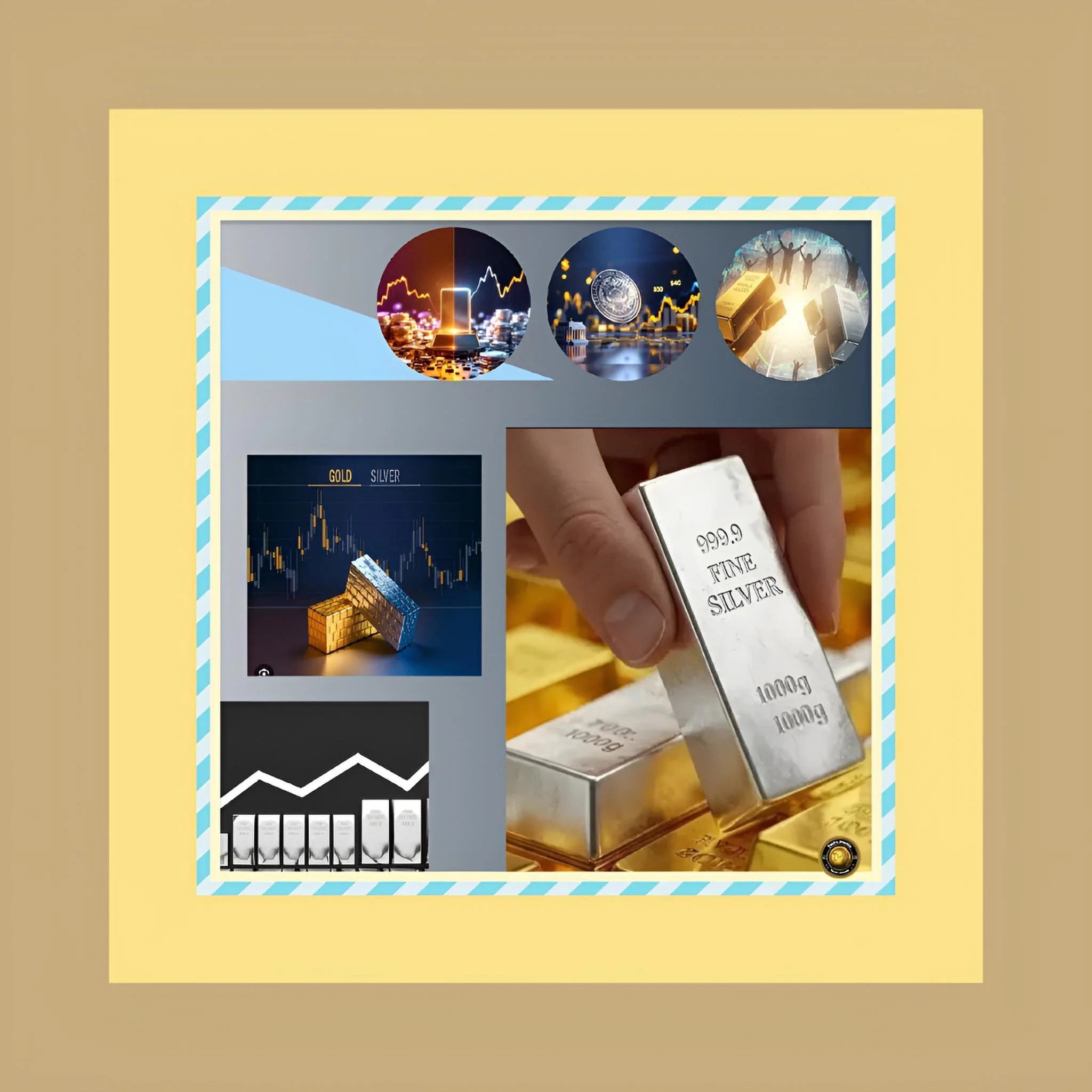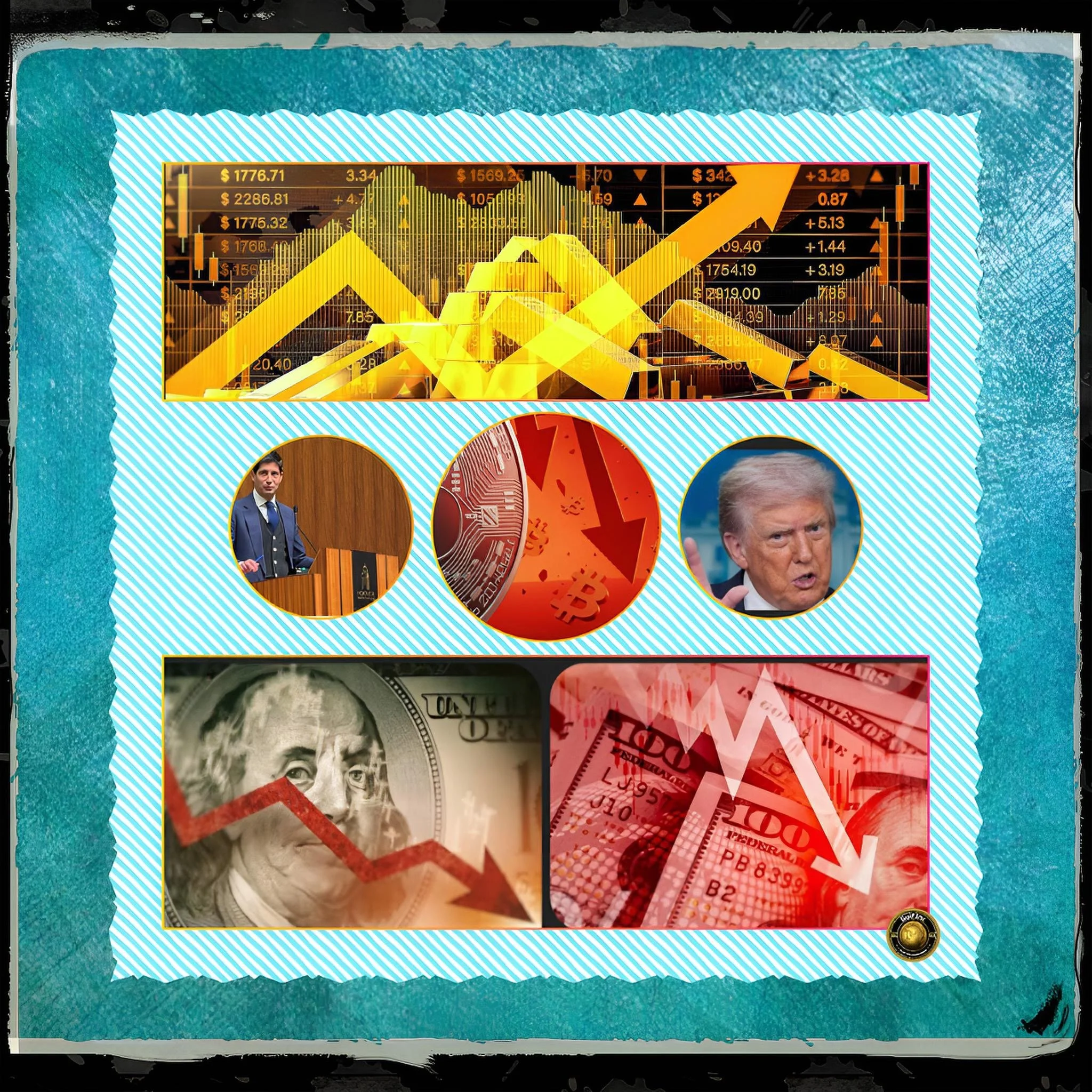
The Precipitous Decline and Structural Recovery of Precious Metals in 2026: A Macroeconomic Assessment
Executive Summary
The precious metals complex experienced an extraordinary reversal on January 30, 2026, when gold plummeted approximately 11% to test $4,900 per troy ounce while silver collapsed nearly 30% from historical peaks, marking the most dramatic single-day decline for silver since 1980.
This capitulation arrived following an unprecedented rally in which gold had appreciated 20% year-to-date and silver had surged 264% over 12 months.
Despite this severe correction, fundamental macroeconomic, geopolitical, and monetary conditions suggest the selloff represents a technical capitulation within a structurally bullish intermediate-term trajectory, with price recovery anticipated to reach the $6,200 threshold by mid-2026.
Introduction
The decline of precious metals in late January 2026 confounded market participants and challenged the conventional wisdom that underpinned the preceding rally.
The white metal's capitulation exemplified how momentum-driven trading can obscure the underlying fundamentals. As one examines the catalysts, mechanics, and probable trajectory of recovery, it becomes evident that while speculative excesses warranted correction, the structural case for precious metals recovery remains intact.
The confluence of geopolitical instability, monetary accommodation, fiscal deterioration, and central bank diversification away from dollar denominations provides a durable foundation upon which prices shall reconstitute.
History and Current Status
The Context of Recent Volatility
Gold initiated 2026 with formidable momentum, driven by three principal vectors: geopolitical tensions emanating from U.S.-Iran confrontation and the Trump administration's unilateral military adventurism in Venezuela; persistent currency debasement expectations arising from escalating fiscal deficits and anticipated monetary easing; and coordinated central bank diversification into bullion as emerging economies sought to de-dollarize their reserves.
The metal reached an intraday high of $5,594.82 per ounce on January 29, 2026, marking the culmination of a 20% monthly advance and an approximate doubling of prices since January 2025.
Silver's trajectory proved even more pronounced. The metal rose from $29 per ounce at the start of 2025 to $113.25 per ounce on January 29, 2026, yielding a 264% annualized return and a 54% monthly gain.
This explosive ascent reflected silver's dual nature as both an industrial commodity experiencing structural supply deficits and a leveraged safe-haven proxy for investors seeking inflation hedges.
The metal's outperformance relative to gold manifested in the gold-silver ratio compressing to approximately 44:1, well above the historical 65:1 mean but indicative of silver's relative valuation tightening.
The deterioration commenced precipitously on January 30, 2026, precipitated by the announcement that President Donald Trump would nominate Kevin Warsh, a former Federal Reserve governor and prominent advocate of monetary tightening and quantitative contraction, as chair of the Federal Reserve.
This revelation recalibrated market expectations regarding future monetary policy trajectory. Warsh's long-standing advocacy for reducing the Fed's balance sheet, skepticism of quantitative easing, and perceived hawkish orientation fundamentally contradicted the market's prior consensus expectation of a dovish successor to Jerome Powell.
Key Developments
The Mechanics of Capitulation
The velocity and amplitude of the selloff illuminated the fragility underlying the preceding rally. Analytical decomposition reveals three nested mechanisms operating in sequence.
First, profit-taking emerged as participants with extended positions exercised discipline, recognizing that silver's 54% monthly appreciation and gold's 20% advance within 4 weeks were unsustainable and disconnected from fundamental economic data. Bullion dealers, hedge funds, and retail investors simultaneously reversed allocations, exacerbating unidirectional selling pressure.
Second, leveraged positioning unwound. The preceding months' rally had attracted speculative capital, particularly into silver futures contracts, wherein participants employed substantial borrowed capital to amplify returns.
As prices began their reversion, margin calls cascaded through electronic futures markets, triggering the forced liquidation of positions at progressively lower price levels. Volatility accelerated as liquidity evaporated, a phenomenon recognized by Saxo Bank's commodity strategist Ole Hansen as "volatility feeding on itself."
Third, the announced monetary policy pivot reversed the principal driver of the rally: the debasement trade. For the preceding 18 months, investors had positioned for dollar weakness, perceived quantitative easing, and inflation persistence.
The prospect of a hawkish Fed chair suggested an environment of monetary restraint, stronger dollar appreciation, and commodity headwinds instead. As the U.S. dollar index surged 1.5% on the Warsh announcement, gold and silver experienced disproportionate losses, reflecting their inverse correlation with dollar valuation and real interest rate expectations.
By late trading on January 30, gold had retreated to $4,909 per ounce (a 12% decline), while silver had plunged to $85 per ounce (a 30% decline from peak valuations).
The cumulative erasure of market capitalization approached $3 trillion, according to published estimates, making this episode the worst single-day performance for precious metals in approximately 40 years.
Latest Facts and Concerns
Understanding Current Valuations
As of late January 2026, gold trades in a range of $4,900 to $5,000 per ounce, recovering approximately $200 from intraday lows but still reflecting a $600 to $700 discount from the recent apex. Silver, by contrast, stabilized near $85 per ounce, suggesting the market is still grappling with extreme volatility and uncertain directional conviction.
Current price levels incorporate several competing concerns. The hawkish monetary policy narrative advanced by the Warsh nomination creates material headwinds for non-yielding assets.
The Federal Reserve's January 29 decision to maintain interest rate stability while signaling moderation in the easing trajectory further unsettled the narrative of accommodative monetary conditions. Macroeconomic data points remain mixed; while unemployment has moved upward from cyclical lows, core inflation continues to defy expectations of rapid mean reversion, complicating the Fed's policy calculus.
Simultaneously, geopolitical tensions remain elevated. The U.S. military posture relative to Iran remains threatening, with Trump's "massive armada" rhetoric suggesting escalatory risk.
Venezuelan instability continues following the extradition of President Nicolás Maduro. European tensions surrounding Greenland acquisition and tariff threats constitute additional destabilizing vectors. These geopolitical factors typically correlate with increased precious metals demand, yet they operate presently under the shadow of anticipated monetary restraint.
Supply-side considerations merit particular emphasis. The World Gold Council reported that global gold demand reached 5,000 tonnes in 2025 for the first time on record, driven by 863 tonnes of central bank accumulation and 801 tonnes of exchange-traded fund inflows.
Silver demonstrates an even more compelling supply-demand imbalance: the market experienced its fifth consecutive annual deficit in 2025, estimated at 95 million ounces, with structural deficits projected to persist throughout 2026 at approximately 117 million ounces.
These deficits reflect the convergence of declining ore grades at mature mining operations and record demand from renewable energy technologies, electronics, and jewelry.
Cause-and-Effect Analysis
The Fundamental Underpinnings
The precipitous decline of January 30 must be analyzed within the context of the preceding momentum-driven rally.
The rise in gold from $2,700 per ounce in January 2025 to $5,600 in January 2026 is a clear mean-reversion candidate from a purely technical perspective.
Asset rallies experiencing percentage gains exceeding 100% within 12-month periods typically exhibit a higher probability of drawdowns of 10% to 15%, as market participants exercise profit-taking discipline and leverage unwinds.
However, this technical characterization obscures the fundamental drivers that supported the rally.
Central banks, led by emerging-market reserve managers in Poland, China, Kazakhstan, and numerous African nations, systematically accumulated bullion as a strategic asset allocation measure.
The World Gold Council indicated that 95% of surveyed central banks planned to increase gold allocations, reflecting a durable shift in reserve diversification away from dollar-denominated instruments.
This constitutes a multi-year trend with considerable runway remaining, as developing economies seek to de-dollarize their reserves amid U.S. sanctions risks and geopolitical fragmentation.
The dollar weakness that preceded the January 30 capitulation reflected legitimate concerns regarding U.S. fiscal sustainability. Federal debt now exceeds 130% of GDP, while annual deficits approach 7% of economic output.
The Trump administration's protectionist trade agenda, if implemented, would further deteriorate the fiscal position by reducing tariff revenue and increasing government expenditure. Under these budgetary conditions, currency debasement represents a probable rather than speculative outcome, thereby supporting gold valuations regardless of monetary policy uncertainty.
Geopolitical risk emanates from multiple theaters simultaneously. The U.S. military positioning relative to Iran, the Venezuelan political crisis, Turkish-Greek tensions in the eastern Mediterranean, Russian encroachment in Eastern Europe, and Chinese assertiveness regarding Taiwan constitute genuine sources of economic disruption risk.
During periods of geopolitical tension, gold demand historically increases by 200 to 300 basis points, reflecting its role as the ultimate safe-haven asset. This premium should persist regardless of the Warsh nomination.
The Warsh nomination itself warrants more nuanced analysis than the immediate market reaction suggests. While Warsh advocated reducing the Fed's balance sheet and expressed skepticism toward quantitative easing, his appointment does not guarantee a precipitous shift toward monetary tightening. The Fed's policy stance remains constrained by persistent inflation above target rates, tepid labor market conditions, and emerging recession risks.
Even assuming Warsh's orthodox monetary philosophy prevails, the practical constraints of the economy likely preclude aggressive rate increases in 2026. Goldman Sachs has projected approximately 60 metric tons of monthly central bank gold purchases throughout 2026, suggesting that even under a more hawkish monetary regime, structural demand remains intact.
Future Steps
Recovery Trajectory and Price Targets
The recovery from the January 30 capitulation should manifest in phases characterized by distinct macroeconomic drivers and technical recovery patterns. In the immediate term (February through March 2026), stabilization should occur through forced short-covering of aggressive speculative positions that liquidated under distressed conditions.
Historical analysis of comparable commodity capitulations indicates that initial recovery phases typically recapture 30-40% of recent losses within 4-6 weeks. This would target gold at $5,200 to $5,300 per ounce and silver at $100 to $110 per ounce.
UBS, the Swiss investment bank, has raised its gold price target to $6,200 per ounce for the March through September 2026 period, predicated upon continued central bank purchasing, ETF inflows, and normalization of market positioning following the capitulation. This represents an upside of approximately 25% from current price levels. Deutsche Bank similarly forecasts gold appreciation to $6,000 per ounce by year-end 2026, while Societe Generale maintains a comparable $6,000 per ounce target.
The recovery should be buttressed by a reversion toward more moderate dollar valuations. The dollar's brief surge following the Warsh announcement reflected an initial repricing of expectations for Fed policy. Still, the persistence of U.S. fiscal deficits and the absence of material rate increases in 2026 should limit sustained dollar strength. A normalization of dollar valuations would restore the currency headwinds that characterized the 2025 rally.
Central bank buying should resume at prior rates following the capitulation-driven dislocation.
Emerging-market central banks, particularly those in China, India, Turkey, and Eastern Europe, demonstrate strategic consistency in their bullion accumulation programs that supersedes short-term price fluctuations. Indeed, lower prices are likely to accelerate these accumulation programs as reserve managers seek to maximize reserve positioning at lower price points.
Silver's recovery should outpace gold's on a percentage basis, contingent upon a normalization of speculative leveraging. The structural supply deficit of 117 million ounces projected for 2026 provides a durable floor beneath the white metal.
The Silver Institute's forecast of continued deficits reflects the divergence between industrial demand, principally from renewable energy and electronics, and constrained mine supply. As the speculative excess dissipates, fundamental supply-demand dynamics should reassert dominance, supporting silver valuations above $100 per ounce by mid-2026.
The achievability of the $6,200 gold price target by mid-2026 depends upon two principal conditions: first, the absence of unexpected monetary tightening that would materially elevate real interest rates; and second, the persistence or intensification of geopolitical tensions that reinforce safe-haven demand. Warsh's influence on monetary policy, while more restrictive than some prior expectations, operates within constraints set by economic conditions.
Should the labor market deteriorate or recession signals intensify, the Fed would remain constrained in maintaining accommodative conditions regardless of its philosophical orientation.
Conclusion
The precious metals collapse of January 30, 2026, represented a technical capitulation of speculative excess rather than a fundamental invalidation of the underlying bull case. While short-term technical indicators warrant caution through February 2026, the macroeconomic, geopolitical, and monetary conditions that supported the extraordinary 2025 rally remain largely intact.
The appointment of Kevin Warsh as Federal Reserve chair introduces a variable that reduces the probability of aggressive quantitative easing, thereby moderating upside scenarios relative to prior consensus expectations. However, the fundamental drivers—central bank de-dollarization, fiscal deterioration, geopolitical fragmentation, and supply-side constraints—continue to operate in a directionally supportive manner for higher precious metals valuations.
Recovery to the $6,200 per ounce gold target should materialize within the March to September 2026 timeframe, predicated upon the normalization of speculative positioning, resumption of central bank purchasing, and potential further deterioration in dollar valuations.
The tradeable opportunity created by the capitulation thus appears substantial to disciplined investors who recognize the tactical dislocation from fundamental valuation drivers.
The precious metals complex, despite the January setback, retains significant structural headroom for appreciation throughout 2026.