When an Empire Refused to Shoot: The Decision That Killed the Soviet Union - Part VI
Executive Summary
The Accelerating Disintegration: The Eastern Bloc Collapse and the August 1991 Coup as Catalysts for Soviet Dissolution
The Soviet Union’s dissolution between December 1989 and December 1991 was not an inevitable process but rather proceeded through two cascading sequences of critical events that progressively weakened central authority and emboldened separatist forces.
The first sequence—the near-simultaneous collapse of communist regimes across Eastern Europe between June and November 1989—demonstrated Moscow’s unwillingness to deploy military force to maintain hegemony over its satellite allies, signalling to Soviet republics that independence was achievable without risking Soviet military intervention.
Gorbachev’s explicit refusal to authorize force in Eastern Europe, motivated by his commitment to perestroika and his personal aversion to bloodshed, represented a strategic turning point: it severed the mechanism through which authoritarian communist federations had historically maintained control over peripheries. The second sequence—the failed August 1991 coup attempt by hardline communists—eliminated Gorbachev’s political authority whilst elevating Boris Yeltsin to dominant power, precipitated the dissolution of the Communist Party of the Soviet Union, and created the political conditions within which republic independence declarations cascaded from demonstration effects and elite calculation that the Soviet centre could not prevent secession.
These two events, connected through the mechanism of demonstrative failure and elite defection, transformed the USSR from a system experiencing managed decline into one undergoing rapid institutional dissolution. The evidence demonstrates that the Eastern Bloc collapse and the August coup were not mere symptoms of underlying decline but rather causal events whose occurrence specifically determined the timing and mechanism of the Soviet Union’s final dissolution.
Introduction
The standard historical narrative of the Soviet Union’s collapse emphasises underlying structural factors—economic stagnation, ideological exhaustion, technological lag, and military overextension—as primary causes, with political events functioning as secondary manifestations of deeper dysfunction.
This interpretation, whilst containing important elements of truth, underestimates the causal significance of specific political events that accelerated and shaped the dissolution process. The Eastern Bloc collapse of 1989 and the August 1991 coup attempt constituted critical junctures wherein decision and chance operated through specific political actors to determine the USSR’s trajectory. Had different decisions been made—had Gorbachev authorized force in Eastern Europe, had the coup plotters succeeded in detaining Yeltsin, had the military followed orders to suppress Moscow protests—the Soviet Union’s trajectory would have diverged substantially from the path toward dissolution that actually occurred.
These events merit analytical attention not because they were dramatic or emotionally compelling, but because they functioned as mechanisms through which broader structural vulnerabilities translated into specific institutional outcomes. The Eastern Bloc collapse created a demonstration effect signalling to Soviet republics that the centre lacked capacity or will to suppress secessionism through force. The August coup created elite uncertainty about the regime’s viability, accelerated elite defection cascades, and elevated an alternative power centre (Yeltsin’s Russian republic) capable of challenging the Soviet centre. Each event created conditions enabling the subsequent event, producing a cascade mechanism wherein initial political failure progressively undermined the centre’s capacity to recover.
The Eastern Bloc Collapse: Signal of Soviet Weakness and Harbinger of Soviet Dissolution
The communist regimes of Eastern Europe, though nominally sovereign, remained fundamentally dependent upon Soviet military force for regime maintenance.
The Hungarian Revolution of 1956, suppressed through Soviet military intervention, and the Prague Spring of 1968, crushed by Soviet-led Warsaw Pact invasion, established the precedent that Moscow would deploy overwhelming military force to suppress challenges to communist rule in its satellite sphere.
The Soviet Union’s Eastern European empire—Poland, Hungary, Czechoslovakia, East Germany, Bulgaria, Romania, Albania—constituted not merely ideological allies but strategic territories providing buffer zones, bases for military deployment, and demonstration of Soviet superpower status.
The revolutions of 1989, which swept communist regimes from power across Eastern Europe within a span of months, thus represented not merely the collapse of communist rule but, more significantly, the signal that Moscow would not deploy force to prevent that collapse.
This signal proved catastrophic for Soviet regime stability because the Eastern Bloc collapse demonstrated to Soviet republics, with vivid clarity, that independence from Moscow was politically achievable.
Poland’s transition exemplified this dynamic. The Solidarity trade union, suppressed since 1981, re-emerged through strikes beginning in August 1988, with workers demanding its legalisation. Rather than suppressing Solidarity through security force deployment, the Polish Communist regime agreed in April 1989 to legalise Solidarity and hold semi-free parliamentary elections. The June 1989 elections produced a stunning result: Solidarity candidates won every allocated seat in the lower house (all 161 seats) and 99 of 100 seats in the upper house. The peaceful electoral transition from communist to non-communist rule proceeded without Soviet military intervention despite the dramatic reversal of communist control.
Hungary’s transition similarly proceeded without Soviet intervention. Hungary’s opening of its border fence with Austria in May 1989 physically dissolved the Iron Curtain’s symbolic boundary, permitting East German citizens to flee westward through Hungarian territory. This border opening, a deliberate Hungarian government decision symbolising the transition from communist to post-communist status, proceeded with full knowledge that Moscow would not intervene militarily to restore the border. The rehabilitation of Imre Nagy—executed for his role in the 1956 revolution—and the adoption of a multi-party system throughout 1989 occurred without Soviet opposition.
The most symbolically consequential event—the fall of the Berlin Wall on 9 November 1989—represented less a spontaneous popular uprising than a bureaucratic accident combined with Gorbachev’s prior refusal to authorise force to prevent it.
East German authorities, attempting to manage mounting protests by loosening border controls, inadvertently released a standing order permitting border passage that immediately resulted in masses of people surging toward the Wall. The wall’s physical destruction, carried out by crowds celebrating the opening, symbolised not merely the end of the East-West divide in Berlin but more broadly the triumph of popular will over communist repression—a triumph that Moscow had explicitly chosen not to prevent through military force.
Czechoslovakia’s Velvet Revolution, beginning with student protests on 17 November 1989 commemorating Nazi suppression of Czech students, escalated into mass demonstrations that by late November 1989 included hundreds of thousands of protesters in Prague. The Communist Party’s entire leadership resigned without Soviet military intervention or support.
The election of Václav Havel as president in December 1989—a dissident intellectual and former political prisoner—symbolised the complete reversal of communist control and Moscow’s acquiescence to that reversal.
The critical mechanism through which the Eastern Bloc collapse affected Soviet stability concerned demonstration effects and elite calculation. Gorbachev’s explicit decision to refuse authorization for Soviet military intervention in Eastern Europe communicated a strategic shift: the Soviet Union would no longer maintain hegemony in Eastern Europe through military force. This decision, motivated by Gorbachev’s conviction that Soviet control over an Eastern European empire was costing too much and providing too little benefit, by his assessment that Afghanistan had demonstrated the futility of military occupation, and by his personal aversion to bloodshed and violence, represented a watershed moment in Soviet-satellite relations.
However, the decision carried consequences unforeseen by Gorbachev. Soviet republics, witnessing Eastern European communist regimes collapse without Soviet military response, began calculating that independence from Moscow was politically achievable. The parade of sovereignties—the cascade of Soviet republics declaring sovereignty or independence—accelerated precisely during and following the Eastern Bloc collapse. Lithuania declared independence in March 1990, Latvia in May 1990, and subsequent republics followed progressively through 1990-1991. The Eastern Bloc collapse signalled to Soviet republics that Moscow would not deploy force to prevent secession, thereby fundamentally altering the strategic calculus of separatist movements.
Furthermore, the demonstration of Eastern European communist regime collapse undermined Soviet ideological legitimacy and exposed the fragility of communist hegemony. If communist regimes in Poland, Hungary, and Czechoslovakia—where the Soviet Union had maintained control through force for four decades—could crumble within months, what legitimacy remained for communist rule in the Soviet Union itself?
The visible transfer of power to non-communist forces demonstrated that alternatives to communism were politically viable and that populations preferred those alternatives when given opportunity. This visible delegitimisation of communism across Eastern Europe contributed substantially to ideological erosion within the Soviet Union itself, as we have documented in previous analysis.
The August 1991 Coup: The Failed Coup That Accelerated Dissolution
By mid-1991, the Soviet system had entered terminal crisis. The parade of sovereignties had proceeded inexorably: Baltic states declared independence in early 1990; Ukraine declared sovereignty in summer 1990; Russian leadership under Boris Yeltsin declared Russian sovereignty on 12 June 1990. Gorbachev, attempting to prevent complete union dissolution, negotiated a Union Treaty that would preserve some central authority whilst granting republics greater autonomy. The Treaty was scheduled for signing on 20 August 1991.
The hardline communist faction—termed the “Gang of Eight” or GKChP (State Committee for the State of Emergency)—viewed the Union Treaty as effectively dissolving the Soviet Union by converting it into a loose confederation of sovereign republics. Rather than permitting the Treaty to be signed, the hardliners decided that military intervention was necessary to restore communist authority and prevent union dissolution.
On 17 August 1991, the GKChP plotters met at a KGB guesthouse in Moscow and made decision to introduce a state of emergency beginning 19 August, to form an emergency committee, and to demand that Gorbachev sign the relevant decrees or resign in favour of Vice President Gennady Yanayev.
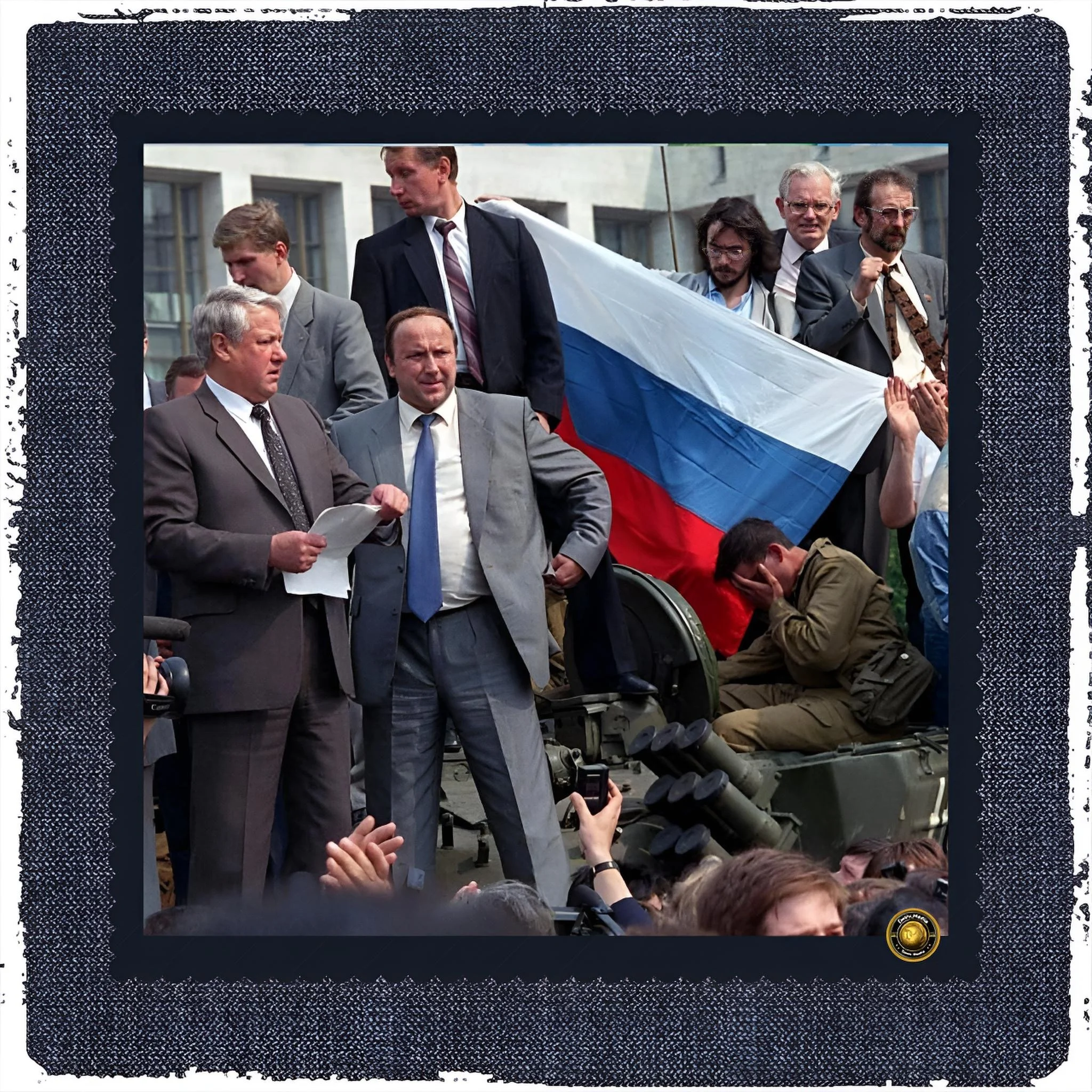
The coup proceeded on 19 August 1991 with dramatic symbolism. Soviet tanks rolled into Moscow as the GKChP issued declarations of emergency. However, the plotters made a critical error that proved fatal to their enterprise: they failed to detain Boris Yeltsin, the recently elected president of the Russian Soviet Federative Socialist Republic. Yeltsin, learning of the coup, travelled immediately to the Russian parliament building (the “White House”) and organised resistance. Rather than attempting to flee or negotiate, Yeltsin rallied parliamentary deputies and Moscow citizenry to resist the coup militarily.[reddit]
The subsequent events unfolded with dramatic intensity. Tens of thousands of Moscow residents gathered spontaneously around the parliament building to defend it against potential military assault. Yeltsin stood on an armoured vehicle and addressed the crowd, calling for military and security force personnel to refuse to obey putschist orders. Military units sent to suppress the anti-coup protests faced crowds of civilians and encountered orders that conflicted with coup directives. The security personnel tasked with suppressing the demonstrations lacked conviction that the coup served legitimate purposes; many troops refused to fire on civilians.
By the evening of 21 August, the third day of the coup, it had collapsed. The putschists, recognising that their enterprise had failed, surrendered. Gorbachev was released from his dacha detention and returned to Moscow.
The political consequences of the failed coup proved far more consequential than the coup itself. Gorbachev, though nominally victorious in returning to office, emerged politically mortally wounded. He had been revealed as powerless: the Soviet elites closest to him had attempted a coup partly because Gorbachev had lost control of events. His authority, already eroded through glasnost-induced legitimacy crisis and perestroika-induced economic dysfunction, was obliterated by the revelation that he could not prevent his own detention or maintain the loyalty of his closest officials.
Boris Yeltsin, by contrast, emerged as the clear victor. Yeltsin’s defiance of the coup, his rallying of popular resistance, and his clear political leadership in the coup’s resistance made him the obvious power centre for those calculating future political prospects. The logic of elite calculation became evident: Gorbachev represented a weakening regime unable to maintain even the loyalty of its inner circle; Yeltsin represented rising power and an alternative political project (Russian sovereignty and democracy) that appeared increasingly viable.
The Cascade Consequences: From Coup Collapse to USSR Dissolution
The failed coup’s immediate consequences triggered a cascade of events that, within four months, produced complete Soviet dissolution. The cascade proceeded through elite defection, institutional collapse, and cascading republic independence declarations.
The first institutional consequence was the Communist Party’s collapse. Gorbachev himself issued a decree suspending Communist Party activities, effectively acknowledging that the party structure could no longer function as governing apparatus.
On 6 November 1991, Boris Yeltsin issued Decree 169 completely banning the Communist Party in Russia, with the justification that “as long as the CPSU structures exist, there can be no guarantee against one more putsch or a coup.” This decree formally dissolved a party that had ruled the Soviet Union for seventy-four years. The party that had survived revolution, civil war, Nazi invasion, and four decades of Cold War could not survive its elite’s loss of conviction and the failed coup that demonstrated its institutional incoherence.
The Communist Party’s dissolution had immediate cascading consequences. Party membership, which had been the basis of political and economic access throughout the Soviet period, became a political liability. Regional officials, economic managers, party functionaries, and security force commanders faced immediate incentives to distance themselves from the discredited Communist centre and seek accommodation with rising republican governments. Elite defection cascaded through the system as those with independent power bases calculated that their interests were better served outside the party structure and outside continued Soviet allegiance.
Simultaneously, republic independence declarations accelerated dramatically in the coup’s aftermath. Ukraine’s Verkhovna Rada adopted the Act of Independence on 24 August, immediately after the coup’s collapse. Ukraine’s declaration proved critical because Ukraine was the second-most economically and politically powerful Soviet republic. Without Ukraine, the Soviet Union could not continue as a multinational federation.
Central Asian republics, which had initially favoured a reformed union due to economic interdependence with Russia, began declaring independence as the cascade accelerated. Armenia voted 99 percent for independence in a September referendum and formally declared independence on 21 September. Tajikistan declared independence on 9 September; Turkmenistan on 27 October.
The final, crucial step occurred on 1 December 1991, when Ukraine held a referendum on independence. More than 90 percent of Ukrainian residents voted in favour of the Act of Independence. This result was politically decisive: Ukraine’s secession made continued Soviet existence mathematically impossible. The Soviet Union had been constructed as a multiethnic federation comprising fifteen republics. Russia alone could not constitute the USSR; Ukraine’s departure eliminated any possibility of preserving Soviet statehood in any meaningful form.
Eight days later, on 8 December 1991, the leaders of Russia (Boris Yeltsin), Ukraine (Leonid Kravchuk), and Belarus (Stanislav Shushkevich) signed the Belavezha Accords at a hunting lodge in Belarus.
The agreement declared that the Soviet Union had ceased to exist and would be replaced by a loose Commonwealth of Independent States without centralised authority or supranational institutions. The three Slavic republics that had signed the 1922 treaty creating the Soviet Union now signed an agreement dissolving it.
On 26 December 1991, the Soviet Union was formally dissolved. Gorbachev resigned as president of a position that no longer existed on 25 December 1991. The Soviet flag was lowered from the Kremlin and replaced with the Russian tricolour. The dissolution that had begun as controlled decline accelerated through demonstration effects and elite calculation cascades had reached formal completion.
Cause-and-Effect Analysis: The Cascade Mechanism of Institutional Collapse
The critical analytical question concerns causality: Did the Eastern Bloc collapse and the August coup cause the Soviet Union’s dissolution, or did they merely accelerate an already-terminal decline? The evidence suggests a more nuanced answer that emphasises contingency and causality interacting through cascading mechanisms.
The Soviet Union was undoubtedly in structural decline by the late 1980s. Economic stagnation, ideological exhaustion, and military overextension created vulnerabilities that no regime could indefinitely sustain. However, structural decline and institutional collapse are distinct phenomena. Regimes experiencing severe structural decline often persist for decades—the Ottoman Empire experienced two centuries of managed decline before dissolution; contemporary North Korea persists despite extraordinary structural dysfunction. The question is not whether the USSR faced underlying problems, but whether those problems necessarily produced dissolution by December 1991, or whether different political events could have produced different outcomes.
The Eastern Bloc collapse created a critical demonstration effect. Gorbachev’s decision not to intervene militarily in Eastern Europe was not inevitable—Soviet leaders had previously chosen military intervention in Hungary (1956) and Czechoslovakia (1968) to maintain hegemony.
Had Gorbachev authorised force in Eastern Europe, the cascade toward Soviet dissolution would have been substantially delayed, though underlying structural problems would have remained. The demonstration that Moscow would not use force to maintain satellite control directly influenced Soviet republican calculations regarding independence’s achievability.
The August coup’s failure was particularly contingent. Had the plotters succeeded in detaining Yeltsin as well as Gorbachev, or had the military obeyed coup directives to suppress Moscow protests, the coup could have succeeded in reimposing central authority. The coup’s failure was not determined by structural decline but by specific decisions and failures: the plotters’ poor organisation, the military’s reluctance to fire on civilians, Yeltsin’s decisive leadership, and popular resistance. The coup’s failure, once it occurred, proved to have irreversible consequences precisely because it demonstrated the regime’s inability to enforce obedience even among its own elite and security apparatus.
The causality connecting the Eastern Bloc collapse and the August coup to Soviet dissolution proceeds through elite calculation and demonstration effects. The Eastern Bloc collapse signalled that Moscow would not use force to prevent peripheral secession, thereby altering the cost-benefit calculus of Soviet republican independence movements.
The August coup’s failure signalled that Moscow’s central authority had completely evaporated and that alternative power centres (Yeltsin’s Russian republic) could successfully challenge and prevail over the Soviet centre. Each event made independence appear more politically achievable to republican elites; each event accelerated elite defection cascades as regional actors calculated that their interests were better served outside Soviet allegiance.
Without the Eastern Bloc collapse, Soviet republics would have faced greater uncertainty about Moscow’s willingness to use force to prevent secession, and elite defection cascades would have been slower. Without the August coup’s failure, Gorbachev might have recovered some authority, and elite uncertainty about the regime’s viability might have been reduced. Neither event alone determined dissolution, but together they created cascading effects through which structural vulnerabilities translated into institutional collapse.
The Signal of Weakness: How Non-Use of Force Altered Strategic Calculation
A particularly significant mechanism through which the Eastern Bloc collapse affected Soviet stability concerns the strategic signal created by Moscow’s non-use of force. Throughout the Soviet Union’s history, peripheral control had been maintained through credible threat of military force.
The Hungarian Revolution of 1956 was suppressed through Soviet military intervention; the Prague Spring of 1968 was crushed by Warsaw Pact invasion; the Baltic independence movements of the late 1980s were met with Soviet military occupation and, in Vilnius in January 1991, military violence.
Gorbachev’s refusal to authorise force in Eastern Europe—motivated by his commitment to perestroika and his assessment that force would destroy his domestic reform agenda—created what game theorists term a “credibility problem.” If Moscow would not use force to maintain control over Eastern European satellites where the Soviet Union had historical dominance and strategic interests, would Moscow use force to prevent Soviet republics from seceding?
The answer became obvious: if Poland, Hungary, Czechoslovakia, and East Germany could transition away from communism without Soviet military response, then surely Soviet republics—possessing greater legitimacy claims as constituent parts of the federation rather than external satellites—could achieve independence.
The parade of sovereignties proceeded in precisely this logical sequence. The Baltic states, which had never voluntarily joined the USSR (incorporated through Soviet military occupation in 1940), moved earliest toward independence, calculating that Soviet response would be limited to economic pressure or military occupation rather than systemic efforts to restore control.
Lithuania’s independence declaration in March 1990 was met with Soviet economic blockade and military intimidation but not with comprehensive military suppression. This demonstrated to other republics that independence was achievable even against Soviet opposition—the centre lacked either conviction or capacity to comprehensively suppress secessionism through force.
The August Coup as Demonstration of Institutional Incoherence
The August coup attempt exposed, with dramatic clarity, the Soviet regime’s institutional incoherence. The coup was organised by the Soviet regime’s most senior officials: the Defence Minister, KGB chief, Vice President, Prime Minister, and other top-ranking officials. If these individuals, controlling security and military apparatus, could not enforce obedience to coup directives even within their own institutions, the regime’s fundamental mechanism of control had evaporated.
The military units sent to suppress Moscow anti-coup protests refused to fire on civilians. This refusal was not due to popular sentiment—military discipline historically operates independently of popular will. Rather, the refusal reflected military officers’ calculation that the coup lacked legitimacy and that suppressing civilians in defence of a failing regime was not worth the sacrifice. The security apparatus, tasked with defending the regime through force, had lost conviction that the regime deserved defence.
The coup’s failure consequently had magnified consequences. It demonstrated to elites throughout the Soviet system that the regime could not maintain discipline even at the highest levels, that military and security forces would not obey orders to suppress opposition, and that alternative power centres could successfully challenge the Soviet authority. These demonstrations triggered rapid elite defection: those calculating future prospects recognised that Yeltsin’s rising power and Russian republic offered superior prospects to remaining within the Soviet structure.
Conclusion
Contingency and Causality in Soviet Dissolution
The Eastern Bloc collapse and the August 1991 coup attempt did not inevitably cause Soviet dissolution, nor were they mere symptoms of underlying decline operating independently of these events. Rather, they functioned as critical junctures wherein specific political decisions and events created cascading consequences that accelerated and shaped the Soviet Union’s trajectory toward dissolution.
The Eastern Bloc collapse demonstrated Moscow’s unwillingness or inability to use force to maintain control, fundamentally altering the strategic calculation of Soviet republics regarding independence. The August coup’s failure demonstrated the regime’s institutional incoherence and accelerated elite defection cascades. Together, these events compressed the timeline of Soviet dissolution from potentially decades of managed decline into a four-month cascade toward complete institutional collapse.
The evidence suggests that the Soviet Union’s underlying structural problems would have eventually produced dissolution without these specific events. However, the particular timing, mechanism, and sequencing of that dissolution were substantially determined by the Eastern Bloc collapse and the August coup. Alternative political events—successful suppression of Eastern European movements, successful execution of the August coup, Yeltsin’s capture or assassination—would have produced substantially different trajectories.
The significance of these events for contemporary analysis lies not in their uniqueness but in their demonstration of how political contingency operates within structural constraints. Regimes experiencing serious structural problems remain vulnerable to critical junctures wherein specific political events create cascading consequences.
Understanding these mechanisms permits more sophisticated analysis of contemporary authoritarian regimes facing comparable vulnerabilities, in which contingent political events might trigger cascading institutional collapse.