Martin Luther King Jr.: Autobiography, Struggle, Legacy, and Scholarly Analysis
Foreward
Prefatory Observations on Textual Genesis and Epistemological Status
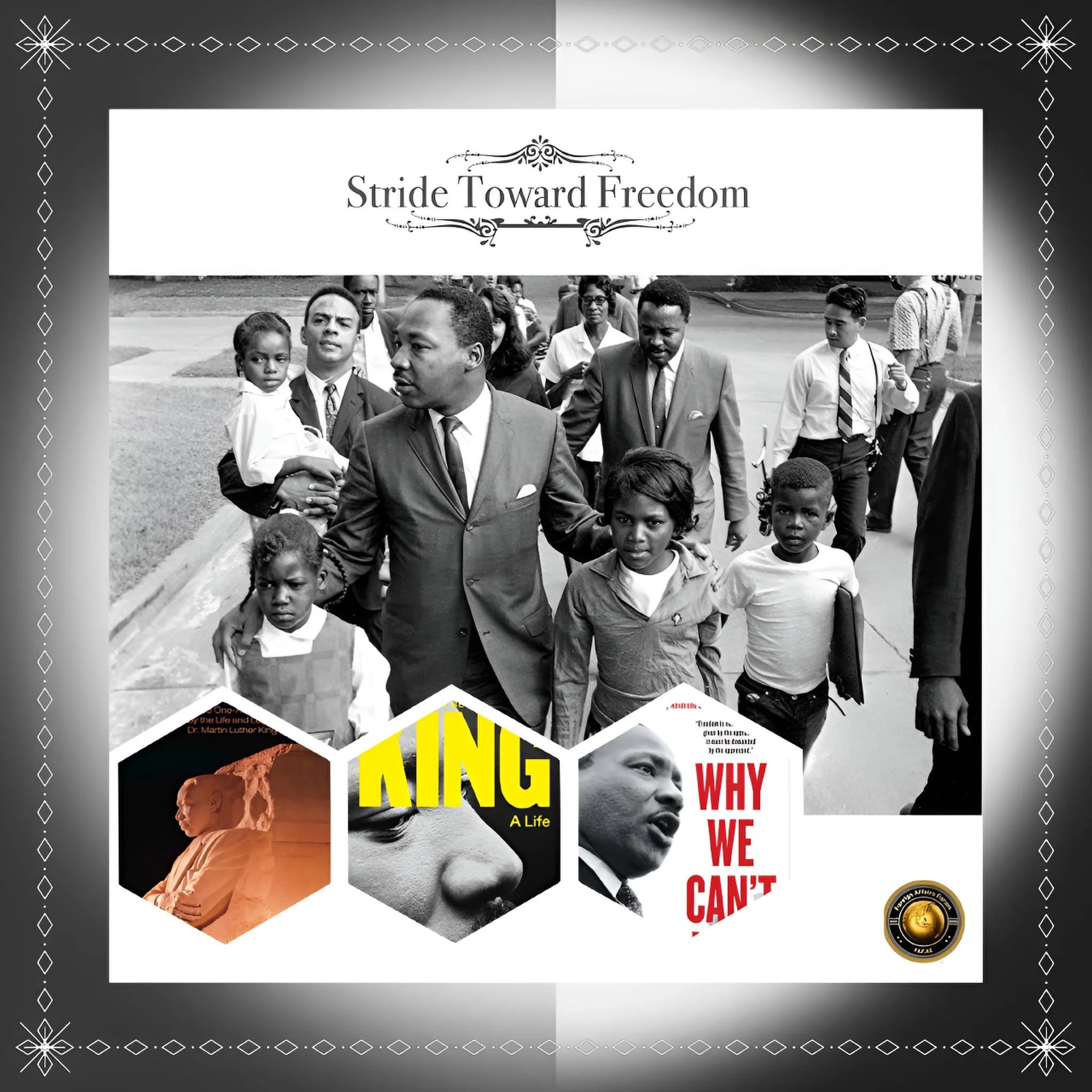
*Stride Toward Freedom: The Montgomery Story* (1958) constitutes far more than a mere phenomenological chronicle of the Montgomery Bus Boycott; rather, it functions as a deliberately constructed philosophical attestation wherein King transmutes what might have devolved into sensationalized reportage into a comprehensive theodicy reconciling Christian soteriology with Gandhian methodology and American constitutional republicanism.
The work emerged through the dialectical tension between publisher commercial incentives and King's intellectual ambitions—a generative friction through which King seized the opportunity to construct what one might characterize as systematic philosophical testimony.
This autobiographical undertaking necessarily encompassed the quotidian dimensions of transformative struggle: familial menace, interpersonal friction among organizational cadres, and the deliberate cultivation of what one might term *magnanimous clemency* toward oppositional interlocutors.
Rather than trafficking in hagiographic mythology, King's memoir instantiates a rigorously honest phenomenological account of the existential expenditures attending nonviolent commitment.
The memorable formulation—"fight for their rights with the weapon of love"—encapsulates the central paradox animating King's philosophical architecture: nonviolence reconceived not as passive acquiescence but rather as disciplined, intentional resistance constituting what one might designate as *praxis*—the integration of theoretical understanding with transformative action.
This conceptualization directly repudiated conventional interpretations of nonviolence as constituting moral weakness or psychological capitulation, reframing it instead as demanding extraordinary moral fortitude and sophisticated strategic calculation.
Intellectual Synthesis and Philosophical Systematization
The Forging of Nonviolence as Methodology and Ontological Commitment
King's primary intellectual endeavor involved synthesizing three historically disparate philosophical and theological traditions into a coherent, internally consistent framework for systematic social transformation.
The trajectory documented in *Stride Toward Freedom*—from seminary neophyte encountering Gandhian philosophy through abstract study to revolutionary practitioner recognizing nonviolence as disciplined methodology of resistance rather than ineffectual sentimentalism—illuminates the epistemological rigors through which King arrived at his mature philosophical positions.
The Montgomery Bus Boycott (1955–1956) functioned as the crucible within which abstract philosophical commitment crystallized into embodied praxis.
The incipient uprising, catalyzed by Rosa Parks's principled refusal to relinquish her seat to a white passenger, achieved extraordinary organizational coordination: the Montgomery Improvement Association, operating under King's intellectual leadership, mobilized approximately 90 percent participation from Black Montgomery's population across thirteen consecutive months.
This sustained mobilization occurred under conditions of extraordinary duress: King himself faced criminal indictment, confronting the Hobson's choice between monetary penalty ($500) or custodial incarceration (386 days).
Yet the movement persisted with remarkable organizational cohesion, ultimately culminating in a Supreme Court adjudication delegitimizing municipal bus segregation as constitutionally impermissible.
Within this crucible of collective struggle there crystallized King's sophisticated philosophical commitment to what he designated "creative maladjustment"—a concept positing that authentically moral individuals possess an imperative ethical obligation to cultivate profound, sustained discontent regarding injustice, to consciously resist the psychological phenomenon of habituation to oppression, and to transmute such disquiet into collectively organized, strategically coherent action.
This conception represents a fundamental philosophical opposition to conventional psychological paradigms emphasizing adjustment and equilibrial homeostasis as indicators of psychological flourishing.
King's insistence upon "cosmic discontent" with systemic brutality posits such discontent as prerequisite for authentic moral agency rather than as psychological pathology warranting therapeutic remediation.
Exegetical Analysis of Signature Quotations and Their Philosophical Architectonics
"I Have a Dream": Declarative Aspiration as Political Weaponization
The celebrated pronouncement—"I have a dream that one day this nation will rise up and live out the true meaning of its creed: 'We hold these truths to be self-evident, that all men are created equal'"—delivered during the March on Washington (August 28, 1963), constitutes a masterwork of rhetorical strategy and philosophical sophistication.
By invoking the Declaration of Independence itself as the normative standard against which contemporary American reality should be measured, King engaged in what one might designate as *normative inversion*: he transformed the founding documents from instruments of mystification legitimating existing hierarchies into weapons of critique exposing the chasm between professed ideals and concrete historical practices.
The spontaneous deviation from prepared remarks—catalyzed when gospel singer Mahalia Jackson encouraged King to articulate his visionary aspirations—represents not mere improvisational flourish but rather the emergence of what one might characterize as the *prophetic imagination*.
This rhetorical reorientation transcended narrowly juridical argumentation to proffer a *soteriological vision* of integrated community—not merely legal compliance but rather the substantive reconstitution of social relations through spiritual and moral transformation.
"Injustice Anywhere": The Metaphysics of Interconnected Justice
The formulation from the *Letter from Birmingham Jail* (April 16, 1963)—"Injustice anywhere is a threat to justice everywhere.
We are caught in an inescapable network of mutuality, tied in a single garment of destiny"—articulates a sophisticated philosophical anthropology grounded in natural law theoretical traditions.
King's assertion that justice operates as an indivisible, systematically integrated whole—that localized suffering anywhere necessarily threatens the moral fabric of the entire social corpus—posits a *holistic metaphysics* of social relations.
Responding to ecclesiastical interlocutors who counseled patience and legal gradualism, King marshaled theological authorities (Augustine, Aquinas) to construct a natural law argument contending that citizens possess a transcendent moral obligation to transgress unjust positive legal ordinances, provided such civil disobedience manifests willingness to accept juridical consequences and thereby performatively appeals to the community conscience.
"True Peace": The Critique of False Consensus
The assertion—"True peace is not merely the absence of tension; it is the presence of justice"—articulates King's fundamental refutation of what one might designate as *consensus through suppression*.
Surface tranquility purchased through the systematic obliteration of legitimate grievance constitutes not authentic peace but rather refined oppression.
Genuine peace demands active, strategic struggle for justice, presupposing that transformative social transmutation necessarily entails periods of what King termed "constructive tension"—disruption experienced by beneficiaries of existing hierarchies as destabilizing yet morally necessary for systemic renovation.
Nonviolence Transposed from Tactic to Ontology
By the concluding phases of his existential trajectory, King advanced the proposition that nonviolence transcended mere tactical calculation or strategic methodology to constitute a *comprehensive ontological commitment*—a determinate way of being fundamentally antagonistic to both external violence of action and internal violence of spirit.
This universalization of nonviolent praxis distinguished King's philosophy from purely consequentialist or utilitarian frameworks, repositioning it instead as *spiritual discipline* and foundational moral stance toward existence itself.
The antithetical formulation—"Darkness cannot drive out darkness, only light can do that. Hate cannot drive out hate, only love can do that"—posits a metaphysical proposition: violence perpetuates and regenerates the very conditions it purports to overcome, engendering cyclical brutality that corrupts both perpetrators and victims.
Nonviolent response, conversely, exemplifies love reconceived as active force—pursuing the transformation and moral reconstitution of adversaries rather than their annihilation.
Comprehensive Structural Analysis: The Triadic Framework of Systemic Evil
By the final years of his intellectual development, King articulated a sophisticated structural analysis identifying three interlocking pathologies—poverty, racism, and militarism—as mutually constitutive dimensions of a unified oppressive apparatus.
Rather than conceptualizing these as discrete phenomena amenable to isolated remediation, King demonstrated their systematic reinforcement and organic integration.
Poor People's Campaign (1968)
The campaign represented an attempted construction of what one might term a *counter-hegemonic bloc*—an interracial coalition simultaneously addressing economic injustice and racial discrimination through unified organizational practice.
This expansive theoretical framework illuminated King's intellectual evolution from civil rights activist narrowly focused upon segregation's juridical abolition to comprehensive social theorist interrogating how capitalist inequality, imperial militarism, and racial hierarchy mutually sustained one another within an integrated system.
King’s *Riverside Church* address (April 1967)
King speech delivered precisely one year antecedent to his assassination—constituted a fundamental philosophical rupture: King's denunciation of American military intervention in Vietnam as fundamentally incompatible with authentic democracy marked his deliberate transgression of the boundaries circumscribing acceptable political discourse, challenging what one might designate as the *foreign policy orthodoxy* of the American state apparatus.
Systematized Philosophy: The Six Constitutive Principles of Nonviolent Praxis
The King Center has systematized his philosophical corpus into six foundational principles.
Principle One
Nonviolence as Active Resistance
Nonviolence constitutes not cowardice but rather *disciplined courage*—the systematic opposition to injustice through strategic engagement rather than passive accommodation.
This reconceptualization directly contested public comprehension of nonviolence as weakness, reframing it instead as demanding extraordinary moral fortitude and intellectual sophistication.
Principle Two
The Beloved Community as Teleological Objective
King conceptualized integration not as superficial legal compliance but rather as substantive, interpersonal, and inter-group living characterized by authentic mutuality.
The "Beloved Community" represented an achievable rather than utopian objective, grounded in reconciliation and mutual recognition transcending instrumental tolerance.
Principle Three
Opposing Evil While Acknowledging Humanity
Nonviolence recognizes that those perpetrating injustice remain themselves *victims* of the systems they enact, permitting fierce structural critique while maintaining the humanity of adversarial interlocutors.
This philosophical subtlety enabled uncompromising analysis of unjust institutions without descending into personal animus.
Principle Four
Redemptive Suffering
King maintained that voluntary suffering endured for just causes possesses intrinsic transformative and pedagogical potentiality for both resisters and the broader society.
The acceptance of juridical punishment for civil disobedience dramatizes injustice's reality and performatively appeals to collective conscience.
Principle Five
Love as Nonviolent Foundation
Nonviolent love encompasses *spontaneous, disinterested, creative commitment* rather than sentimentalized emotion, demanding active dedication to even adversarial welfare.
Principle Six
Metaphysical Optimism Regarding Justice's Ultimate Triumph
The cosmos itself, King insisted, inherently favors justice, grounding nonviolent action in metaphysical conviction despite empirical setbacks and provisional defeats.
Contemporary Institutional Persistence of Structural Inequality: The Unrealized Visionary Project
Statistical Documentation of Systemic Continuity
King's aspirational vision remains substantively unrealized across multiple dimensions of American social formation.
Statistical evidence documents the systematic persistence of inequalities King targeted
Black Americans confront poverty rates nearly triple those of white Americans (18.8% versus 7.3%), with homeownership disparities remaining pronounced (44.1% versus 73.7%).
Educational attainment demonstrates persistent stratification notwithstanding the Brown v. Board of Education adjudication: merely 22 percent of Black Americans aged 25+ possess baccalaureate credentials compared to 34 percent of white Americans.
Most disturbingly, incarceration statistics reveal particularly egregious structural violence
Black Americans constitute 34 percent of the carceral population despite constituting approximately 13 percent of the general population, while experiencing police lethal violence at rates 2.8 times exceeding white Americans.
The Domestication and Ideological Neutering of King's Radical Vision
Contemporary scholarship and activist analysis emphasize that public commemoration has substantially "domesticated" King's legacy, foregrounding his dream of racial concord while systematically obscuring his fierce structural critique.
The triumphalist narrative of 1960s–1970s "progress" functioned to obfuscate King's own accelerating radicalism.
Contemporary observance frequently recycles *sanitized* King utterances while systematically suppressing his characterization of police as "enforcers of systemic oppression" within northern municipalities, his diagnosis of "white racism" as America's fundamental pathology, and his insistence that "riots" constitute rational responses to intolerable conditions when transmuted into organized resistance.
King's own 1968 pronouncement—"The thing wrong with America is white racism"—remains substantially more radical than contemporary mainstream political discourse acknowledges.
His observation that "large segments of white society are more concerned about tranquility and the status quo than about justice and humanity" continues to diagnose American political pathologies with remarkable prescience.
Institutional Violence and the Persistence of Police Brutality
King's critique of police violence transcended characterization of southern theatrical racism to encompass systemic northern brutality.
By recognizing that "police misconduct in the north" received rationalization and toleration whilst southern populations "trembled with outrage," King articulated how institutional violence concentrates state coercive apparatus against Black communities.
Contemporary movements identifying Black Lives Matter as King's ideological heir articulate defensible claims: King explicitly declared, "We can never be satisfied as long as the Negro is the victim of the unspeakable horrors of police brutality"—a pronouncement directly pertinent to contemporary policing practices.
The Contested Contemporary Efficacy of Nonviolence
King's commitment to nonviolent methodology remains deeply contentious.
Critics originating within Black communities argue that his later intellectual evolution toward confronting systemic poverty and imperial militarism left unresolved philosophical tensions regarding nonviolence's efficacy when confronted with state violence.
Yet over half a century subsequent to his assassination, nonviolent movements have demonstrated repeatedly their capacity for catalyzing significant social transformations: the gay rights movement, Solidarity in Poland, the Green Revolution in Iran, and recent demonstrations encompassing the Women's March and Black Lives Matter activism all draw—sometimes explicitly, frequently implicitly—upon the nonviolent frameworks King theorized and instantiated.
Philosophical Implications and Analytical Lessons: Theoretical Extrapolations for Contemporary Struggle
First Lesson: Systemic Integration Rather Than Compartmentalized Analysis
King's explication of the triadic interconnection (poverty, racism, militarism) models a sophisticated epistemological framework recognizing that discrete injustices constitute integrated, mutually reinforcing systemic wholes.
Contemporary movements addressing climate alteration, police brutality, economic stratification, and military expenditure independently frequently neglect King's crucial insight that *efficacious resistance requires analyzing systemic interdependencies*.
Contemporary policy deliberations persist in compartmentalizing these phenomena despite their substantive constitutional integration.
Second Lesson: Natural Law the Theory as Transcendent Normative Framework
King's philosophical grounding in natural law traditions distinguished his civil disobedience from utilitarian calculation or pragmatic convenience.
His insistence that unjust ordinances possess no legitimate normative authority—borrowing Augustine's principle that injustice nullifies legality—remains essential counterweight to legalistic argumentation restricting activism to "constitutional channels," particularly given legislatures' increasingly repressive interdictions upon protest itself.
Third Lesson: Creative Maladjustment as Psychological and Moral Necessity
King's conceptualization of creative maladjustment fundamentally contests psychology's emphasis upon adjustment and equilibrial homeostasis as indicators of mental flourishing.
His insistence that morally conscious individuals must deliberately cultivate sustained discontent regarding injustice contradicts contemporary therapeutic culture's emphasis upon individual well-being through acceptance and adaptation.
This carries substantial implications for activist praxis: sustainable resistance necessitates cultivating *principled anger* and *strategic hope* rather than pursuing false peace through accommodation.
Fourth Lesson: Moral Vision as Strategic Political Weaponization
King's rhetorical virtuosity derived substantially from his invocation of America's unfulfilled ideals as philosophical weaponry against its practices, deploying constitutional and religious idioms to hold the nation accountable to its professed commitments.
Contemporary activism might strategically leverage analogous tactics: rather than framing demands as radical departures from established norms, King's methodological approach insisted that justice represents *restoration of authentic American principles betrayed through historical practice*.
This reconceptualization proves potent against accusations of utopianism.
Fifth Lesson: The Insufficiency of Attitude Transformation Without Institutional Reconstitution
Despite nonviolence's considerable moral power, King's own experiential trajectory demonstrated that individual conscience conversion and legislative accomplishment prove insufficient without fundamental institutional restructuring.
The Fair Housing Act, enacted days subsequent to his assassination, represented legislative achievement, yet housing discrimination persisted through ostensibly "non-racial" mechanisms (redlining patterns, predatory financial practices).
Contemporary activists must apprehend that juridical victories demand organizational capacity for enforcement and substantive structural transformation to realize them meaningfully rather than merely formally.
Sixth Lesson: The Ethical Impermissibility of Indefinite Postponement
King's categorical rejection of patient gradualism—"justice too long delayed is justice denied"—remains urgently pertinent. Opponents of accelerated social transformation consistently counsel deferral, invoking prudential caution and stability.
King's insistence that oppressed populations need not endure indefinite postponement of their liberation constitutes an essential moral principle preventing endless deferral of justice claims.
Conclusion
The Unfinished Revolutionary Project and Its Ongoing Summons
Martin Luther King Jr.'s autobiographical testimony, philosophical development, and systemic legacy reveal a theorist substantially more complex, rigorous, and radical than popular commemoration acknowledges.
His intellectual trajectory—from Montgomery's bus boycott organizer to systemic critic of American militarism and capitalist accumulation—demonstrates extraordinary moral seriousness and intellectual courage.
The persistent structural inequalities documented herein—material poverty, carceral confinement, police violence, educational and economic stratification—constitute empirical evidence that the conditions King contested remain substantially unaddressed.
Yet King's philosophical heritage transcends merely unfulfilled aspiration.
His systematized framework of nonviolent resistance, grounded in natural law ethics, commitment to the Beloved Community, and structural analysis of systemic evil continues furnishing intellectual and moral resources for contemporary emancipatory struggles.
His insistence that justice operates as indivisible totality and that creative maladjustment constitutes moral necessity rather than pathology challenge contemporary fragmentation of activism and therapeutic individualism.
The most consequential lesson extracted from King's existential project may be precisely this: transformative social renovation demands simultaneously maintaining coherent moral vision, engaging strategic struggle with sophisticated organizational capacity, accepting suffering's redemptive potentiality, and refusing despair when victories prove incomplete and provisional.
In this fundamental sense, King's "unfinished work" persists not merely as historical artifact but rather as living philosophical summons to those committed to advancing justice within an epoch characterized by persistent structural inequality and systemic brutality.