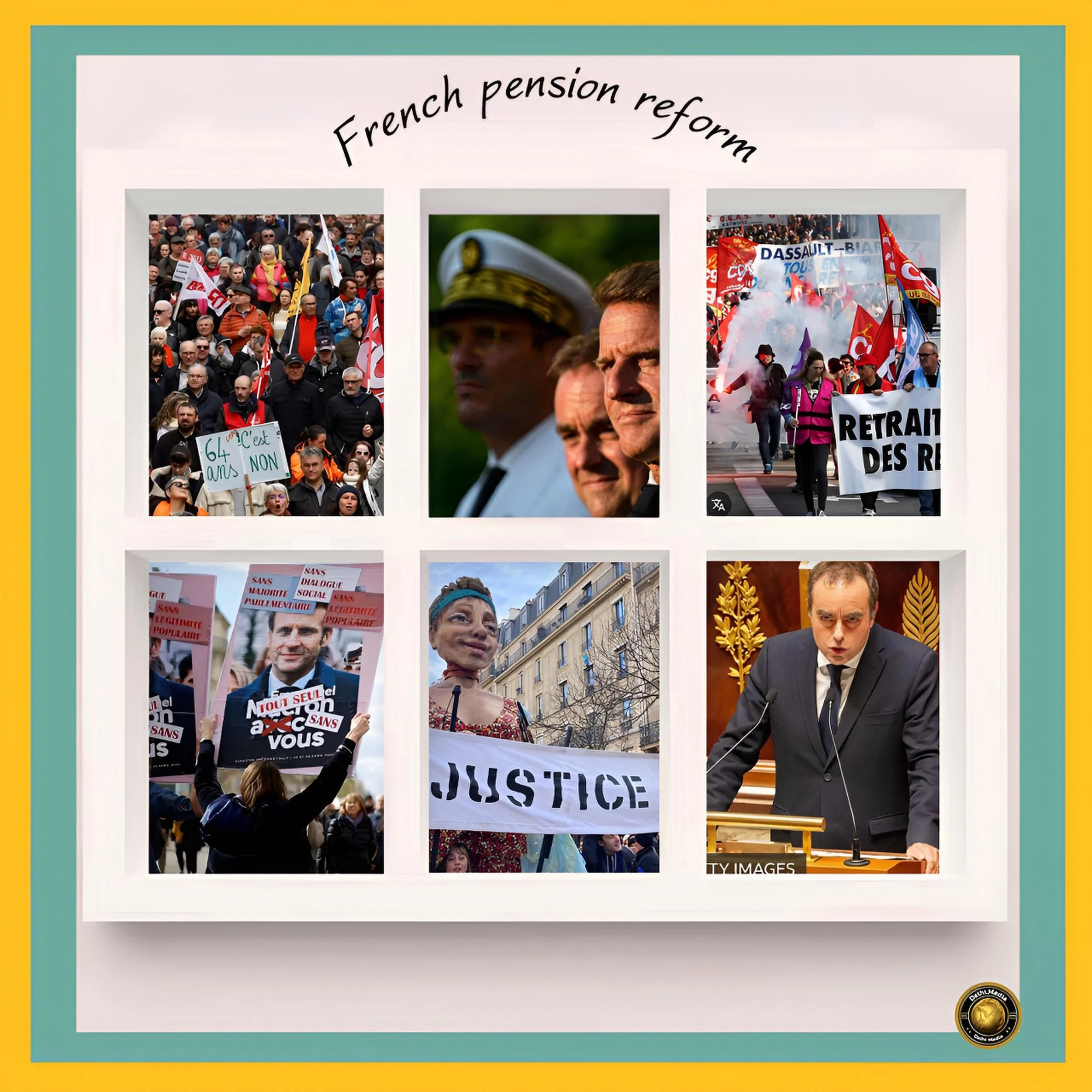
French Pension Reform Pause: A Pyrrhic Victory That Masks Deeper Dysfunction
Introduction
The pension reform suspension represents a strategic reprieve for Macron’s government rather than genuine stability—a short-term fix that comes at tremendous cost to the government’s already compromised fiscal consolidation agenda and symbolic legacy.
What Happened: The Parliamentary Vote
On November 12, 2025, France’s National Assembly overwhelmingly voted to suspend the controversial 2023 pension reform by 255 to 146 votes.
The measure, negotiated as a critical concession to the Socialist Party, pauses the planned increase of the legal retirement age from 62 to 64 until January 1, 2028—effectively postponing the reform until after the 2027 presidential election.
This suspension will benefit approximately 3.5 million French citizens who will be able to bring forward their retirement by several months.
Prime Minister Sébastien Lecornu announced the suspension on October 14 as part of a final effort to secure Socialist support and avert a no-confidence motion against his government.
Without Socialist backing, Lecornu would have faced a fatal coalition of far-right, far-left, and centrist opponents—a political arithmetic that effectively made the Socialists the kingmakers in France’s fractured 577-seat National Assembly.
A Government That Lives—But How Precariously?
The pension concession achieved its immediate objective: government survival for now. However, this survival comes with severe qualifications.
Lecornu’s government remains deeply fragile, having cycled through leadership changes with alarming frequency.
Macron has appointed seven prime ministers in eight years—five in just the past two years alone.
This represents an extraordinary breakdown of executive stability.
Lecornu himself nearly collapsed after just 14 hours when he first attempted to form a cabinet in early October, only to be reappointed days later after negotiations with parliamentary factions.
The pattern reveals a government structure held together by temporary bargains rather than sustainable coalitions.
Each concession—whether on pensions, wealth taxes, or constitutional procedures—buys time but erodes the government’s ability to implement coherent policy.
The Socialist Party’s conditional support remains contingent.
After securing the pension suspension, the Socialists immediately pivoted to demanding a wealth tax on ultra-rich households and mega-inheritances.
Finance Minister Roland Lescure has refused to include such a tax in the budget.
As Socialist leader Olivier Faure warned: if no significant progress on wealth taxation materializes, the party reserves the right to file a no-confidence motion.
The Budget Crisis: Where Consolidation Goes to Die
The pension pause strikes at the heart of France’s most urgent fiscal challenge. France faces the eurozone’s largest budget deficit at 5.8% of GDP in 2024, well above the EU’s 3% ceiling, with public debt standing at 113-116% of GDP.
These figures exclude only Greece and Italy within the European Union.
Lecornu had initially targeted deficit reduction of €30 billion for 2026, aiming to cut the deficit to 4.7% of GDP.
The pension suspension directly undermines this objective. The suspension costs an estimated €300 million in 2026 and €1-2.1 billion in 2027—expenses that cannot now be offset by the corresponding savings from raising the retirement age.
Observers and fiscal watchdogs have already signaled that deficit targets will not be met. Goldman Sachs revised upward its 2025 deficit forecast to 5.5% of GDP, expecting “minimal progress” in deficit reduction.
The European Commission projects France’s deficit will actually worsen to 5.7% of GDP in 2026.
The Haut Conseil des Finances Publiques (France’s fiscal watchdog) warned that the government’s economic projections are “not credible” and rely on “uncertain and unverified assumptions.”
Roland Lescure, the new Finance Minister, offered only uncertain reassurance: “We’ll get there” on the budget—a phrase that reflects the desperation of a government hoping rather than planning.
The Macron Legacy: Frozen at a Critical Juncture
The pension reform suspension crystallizes the tragedy of Macron’s presidency. What was positioned as a flagship reform—the symbolic centerpiece of his second-term agenda—has now been indefinitely postponed under political pressure.
This is not merely a tactical retreat but a fundamental reversal of one of Macron’s major economic achievements.
Macron’s broader economic record presents a deeply mixed picture. When he took office in 2017, France’s debt-to-GDP ratio stood at roughly 98.5%.
By 2024, it had exploded to 113-116%, placing France among Europe’s worst performers.
The divergence from eurozone averages has been stark: when Macron arrived, France’s debt was 11 percentage points above the eurozone average; by 2024, that gap had widened to 25 percentage points.
Several factors contributed to this deterioration. The pandemic’s extraordinary fiscal response (reaching an 8.9% deficit in 2020) left lasting imprints.
Energy subsidies following Russia’s invasion of Ukraine cost approximately €45 billion in 2023 alone—roughly 1.9% of GDP. However, these cyclical pressures have been compounded by structural spending patterns.
France’s public sector spending consistently exceeds that of any other OECD member, accounting for over 57% of GDP in 2024. Social protection spending alone—at 23.3% of GDP—is the second-highest in the EU, trailing only Finland.
On growth, Macron’s record also disappoints. After early momentum—unemployment fell from 10% to 8% under his initial labor reforms—growth has stalled.
Youth unemployment hovers stubbornly around 20%. France’s growth rate remains well below eurozone averages, and industrial capacity has continued to decline as a share of economic output.
The pension reform suspension symbolizes the exhaustion of Macron’s reform agenda.
Early ambitions to systematically restructure France’s welfare state through a combination of labor market liberalization and controlled social spending have given way to a defensive crouch.
The government no longer even attempts to pass budgets through standard parliamentary procedures; instead, it negotiates sector-by-sector concessions with opposition groups, each retreat buying temporary survival but cumulatively preventing coherent fiscal reform.
A Political System Under Strain
France’s political system itself has become dysfunctional under the pressures created by Macron’s June 2024 snap election gamble.
That election—intended to strengthen his hand—destroyed his parliamentary majority and fractured the National Assembly into three hostile blocs: Macron’s centrist Renaissance, the far-right National Rally (RN), the far-left La France Insoumise (LFI), and various other factions including Republicans and Socialists.
Without a clear majority, the government cannot pass legislation through normal parliamentary procedures.
Lecornu has pledged not to use Article 49.3 of the Constitution (which allows governments to bypass parliamentary votes on the budget), a restraint that makes his legislative position even more precarious.
The absence of this procedural option means every budget line requires negotiation, and every negotiation introduces vulnerability to extortion-like demands from swing parties.
This fragmentation has produced structural governance failure. France has experienced institutional crises around budget passage that would have been unthinkable even five years ago.
The country came perilously close to operating under an emergency provisional budget regime in late 2024, a constitutional backstop last seriously invoked in 1980.
Conclusion
The Path Ahead: Existential Questions
The pension suspension raises three critical questions about France’s trajectory through 2027:
First, can the government survive the remainder of the 2026 budget process?
Parliamentary debate and amendment processes run through December 23, and multiple opportunities remain for opposition factions to force another government collapse.
The Socialist Party’s renewed threats over wealth taxation demonstrate that each concession opens new vulnerabilities.
Second, what becomes of fiscal consolidation?
With the pension reform postponed and its savings eliminated from the budget equation, France’s deficit reduction path becomes mathematically impossible to achieve through spending cuts alone.
Either taxes must rise substantially—economically dangerous in a slow-growth environment—or deficit targets must be abandoned.
Pierre Moscovici, head of the public audit office, warned that France’s debt could exceed Italy’s by 2029 unless meaningful consolidation occurs. Instead, France appears headed toward persistent 5.5-5.7% deficits indefinitely.
Third, what remains of Macron’s presidency beyond survival?
With 16 months remaining until the April 2027 election, Macron enters the final phase of his term with his approval rating at 26%—dangerously close to François Hollande’s historic lows.
His economic legacy is debt accumulation and stalled growth; his political legacy is constitutional strain and repeated government collapses.
The pension reform suspension—the indefinite postponement of his signal second-term initiative—symbolizes an administration no longer advancing any positive agenda, merely fighting for continuity.
In essence, the pension reform pause buys the government another few weeks or months of political survival at the cost of permanent abandonment of meaningful fiscal reform.
This is not governance but managed decline, a trajectory that guarantees neither stability nor solutions to the underlying fiscal and growth challenges that define the French crisis.