Mali’s Security Crisis: Strategic Analysis of JNIM’s Threat to Bamako and the Sahel
Executive Summary
Mali faces an acute existential threat from JNIM, which has transitioned from a primarily northern insurgency to a coordinated campaign employing economic warfare, military strikes, and psychological operations to capture the capital.
The group’s strategic shift represents a qualitative escalation that directly threatens state collapse.
Introduction
The Immediate Threat: JNIM’s Economic Siege and Military Proximity
JNIM’s current strategy represents a fundamental evolution in jihadist tactics across the Sahel.
Rather than attempting a frontal assault on Bamako’s military installations, the Al-Qaeda affiliate has implemented a sophisticated multi-layered blockade campaign that functions as both military siege and economic coercion.
Since early September 2025, JNIM has systematically cut off fuel supply corridors from Senegal and Côte d’Ivoire—the two primary sources supplying approximately 95% of Mali’s petroleum.
This has created cascading humanitarian crises: fuel shortages have forced school and university closures, created hours-long queues at gasoline stations, disrupted electricity supply, and created widespread blackouts across the capital.
The blockade is not a conventional military siege.
Rather, it functions as a networked disruption of critical infrastructure corridors—particularly the vital Dakar-Bamako and Conakry-Bamako trade routes that carry over 60% of Mali’s total trade.
JNIM has simultaneously established control checkpoints across western Mali along the borders with Mauritania, Guinea, Côte d’Ivoire, and Senegal, demonstrating territorial consolidation and the capacity to enforce coordinated operations across vast geographic distances.
Recent Operational Demonstrations: The Mariam Cissé Execution as Signaling
The execution of 20-year-old social media influencer Mariam Cissé on November 7, 2025, provides crucial insight into JNIM’s strategic communications objectives.
Cissé, who had approximately 90,000-140,000 TikTok followers, regularly posted pro-government military content and wore military fatigues in videos showing solidarity with Malian armed forces.
JNIM militants allegedly affiliated with the group abducted her on November 6 from a weekly market fair in Tonka (a town in the Timbuktu region roughly 150 kilometers from Timbuktu) and brought her back to the town’s central square the following day.
Her public execution, witnessed by terrified residents and explicitly framed by perpetrators as a warning to anyone supporting the Malian army, demonstrated several critical dimensions of JNIM’s approach.
Information Operations
The targeting and execution of a digitally influential figure represents a deliberate strategy to intimidate the civilian population from using social media to support government forces or resist jihadist control.
Territorial Control Messaging
The fact that this occurred in a town where no Malian security forces are stationed (with the nearest military base 31 kilometers away) visually demonstrated JNIM’s effective governance authority over populated areas.
Psychological Warfare
The public nature of the execution, carried out in front of hundreds and with clear ideological framing, signals JNIM’s intent to consolidate both territorial and narrative control in areas under its influence.
Leadership and Strategic Objectives
JNIM operates under the leadership of Iyad Ag Ghali, a Tuareg militant who founded the Ansar Dine movement and was designated as a global terrorist by the US in 2013.
Contemporary prominent members include Yahya Abu Hammam (former AQIM emir in Timbuktu) and Amadou Kouffa (former Macina Liberation Front emir).
The organization’s formal objectives center on two primary goals.
(1) the expulsion of foreign military forces (particularly French and UN personnel who have since largely withdrawn)
(2) establishment of Islamic law across the Sahel region, which Ghali has publicly stated represents a strategy to expand presence across West Africa and train militants for operations against perceived enemies while distributing material resources to local communities.
While JNIM nominally seeks to build a Salafi-jihadist caliphate, operational analysis suggests the group’s primary near-term objective is not full state overthrow but rather achieving de facto governance through territorial control and coercive authority over populations, demonstrating that existing state structures cannot provide security or services.
JNIM’s Evolving Operational Capabilities
Recent assessments indicate JNIM has achieved significant operational maturity and tactical sophistication.
The group has
Reached a new level of operational capability enabling complex attacks involving drones, improvised explosive devices (IEDs), and large numbers of coordinated fighters against well-defended military installations.
Captured and seized large quantities of weaponry and military equipment from government forces.
Shifted tactical approach toward “greater political entrenchment,” increasingly positioning itself as a governing actor by seeking territorial control, establishing rudimentary governance structures, and cultivating local support through shadow administration in areas like Farabougou.
Demonstrated capacity for simultaneous multi-regional operations, coordinating blockade campaigns across western Mali while maintaining offensive operations in central regions.
JNIM has also pioneered a deliberate economic warfare component to its strategy, attacking fuel tankers and foreign-run mining and industrial facilities while imposing extortion taxes on communities and conducting kidnappings for ransom.
This represents strategic diversification beyond conventional combat operations toward a comprehensive coercive governance model.
Competing Jihadist Dynamics: JNIM vs. ISGS
The threat landscape is further complicated by rivalry between JNIM and the Islamic State in the Greater Sahara (ISGS).
While both groups formally compete for ideological and strategic supremacy, analysis indicates they maintain an implicit strategic truce underpinned by shared interest in targeting Sahelian security forces.
This represents a departure from their earlier open conflict (2019-2020), during which JNIM largely contained ISGS operations through superior tactical coordination and territorial consolidation.
ISGS operates primarily in the tri-border Liptako-Gourma region (encompassing portions of Mali, Burkina Faso, and Niger) and has expanded from an estimated 425 combatants in late 2018 to between 2,000-3,000 fighters by 2025—a four to sixfold increase.
However, JNIM has successfully excluded ISGS from central and western Mali, confining the Islamic State affiliate largely to rural northern and border zones.
Territorial Control and Military Challenges
Current territorial dynamics favor JNIM dramatically.
The group maintains established control over large swathes of rural regions spanning northern Mali, central regions around Mopti, and increasingly southwestern areas around Kayes and Nioro.
JNIM has also captured provincial capitals in Burkina Faso—including Djibo and Diapaga in May 2025—and temporarily took control of military and civilian infrastructure in these towns, demonstrating cross-border operational capacity.
The Malian military faces profound structural disadvantages in countering this distributed threat model.
The Armed Forces are organized for conventional warfare against conventional adversaries but confront an asymmetric conflict against a mobile, deeply entrenched insurgent force operating through decentralized cells that can rapidly adapt to local conditions. Key vulnerabilities include:
Geographic and logistical disadvantages
JNIM operates effectively in vast, semi-arid terrain with ungoverned routes that defy easy surveillance.
Terrain features favor guerrilla tactics—narrow roads, bush paths, and seasonal rivers create natural obstacles to mechanized military movement.
Structural organizational disadvantage
Unlike movements dependent on single command structures, JNIM operates as a highly decentralized network of semi-autonomous cells that can quickly adapt to state responses while exploiting grievances to recruit locally.
Each cell draws on local conditions independently, maximizing resilience.
Limited state presence
The Malian state has historically struggled to extend governance beyond urban centers like Bamako and Ségou.
Rural populations often view army arrivals as intrusion rather than protection, given decades of neglect, corruption, and documented abusive counterinsurgency practices that have alienated populations and eroded intelligence networks.
Military Government Capacity and International Support Limitations
The military junta led by General Assimi Goïta seized power in 2020 and again in 2021, consolidating control through successive coups ostensibly justified by security imperatives.
However, the junta has demonstrably failed to improve security outcomes.
Violence has actually escalated under junta rule: in early June 2025, JNIM assaulted multiple Malian army positions resulting in at least 30 fatalities at a single encampment; in September 2024, JNIM infiltrated Bamako itself, seizing the airport for several hours and attacking military barracks; and heavy confrontations in July 2024 near the Algerian frontier resulted in significant casualties for both Malian forces and Russian-supported Wagner personnel.
The junta extended its mandate through June 2025, granting Goïta an additional five-year renewable mandate through 2030 (eliminating promised civilian elections).
The defense budget for 2025 was set at 485 billion CFA francs (approximately $858 million), comprising 20% of the total budget—a figure critics argue is excessive given the ongoing economic crisis.
Russian military support, which was intended to provide an alternative security partnership following French military withdrawal, has proven substantially ineffective.
Approximately 80% of Mali’s Africa Corps consists of former Wagner personnel who transferred to the Russian Ministry of Defense following Wagner’s formal dissolution in June 2024.
However, Russian operations have failed to prevent JNIM’s expansion into central and western regions.
A particularly significant demonstration occurred on August 1, 2025, when JNIM ambushed a Russian convoy near Ténénkou in the Mopti region, killing an estimated 14 Russian personnel and over 35 Malian soldiers.
Tensions have emerged within the Malian junta regarding cooperation with Russian forces, who operate largely outside the Malian chain of command, appropriate resources and weapons, and selectively intervene in support of Malian Armed Forces operations.
Russian forces are reportedly frustrated by lack of access to Mali’s lucrative mining sector (which generates approximately 50% of government tax revenues), with expected mining concessions largely failing to materialize.
Simultaneously, Turkish military contractors (SADAT) have arrived in Bamako to provide training to President Goïta’s personal security detail, creating additional geopolitical complications and operational friction.
Regional and International Response Dimensions
The situation in Mali now carries significant regional and geopolitical implications.
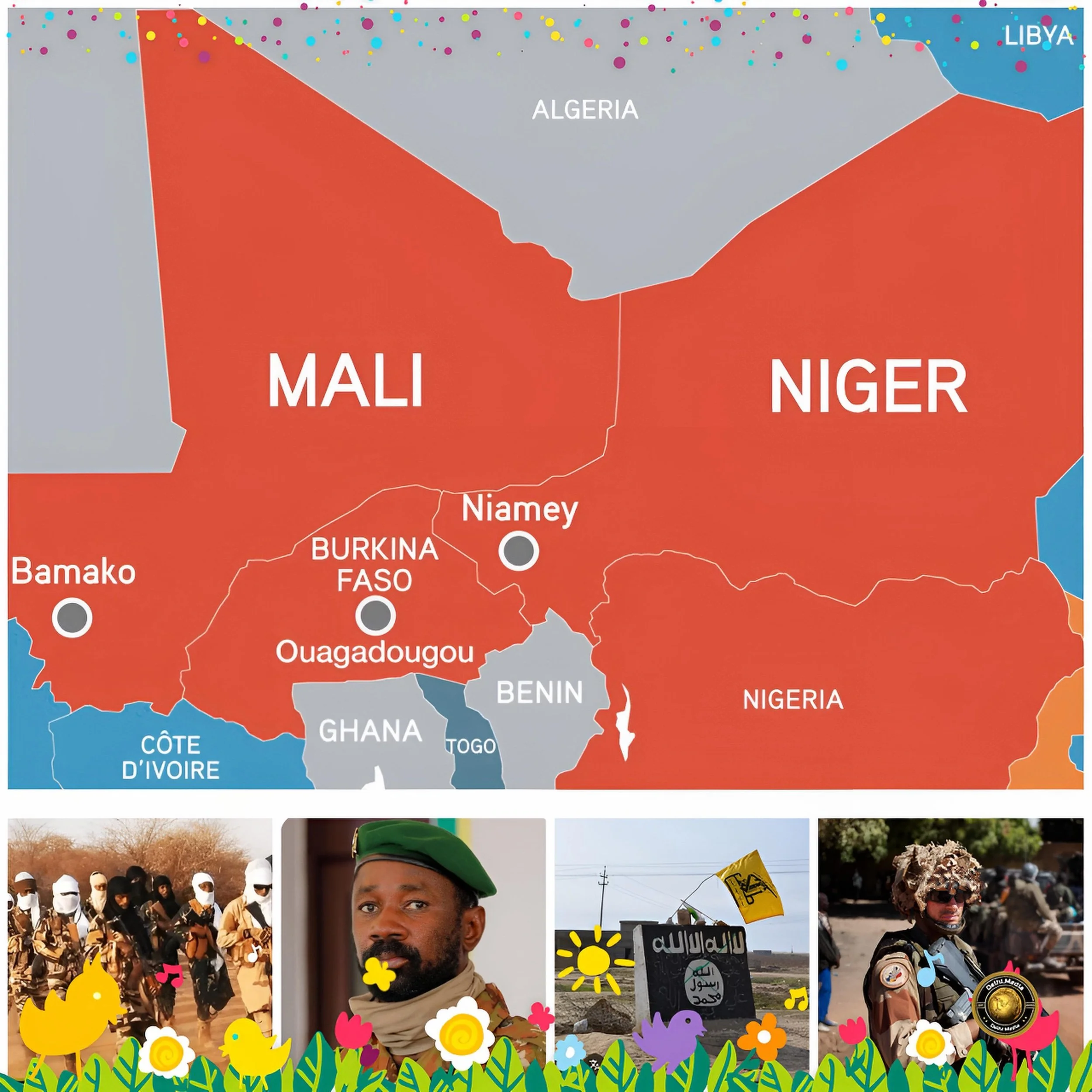
Mali, along with Burkina Faso and Niger, formed the Alliance of Sahel States (AES) in 2023 as a collective defense arrangement.
All three countries have experienced military coups and subsequent pivots away from French and UN security partnerships toward Russian alternatives.
However, this reorientation has not improved security outcomes.
International responses have been limited and fragmented.
Several Western nations—including the United States, United Kingdom, Germany, Australia, and Italy—have advised citizens to leave Bamako.
The African Union has called for urgent international response, including intelligence sharing, though concrete mechanisms remain undeveloped.
Turkey has increasingly positioned itself as an alternative security partner for Sahel states, hosting Mali’s first Global Defense Expo (BAMEX 2025) and showcasing advanced Turkish defense technologies.
The withdrawal of French military forces from their last Sahel base in Chad marked the end of a decade-long military intervention, and France currently maintains minimal presence in the region.
This strategic withdrawal, coupled with reduced EU and Canadian involvement and uncertainty about US counter-terrorism priorities (which have shifted toward great-power competition with China and Russia), has created significant security gaps that jihadist groups are actively exploiting.
The Broader Sahel Trajectory and Potential Domino Effects
Analysts increasingly view Mali as a potential indicator for the broader Sahel region.
If Mali falls under JNIM control or experiences state collapse, there are serious concerns about a “domino effect” affecting neighboring Burkina Faso and Niger, potentially propelling momentum throughout coastal West Africa.
Such an outcome would represent a historic geopolitical realignment—the first instance of a major West African capital falling under jihadist control through a combination of military pressure and governance failure.
This carries particular implications for Russia, which has positioned itself as an alternative security partner.
Mali’s fall would demonstrate that Moscow’s military presence and resources are insufficient to prevent state collapse in fragile contexts, potentially undermining Russian strategic positioning across the African continent and contradicting the Russian narrative regarding the effectiveness of its security partnerships as alternatives to Western intervention.
Conclusion
Critical Information Gaps and Strategic Uncertainties
Several dimensions of the Mali crisis warrant deeper analytical attention beyond the immediate security picture.
Bamako’s actual defensive capacity
While the blockade strategy is well-documented, specific assessments of Bamako’s military installations, garrison strength, defensive capabilities, and contingency plans for protecting critical government infrastructure remain limited in public sources.
Internal Malian military dynamics
The nature and extent of dissent within the Malian Armed Forces regarding Russian partnerships, operational strategy, and leadership authority could affect state resilience during crisis.
JNIM’s actual intentions regarding direct assault on Bamako
Whether JNIM intends to achieve actual military capture of the capital or rather maintain pressure sufficient to force government negotiation or collapse through administrative failure.
Potential negotiation pathways
Historical research suggests JNIM has engaged in preliminary negotiations with Malian government representatives, though these have not been publicized.
The conditions under which JNIM might consider a ceasefire or negotiated settlement remain opaque.
Humanitarian and refugee displacement implications
While some refugee flows to Mauritania have been documented, comprehensive data on internal displacement and humanitarian consequences remains underdeveloped.
Supply line alternatives and resilience measures
Whether Bamako possesses strategic fuel reserves or alternative supply arrangements that could mitigate the blockade’s effects beyond the short term.
International intelligence assessments
Detailed US, French, and other intelligence community assessments of JNIM’s current strength, composition, and specific operational plans likely remain classified.
This situation represents a critical inflection point not only for Mali but for the entire West African security architecture, with implications extending to global jihadist movements, great power competition in Africa, and the future viability of the international system’s capacity to address state collapse in fragile regions.