Beginners 101 Guide: What Is Happening in Silicon Valley Right Now — and Why It Matters for the World
Executive Summary
Four big stories are unfolding in Silicon Valley right now. OpenAI, the company behind ChatGPT, is getting ready to sell shares on the stock market and is bringing in serious banking executives to show it can be trusted with public money. Apple and OpenAI are fighting in court over stolen hardware secrets.
Hundreds of American startups are begging the United States government not to ban cheap Chinese AI tools that they rely on to build their products. And a young researcher who left OpenAI is trying to raise $200 million to use AI to find new medicines.
All four stories are connected, and together they explain why artificial intelligence has stopped being just a technology story and become a story about power, money, law, and the future of the world economy.
Introduction: Why Silicon Valley’s Decisions Matter to Everyone
Think of Silicon Valley the way you might think of an oil field in the twentieth century.
The decisions made there — about who gets access to the resource, on what terms, and under what rules — ripple outward and affect everyone, whether they live in San Francisco or Bangalore or Lagos.
Except the resource is not oil. It is artificial intelligence: the ability to build computer systems that can reason, create, design, and discover at speeds and scales that no human being can match alone.
In the last two weeks of July 2026, four important things happened there almost simultaneously.
To understand why they matter, it helps to think of them as four pieces of a puzzle.
Each piece makes sense on its own. But when you put them together, you see a picture of an industry at a turning point — one where the rules are being rewritten in real time, with enormous consequences for governments, businesses, and ordinary people everywhere.
History and Current Status: How We Got Here
A few years ago, most people had never interacted with an AI system that felt genuinely useful.
Then ChatGPT arrived in late 2022, and within months it had more users than almost any consumer product in history.
The companies that built these large AI systems — OpenAI, Google DeepMind, Anthropic, Meta — suddenly found themselves at the centre of a global technology race.
To build frontier AI systems, you need three things: enormous amounts of computing power (built on specialised chips called GPUs), vast datasets of human-generated text and images, and teams of extraordinarily talented researchers and engineers. In 2026, only a handful of organisations have all three.
OpenAI is the most prominent of them, and it is now valued at over $850 billion — more than most of the world’s largest traditional companies.
But being the most capable is not the same as being the most financially secure, the most legally protected, or the most politically durable. The four stories happening right now are all, in different ways, about the gap between technological capability and institutional maturity.
Key Developments: The Four Stories Explained Simply
Story One: OpenAI Wants to Go Public and Is Getting Its House in Order
Imagine you have been running a brilliant but somewhat chaotic company for a decade.
You have grown far beyond anyone’s expectations. Now you want to sell shares to the public — to let ordinary investors buy a piece of your company on the stock market. Before you can do that, you need to convince serious financial people that you are trustworthy and well-managed.
That is exactly what OpenAI is doing.
On July 21, 2026, it announced that two highly respected banking executives — David Vélez, who built Nubank into the largest digital bank in Latin America with over 135 million customers, and Robin Vince, the head of BNY, one of the oldest financial institutions in America — had joined its board of directors.
Vince took on the specific job of chairing the audit committee, which is the group responsible for making sure the financial numbers are accurate and honest.
Why does this matter?
Because OpenAI has had governance problems before. In November 2023, its own board fired and then rehired CEO Sam Altman within a matter of days, exposing how fragile its internal structures were.
By bringing in experienced financial executives, OpenAI is saying: we are ready to be held to the standards that public investors will demand.
The company has already quietly filed its stock market prospectus with United States regulators.
An IPO could happen by the end of 2026 or in early 2027.
Dr. Antonio Bhardwaj, a polymath specialising in human-centred AI for geopolitical strategy, semiconductors, and supercomputing, explains it this way: “Adding a BNY chief to chair the audit committee is not just a corporate formality. It tells every major government, sovereign wealth fund, and institutional investor in the world that OpenAI is building the accountability infrastructure of a mature global institution. In the AI age, governance is a form of geopolitical credibility.”
Story Two: Apple and OpenAI Are Fighting Over Stolen Secrets
This is the most dramatic story of the four, and it reads almost like a thriller.
Apple and OpenAI were once partners. In 2024, Apple integrated OpenAI’s ChatGPT technology into the iPhone. They were supposed to be on the same team.
But OpenAI has been quietly building its own hardware — physical devices that will compete with Apple’s products.
To do that, it hired dozens of engineers and designers away from Apple, including Tang Yew Tan, who had spent twenty-four years at Apple as a senior vice president responsible for designing the iPhone and Apple Watch.
OpenAI also spent $6.5 billion to acquire a company set up by Jony Ive, the legendary designer who created the visual identity of every major Apple product from the iMac to the iPhone.
Apple alleges that some of these former employees took confidential information with them when they left.
One employee allegedly failed to return his Apple laptop and used it to download dozens of secret files about unreleased Apple products.
Even more strikingly, Apple alleges that OpenAI’s hardware chief asked job candidates who were still working at Apple to bring actual physical components from Apple’s facilities to their job interviews, as a kind of demonstration of what they knew.
OpenAI denies all of this, saying it has no interest in other companies’ trade secrets and believes strongly in fair competition.
What is OpenAI actually building?
A portable, screenless smart speaker that can move on its own, listen to you, answer questions, control your home appliances, and serve as a kind of AI companion.
Think of a more intelligent, more conversational version of Amazon’s Alexa or Google Home.
The device is expected to be unveiled by the end of 2026 and go on sale in early 2027.
Meanwhile, Apple is developing its own AI-native home products, including a smart display with a robotic arm and an upgraded Siri assistant built into iOS 27, its new mobile operating system.
The future of how people interact with AI is being contested, right now, in both a California courtroom and several hardware engineering laboratories.
Story Three: Hundreds of Startups Are Fighting for Their Lives Over Chinese AI
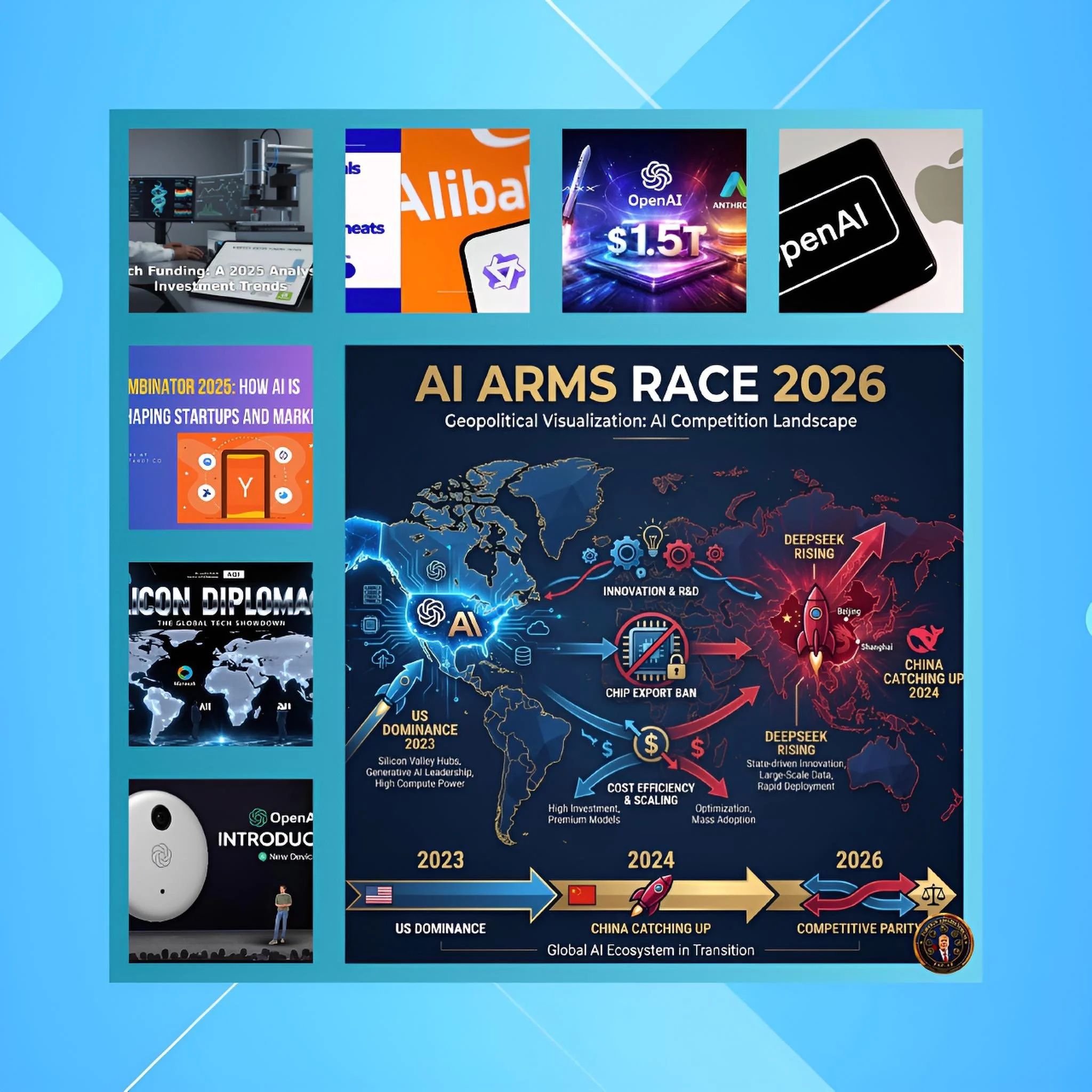
Here is a fact that surprises many people: the majority of AI tokens — the basic units of computation that AI models process — consumed globally in mid-2026 came from Chinese AI models.
Roughly 80% of American AI startups use Chinese base models to build their products.
Why? Because Chinese companies like Alibaba have released high-quality, open-weight AI models — meaning anyone can download them, modify them, and run them on their own computers, for free or at very low cost.
This is enormously valuable for a small startup that cannot afford to pay the prices that OpenAI or Anthropic charge for access to their models.
The United States government is considering restricting these Chinese models for national security reasons.
The concern is that Chinese AI models might have built-in biases, backdoors, or data-sharing arrangements that could compromise American users.
Nearly two hundred American startups have written to the government urging it not to impose a broad ban.
Their argument is simple: if you cut off access to affordable Chinese models, you will destroy hundreds of small companies that cannot afford the alternatives, and you will leave the market to the large, well-funded incumbents.
On July 25, 2026, twenty-five major technology companies — including Microsoft, Nvidia, Meta, and IBM — also signed a joint letter making the same case.
This is a genuine dilemma with no easy answer. On one hand, depending on Chinese AI infrastructure does create real security risks.
On the other hand, banning those tools would slow American innovation, raise costs for startups, and help the biggest companies at the expense of the smallest ones.
Dr. Antonio Bhardwaj puts it bluntly: “The risk of broad restrictions is that you end up with an innovation ecosystem that looks less like Silicon Valley and more like a regulated utility — controlled by a few large incumbents, insulated from competition, and ultimately less dynamic than the ecosystem you were trying to protect.”
Story Four: AI Is Going Into Medicine, and Investors Are Pouring In
The fourth story is perhaps the most hopeful.
Miles Wang, a young researcher who worked at OpenAI on using AI to accelerate scientific discovery, is leaving to start his own company focused on using AI to find new medicines.
He is in discussions to raise $200 million at a $2 billion valuation, with the venture capital firm Lightspeed expected to lead the round.
His approach is clever. Instead of trying to invent entirely new drugs from scratch — a process that can take over a decade and cost billions of dollars — his startup plans to use AI to find new uses for drugs that already exist or that previously failed in clinical trials. Because those drugs have already been tested for safety, they can potentially reach patients much faster.
He is not alone.
Chai Discovery recently raised $400 million at a $3.8 billion valuation doing similar work.
Google DeepMind’s spinout Isomorphic Labs raised $2.1 billion in May 2026.
The total venture capital flowing into AI drug discovery since 2024 has exceeded $15 billion.
The implications for human health are potentially enormous.
Drug development has traditionally been one of the slowest, most expensive, and most uncertain processes in all of human enterprise.
If AI can genuinely accelerate the identification of useful molecular compounds, it could eventually reduce the cost and time required to develop treatments for diseases that currently have none.
Cause-and-Effect Analysis: Why These Four Stories Are Really One Story
All four stories are connected by a single thread: artificial intelligence has reached a level of power and commercial value where the decisions being made about it — in boardrooms, courtrooms, policy offices, and venture capital partnerships — have consequences that extend far beyond the technology itself.
OpenAI’s IPO preparations create the financial pressures that drive its hardware ambitions. Its hardware ambitions require talent that Apple spent decades developing.
Acquiring that talent, by whatever means, triggers legal confrontation.
The policy debate over Chinese AI models shapes the competitive landscape that determines whether OpenAI’s IPO valuation is justified or inflated. And the flow of AI capital into medicine transforms the stakes of the entire debate, because now the question is not just who makes the best chatbot but who gets to use AI to find the next cancer drug.
Future Steps: What Comes Next
In the next twelve to eighteen months, watch for three things.
First, whether OpenAI actually lists on the stock market, and at what valuation. That event will reset the entire landscape of AI investment and competition.
Second, how the Apple versus OpenAI lawsuit resolves — either through settlement or through a court ruling that sets new legal boundaries around talent mobility and hardware intellectual property in the AI industry.
Third, whether the United States government imposes restrictions on Chinese open-weight models, and how the startup ecosystem responds if it does.
Behind all three of these near-term questions lies a longer-horizon question that will define the decade: whether democratic societies can build governance institutions capable of keeping pace with the speed of AI development.
That is not a technical problem. It is a political and institutional challenge of the first order.
Conclusion: The World Is Watching Silicon Valley
The decisions being made in Silicon Valley right now are not just business decisions.
They are decisions about what kind of AI future the world will inhabit — who will have access to the most powerful tools, under what conditions, and on whose terms.
For countries like India, which is simultaneously a major consumer of AI capabilities, a growing producer of AI talent, and a nation with its own strategic interests in the governance of frontier technology, these developments deserve close and sustained attention.
As Dr. Antonio Bhardwaj observes: “The most important thing to understand about this moment is that the rules are not yet written. The institutions that will govern AI are still being built, the legal precedents that will constrain hardware competition are still being established, and the policy frameworks that will balance security and openness are still being debated. That means there is still time for a wider range of voices — including from the Global South — to shape what those rules say. The window will not stay open indefinitely.”
The AI revolution is not happening to the world. It is being built by it — by the choices of engineers, lawyers, investors, policymakers, and citizens who are deciding, right now, what kind of future they want to live in.