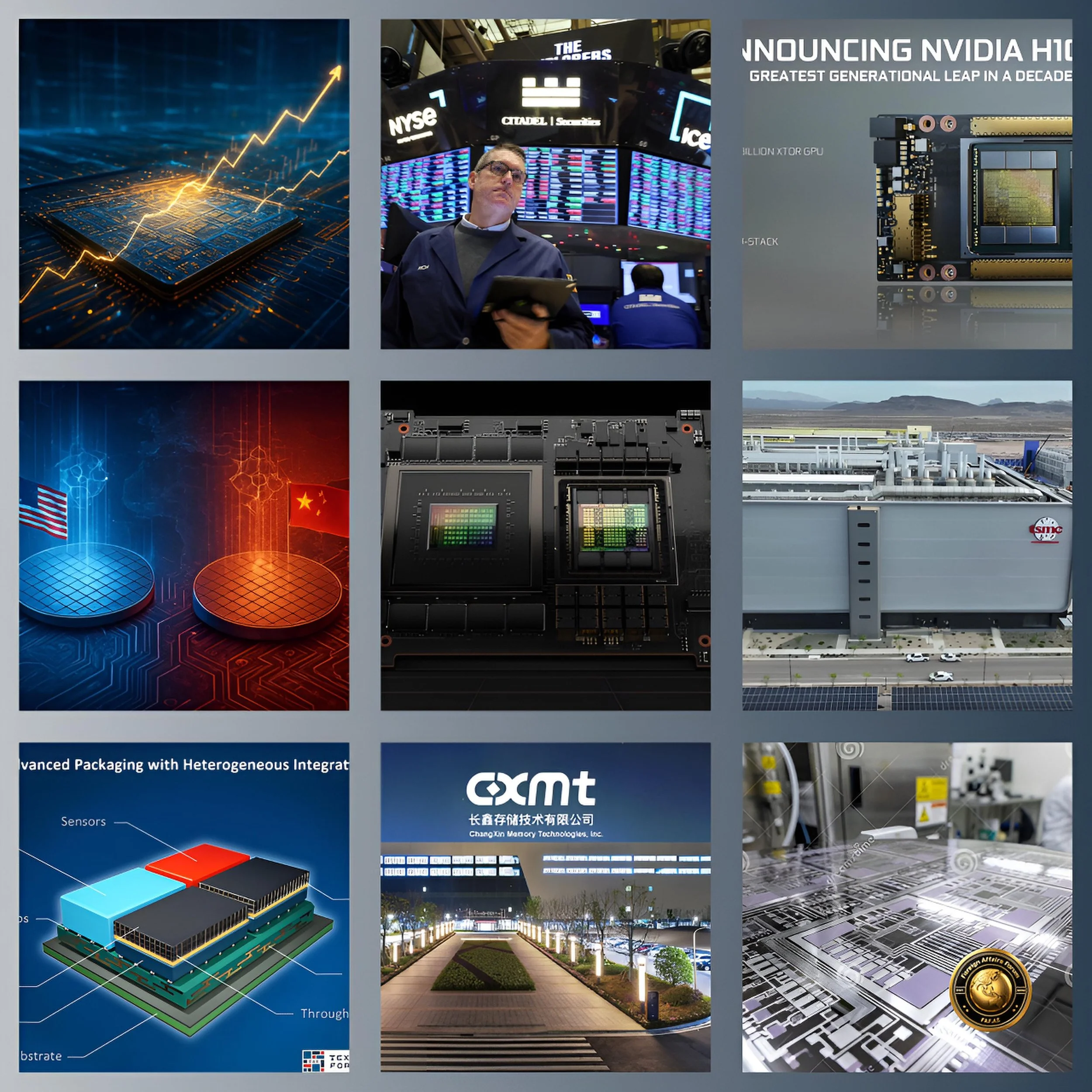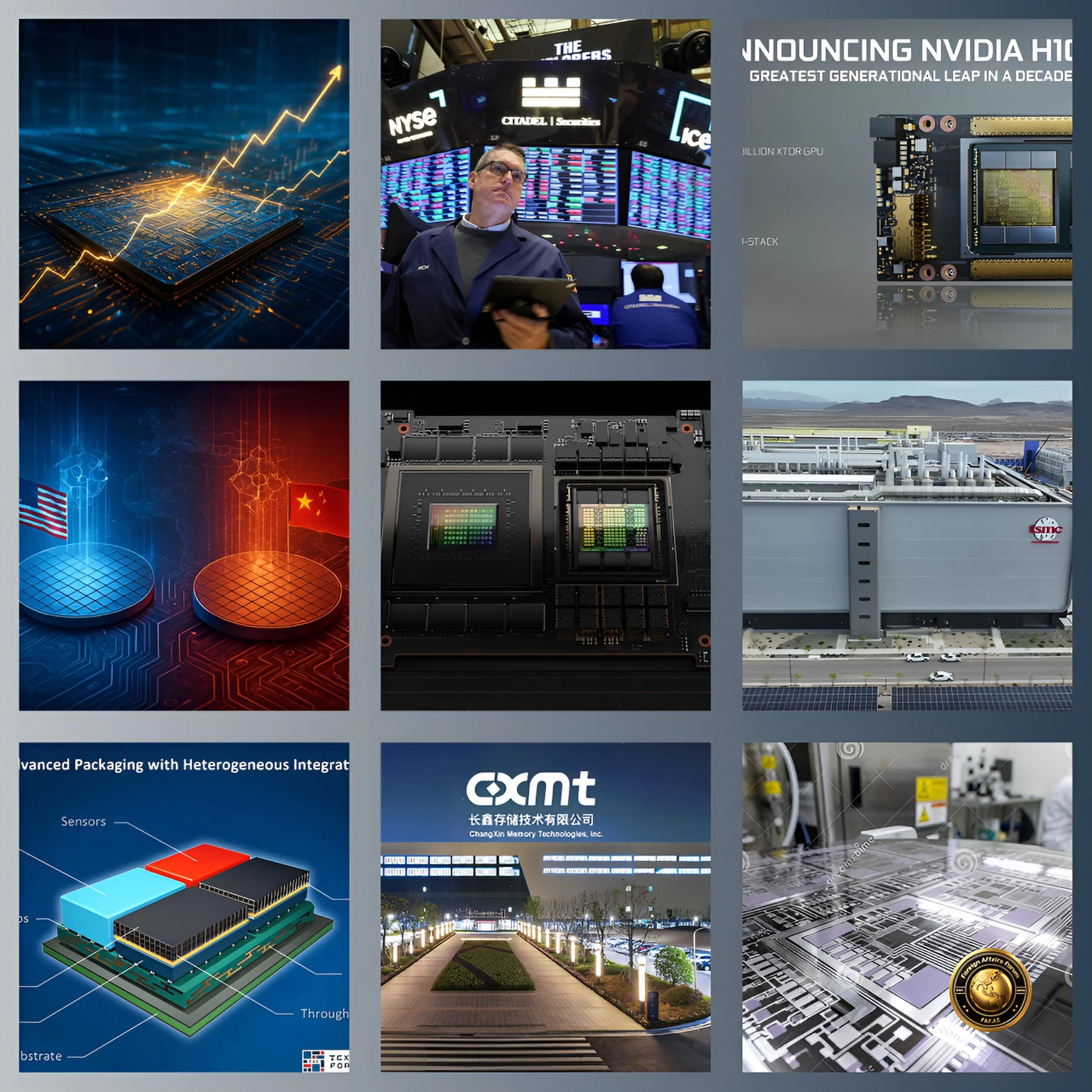
The Silicon Crossroads: How TSMC’s $265 Billion Investment, China’s CXMT Megalisting, and a Global Valuation Shift Are Redrawing the AI Power Map
Executive Summary
Analysis of the Semiconductor Supercycle, Strategic Reshoring, and the Geopolitics of Advanced Manufacturing
The week of July 16, 2026 will be remembered as a defining moment in the history of the global semiconductor industry — not because of a single announcement, but because of a convergence of forces that revealed, with unusual clarity, the structural tensions reshaping the technology order.
Taiwan Semiconductor Manufacturing Company’s decision to raise its cumulative investment in Arizona to $265 billion confirmed what many had suspected: the AI infrastructure supercycle is not a temporary market enthusiasm but a generational realignment of industrial capacity.
Simultaneously, ChangXin Memory Technologies’ near-record initial public offering on Shanghai’s Star Market signaled China’s accelerating push toward semiconductor self-sufficiency, while broader capital markets imposed a long-overdue discipline on AI-adjacent valuations.
Together, these three developments constitute a tripartite stress test of the world’s most strategically consequential supply chain — one whose outcomes will shape geopolitical balances of power, innovation hierarchies, and national security architectures for decades to come.
Introduction: When Chips Become the Currency of Power
There is a moment in the evolution of any strategic resource when its significance transcends commerce and becomes indistinguishable from national power itself. Oil reached that threshold in the early 20th century. Nuclear fission reached it in the 1940s. Advanced semiconductors — particularly those enabling artificial intelligence at scale — have reached it now.
The convergence of events in July 2026 illuminates this transition with extraordinary vividness.
TSMC, the Taiwanese foundry that manufactures the overwhelming majority of the world’s most sophisticated chips, announced on July 16, 2026 that it would expand its total U.S. investment to $265 billion, raising a prior $165 billion commitment by another $100 billion and cementing what Phoenix Mayor Kate Gallego described as the largest economic development investment in American history.
On the same day, TSMC reported second-quarter net profit of NT$706.56 billion — approximately $22 billion — a 77.4% year-on-year surge that shattered analyst expectations and confirmed the structural durability of AI-driven demand.
Across the Pacific, ChangXin Memory Technologies, better known as CXMT, finalized pricing for its initial public offering on Shanghai’s STAR Market at 8.66 yuan per share, positioning the listing to raise up to $9.8 billion at an implied valuation of approximately $85 billion — the largest such offering by a Chinese semiconductor company on any mainland exchange.
Meanwhile, global semiconductor equities continued to experience the selective pressure of a market undergoing its first serious valuation reckoning after two years of AI-fuelled euphoria.
These three storylines are not merely parallel. They are structurally interdependent, and understanding their intersection requires placing them within a broader analytical framework — one that accounts for the geopolitics of supply chain geography, the economics of advanced packaging, the strategic logic of capital market signalling, and the emerging bifurcation of the global technology order.
As Dr. Antonio Bhardwaj, a polymath with global expertise in AI for geopolitical strategy, semiconductors, and supercomputing, observes: “What we are witnessing is not simply an industrial expansion. It is the physical instantiation of a new geopolitical doctrine — one in which the geography of fabrication is increasingly treated as an extension of the geography of national security. TSMC’s Arizona investment is not a business decision alone. It is a sovereign declaration written in concrete and silicon.”
History and Current Status: The Long Road to Silicon Sovereignty
The global semiconductor industry’s current configuration is the product of five decades of deliberate specialisation, cost optimisation, and geographic concentration.
From the 1970s onward, the industry migrated progressively toward Asia — first Japan, then South Korea and Taiwan, and more recently China — in pursuit of engineering talent, government subsidy, and manufacturing scale.
By the early 2020s, TSMC alone commanded approximately 73% of the global advanced foundry market, fabricating chips at nodes that no other company could reliably produce in volume. This concentration produced extraordinary efficiencies but embedded a structural vulnerability into the technology supply chains of every major economy.
The COVID-19 pandemic of 2020 exposed that vulnerability with unusual brutality. Automotive manufacturers discovered that their just-in-time supply chains had no buffer against a foundry shutdown in Taiwan.
Consumer electronics firms found themselves unable to meet demand surges because chipmaking capacity, once idled, cannot be reconstituted in months. And defence planners in Washington and Brussels were forced to confront the uncomfortable reality that their most advanced weapons systems depended on manufacturing processes conducted almost entirely beyond their sovereign territory.
The U.S. CHIPS and Science Act of 2022 was the legislative response — a $52 billion commitment to incentivise semiconductor manufacturing on American soil.
TSMC received up to $6.6 billion in grants under that legislation, and its first Arizona fabrication plant, known as Fab 21 Phase One, entered volume production of four-nanometre chips in the fourth quarter of 2024, supplying Apple, NVIDIA, and other leading customers with quality comparable to TSMC’s Taiwan facilities.
Arizona production revenue was expected to grow from roughly 2% of TSMC’s total revenue in 2025 to between 4% and 5% by 2027, with the first Arizona fab reporting a profit of approximately NT$16.14 billion, or roughly $514 million, in its first full year of mass production in 2025.
The $265 billion figure announced in July 2026 represents a fourth iteration of TSMC’s U.S. commitment.
The company started with an initial pledge of approximately $65 billion, added $100 billion in March 2025, bringing the total to $165 billion, and then confirmed a further $100 billion on July 16, 2026 at its Q2 earnings conference in Taipei.
The expansion will add at least four new fabrication plants to the Arizona cluster, along with two advanced packaging facilities, and when fully built out, TSMC could operate up to ten fabs on U.S. soil. The company purchased approximately 900 acres of land in January 2026 for around $197 million to accommodate the growing footprint, and already employs more than three thousand workers in Arizona.
The strategic logic underlying this commitment is both commercial and geopolitical. The new fabs will produce chips at the two-nanometre node and below, and CEO C.C.
Wei confirmed the money will fund several more logic wafer fabs for two-nanometre and below technologies alongside advanced packaging plants to serve multi-year demand from TSMC’s leading U.S. customers. The decision to scale construction to customer demand rather than to a fixed timeline reflects a discipline that distinguishes TSMC’s approach from the build-it-and-hope posture that characterises less commercially rigorous state-directed industrial programmes.
In China, the trajectory is mirror-image in intent if not identical in method.
CXMT, founded in 2016 and headquartered in Hefei, Anhui province, has emerged as the most credible challenger to the South Korean memory duopoly of Samsung and SK Hynix.
The company priced its Shanghai IPO at 8.66 yuan per share, positioning itself to raise gross proceeds of 57.9 billion yuan, or approximately $8.5 billion, from the sale of nearly six billion seven hundred million shares, representing ten percent of its enlarged capital and giving CXMT an implied valuation of 579 billion yuan, roughly $85.2 billion, upon listing on Shanghai’s STAR Market.
The magnitude of that listing — surpassing the record set by SMIC, which raised 53.23 billion yuan in Shanghai in 2020 — reflects the degree to which Beijing has elevated semiconductor self-sufficiency to the status of a primary strategic objective.
Key Developments: Three Simultaneous Inflection Points
The TSMC Arizona Expansion and the CoWoS Bottleneck
The most technically significant dimension of TSMC’s July 2026 announcement concerns not the fabrication fabs themselves but the advanced packaging facilities embedded within the expansion plan.
Chip-on-Wafer-on-Substrate technology — universally known as CoWoS — has emerged as the single most constrained resource in the global AI chip supply chain. CoWoS is the integration technology that allows compute dies, high-bandwidth memory, interposers, and substrates to be combined into the unified packages that make NVIDIA’s GPU accelerators and TSMC’s most powerful AI chips functional as products. Without CoWoS, a wafer of silicon, however brilliant its transistor geometry, cannot be converted into a deployable AI accelerator.
TSMC’s CEO C.C. Wei told shareholders at the company’s June 2026 annual meeting that CoWoS capacity remains “extremely tight and sold out through 2026,” with Silicon Analysts’ CoWoS allocation tracker finding lead times of fifty-two to seventy-eight weeks at TSMC’s advanced-packaging backend facilities, with bookings extending into 2027.
NVIDIA alone has secured 60% of total CoWoS capacity through 2026, with Apple’s processors similarly dependent on advanced packaging unavailable elsewhere. The Arizona CoWoS expansion announced in July directly targets that constraint, adding capacity on U.S. soil and giving hyperscalers with domestic-sourcing requirements a path to AI accelerators that does not route entirely through Taiwan.
TSMC has confirmed plans to build two additional next-generation advanced packaging facilities at the Chiayi Science Park in southern Taiwan, with the annual output value of products expected to exceed NT$300 billion once fully operational, complementing the Arizona expansion with increased domestic Taiwanese capacity.
The CXMT IPO and the Memory Geopolitics of AI
The significance of CXMT’s listing extends beyond its headline valuation. Dynamic random-access memory, or DRAM, has become the next strategic frontier in AI computing.
High-bandwidth memory, a form of stacked DRAM that sits in close proximity to the GPU die within a CoWoS package, determines the speed at which a GPU can move data — and in large-scale AI training, memory bandwidth often constrains performance more acutely than raw compute throughput.
Samsung and SK Hynix have dominated high-bandwidth memory production, with SK Hynix in particular holding a commanding position in the supply of HBM components used in NVIDIA’s flagship accelerators. CXMT’s stated ambition is to challenge that duopoly.
According to analysis of CXMT’s diluted price-to-earnings ratio based on its 2025 performance and the IPO price, the figure reaches approximately three hundred nine times — an extraordinary level roughly ten times higher than Samsung Electronics’ ratio of thirty-three times and SK Hynix’s thirty times over the same period.
That valuation premium reflects not current earnings power but anticipated strategic positioning: investors are pricing CXMT as a geopolitical asset as much as a commercial enterprise, betting that Beijing’s determination to achieve domestic HBM production will translate into policy support that conventional financial metrics cannot fully capture.
Industry analysis suggests that if CXMT achieves viable HBM three yields in 2026 and HBM three E by 2027 as planned, it would materially reduce China’s dependence on South Korean memory in AI accelerator supply chains — a development with implications that range from procurement economics to the durability of U.S. and allied export control regimes.
In early 2026, the U.S. government approved licensed exports of NVIDIA H200 AI chips to China under conditions intended to balance national security with commercial interests, a move that sparked substantial debate in Washington.
That debate will intensify if CXMT succeeds in commercialising high-bandwidth memory at competitive specifications, since the calculus of U.S. export policy rests partly on the assumption that Chinese AI development remains constrained by memory access rather than compute alone.
The Valuation Reckoning and the Return of Market Discipline
The third development of July 2026 was perhaps the most psychologically significant: TSMC’s stock fell more than 2% on the day it reported the best quarterly earnings in its history.
A JPMorgan equity trader attributed the selloff to inflated expectations rather than negative news, saying investor sentiment reflects how elevated the bar has gotten for the semiconductor sector given the prior months of outperformance driven by AI excitement.
That paradox — record results, falling stock — encapsulates a broader market transition that had been building for months.
The June 2026 semiconductor selloff erased approximately $1.4 trillion in market value across the AI chip sector in a single trading session, with the Philadelphia Semiconductor Index plummeting 10%, Broadcom crashing 12.6%, and Marvell plunging 17%.
The immediate trigger was a modest earnings miss by Broadcom on AI revenue guidance, but the structural cause was more fundamental: after months of pricing semiconductor stocks for perfection, investors were beginning to demand evidence of durable earnings rather than speculative AI exposure.
Analysts noted that investors are becoming less willing to pay any price for AI exposure and more interested in identifying companies with sustainable earnings, durable competitive advantages, and realistic valuations — suggesting that AI is entering a stock-picker’s market where not every semiconductor company will win equally going forward.
Latest Facts and Concerns: The Data Behind the Headlines
TSMC’s second-quarter gross margin climbed to 67.7%, edging above the company’s own guidance ceiling and reflecting the pricing power that comes from holding roughly 73% of the global advanced foundry market with no credible near-term challenger for the customers that matter most.
TSMC now expects third-quarter revenue of $44.6 billion to $45.8 billion, up 12% sequentially at the midpoint, and raised its full-year revenue growth forecast to slightly above 40% in U.S. dollar terms, with capital expenditure expected to rise to between $60 billion and $64 billion, with 70% to 80% of the total going to advanced process technologies.
High-performance computing revenue surged 20% quarter-on-quarter, accounting for 66% of total revenue, while processes at seven nanometres and below now represent 77% of TSMC’s wafer revenue.
3 nm and 5 nm nodes together accounted for more than half of total revenue, while the two-nanometre process had begun generating sales for the first time.
On the packaging front, the global advanced packaging market reached approximately $46 billion in 2024, with a compound annual growth rate of 9.5% from 2024 to 2030, with the market size expected to exceed $79.4 billion by 2030.
That trajectory is driven almost entirely by AI accelerator demand and the proliferation of chiplet architectures that require heterogeneous integration to function.
Concerning CXMT, the company reported consolidated net income of 7.14 billion yuan in full-year 2025, though only 1.87 billion yuan was attributable to parent shareholders, with 74% attributable to minority interests — a consequence of the ownership architecture through which CXMT controls fabrication assets it mostly does not own through long-term acting-in-concert arrangements.
This structural complexity has prompted analysts to caution that headline consolidated figures overstate what public shareholders will actually receive, raising governance questions that may temper post-listing enthusiasm among institutional investors with fiduciary obligations in jurisdictions that impose stricter disclosure standards.
By 2026, the global AI chip supply chain has moved beyond a simple bipolar structure, with new power players emerging across a complex and interconnected web of regional centres in North America, Europe, and a diversifying Asia.
The European Union’s Chips Act has mobilised over €43 billion in public and private investments, with the goal of doubling the EU’s global semiconductor production share to 20% by 2030.
The concern that shadows all of these developments is not the absence of demand but the sustainability of the expectations embedded in current investment commitments.
TSMC attached no construction schedule to the four new fabs announced in July, saying the pace will follow customer demand — a flexibility that protects the company if AI orders cool, with orders driving shovels rather than the other way around.
That conditional architecture is prudent, but it also signals an awareness, rarely voiced explicitly in corporate communications, that the current trajectory of AI infrastructure spending cannot be extrapolated indefinitely without a corresponding acceleration in demonstrable returns.
Cause-and-Effect Analysis: Unpacking the Strategic Logic
The causal architecture underlying these three simultaneous developments is more intricate than a straightforward supply-and-demand narrative would suggest.
TSMC’s decision to scale its Arizona investment to $265 billion is causally downstream of at least four independent drivers.
First, the structural tightness of CoWoS capacity has created a production bottleneck that threatens to limit the ability of NVIDIA, AMD, and the hyperscale cloud providers to deliver AI accelerators to their customers — regardless of wafer fabrication throughput.
By building advanced packaging facilities on American soil, TSMC is addressing the bottleneck at its geographic locus, reducing exposure to the Taiwan Strait risk that has preoccupied defence planners in Washington and Tokyo alike.
Second, the CHIPS Act framework created financial incentives that materially alter the investment calculus for overseas capacity.
The $6.6 billion in grants already disbursed to TSMC, combined with additional investment tax credits, effectively subsidised a portion of the cost differential between high-wage American manufacturing and lower-cost Asian alternatives.
Third, the geopolitical pressure applied by successive U.S. administrations — through both carrots and sticks, as one analyst put it — has made it strategically advantageous for TSMC to demonstrate commitment to American manufacturing regardless of the pure economics. And fourth, TSMC’s leading U.S. customers — Apple, NVIDIA, AMD, Qualcomm, and the major hyperscalers — have multi-year demand profiles that provide the revenue visibility necessary to justify capital commitments of this magnitude.
CXMT’s IPO is causally connected to a parallel but distinct set of forces. Beijing’s 15th Five-Year Plan, covering 2026 to 2030, explicitly targets semiconductor self-sufficiency as a strategic priority, with specific goals around advancing logic process nodes to seven and five nanometres and expanding domestic HBM production.
CXMT’s access to public capital markets provides the funding necessary to accelerate that programme — estimated at several tens of billions of yuan — while simultaneously signalling to global investors that China’s semiconductor ambitions have institutional depth and commercial credibility rather than existing solely as state-directed mandates.
The listing also establishes a valuation benchmark that will influence private-market funding rounds for the broader ecosystem of Chinese memory and logic chip developers.
The market’s valuation reset is causally upstream of a reorientation in capital allocation that will have structural consequences for the innovation ecosystem.
Market logic has shifted from “infinite demand” to “efficiency verification,” with investors paying more attention to specific return-on-investment data for AI projects rather than simple capital expenditure guidance, and whether cloud vendors are beginning to show signs of overbuilding in AI infrastructure investment becoming a key observation variable.
This shift does not negate the structural AI investment thesis, but it modifies its expression — from broad-based sector enthusiasm to selective positioning in companies with differentiated technical moats, demonstrated profitability, and defensible market positions.
Dr. Bhardwaj frames the causal dynamics with characteristic precision: “The three developments of this week are not coincidental. They represent the simultaneous operation of three feedback loops — one geopolitical, one sovereign-commercial, and one financial — each of which was set in motion by the same underlying fact: that AI compute infrastructure has become the most strategically valuable form of fixed capital in the world. When the most important commodity in the global economy is a manufactured object that only a handful of facilities on earth can produce, every government, every corporation, and every capital market will respond to that reality simultaneously. That is precisely what we are seeing.”
The cause-and-effect chain also runs through less-visible layers of the supply chain. Advanced packaging is causally upstream of AI accelerator availability.
AI accelerator availability is causally upstream of hyperscale data centre build-out. Data centre build-out is causally upstream of AI model training capacity. And training capacity is causally upstream of the frontier AI capabilities that are increasingly shaping military, diplomatic, and economic competition.
When TSMC announces that CoWoS is sold out through 2026, it is not merely making a statement about a specialty packaging technology. It is, in effect, placing a ceiling on the rate at which the global AI frontier can advance in the near term.
The CXMT IPO complicates this chain in ways that will become clearer over the next two to three years.
If China successfully domesticates high-bandwidth memory production, the bottleneck migrates from a point of relative Western advantage — Korean HBM producers operate within the U.S. export control perimeter — to a point of genuine technological parity. That migration would represent one of the most significant shifts in the strategic balance of AI capability since the first rounds of U.S. export restrictions were imposed in 2022.
As of 2026, what started as a targeted export control regime has evolved into something far more complex: a bifurcated global chip ecosystem where both the United States and China are building independent supply chains, independent chip architectures, and increasingly incompatible AI infrastructure — a structural realignment of the $600 billion global semiconductor market whose decisions will define competitive positions through 2035.
Future Steps: Pathways Through Strategic Uncertainty
The trajectories established by July 2026’s developments will unfold across multiple time horizons, each with distinct implications for the stakeholders involved.
In the near term — the next twelve to eighteen months — the most critical variable is the execution of TSMC’s Arizona expansion.
The Arizona expansion has faced well-documented challenges, including construction delays and cultural friction between Taiwanese management practices and American labour expectations, and scaling to ten fabs is an enormous operational undertaking with real execution risk.
The company has been forthright about these challenges, and the decision to tie construction pace to customer demand rather than a fixed schedule is precisely the kind of adaptive management that distinguishes commercially disciplined capital allocation from state-driven industrial planning.
Nevertheless, the transition from announcing capacity to delivering it at production quality will require sustained organisational focus and the continued availability of specialised process engineering talent that remains scarce in the American workforce.
TSMC is simultaneously ramping 2nm production — the company’s most advanced process node — with significant implications for gross margin and competitive positioning.
CFO Wendell Huang told analysts that the steep production increase expected in the second half of 2026 will dilute gross margins by roughly three to four percentage points before scale efficiencies take hold. That near-term margin compression is the expected cost of node transition and capacity ramp, but it creates a period of vulnerability to any deceleration in AI demand that would leave newly commissioned capacity underutilised.
For CXMT, the immediate priority following its July 2026 IPO listing will be the deployment of the proceeds — estimated at up to $9.8 billion including the overallotment option — toward three strategic objectives: technological upgrades for memory wafer production lines, expansion of manufacturing capacity, and continued research into next-generation DRAM architectures.
The critical technical milestone is the achievement of viable HBM3 yields, which would establish CXMT as a qualified supplier for Chinese AI accelerator manufacturers seeking to reduce dependence on Korean memory.
The success of CXMT’s IPO is likely to act as a catalyst for future large-scale semiconductor listings from China, with market observers increasingly speculating that other major unlisted semiconductor firms, such as China’s leading NAND flash producer, will follow with their own offerings.
Over the medium term — the next three to five years — the most consequential development will be the emergence of what analysts describe as a bifurcated technology infrastructure: two parallel ecosystems of AI hardware, software, and services that are increasingly incompatible with each other and oriented toward distinct geopolitical spheres.
As China adopts domestic EDA tools, domestic chip architectures, and domestic software stacks, global AI safety standards and cross-border technology auditing become increasingly difficult, with enterprises operating across both ecosystems facing growing complexity in maintaining compatibility and compliance. This bifurcation creates genuine risks for multinational corporations, academic institutions, and international organisations that depend on shared technological infrastructure for collaboration.
The advanced packaging landscape will be particularly dynamic. Governments in the United States, Europe, Taiwan, South Korea, China, and India increasingly view semiconductor packaging capabilities as critical to technological sovereignty and economic security, with the competition having expanded beyond chipmakers to include packaging providers, materials suppliers, and equipment manufacturers.
The European Union’s ambition to double its semiconductor production share to 20% by 2030 will require not only fabrication investment but a simultaneous build-out of advanced packaging capability — a domain that has historically been dominated by Asian manufacturers and for which specialised workforce development will require years of deliberate effort.
India’s emerging role in this landscape deserves particular attention.
New Delhi has announced semiconductor manufacturing incentives that have attracted interest from global foundries, and the country’s engineering talent base provides a potential workforce advantage for labour-intensive packaging and testing operations.
However, converting policy intent into operational manufacturing capacity at competitive specifications requires an ecosystem depth — in substrate materials, chemicals, specialised equipment service networks, and process engineering expertise — that India is only beginning to cultivate.
Looking toward 2030 and beyond, the trajectory of AI hardware will be shaped by two competing forces: the continued scaling of existing semiconductor architectures, which is becoming increasingly expensive and technically challenging at sub-two-nanometre nodes, and the emergence of alternative computing paradigms — photonic computing, neuromorphic architectures, and quantum processing — that may offer superior performance-per-watt ratios for specific AI workloads.
TSMC’s suppliers describe the same demand picture for the near term, with ASML raising its 2026 outlook and Applied Materials’ CEO Gary Dickerson indicating that the industry is set for years of capacity expansion. But the long-term competitive advantage in AI computing will likely accrue not to those who produce the most silicon, but to those who most efficiently integrate silicon with emerging complementary technologies.
Dr. Antonio Bhardwaj articulates the longer arc with characteristic clarity: “The $265 billion that TSMC is committing to Arizona is not the end of the story. It is the foundation layer of a much larger strategic architecture. The question that will define the next decade is not whether the United States can manufacture advanced chips on its own soil — it can, and it will. The question is whether it can build the full stack of capabilities, from materials science through advanced packaging through systems integration through software ecosystems, that transforms manufacturing presence into genuine technological sovereignty. That is a generational challenge, and it requires a quality of sustained institutional patience that democratic systems find genuinely difficult to sustain.”
Conclusion: The Architecture of a New Technology Order
The events of July 2026 do not represent a clean resolution of the strategic tensions that have defined the global semiconductor industry since the first rounds of U.S.-China technology competition in 2018. They represent instead a moment of crystallisation — a point at which the outlines of a new technology order have become sufficiently visible that the stakeholders within it are being compelled to make consequential commitments.
TSMC’s $265 billion Arizona investment is the most tangible expression of that compulsion. It is simultaneously a commercial response to extraordinary AI demand, a geopolitical accommodation to the strategic preferences of the world’s largest economy, and a hedge against the geographic risk that has haunted TSMC’s customers since the Taiwan Strait military exercises of 2022 and 2023.
The fact that it is accompanied by record financial results and a forward revenue guidance exceeding 40% growth suggests that the commercial and strategic imperatives are, at least for now, aligned.
CXMT’s megaIPO represents an equally consequential, if less discussed, dimension of the emerging order.
China’s semiconductor self-sufficiency drive is not a rhetorical aspiration. It is a multi-hundred-billion-yuan industrial programme, backed by state policy, capital market mobilisation, and the organisational capacity of a government that has demonstrated — in solar panels, electric vehicles, and high-speed rail — the ability to translate strategic intent into global competitive position over a span of one to two decades.
The question is not whether China will develop world-class memory chip manufacturing capability, but how quickly, and what the implications will be for the export control regimes and technology alliances that currently constrain that capability’s deployment.
The market’s valuation discipline, however uncomfortable for those holding concentrated semiconductor positions, is ultimately healthy. It forces a distinction between companies whose AI revenues reflect durable structural demand and those whose valuations reflect speculative enthusiasm detached from earnings reality.
That distinction matters not only for investors but for the broader innovation ecosystem, since capital misallocated to speculative semiconductor plays is capital unavailable to the adjacent technologies — photonics, power management, memory architectures, advanced substrates — that will determine the next generation of AI hardware performance.
Dr. Antonio Bhardwaj offers a synthesis that captures both the magnitude and the complexity of the moment: “We are living through the construction of a new industrial order whose parameters are being set not in legislative chambers or diplomatic conferences but in the capital expenditure decisions of a handful of corporations and the equity markets that finance them. TSMC’s Arizona expansion, CXMT’s Shanghai listing, and the market’s demand for earnings discipline are three expressions of the same underlying reality: that the world’s most consequential technology has become too important to leave to any single geography, any single ownership structure, or any single valuation framework. What comes next will be determined by the quality of the choices being made now — in boardrooms, in ministries of industry, and in the engineering laboratories where the next generation of chips is already being designed.”
The silicon crossroads of 2026 is not a destination. It is an intersection at which the vectors of AI capability, national security, capital market discipline, and industrial sovereignty converge — and where the directions taken in the coming months and years will define the contours of global power for generations.